Best Tools, Techniques and Hacks for Recruiters in 2026
The advanced tools, AI skills and techniques senior recruiters run in 2026 to find candidates and find clients: search infrastructure, signal data, MCP.
Do this in Instalent - source, verify and reach candidates in one flow.

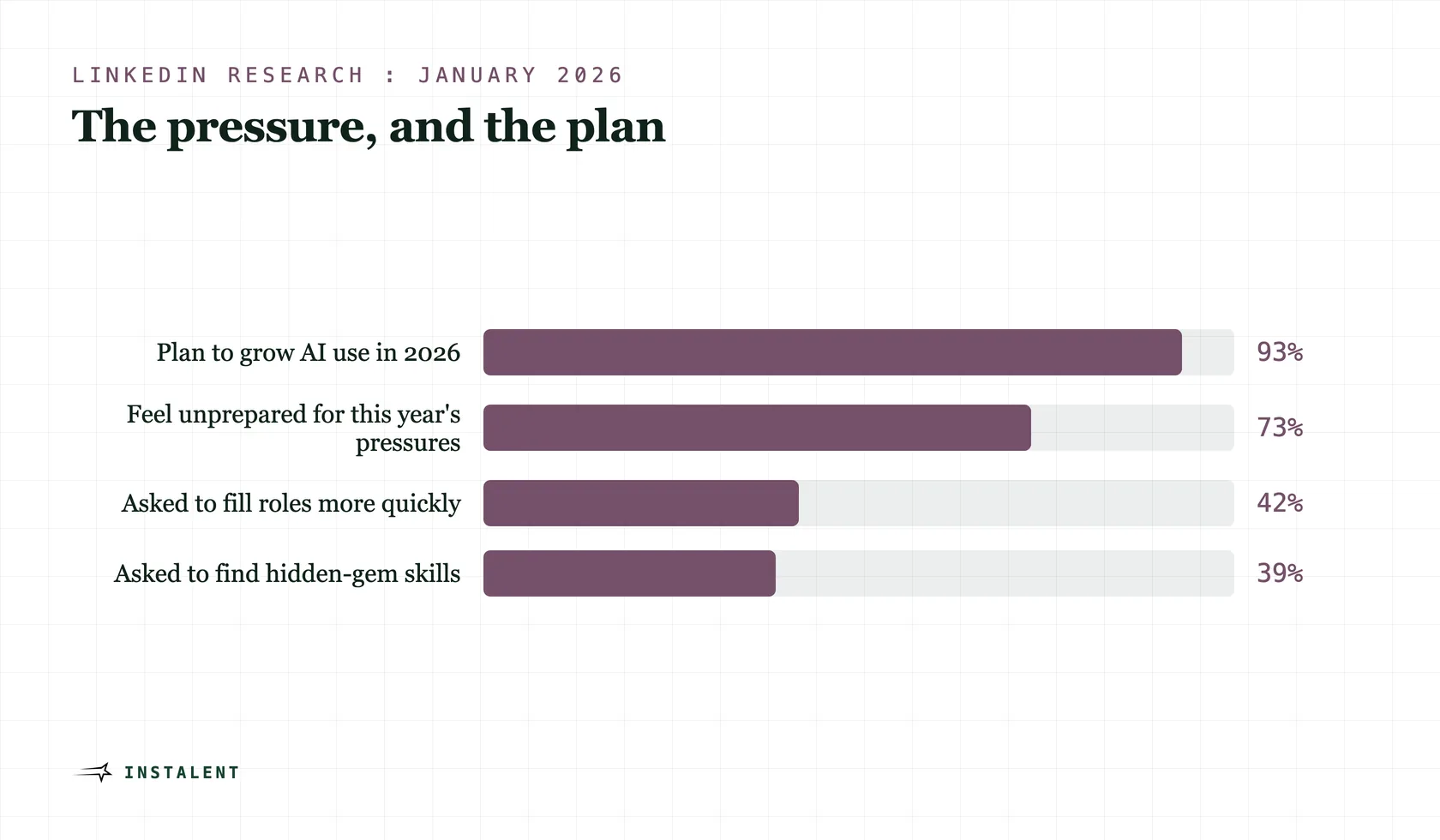
In LinkedIn research published in January 2026, 73% of talent professionals said they felt unprepared for the pressures of their job this year, 42% are being asked to fill roles more quickly, and 39% are being asked to find hidden-gem candidates with skills they would never have found before. This is not a starter kit for that. It assumes you already write Boolean in your sleep, already know what an X-ray is, and are past the stage where another AI writing assistant helps. It is the layer above, for both halves of the job: finding the candidate, and finding the client.
Assume you have ChatGPT, Claude, Gemini, Perplexity and NotebookLM already. At this level the differences that matter are narrow: run deep-research modes for market and org work rather than one-shot chat, use the long-context models for evidence extraction against a spec, and point a notebook tool only at your own intake notes and transcripts when you need answers that cannot drift. None of that is the leverage. The leverage is below.
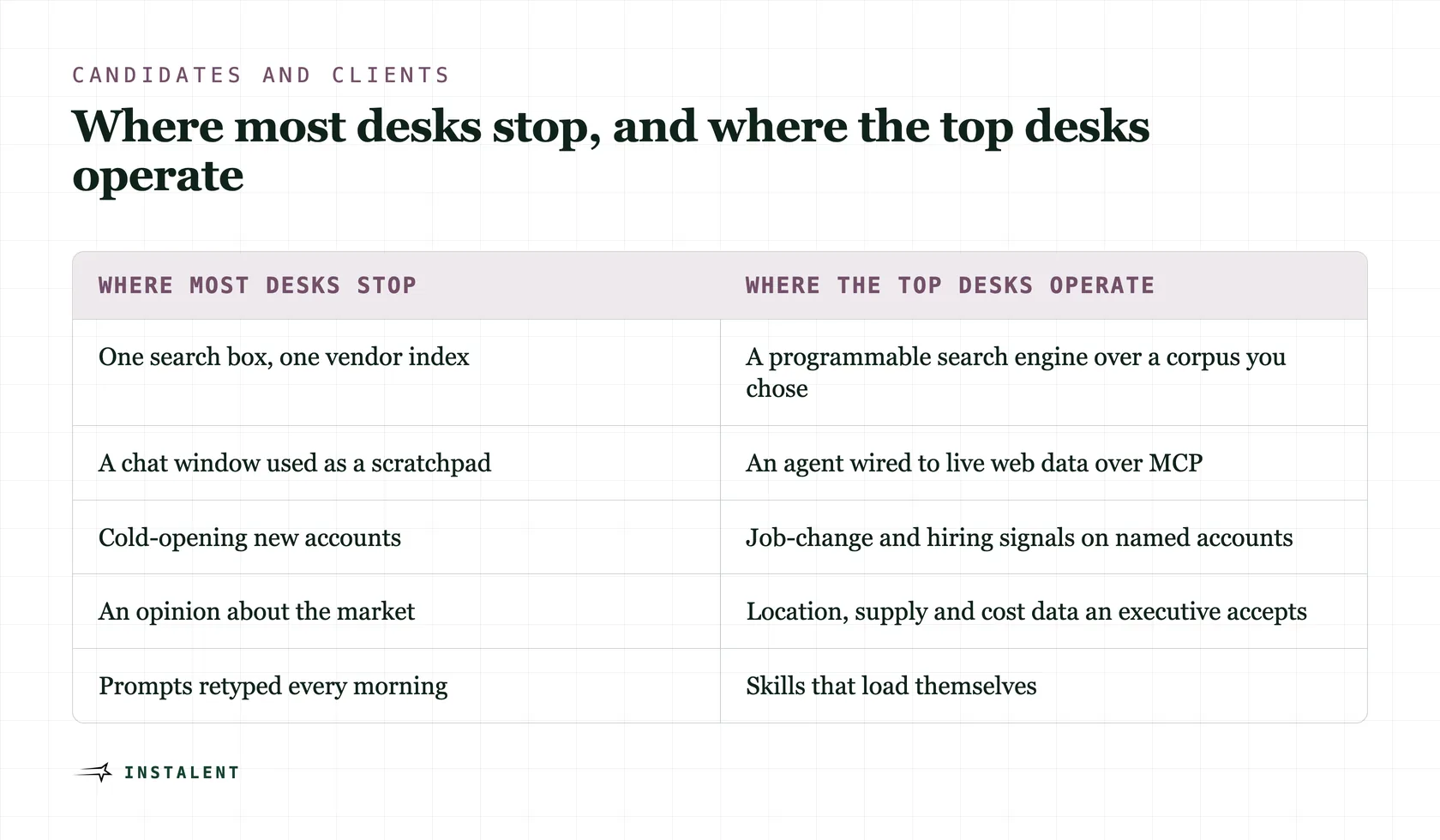
The platform layer, and we build one
Every desk runs something as its spine, so start there and let me be straight about our position: we make Instalent, and this post is on our blog.
What it does is the whole chain rather than one stage of it. Describe the role in plain English and the search runs across the open web, public code and professional signals. Enrichment queries multiple independent sources in a waterfall and keeps the first verified result. Every profile is scored against your criteria with the evidence attached, including how the companies in someone's background classify, so "senior at a startup" and "senior at a large enterprise" stop reading the same. Multichannel outreach runs from the same workspace and stops the moment someone replies, and every reply lands in one unified inbox. Client prospecting does the same for companies and decision makers, which is the part most sourcing tools do not touch at all. It is not an ATS and does not try to be: it syncs both ways with RecruiterFlow, Greenhouse, Lever and TeamTailor.
You will still be asked about the others in every vendor conversation this year, so here they are in one line each, linked to our own comparison of them: hireEZ for a large aggregated index, SeekOut for technical and cleared depth, Gem for in-house pipeline analytics, Juicebox for natural-language search, Loxo for agency workflow, Fetcher for managed candidate batches.
The pattern across all of them is the same, and it is the reason the rest of this post exists: the index is theirs, the enrichment is capped, and the chain from a shortlist to a booked call still crosses two or three other products. Whichever spine you run, the layers below are what make it worth more.
Build your own search infrastructure
This is the biggest capability gap between a good sourcer and a great one, and almost nobody writes about it.
- Google Programmable Search Engine lets you build a search engine restricted to exactly the sites you care about: conference speaker pages, university lab directories, GitHub, portfolio hosts, regional boards, a list of 200 competitor domains. You stop fighting a 400-character string and start querying a corpus you defined. Free with ads, low cost without. The definitive advanced reference is the book Custom Search, by Irina Shamaeva and Dave Galley, and Boolean Strings has ten worked examples for recruiters.
- SerpApi in a Google Colab notebook turns a search you run by hand into one you run 200 times. Free tier is 250 searches a month, $25 for 1,000, and Colab needs nothing installed. This is how experienced sourcers pull hundreds of profile URLs across a list of titles, companies and cities in one pass instead of paging through results.
- RecruitEm and Free Sourcing Tools remain the fastest way to hand-build an X-ray. The second is 18 utilities from Guillaume Alexandre and Pierre Andre Fortin, no signup, and its plain-language-to-Boolean chat beats most paid equivalents.
- GitHub advanced search filters real committed code by language, location and recency. For engineering roles that is evidence, not a self-reported skill list.
- The Wayback Machine on a company's team page, 12 and 24 months apart, is the cheapest org-chart reconstruction there is. Who left, who arrived, which team quietly tripled.
The web-data layer your agents actually run on
If you want an AI client to do real work, it needs live web access and structured output. Three tools own this category, all with free tiers and all with MCP servers, so they plug straight into Claude, ChatGPT, Cursor and anything else that speaks the protocol.
- Firecrawl turns any URL into clean markdown or JSON against a schema you define, and can navigate multi-step pages. 1,000 free pages a month, official MCP server, over 400,000 installs of it.
- Exa is a semantic search API built for agents rather than humans, with company research across 70 million-plus businesses, people and code search, and a highlights mode that cuts token use sharply. Free tier, MCP server.
- Apify is a store of 59,000-plus ready-made extractors covering job boards, company sites and search engines. Free plan gives $5 of monthly usage credit with no card.
Where this gets you in trouble
Extractor stores include actors that pull data from behind a login on professional networks. Running those breaks the terms of the network you depend on, and the account restriction lands on the recruiter, not the vendor. Keep automated collection to the public web, job boards, company sites and your own data. The technique with no downside is the one above: define a corpus, search it programmatically, and read what is publicly published.
The client side: find the company before the req is public
Half of a senior desk is client work, and the BD stack is where recruiters lag furthest behind the sales world. The signal you want is not "who is hiring", which everyone can see. It is who is about to, and who already knows you.
Our own answer to this is client prospecting: the same engine that finds candidates points at companies and decision makers instead, so the account list and the candidate list sit in one workspace rather than two products that never meet, and outreach to a prospective client runs through the same sequences and the same inbox as outreach to a candidate.
What you add underneath it is raw signal, and this is where dedicated data sources earn their keep:
| Signal source | What it gives you |
|---|---|
| PredictLeads | Job openings with full descriptions across 2.7M-plus companies, 37 categories of news events (expansion, funding, partnerships, acquisitions), financing rounds, and 18.5M-plus lookalike companies. API, webhooks and an MCP server |
| UserGems | Job changes and 30-plus other buyer signals. For an agency this is the warmest lead there is: the hiring manager who already trusted you, now with a new budget |
| BuiltWith | Technology adoption across 126,000-plus internet technologies, free to look up per site. The way to find every company that just adopted the stack your candidates specialise in |
| EDGAR full-text search | Free full text of every electronic SEC filing since 2001. Search for new facilities, market entries, named suppliers and competitors before any of it reaches a press release |
| Companies House API | Live UK register data: officers, filings, incorporations. The same idea applies to any national registry you work in |
One note on using these well: a count of open reqs in one function is a stronger buying signal than a funding round, because it is evidence of pain now rather than money later. Point the signal at an account list, then let whatever runs your outreach do the follow-up.
The craft side of this is already written up: buying signals for recruiters for reading the trigger, client market mapping for building the account universe, reaching the actual decision maker for getting past the gatekeeper, and how recruitment agencies win clients for the motion around it. If you want the scored comparison of the dedicated BD platforms rather than this component view, that is the client prospecting tools round-up.
Orchestration, so the list enriches itself
The question here is whether you buy the pipeline or build it. In Instalent it is bought: the enrichment waterfall, the scoring pass and the scheduled runs that keep a shortlist topping up between your calls are the product, not a workflow you wire together, and nothing leaves the workspace to make it happen.
If you would rather build, two things are worth knowing.
- n8n for automation you own outright. The self-hosted community edition is free, which is the version that matters when the thing you are automating touches candidate data.
- Agentic coding tools are the underrated one. Senior recruiters are now writing their own scripts by describing them: a diff of two market maps, a deduplicated merge of four exports, a scheduled job that re-checks 60 target accounts. You no longer need to be an engineer to get value from that, which was not true 18 months ago.
The third option is the spreadsheet-plus-enrichment approach the growth world runs on, which recruiters have borrowed. Clay is the name you will hear; it is powerful, it is built around a sales motion rather than a req, and you assemble the recruiting workflow and pay per data provider yourself. Our comparison of the two is on that page.
Talent intelligence, for the conversations you have with executives
When a client or an executive challenges a market, you either have data or you have an opinion. For most conversations the map you build yourself is enough, and client market mapping inside Instalent will give you the companies, the shape of their teams and the contacts in them for the market you are actually working.
Where you need economy-scale numbers, headcount trends across millions of companies or a location argument for a workforce plan, that is a different tier of data and a different budget.
| Platform | What it gives you |
|---|---|
| Draup | Location intelligence scored on talent density, cost and competition, plus skills architecture and peer benchmarking |
| Horsefly Analytics | Supply, demand and cost across 815,000-plus titles and 170,000 towns and cities |
| Revelio Labs | Headcount, hiring, attrition and skills across 30 million-plus mapped companies, plus a free public AI labour-market tracker |
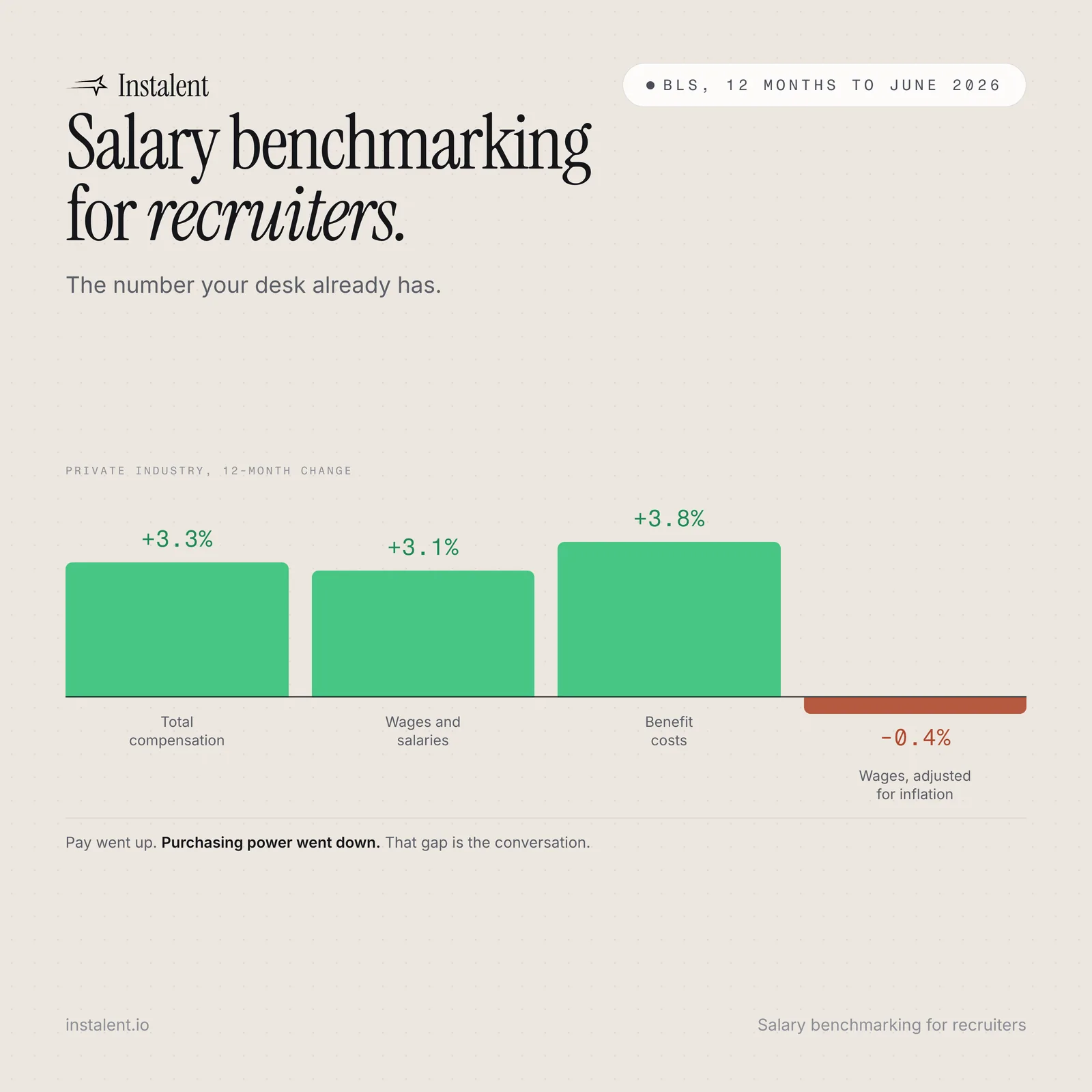
None publish pricing, which tells you the tier. Where budget is the constraint, three free sources cover most arguments: Levels.fyi for verified compensation, Indeed Hiring Lab for economist-written analysis of postings, wages and openings, and the BLS Occupational Outlook Handbook when you need a number nobody can dispute.
AI skills, with the maturity tiers stated honestly
An AI skill is a folder with a SKILL.md file holding instructions and resources that a model loads by itself when the work matches. It is an open standard now, documented at agentskills.io and supported across most serious AI clients. This is where the compounding is, and most of the skills worth having already exist. Read one before you install it, the same way you would with any software from a stranger.
Tier one, maintained by the model vendor. Anthropic's public skills repository is Apache 2.0, and the four document skills are the same code behind Claude's own document handling.
| Skill | What a senior desk does with it |
|---|---|
xlsx | Merge and dedupe exports, build the pipeline or BD model you actually report on |
pptx | A client-ready market map or slate deck without opening a template |
pdf | Pull structure out of CVs, briefs and scoping documents |
doc-coauthoring | A staged workflow for a proposal or SOW, ending in a reader test by a fresh model instance before a client sees it |
skill-creator | Capture, draft, test and package your own skills, with evals |
Tier two, large and well-maintained by a known author. Addy Osmani's agent-skills is 24 MIT-licensed production engineering skills. Two reasons it belongs on a recruiter's list: it is the clearest example of what a serious skill looks like inside, and if you hire engineers, its skill names are a free vocabulary lesson in how modern teams actually work.
Tier three, recruiting-specific community packs. Smaller and unproven, so audit them, but they are the only place recruiting-shaped skills exist today:
- carlopezzuto/recruiting - MIT, 11 agents and 16 skill modules including
boolean-search,talent-mapping,sourcing-plan,persona-research,interview-design,candidate-evaluationandstakeholder-reporting. - zubair-trabzada/ai-recruiter-claude - MIT, 14 skills covering screening, scoring, salary benchmarking and report generation.
- tuanductran/hr-skills - MIT, an HR skill library structured with instructions, content, prompts and examples per skill.
Where to browse the rest. theskillmd.com indexes 334 HR skills as metadata linking back to source repos, including ATS automation skills for several major systems. Claude Skills Hub indexes tens of thousands more and is explicitly not affiliated with Anthropic, so treat it as a search engine rather than a recommendation.
Then write four of your own, with skill-creator doing the typing: your ICP and calibration anchors, your scoring rubric, your voice, and your rules. Instalent publishes its own recruiting skills so an AI client can run sourcing, client prospecting and outreach directly: installing the Instalent skills.
If the leak is after the shortlist
Worth saying plainly: our lane is everything up to the reply. If your loss reason is not sourcing but what happens in the interview loop, the category to look at is interview intelligence, which records the conversation and reports on interview quality at the pattern level, including talk ratios and structure adherence. Diagnose the leak before you buy anything for it, because a shortlist problem and an interviewing problem look identical on a time-to-fill chart and have nothing in common otherwise.
Twelve recruiter productivity techniques that separate the top desks
- Define a corpus before you write a query. A programmable search engine over 200 chosen domains beats a longer string on the open web every time.
- Reconstruct the org chart, do not ask for it. Archived team pages, conference speaker lists and commit history tell you who reports to whom before your first call.
- Reverse-engineer the spec from your own decisions. Give the model the spec, three profiles you would interview and two you would reject, then ask: "infer the must-haves I am actually screening on, and list the ones the spec never states."
- Score the whole slate in one pass, on one rubric, with evidence attached per criterion. Not the three you already liked. It is also the cheapest bias control available to you.
- Demand citations from any model touching a person. Add "if the evidence is not there, say so and stop" and the flattering guesses disappear.
- Track the movers, not the market. Every hiring manager you have ever placed for is a live account the moment they change employer. Automate that watch and you will never cold-open again.
- Count the reqs before you pitch. Five open roles in one function is evidence of pain now. A funding round is only money later.
- Read the filings. Full-text search on public filings surfaces new sites, market entries and named suppliers months before the press release, and it costs nothing.
- Keep a feeder-company list per client, versioned. Rebuilt searches are the most expensive recurring waste on a senior desk.
- Screen on the skill, not the title, because titles inflate at small companies and deflate at large ones. Skills-based sourcing is where the pool widens.
- Protect the send like it is an asset. Google's sender guidelines want spam complaints under 0.10% in Postmaster Tools and treat 0.30% as a line you never cross, and senders above 5,000 messages a day have needed authentication and one-click unsubscribe since February 2024. Full picture in sender reputation for cold outreach.
- Put standards in files, not in your head. The skill you write once is the only part of this that compounds while you sleep.
Deeper craft if you want it: the AI sourcing brief for the written spec, passive candidates for reaching people who are not looking, and why Boolean is no longer the skill for where search is heading.
Keep the decision, and the audit trail
Automated employment decision tools carry real obligations. New York City's Local Law 144 has been enforced since 5 July 2023 and requires an annual independent bias audit, a public summary of it, and at least 10 business days' notice to candidates. Rules elsewhere are moving. Rank, summarise and prepare with AI. Keep selection and rejection with a named human, and keep a record of how each call was made.
Where senior recruiters actually keep up
Tooling changes faster than any article can hold. These are the sources the people who find the tools first are reading.
- SourceCon Weekly, free, the original publication for sourcers, plus the SourceCon Innovation Lab for tools that are not on anyone's list yet.
- Recruiting Brainfood from Hung Lee, weekly since 2017 and still the most useful hour in the industry, with the Brainfood Live sessions alongside it.
- Boolean Strings from Irina Shamaeva, where advanced search techniques get published years before they reach a vendor roadmap.
- Dean Da Costa's tool list, a constantly growing catalogue of extensions, scrapers, Boolean utilities and OSINT resources, with downloadable spreadsheets. Nobody has a bigger one.
- Sourcing Summit and RecruitingDaily for the training and the working sessions.
Where the recruiter productivity stack stops
Look at what you have just assembled. A programmable search engine, a notebook that runs searches at scale, a crawl API, a semantic search API, an extractor store, a signal feed for accounts, a job-change watch, an orchestration spreadsheet, a talent intelligence subscription, a skills folder and one of the big sourcing platforms. Every piece is good. Between each pair is an export, a paste, a reconciliation and a moment where you are the integration layer.
Nothing in that list is wrong. The cost is not in any one piece, it is in the seams: the export, the paste, the reconciliation, the twenty minutes at 6pm working out which list is current. That work never appears on a dashboard and it is most of why a heavy desk feels heavier than the req count says it should.
Removing the seams is the whole design of Instalent, which is why the chain described at the top runs end to end in one workspace for candidates and clients at once. For a reader who has got this far, the part worth knowing is that it is also an agent you can drive from ChatGPT, Claude or Gemini over MCP, with per-step control over what it may do alone. It sits inside the agent setup you are already building rather than beside it, which is not true of anything else on this page. If you carry a desk alone, the solo recruiter setup is the shortest way in.
Want the chain without the integration work? Get started and run one real role end to end.
Sources
- Recruiters are increasing their AI usage as pressure to hire intensifies - HR Dive, 8 January 2026, reporting LinkedIn research: 73% feel unprepared for this year's pressures, 42% asked to fill roles more quickly, 39% asked to find hidden-gem skills, 93% plan to grow AI use in 2026
- How AI Is Reshaping Talent Acquisition in 2026 - SHRM, 8 June 2026, citing SHRM Talent Trends: 51% of organisations use AI in recruitment
- Agent Skills overview, the agentskills.io open standard and the anthropics/skills repository - skill format, licensing and every skill named above, accessed 14 August 2026
- What is the Model Context Protocol? - the open standard behind the MCP servers named here, accessed 14 August 2026
- Email sender guidelines - Google Workspace Admin Help, spam-rate thresholds and bulk sender requirements, accessed 14 August 2026
- Automated Employment Decision Tools - NYC Department of Consumer and Worker Protection, Local Law 144 of 2021
- Capability, free-tier and licence details were read at each product's own pages: Firecrawl, Exa, Apify Store, SerpApi, Google Programmable Search Engine, PredictLeads, UserGems, BuiltWith, EDGAR full-text search, Companies House API, Draup, Horsefly Analytics, Revelio Labs, n8n, RecruitEm, Free Sourcing Tools, Levels.fyi, Indeed Hiring Lab
Find better candidates, faster
Source, verify and reach candidates on one engine. Get 50% off your first month.
Keep reading