Top 10 Client Prospecting Tools for Recruitment Agencies in 2026, Scored
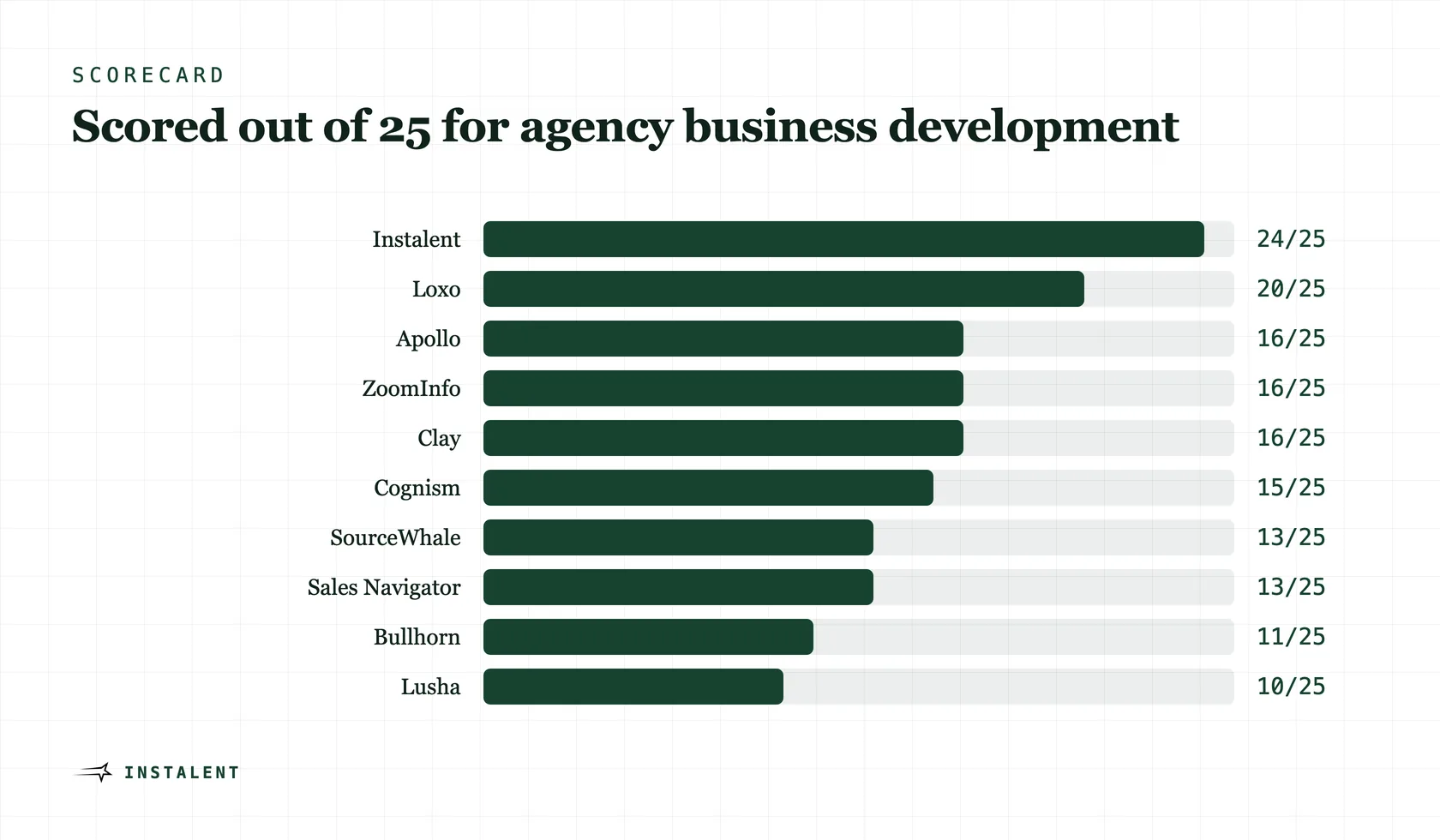
The top 10 prospecting tools for recruitment agencies, scored out of 25 on the five things an agency BD desk actually needs. Most lose the same two points.
Do this in Instalent - find companies hiring now and reach the decision-maker.
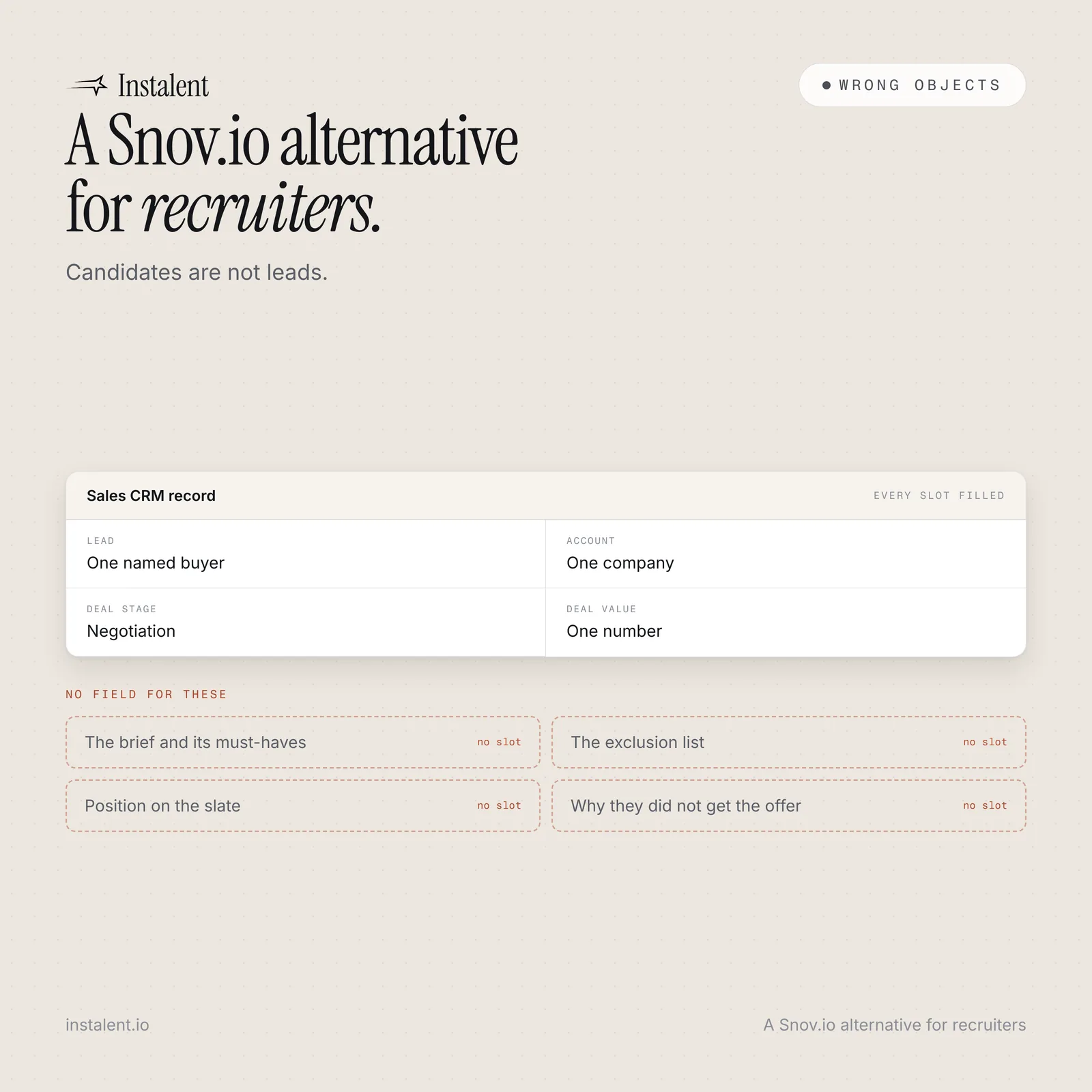
Every agency BD stack is built out of tools made for somebody else. Sales Navigator was made for account executives. ZoomInfo and Cognism were made for B2B sales teams. Clay was made for growth engineers. You are paying sales-team prices to answer a recruiting question: which companies have the role I fill, and who signs the fee agreement? Here are the top 10 client prospecting tools for recruiters, each scored out of 25 against that question, with an honest note on where we land in our own table.
Business development is the constraint on most desks right now. Bullhorn's GRID 2026 report, built on responses from nearly 2,300 recruitment professionals, names hiring freezes and budget constraints as the biggest obstacle to winning new business, with competition from other firms second and rising. Fewer companies are buying, and more agencies are chasing the ones that are. That makes the quality of your prospecting list the whole game, and it makes what you spend on prospecting software worth auditing.
What a client prospecting stack costs before it finds you one client
The published numbers, so you can price your own stack honestly.
- Sales Navigator is $119.99 per seat per month for Core and $159.99 for Advanced, with 50 InMail credits a month on every tier.
- Lusha starts at $49.90 a month for 400 credits, with a free tier at 40. A revealed email costs 1 credit; a phone number costs 10.
- Clay has a free tier at 100 data credits a month and runs a dual meter after that: data credits to buy records from its marketplace, actions to run the enrichments.
- Loxo has a free tier, then $169 per user per month for Basic. Its prospecting layer, an 850M+ profile talent graph plus account-based prospecting, sits on the quote-only Professional tier.
- Bullhorn publishes $99 per user per month for Starter and $165 for Core. Its Pro and Max tiers are quote-only.
- Cognism publishes no list price. Its packages start at five seats and bill by revealed contact.
- ZoomInfo publishes no list price either. Vendr's buyer data, drawn from 1,568 verified purchases and last updated February 2026, puts the median contract at $33,500 a year.
None of that is wasted money. It is just aimed at a different job. A seller wants every company in a segment. You want the small subset with a live need in your niche, and the one person inside it who owns the hire.
The five questions a BD stack has to answer
This is the rubric. Five criteria, five points each, 25 total. It is built around the actual sequence of an agency BD week, not a feature list.
- Finds companies with the need. Can it tell you which companies employ or are hiring the role you fill, rather than which companies exist in a size band and an industry tag?
- Names the decision-maker. Does it get you to the hiring manager or department head who owns the budget, not a generic contact at the company?
- Verified contact details. A deliverable work email and a direct mobile, with a confidence signal so you know what you are sending into.
- Runs the outreach and brings replies back. Sequences, follow-ups that do not slip, and every reply in one place instead of four tabs.
- Fits a recruitment desk. Two-way ATS sync, req and BD workflow, and no assumptions borrowed from a SaaS sales team.
Read our own score with a pinch of salt
We built this rubric and we make one of the products in it. Instalent scores well because the rubric describes the job we built for. The useful part is the rubric, not our number - take the five questions to your own shortlist and score it yourself. Our full approach to comparisons, including how we pick competitors and how to send a correction, is on our comparison methodology page.
The top 10 prospecting tools for recruitment agencies, scored
Scores are our read of each product's publicly documented capability for agency business development specifically. A low score is not a verdict on the product. It usually means the product was built for a different job and does that job well.
| # | Platform | Need | Decision-maker | Contact data | Outreach | Desk fit | Total |
|---|---|---|---|---|---|---|---|
| 1 | Instalent | 5 | 5 | 4 | 5 | 5 | 24 |
| 2 | Loxo | 3 | 4 | 4 | 4 | 5 | 20 |
| 3 | Apollo | 3 | 4 | 4 | 4 | 1 | 16 |
| 4 | ZoomInfo | 4 | 4 | 4 | 3 | 1 | 16 |
| 5 | Clay | 4 | 4 | 4 | 3 | 1 | 16 |
| 6 | Cognism | 3 | 4 | 5 | 2 | 1 | 15 |
| 7 | SourceWhale | 1 | 1 | 1 | 5 | 5 | 13 |
| 8 | Sales Navigator | 3 | 5 | 1 | 2 | 2 | 13 |
| 9 | Bullhorn | 1 | 1 | 1 | 3 | 5 | 11 |
| 10 | Lusha | 2 | 3 | 3 | 1 | 1 | 10 |
Loxo is the closest thing here to a single engine, and the reason it takes second place. It is recruiting-native, so it clears question 5 outright, and its top tier adds a large talent graph plus account-based prospecting and campaign outreach. Two caveats. The prospecting layer is on the quote-only Professional tier, so the $169 Basic price is not the one that buys you BD. And its talent graph is built around finding candidates, so the client-need question is answered indirectly, by inference rather than by design. We go deeper on that trade in our Loxo alternative write-up.
Sales Navigator is still the best product in the world at one of the five. Nothing names the right person inside a company faster. But its own plan comparison lists no verified email or mobile on any tier, and 50 InMails a month is a nurture budget, not a BD engine. You end up buying a second tool to get the contact and a third to run the sequence.
Apollo and ZoomInfo are the same shape at different price points: a large contact database with sequencing bolted on, sold to sales teams. Both filter on job postings, which is a real hiring signal and the reason they score above Lusha. It is also a narrow one. Only companies advertising right now show up, and that is the exact pond every other agency is fishing.
Cognism earns the only 5 in the contact-data column. Phone-verified mobile numbers, strongest in UK and European markets, are its stated selling point, and if your BD runs on the phone that is the column that matters most. It is the weakest of the databases on running the outreach, and quote-only pricing at a five-seat minimum is a procurement conversation, not a Tuesday decision.
Clay is the most capable and the most expensive in hours. You can compose almost anything, waterfall several data providers, and build a genuinely good BD list. Somebody on your team has to build and maintain it. On a desk carrying live reqs, that person does not exist.
SourceWhale is the mirror image of the databases, and the reason it is in this table. It is built for recruitment, syncs properly with the CRM, and runs multichannel BD cadences that never drop a follow-up. It just starts one step in. It is an outreach layer, not a database, so you still have to find the companies and source the contacts somewhere else. We covered that gap in more depth in our SourceWhale alternative write-up.
Bullhorn is in this table because every agency asks the same question: can I not just do this in Bullhorn? It is the system of record for a huge share of the industry and it runs a proper BD pipeline. But a CRM stores the companies and contacts you already know. It does not go and find the ones you do not. It is where business development gets recorded, not where it gets discovered.
The table splits into two clusters
Rank the ten and they do not spread out. They fall into two groups that fail in opposite directions.
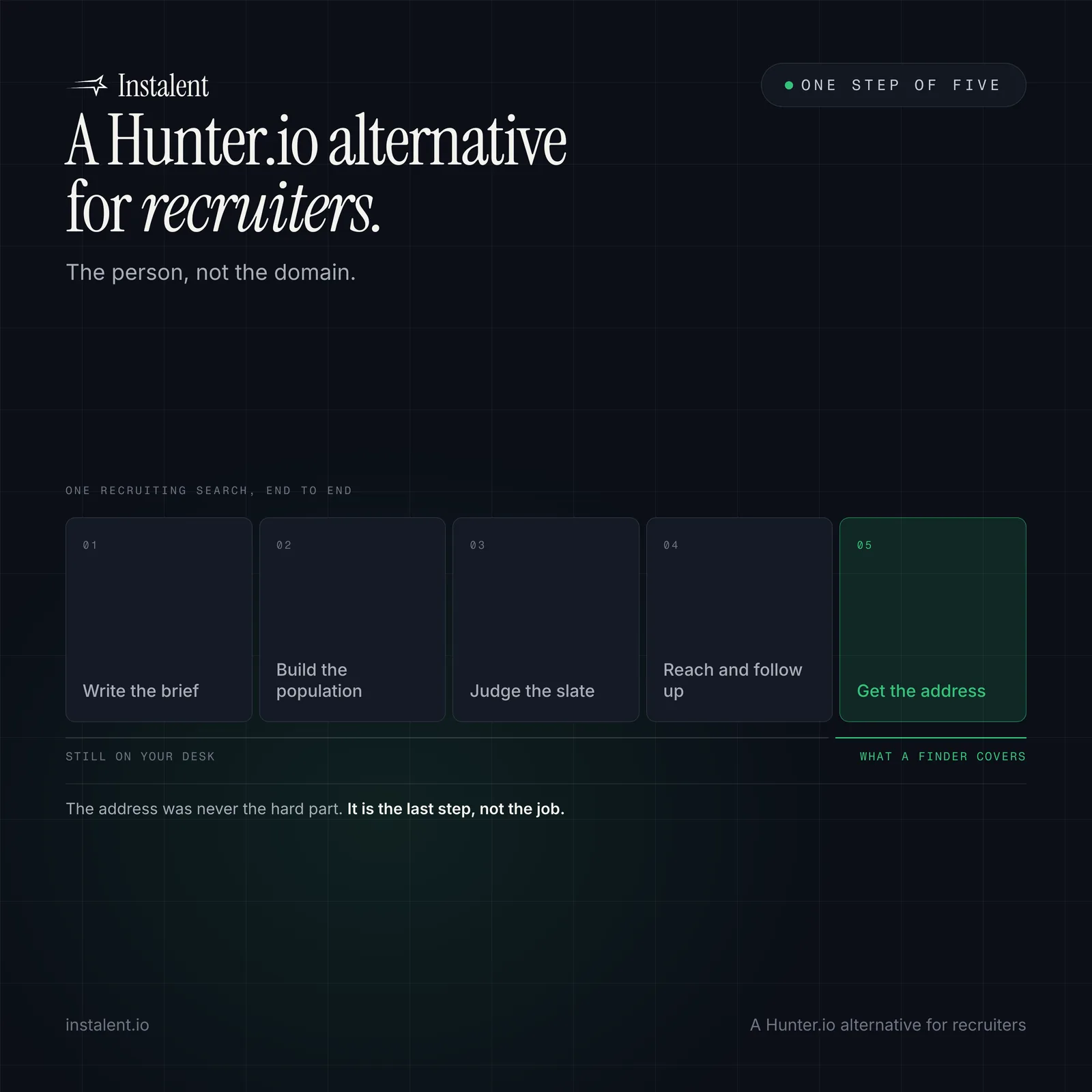
The six sales-data tools all land between 10 and 16, and not one of them is a weak product. They drop the same two criteria. Databases are good at question 2 and question 3: give one a company and it will name a plausible decision-maker and hand you a number. Where they go quiet is question 1 and question 5, which companies actually have your need and whether any of it fits how a recruitment desk runs. A firmographic filter tells you a company exists. A job-board filter tells you a company is already advertising, which means it is already being called by everyone else.
The recruiting-native tools fail the other way. SourceWhale and Bullhorn take top marks on fitting a recruitment desk and bottom marks on finding anyone in the first place. Both assume the list already exists. Loxo is the exception, and it is instructive: it is the only competitor that covers both sides of the line, and the only one above 16.
That is the seam. Sales-data tools stop before the outreach and know nothing about recruiting. Recruiting-outreach tools start after the list exists. Agencies bridge the gap with a stack, and the stack is where the hours and the licence fees go. If you want the underlying market data on why this got harder in 2026, we wrote it up in the client scarcity problem.
Where Instalent lands, and where it does not
We built for the seam. Describe the client you want in plain English and Instalent prospects the companies that employ or are hiring the role you fill, names the people who own that hire, enriches verified contact details from multiple sources with a confidence signal, then runs multichannel outreach and lands every reply in one unified inbox. It syncs two ways with RecruiterFlow, Greenhouse, Lever and TeamTailor, and the same engine sources the candidates once the role is signed.
The honest 4 in our own table is the contact-data column. Coverage varies by market and by seniority, and no provider verifies every mobile for every person. We show a confidence signal instead of pretending otherwise.
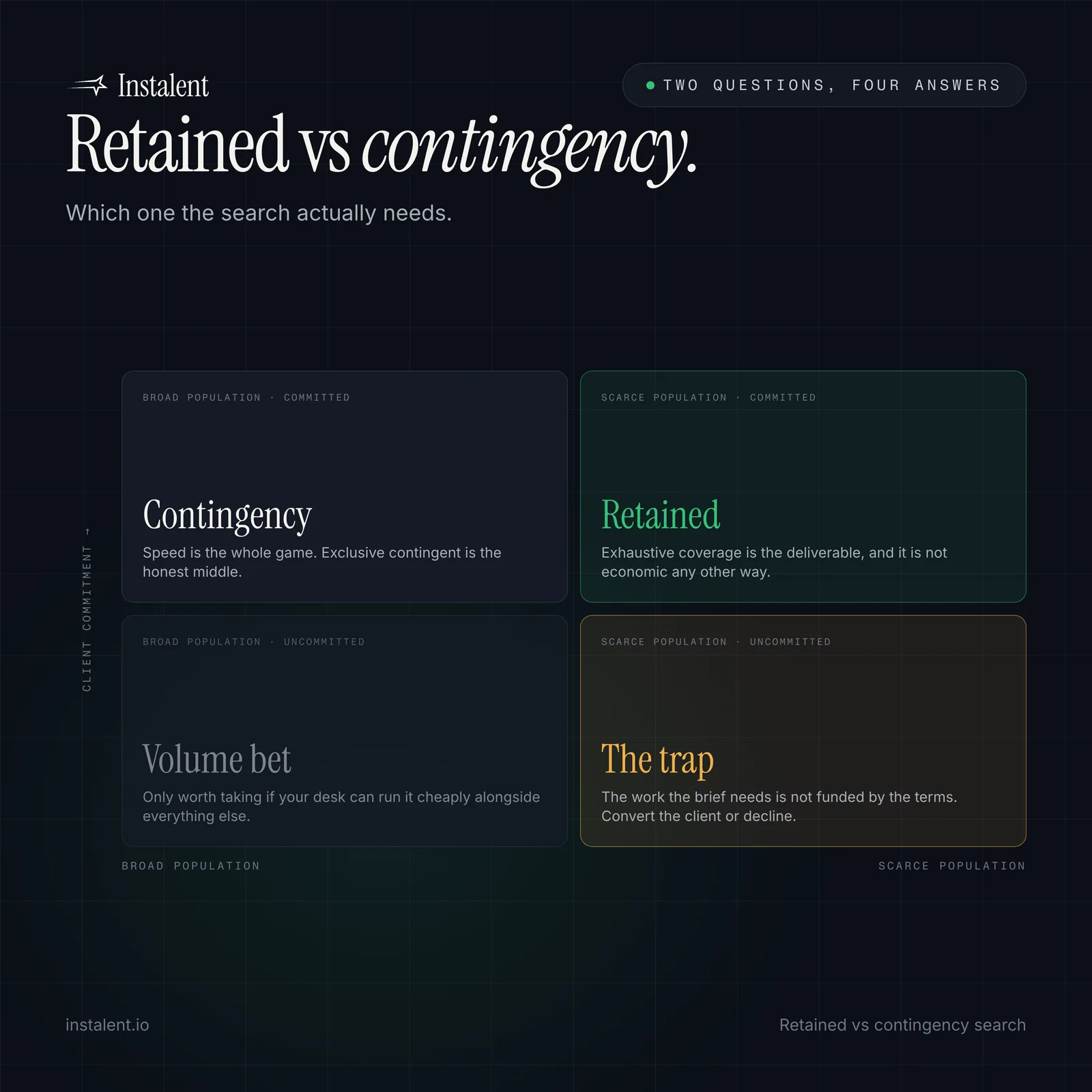
Two cases where we are not the answer. If your contact data is already handled by a database you trust and your team just wants best-in-class BD sequencing on top of it, a focused outreach tool is simpler and faster to adopt. And if you are ready to replace your ATS, CRM and outreach in one move, a full recruiting platform is a different purchase from the one this table is scoring. Buy the seam only if the seam is your problem.
Run a two-week bake-off on a live desk
Scores are a shortlist tool. The desk decides. Pick one niche you actually bill in and run every finalist through the same test.
- Same brief, same week. Count companies with a genuine live need, not rows exported.
- Count how many of those come with a named decision-maker and a contact you would actually send to.
- Track replies per 100 sends, not open rates. Opens have been unreliable since inbox privacy protections became the default.
- Time the whole loop, from brief to first reply, and log who had to touch it.
- Check the exit: can you export your data and does it write back to your ATS.
Score before you sign
Annual contracts and five-seat minimums are the norm in this category. Run the bake-off before the paperwork, and make the vendor prove question 1 on your niche, not on their demo data.
Want to score us on your own desk? Get started and run one real BD brief end to end. If you want the method rather than the tooling, how agencies find and win new clients and client market mapping are the two to read next.
Common questions
What is client prospecting in recruitment? Client prospecting is the business-development half of an agency desk: finding companies that have a hiring need you can fill, identifying the person who owns that hire, and opening a conversation. It is the mirror image of candidate sourcing, and most agencies run it with tools built for B2B sales teams rather than for recruiters.
How do recruitment agencies find new clients? The durable methods are referrals, a defined ideal client profile, and hiring-signal prospecting - finding companies that employ or are actively hiring the role you specialise in, rather than filtering a database by industry and headcount. Our guide on how agencies find and win new clients walks the full process, and client market mapping covers building the list itself.
Can I use Apollo or ZoomInfo for recruitment business development? Yes, and plenty of agencies do. Both give you a large contact database and workable sequencing. What neither gives you is a recruiting workflow or a reliable way to tell which companies have your specific hiring need - their job-posting filters only surface companies already advertising, which is the most competitive slice of the market.
What is the best tool for recruitment agency BD? It depends which of the five questions above is your bottleneck. If you need phone-verified mobiles for a call-first desk, a specialist data provider wins. If you need BD sequencing on contacts you already hold, a recruitment outreach tool wins. If the gap is finding the companies and the decision-makers in the first place, you need something that covers the seam.
How much do client prospecting tools cost? Published prices here range from $49.90 a month (Lusha Starter) to $159.99 per seat per month (Sales Navigator Advanced). The enterprise names publish nothing: Vendr's buyer data puts the median ZoomInfo contract at $33,500 a year, and Cognism quotes per deal on a five-seat minimum.
Sources
- Bullhorn - GRID 2026 Industry Trends Report (February 2026, ~2,300 recruitment professionals surveyed)
- LinkedIn - Sales Navigator plan comparison (accessed August 2026)
- Lusha - pricing (accessed August 2026)
- Clay - pricing (accessed August 2026)
- Cognism - pricing (accessed August 2026)
- Loxo - pricing (accessed August 2026)
- Bullhorn - pricing (accessed August 2026)
- Vendr - ZoomInfo buyer guide (last updated February 2026, 1,568 verified purchases)
Find your next client before your competitors do
Spot companies that are hiring, reach the decision-maker and win the brief. Get 50% off your first month.
Keep reading