The Interview Debrief Is Where the Brief Actually Changes
Hiring managers say not quite right. That is an impression, not feedback. How to run a debrief that returns a reason you can actually source against.
Leave the debrief with a changed search, not a sentiment.
Three candidates, three hours of your client's time, and the debrief produces one sentence: none of them were quite right. You say you will go back out. The search is now a week older, the brief on paper has not changed, and the brief in the hiring manager's head has moved in a direction nobody wrote down. The next slate will miss for the same reason, and the reason will still be unnamed.
"Not quite right" is an impression, not feedback
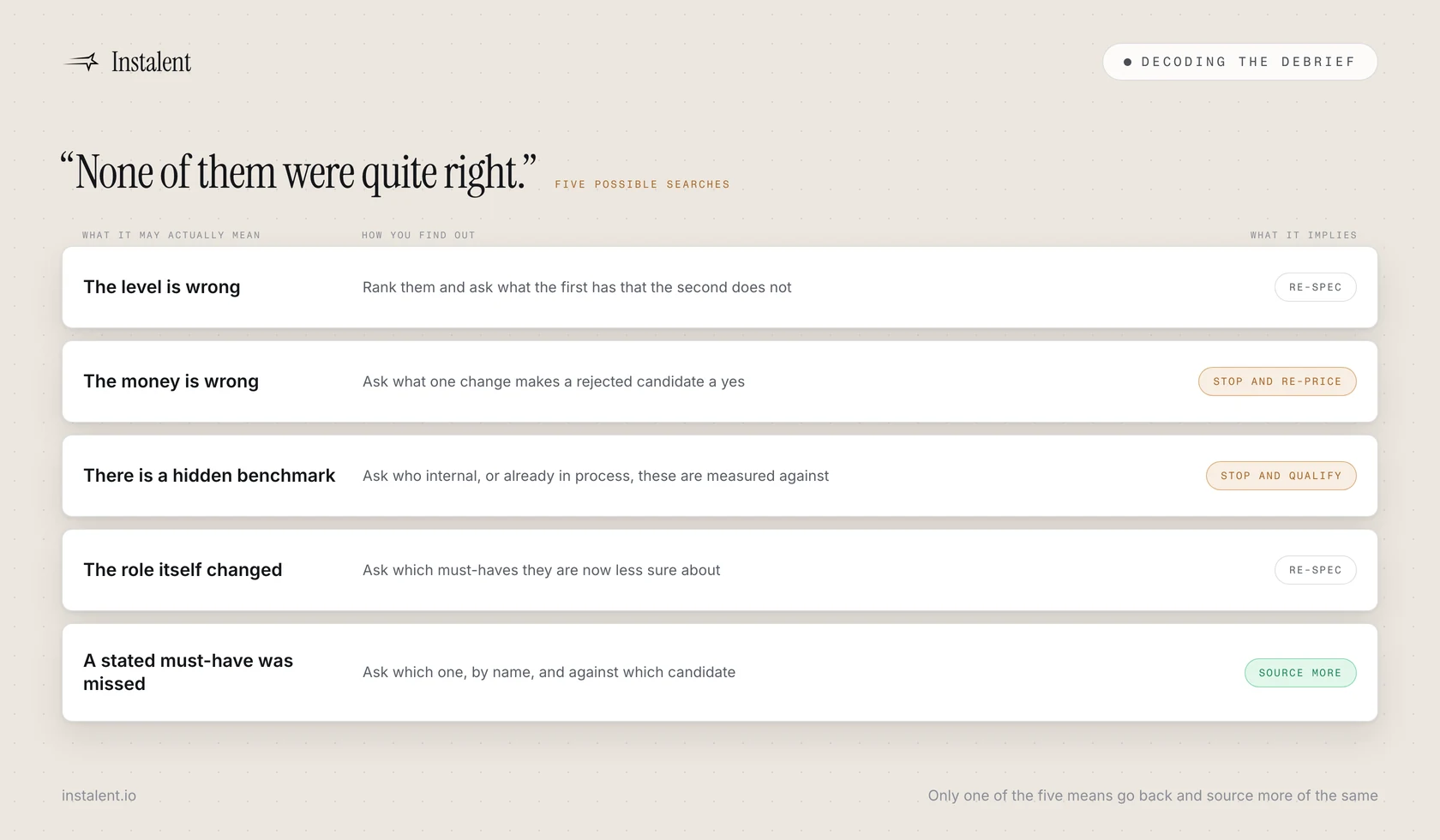
It feels like information because it arrives in the shape of a verdict. It is not, because it has no referent. That sentence can mean at least five different things:
- The level is wrong, and they have realised it only now that they have met three people at it
- The money is wrong, and the candidates they liked are above the band
- Someone internal or already in process has become the benchmark and nobody told you
- The role itself has changed since you took the brief
- The candidate genuinely missed a stated must-have
Only the last one means go back and source more of the same. Two of them mean stop sourcing entirely until something else is settled. Leaving the call without knowing which of the five you are in is how a search quietly becomes unfillable while still looking active on your board.
The debrief is where the spec moves
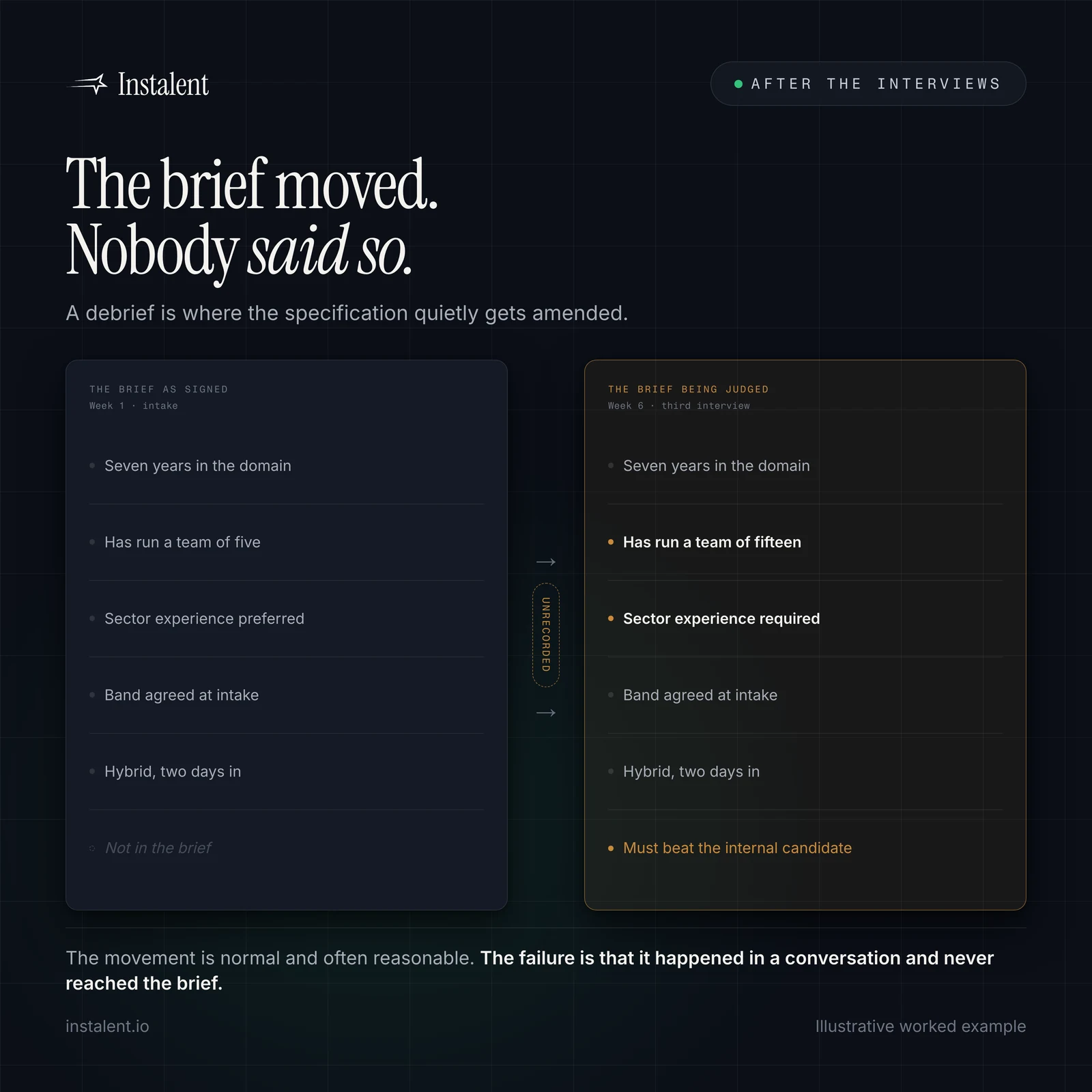
Here is the structural fact that makes this worth a whole process. The brief signed at intake is almost never the brief being judged by the third interview. That movement is normal, and often reasonable. The failure is that it is invisible.
The intake call is where the spec is set and, if it is run as a feasibility test rather than a wish list, where it is written down with a date. The debrief is where that spec silently gets amended. And "when the spec moved, and who moved it" is precisely the field that is missing when anyone tries to run a post-mortem on a search that died. The three conversations are one discipline: set it, notice when it changes, be able to read it back.
Ask for a comparison, never for a verdict
An absolute judgement can be given without exposing a criterion. "She was not quite right" costs the speaker nothing. A comparative judgement cannot be made without one, which is why the whole technique is to force a comparison.
- "Rank these three, and tell me what the first one has that the second does not." The answer to the second half is your actual criterion, often for the first time.
- "If I could change one thing about candidate B, what makes them a yes?" Converts a rejection into a specification.
- "Which of our must-haves did they genuinely miss, and which are you now less sure about?" Gives the manager explicit permission to move the spec in front of you instead of behind you.
- "What would you need to see to move this week?" Tests urgency and authority at the same time.
- "Is there anyone internal, or already in process elsewhere, that these are being measured against?" The highest-value question on the list and the one almost nobody asks. A hidden benchmark explains more failed slates than any sourcing problem.
Collect the views before the room agrees on one
If three people interviewed, get three views before they become one view. Ask each for their read, or at minimum ask the quietest person first.
This is not a claim about bias research, it is a practical point about meetings: the first confident person to speak sets the frame, and everyone after them is responding rather than reporting. You paid for three independent assessments. A debrief run as an open discussion often gives you one assessment and two endorsements.
Leave with a changed search, not a sentiment
A debrief is worth having only if something is different when you hang up. There are three honest outcomes, and you should name which one you are in, out loud, before the call ends:
- A criterion changed. You are re-sourcing against a different spec. Say what it now is.
- The money or the level changed. You are re-pricing, and that is a different conversation with different people. Salary benchmarking is the evidence for it.
- The process changed. Same spec, same band, but the sequence or the speed has to move, usually because a candidate was lost to it.
If none of the three is true, the search has not progressed, and that is itself a finding worth saying plainly to the client.
Why the interview is worth running properly
It is worth knowing how much weight this stage actually carries. In the 2022 re-analysis of selection method validity by Sackett, Zhang, Berry and Lievens in the Journal of Applied Psychology, structured employment interviews came out as the strongest single method, at .42, ahead of job knowledge tests at .40, work sample tests at .33 and cognitive ability tests at .31.
The interesting part for a debrief is the spread. Structured interviews also carry the widest variation of those methods, with a standard deviation of .19 and a lower 80% credibility value of .18, below the equivalent figures for job knowledge tests, biodata and work samples. That is what you would expect of a method whose value depends heavily on how it is run. The interview deserves the weight, and it rewards structure, which includes what happens in the half hour after it.
Interview questions to ask candidates covers the questions and scoring the answers. Reference checks covers the step after, and why it is a verification tool rather than a scoring one.
Write the change down, with a date
The debrief produces the single most perishable artefact in a search: the real reason. Record it as the criterion that changed, the date, and who changed it, against the role itself rather than in a notebook.
That is what makes the next slate defensible and the eventual review possible. Scoring a shortlist covers holding a slate to one rubric, and candidate analysis keeps the criteria and the per-criterion reasoning attached to the profiles so an amended spec can be applied to the whole pool rather than remembered. The agency view is on solutions for recruitment agencies.
Want the amended spec applied to the whole pool, not just the next ten? Get started
Common questions
What is an interview debrief?
The conversation after a client or hiring manager has met candidates, where the recruiter establishes why each one did or did not work. Run properly it is also where the brief gets amended, because the specification being judged at the third interview is rarely the one signed at intake.
What does it mean when a hiring manager says “not quite right”?
It is an impression rather than feedback, and it can mean at least five different things: the level is wrong, the money is wrong, a hidden internal or external benchmark has appeared, the role itself has changed, or the candidate missed a stated must-have. Only the last means go back and source more of the same, and two of them mean stop sourcing until something else is settled.
What questions should you ask in an interview debrief?
Ask for comparisons rather than verdicts, because a comparison cannot be made without exposing a criterion. Rank the candidates and say what the first has that the second does not, ask what single change would make a rejected candidate a yes, ask which must-haves were genuinely missed and which the manager is now less sure about, ask what they would need to see to move this week, and ask whether anyone internal or already in process is being used as the benchmark.
How do you stop a search drifting after interviews?
Leave every debrief with one of three named outcomes: a criterion changed, the money or level changed, or the process changed. Then record the change, the date and who made it against the role itself. If none of the three is true, the search has not progressed, which is a finding worth telling the client.
Sources
- Revisiting meta-analytic estimates of validity in personnel selection: Addressing systematic overcorrection for restriction of range - Sackett, P. R., Zhang, C., Berry, C. M., & Lievens, F. (2022), Journal of Applied Psychology, 107, 2040-2068. Table 3: structured employment interviews .42 with an SD of .19 and a lower 80% credibility value of .18; job knowledge tests .40 (SD .13, lower 80% .23); empirically keyed biodata .38 (SD .09, lower 80% .26); work sample tests .33 (SD .09, lower 80% .21); cognitive ability tests .31 (SD .14, lower 80% .13).
- Is Cognitive Ability the Best Predictor of Job Performance? New Research Says It's Time to Think Again - Society for Industrial and Organizational Psychology, on the Sackett et al. (2022) findings.
Find better candidates, faster
Source, verify and reach candidates on one engine. Get 25% off your first month.
Keep reading