Salary Benchmarking for Recruiters: The Number Your Desk Already Has
How to conduct salary benchmarking on a live desk: why survey data goes stale, the four sources ranked by weight, and what to do when the budget misses the market.
Instalent turns live search into market evidence you can quote.
Salary benchmarking is usually described as a compensation exercise: buy a survey, find the percentile, set the band. That is a reasonable way to run a pay structure and a poor way to fill a role. A recruiter needs a different thing from the same words, which is not what the market paid last year but what this specific population will actually move for, this month, for this client.
What recruiters need from salary benchmarking
A compensation team benchmarks to be defensible. They need a number that survives an audit, applies across a whole job family, and holds for a year.
A recruiter benchmarks to be right. You need a number that gets a reply from the eleven people who can actually do the job, and that holds for about as long as the search does.
Those are different jobs, and they pull in opposite directions:
- Survey data is averaged, which is exactly what you do not want when the shortlist is nine people with unusual backgrounds.
- Survey data is retrospective, which matters more when the market is moving.
- Survey data is national or regional, and a scarce skill does not price regionally. It prices against whoever else is hiring for it right now.
None of that makes surveys useless. It makes them the floor of the evidence, not the answer.
The ground moves more than a yearly number admits
This is measurable, and it is worth quoting to a client who thinks last year's band still applies.
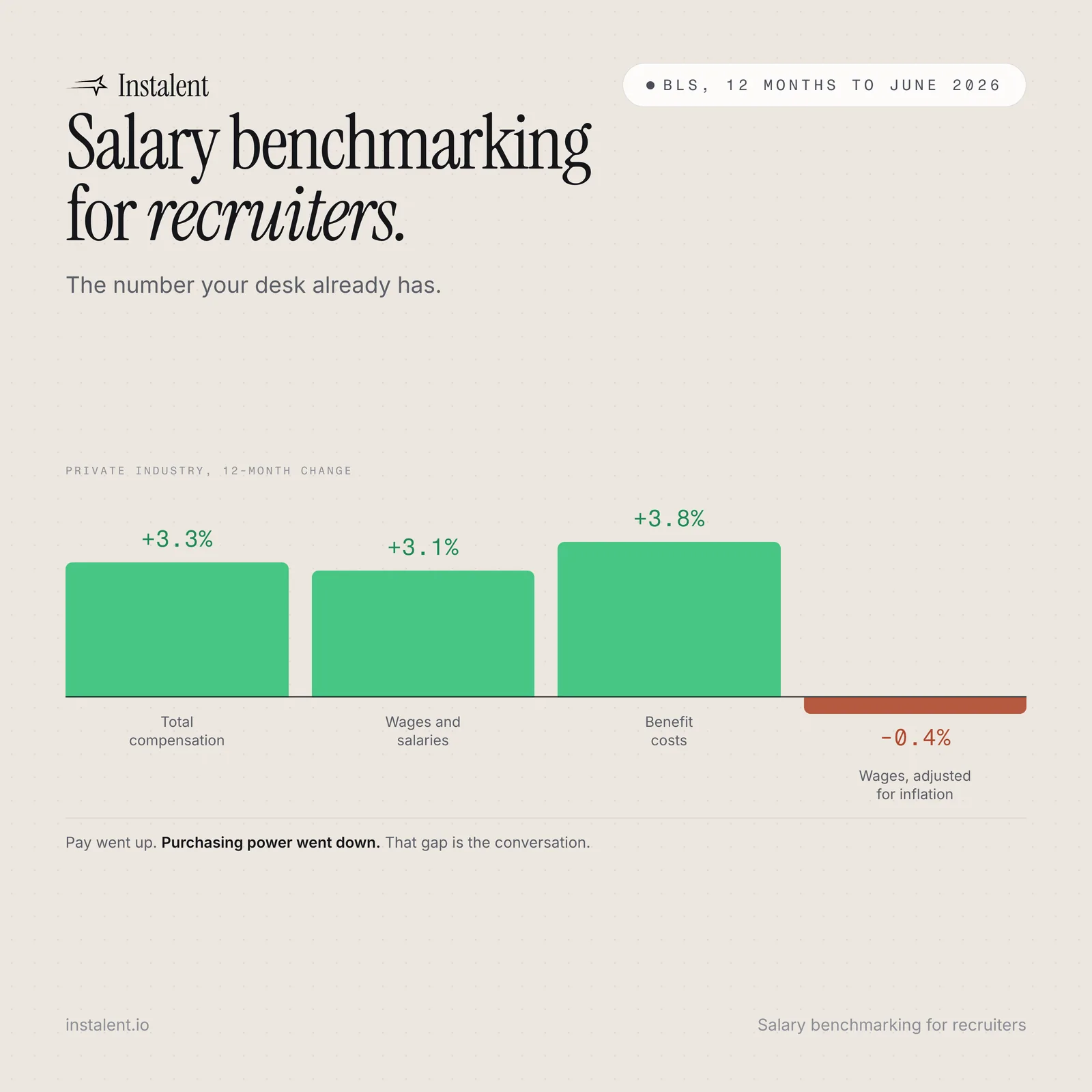
In the US Bureau of Labor Statistics Employment Cost Index released 31 July 2026, private industry wages and salaries rose 3.1% over the 12 months ending June 2026, total compensation rose 3.3%, and benefit costs rose 3.8%.
Two things in that release matter more than the headline.
First, the wage figure decelerated: it was 3.4% for the 12 months ending March 2026. So the rate of change is itself changing, which is precisely the condition under which an annual benchmark misleads.
Second, inflation-adjusted wages and salaries fell 0.4% over the year. Nominal pay went up and real pay went down. That is the gap between what your client thinks is a generous increase and what the candidate experiences when they look at their outgoings.
Why the real-wage number is the useful one in a conversation
When a candidate says an offer is not enough despite being above last year's band, they are usually not negotiating for sport. Pay rose and purchasing power did not. Quoting the constant-dollar figure turns a stand-off into a shared fact.
How to conduct salary benchmarking on a live desk
Five steps, in the order they actually happen on a req.
- Define the population before the number. Benchmark the people who clear your must-haves, not the job title. Titles are inconsistent between companies, so a title-based benchmark is a survey of naming conventions. Writing a sourcing brief covers getting that definition right.
- Take the survey as your floor. Published data gives you a defensible starting range and a sanity check. Note the date it was collected, not the date it was published. Those are often a year apart.
- Read what the market is currently asking for. Live postings for the same population tell you what employers are willing to advertise. That is the asking price, not the closing price, and it runs ahead of surveys.
- Ask the population. This is the step only a recruiter has. When you reach twenty qualified people, a handful will tell you what they are on and what would move them. That is current, specific, and it is the only source that reflects the people you can actually get.
- Write the number as a range with a reason. "£X to £Y, and here is what sits at each end" beats a point estimate, because it gives the client somewhere to move without reopening the whole conversation.
The four sources, ranked by how much they should move your number
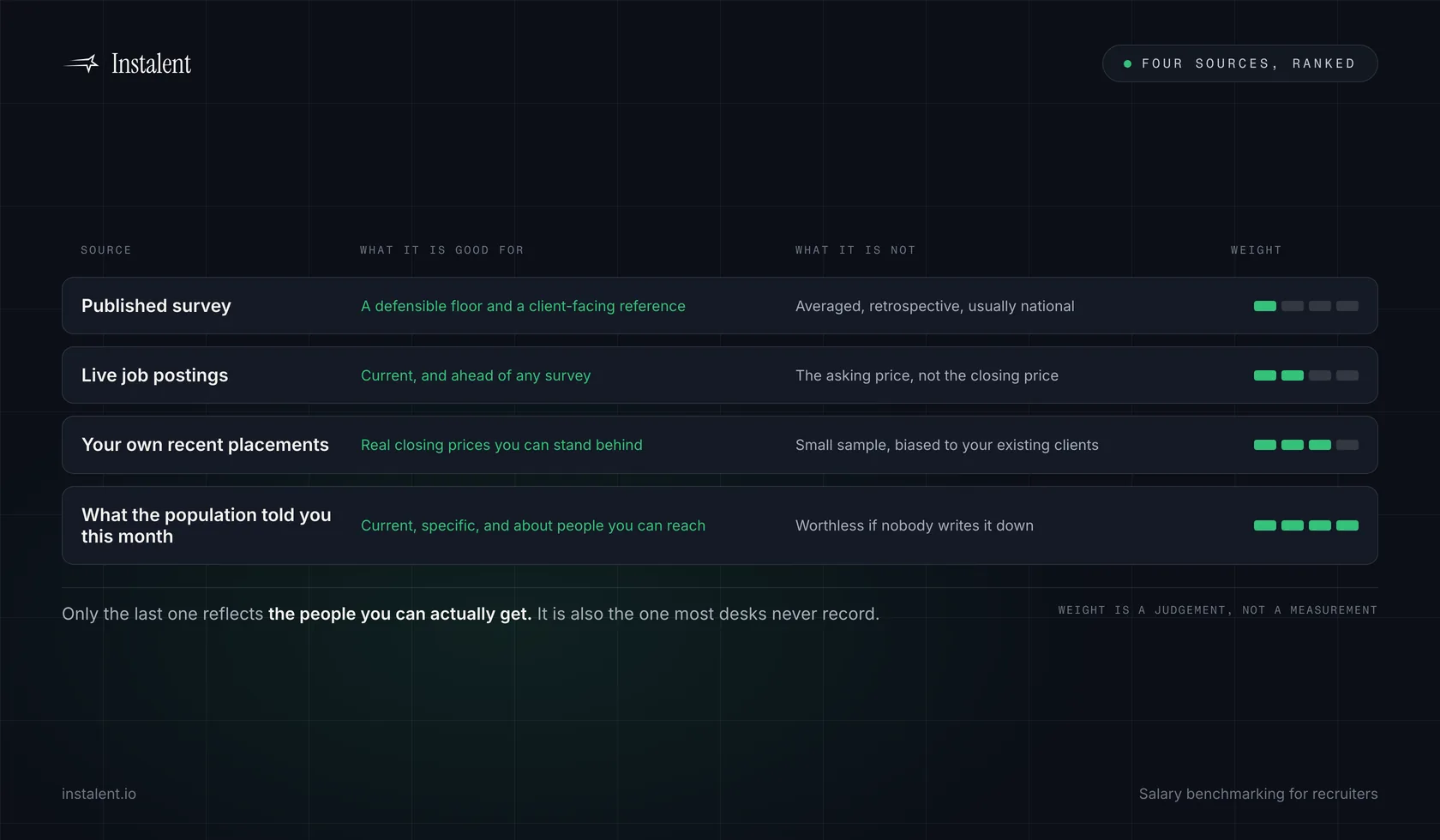
Weakest to strongest:
- Published survey. Broad, defensible, averaged, and collected before you read it. Good for the floor and for the client conversation. Poor for a scarce population.
- Live postings. Current, but it is what employers hope to pay. Treat as an upper bound on the advertised market and a lower bound on what a passive candidate needs.
- Your own recent placements. Real closing prices, but a small sample and biased toward the clients you already work with.
- What the population told you this month. Current, specific, and unavailable to anyone who is not actively in the market. This is the recruiter's real advantage and most desks do not write it down.
Write it down while it is in front of you
The fourth source evaporates. A candidate mentions their package in a call, it goes in a note nobody searches again, and three months later the same question gets asked from scratch. A pool you can search is also a compensation record. Talent mapping covers keeping that market view current rather than rebuilding it per req.
When the budget does not meet the market
This is the conversation the benchmarking is for, and it should happen in week one.
If the qualified population prices above the client's band, you have four honest options and it is worth naming all of them rather than quietly running a search that cannot close:
- Move the money.
- Move a requirement, usually the one eliminating most of the pool.
- Move the shape of the role, for example seniority or scope.
- Move the location or working pattern, which changes which population you are pricing against.
The one option that does not work is running the original search harder. If the number is wrong, more sourcing produces more people who say no.
Knowing which requirement is costing you the most pool is the part that makes this concrete rather than a complaint. That is the same work described in talent intelligence, and it is why candidate analysis shows the breakdown per criterion instead of a single score. If one must-have is eliminating most of the qualified market, that is the requirement to put a price on.
For agency desks, this is also a commercial conversation as much as a technical one, and the model you work under changes how early you can afford to have it. The wider picture for agencies sits alongside it.
Want the market evidence to come out of the search itself? Get started
Common questions
What is salary benchmarking?
It is the practice of establishing what a role should pay by comparing it against the market. For a compensation team that means a defensible band across a job family. For a recruiter it means what the specific population who can do this job will actually move for, right now.
How do you conduct salary benchmarking?
Define the population by must-haves rather than job title, take a published survey as your floor, read live postings for the current asking price, ask the qualified people you approach what would move them, then write the answer as a range with a reason at each end.
Why is survey data not enough on its own?
It is averaged, retrospective and usually national, and a scarce skill does not price regionally. It prices against whoever else is hiring for it right now. Surveys are the floor of the evidence, not the answer.
What do you do when the client's budget is below the market?
Name the options in week one: move the money, move the requirement that is eliminating most of the pool, move the shape of the role, or move the location or working pattern. Running the original search harder does not work, because if the number is wrong more sourcing only produces more people who say no.
Sources
- Employment Cost Index Summary, June 2026 - US Bureau of Labor Statistics, released 31 July 2026 (private industry, 12 months ending June 2026: wages and salaries +3.1%, total compensation +3.3%, benefit costs +3.8%; inflation-adjusted wages and salaries -0.4% over the year).
- Compensation costs for private industry workers up 3.4 percent over the year ending March 2026 - US Bureau of Labor Statistics, The Economics Daily, 2026 (the prior quarter's 3.4% wage figure, used here to show the deceleration).
- Employment Cost Index home - US Bureau of Labor Statistics (series home, quarterly releases).
Find better candidates, faster
Source, verify and reach candidates on one engine. Get 50% off your first month.
Keep reading