Talent Mapping: How to Build a Map Your Desk Actually Uses
What talent mapping is, the five-step talent mapping process, the fields that earn their place, and how a map built this way stops going stale.
Build the map once - then search, verify and reach out from the same place.
Most talent maps are built once, presented in a deck, and never opened again. The ones that pay for themselves are built as working assets: a live view of who does this work, where they sit, what they are paid and who has moved recently. This is what talent mapping is, the process that produces a usable map, and the specific reasons maps rot - because a map nobody trusts is worse than no map at all.
What is talent mapping?
Talent mapping is the practice of building a structured view of the people who could do a role, before you have a vacancy for them. A talent map records who does the work today, which companies employ them, how they are titled in each of those companies, roughly what the market pays, and how reachable each person is. It is research about a market, not a shortlist for a req.
The distinction from sourcing is the timing. Sourcing starts when a role opens. Talent mapping happens ahead of it, so that when the role opens the answer already exists.
Talent mapping vs a talent pipeline vs a candidate list
This is the confusion that produces useless maps, so it is worth being blunt about it.
A candidate list is people who might be interested in one job. It is scoped to a vacancy, it ages out when the vacancy closes, and its value is entirely in the names.
A talent map is scoped to a market. Its value is in the structure: the companies that feed your roles, the titles that describe the same work, the pay bands that actually clear, and the movement between them. Names are the least durable part of it. Companies, titles and pay bands stay useful for years.
A talent pipeline sits between the two. It is the subset of the map you are actively warming for roles you expect - people you have spoken to, who know who you are, and who you have a reason to call again. The map is the whole market; the pipeline is the part of it you have a relationship with. You build a talent pipeline out of a talent map, not instead of one, which is why teams that skip the mapping step end up with a pipeline that is just whoever happened to reply last quarter.
If your "talent map" would be worthless the day the role is filled, you built a list.
The talent mapping process in five steps
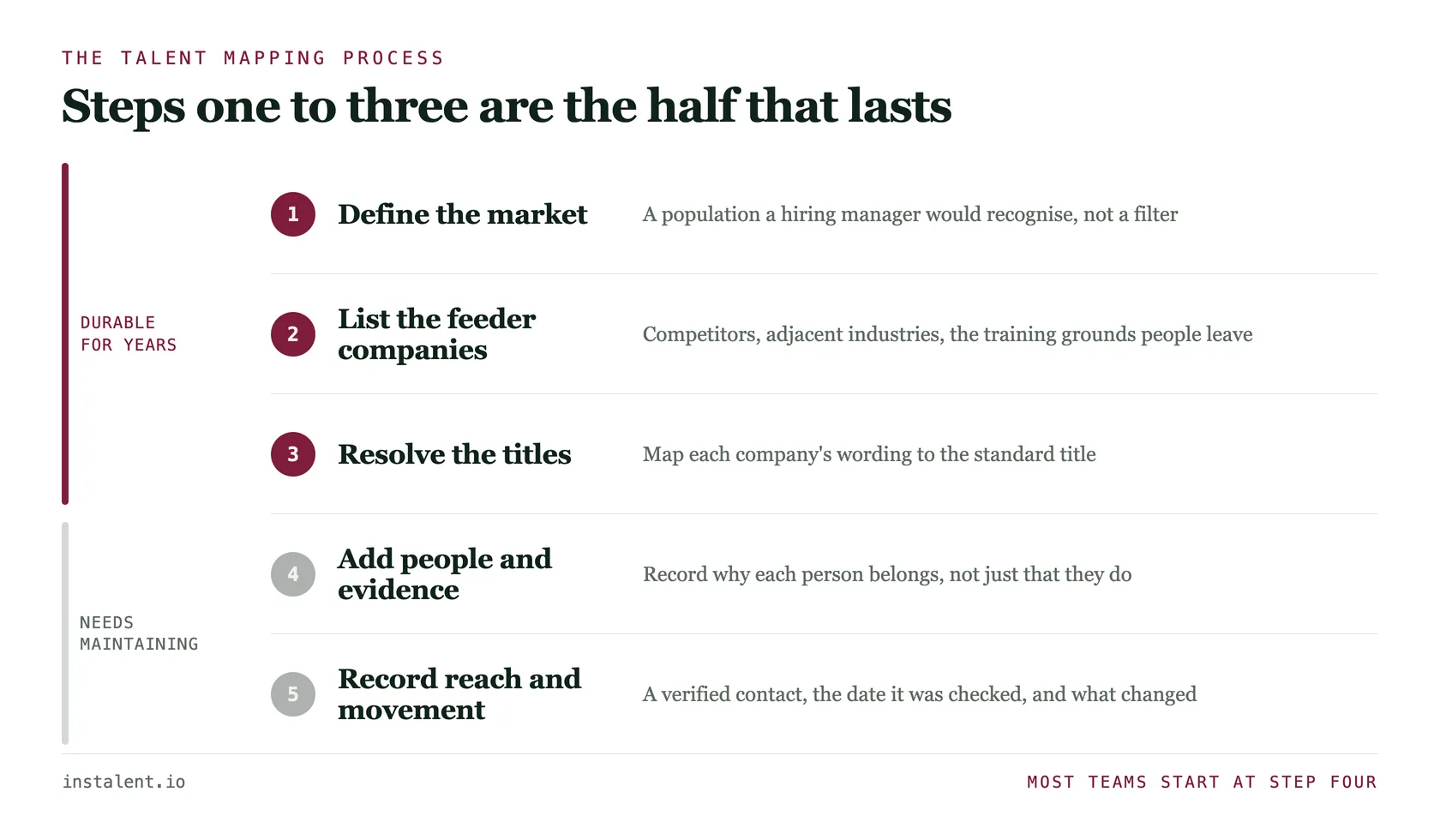
1. Define the market, not the role. Write the population in one sentence a hiring manager would recognise. "Backend engineers who have owned a payments system at scale" is a market. "Senior software engineer, 5+ years" is a filter.
2. List the feeder companies. Which organisations actually employ these people - direct competitors, adjacent industries, the vendors and consultancies that serve them, and the training grounds people leave after two or three years. This list is the spine of the map and changes slowly.
3. Resolve the titles. The same work is titled differently in every company. "Data engineer", "analytics engineer" and "platform engineer" can describe one job. Record the mapping between company and title, because that is what makes every future search cheap.
4. Populate people and evidence. Now add individuals, and record why each one belongs - the talk they gave, the project they maintain, the licence they hold, the system they owned. Evidence someone else granted is worth more than a self-written profile.
5. Record reachability and movement. A verified way to contact someone, when it was last checked, and what changed since. This is the step that decides whether the map is an asset or an archive.
What goes in the map
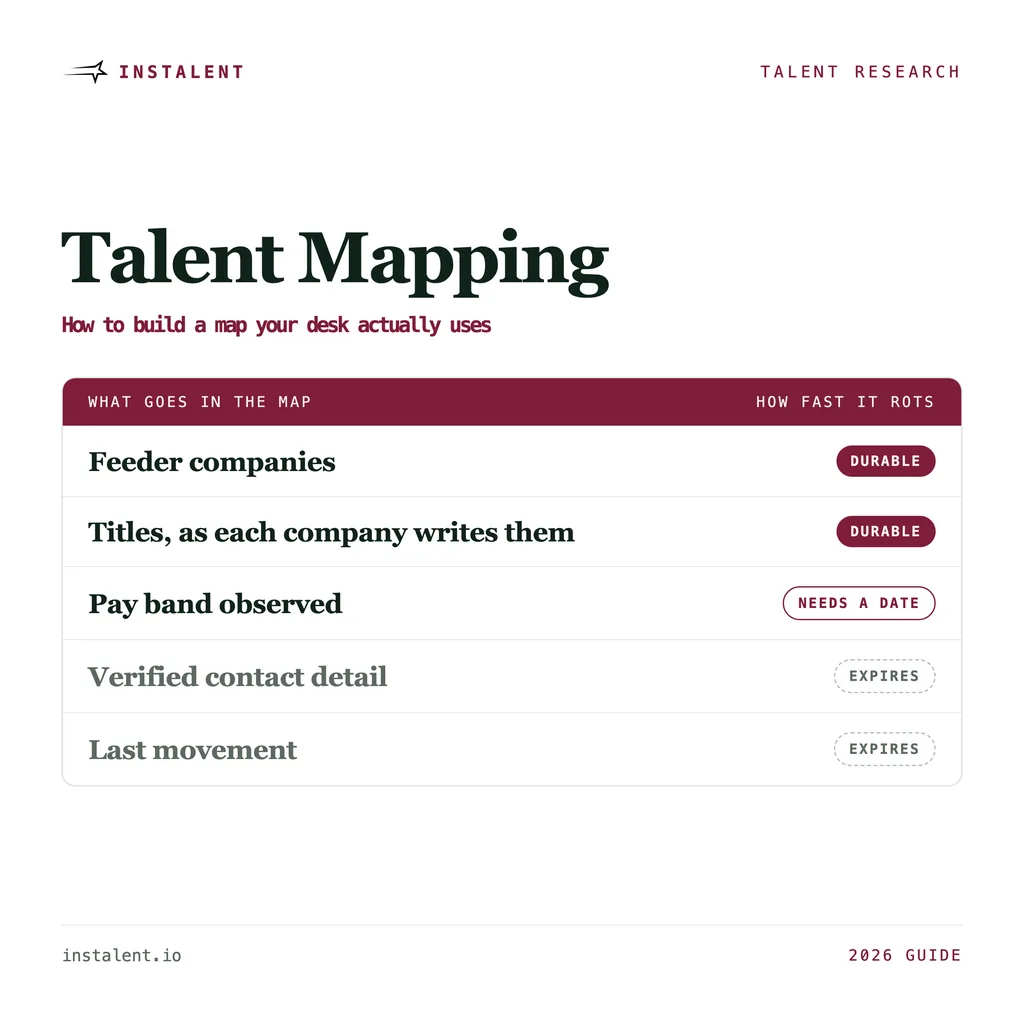
Fields earn their place by being either durable or decision-changing. A useful minimum:
- Company and its segment - durable
- Title as that company writes it, plus the standard title it maps to - durable
- Pay band observed for that title at that company, with a date - decision-changing
- Person, with the specific evidence that qualifies them
- Verified contact detail, with the date it was last confirmed
- Last movement - joined, promoted, left, and when
What does not earn its place: a relevance score you cannot explain, a "status" field nobody updates, and anything you copied from a profile without checking.
When a talent map pays for itself
Three moments, and they are all measurable.
Speed on a live role. In Bullhorn's 2026 GRID report - nearly 2,300 recruitment professionals - 56% of the top-performing firms place in under ten days, and 22% in three days or less. You do not reach three days by working faster once a role lands. You reach it because the map already exists and the contact details are already verified.
Re-use across roles. The same map serves every role in that market. A map built for one search that gets used on six is the cheapest sourcing you will ever do, which is the same economics behind redeployment: GRID finds 85% of firms with a redeployment plan report placement times under 20 days.
Credibility with the client. A map is the artefact that lets you say "here is the entire market, here is what it pays, and here is why this role is not landing" - and be believed. That conversation is worth more than a shortlist.
The test for a real map
Open the map for a market you worked six months ago. If you can still answer "who are the ten companies that employ these people, and what do they pay?" without new research, it is a map. If all you have is a list of names with dead phone numbers, it was a shortlist wearing a map's name.
Where talent maps go stale
Maps do not fail because the research was wrong. They fail in three predictable ways.
Contact data decays and nothing flags it. A number checked two years ago is a guess. If the map does not record when a detail was verified, every entry silently becomes equally untrustworthy, and the whole asset stops being used.
People move and the map does not. Movement is the highest-value field and the least maintained. A candidate who changed employer eighteen months ago is now sitting at a different feeder company, possibly one you do not have listed.
The map lives where the work does not. A deck in a shared drive is not a working asset. If updating the map is a separate task from doing the sourcing, it will not happen.
Public evidence is a slice, not the whole market
GitHub's Octoverse 2025 reports that 81.5% of all contributions now happen in private repositories. Whatever market you map, a large share of the real work is not publicly visible. Build the map from what you can verify, and never treat absence of public evidence as absence of skill.
Talent mapping tools, and what they actually do
There is no single "talent mapping tool" category that does the whole job, and it helps to be clear about what each layer contributes:
- Search finds the people and the companies. It is only as good as the market definition from step one.
- Enrichment turns a name into a verified, dated way to reach them. This is the layer that decides whether the map survives contact with a live role.
- Scoring explains why someone belongs in the map, with the evidence attached, so the next person can trust it.
- A system of record keeps it. For most agencies that is the ATS or CRM; the map is only useful if it lands somewhere the team already opens.
Depth is what makes all of this affordable. Of the 58 firms on SIA's 2026 Fastest-Growing US Staffing Firms list, 74% serve one of just three segments - healthcare 34%, IT 27%, industrial 14%. Specialists can maintain maps because they map the same market repeatedly. Generalists rebuild from scratch every time.
From map to shortlist
The reason maps rot is almost always that mapping, verifying and reaching out live in three different tools. Instalent keeps them together: describe the market in plain English and get the people across sources rather than one index, verified contact details from multiple sources with the freshness tracked, fit scored against your criteria with the evidence shown, and multichannel outreach when the role finally lands - all syncing to RecruiterFlow, Greenhouse, Lever or TeamTailor so the map lives where your team already works.
Want to map a market before the next role lands? Get started and run one real role end to end.
Related reading: what is headhunting covers the method behind executive search and how it differs from recruiting, talent acquisition vs recruitment covers why this work sits before the req at all, talent pipeline is what a map becomes once you have actually spoken to people, recruiting CRM vs ATS covers which system should hold the map, client market mapping applies the same discipline to companies rather than candidates, candidate sourcing strategies covers what to do with the map once it exists, and how to source software engineers works one market end to end.
Sources
- Bullhorn GRID 2026 Industry Trends Report - nearly 2,300 recruitment professionals, fielded November to December 2025
- GitHub Octoverse 2025 - 28 October 2025
- SIA: 2026 Fastest-Growing Staffing Firms in the United States - 14 July 2026
Find better candidates, faster
Source, verify and reach candidates on one engine. Get 25% off your first month.
Keep reading