What Is Headhunting? The Method, and How It Differs From Recruiting
What headhunting actually is, how it differs from recruiting, how executive search firms find candidates, and what the method looks like in technical hiring.
Map the market and reach named people directly - the research half, without the weeks.
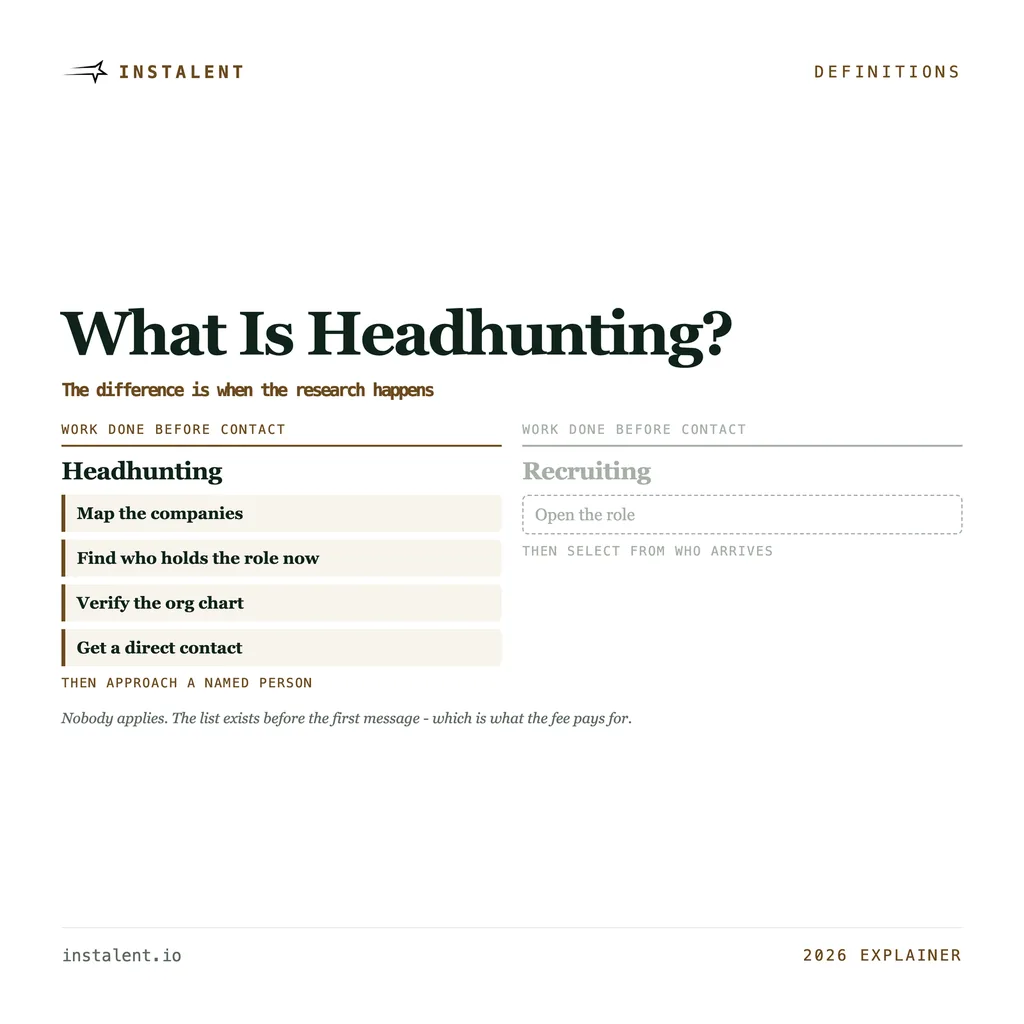
Headhunting is usually explained as recruiting for expensive people. That is a description of the price, not the method. The actual difference is that a headhunter starts from a map of who does the work rather than from a pool of people who responded - which means the research happens before anyone is contacted, and the approach is made to a named individual who was never going to apply.
The definition that survives contact with the work
Headhunting is identifying specific individuals already doing the work you need, usually inside named organisations, and approaching them directly.
The load-bearing words are specific individuals and directly. Nobody applies. No advertisement is involved. The list exists before the first message, and it was built by research rather than assembled from people who put their hand up.
That is why the price is high, and the price is a consequence of the method rather than the definition of it.
Headhunting vs recruiting
Recruiting works with a pool that partly arrives on its own: applicants, referrals, people already in the database, plus whatever sourcing adds. The skill is selecting well and moving fast.
Headhunting builds the list from the outside in. Which companies employ this population, what the role is called inside each of them, who holds it now, and how do you reach that person. The skill is research first and persuasion second, because the person you want has a job they were not planning to leave.
The practical consequence is where the hours go. A recruiting week is mostly conversations. A headhunting week is mostly research, and the conversations are fewer, later and higher-stakes.
How executive search firms actually find candidates
The method is more ordinary than the mystique suggests, and it is repeatable.
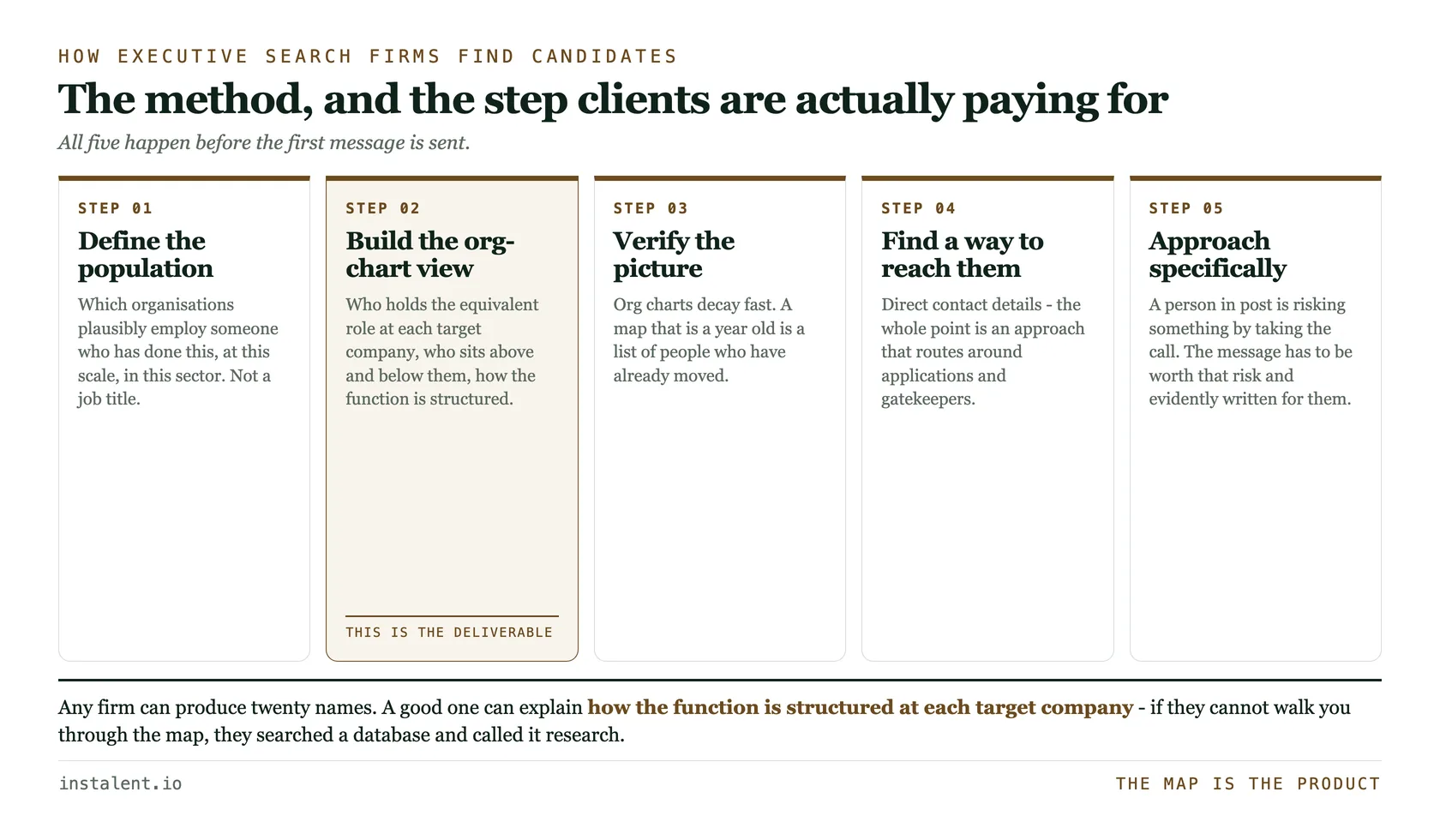
1. Define the population, not the job title. Which organisations plausibly employ someone who has done this before, at this scale, in this sector.
2. Build the org-chart view. For each target company, establish who currently holds the equivalent role, who sits above and below them, and how the function is structured. This is market mapping, and it is the actual deliverable - clients are paying for the map as much as for the hire.
3. Verify the picture. Public sources plus the firm's network. Org charts decay quickly, and a map that is a year old is a list of people who have moved.
4. Find a way to reach them. Direct contact details, because the whole point is an approach that does not route through an application process or a gatekeeper.
5. Approach discreetly and specifically. A senior person in post is risking something by taking the call. The message has to be worth that risk, and it has to be evidently written for them.
The step that separates good search from a list of names
Step two is the one clients notice. Any firm can produce twenty names; a good one can explain how the function is structured at each target company, who the person reports to, and why they might move now. If a search firm cannot walk you through the map, they searched a database and called it research.
IT headhunting is the same method on harder ground
Technical populations break step two, because job titles carry unusually little information. Two people with the same title can be doing entirely different work, and seniority in engineering is signalled badly by titles and well by evidence somebody else granted.
So technical headhunting leans on a different evidence base: a maintained project, an accepted conference talk, a merged contribution, a paper with co-authors. That evidence was granted by someone other than the candidate, which is exactly what makes it worth more than a self-written profile. How to source software engineers goes through what still discriminates.
The honest limit is worth stating, because screening on public evidence quietly excludes people. GitHub's Octoverse 2025 reports 81.5% of all contributions now happen in private repositories. Most engineering work is invisible. Use public evidence to find people; never use its absence to rule them out.
Retained or contingent: how headhunting is actually bought
The method above describes the work. How you pay for it decides whether the work actually happens, and it is the distinction most explainers skip.
Contingent means the firm is paid only if you hire someone they introduced. No placement, no fee. It sounds like the safer deal, and for the right role it is - but read what it does to incentives. The firm is carrying the cost of the search itself, often against three or four competitors on the same vacancy, so the rational move is speed and volume: send credible people fast, before someone else does. That is a reasonable strategy for a role with a large reachable population. It is a poor one for a search where the answer is forty people in the country and finding them takes three weeks of mapping nobody is paying for.
Retained means you pay in stages regardless of outcome - typically an engagement fee to start, a further stage part-way, and the balance on placement. You are buying the research, not just the introduction. The firm can afford to spend the weeks on step two because those weeks are funded, and it can afford to tell you the honest thing: that your brief is wrong, that the salary band is below market, or that the person you want does not exist at that price.
The trade is straightforward once it is stated plainly:
| Contingent | Retained | |
|---|---|---|
| You pay | Only on placement | In stages, regardless of outcome |
| The firm is optimising for | Speed, and beating competitors to a submission | Depth of research, because the hours are funded |
| Usually exclusive | No - often several firms at once | Yes |
| The map | Rarely built; too expensive to fund unpaid | Built, and is part of what you are buying |
| Fits | Larger reachable populations, less senior roles | Small populations, senior or confidential searches |
| The real risk | Nobody does the hard part | You pay even if the search fails |
The failure mode nobody warns you about
Putting a genuinely hard search out on contingent terms is the most common way a role stays open for six months. Every firm looks at the effort required, calculates the odds against the competition, and quietly deprioritises it in favour of easier vacancies. Nobody tells you this happened. The role simply produces no candidates, and it reads as a market problem rather than a structure problem.
There is a third arrangement worth knowing: exclusive contingent, where you commit to one firm but still only pay on placement. It removes the race and gives the firm a reason to invest more, without the upfront cost of a retainer. It works when the relationship is genuinely trusted and the role is somewhere between the two extremes.
What it costs, and when it is worth it
Headhunting is expensive because the research is expensive. Weeks of mapping produce a shortlist that a database search cannot, and the fee reflects the hours rather than the seniority as such.
It is worth it when the population is small, the people you want are employed and not looking, and the cost of the wrong hire is high. It is poor value when the population is large and reachable, because you are paying for research that an ordinary search would have produced.
That is also the reason the method has spread below executive level: the research half has become dramatically cheaper than it was, so the map is now affordable for roles that could never have justified a retained search.
Where the method meets the tooling
The persuasion half of headhunting is a human job and will stay one. A senior person deciding whether to take a call is responding to judgement, discretion and a specific reason - none of which is a software problem.
The research half is different. Building the map, working out what the role is called at each target company, finding which named individual holds it, and getting a contact detail that actually connects - that is exactly the work that used to consume the weeks the fee paid for.
Instalent covers that half: describe the population in plain English and get named people from across sources, with verified contact details, fit scored against your criteria with the evidence shown, and multichannel outreach with every reply in one inbox - alongside RecruiterFlow, Greenhouse, Lever or TeamTailor. It works the same way for executive search desks as for any other. The judgement stays with you; the weeks of research do not.
Want the map without the weeks? Get started and run one real role end to end.
Related reading: talent mapping is step two done properly, what is a sourcing recruiter covers the adjacent role and where it stops, and how to source passive candidates covers approaching people who are not looking.
Sources
- GitHub Octoverse 2025 - 28 October 2025; 81.5% of contributions now occur in private repositories
Find better candidates, faster
Source, verify and reach candidates on one engine. Get 25% off your first month.
Keep reading