Reference Checks Are Not a Prediction. Here Is What They Are For.
The most-quoted validity figure for reference checks is a 1998 number the field could not update. What the call is genuinely good for instead.
Test the claims that are load-bearing, and record what came back.
You make the call. The referee says they were great, a real asset, absolutely would hire them again. You write "references clear" and move on. Everybody runs this step, almost nobody believes the output, and it survives because it looks like diligence. The useful question is not whether to keep doing it. It is what the call can actually establish, which turns out to be narrower and more valuable than the thing most desks are trying to get from it.
The number everyone quotes, and where it actually comes from
For twenty years the field worked from Schmidt and Hunter's 1998 summary of how well each selection method predicts job performance. In 2022, Sackett, Zhang, Berry and Lievens published a re-analysis in the Journal of Applied Psychology arguing that the old corrections for range restriction were systematically too large, and produced revised estimates.
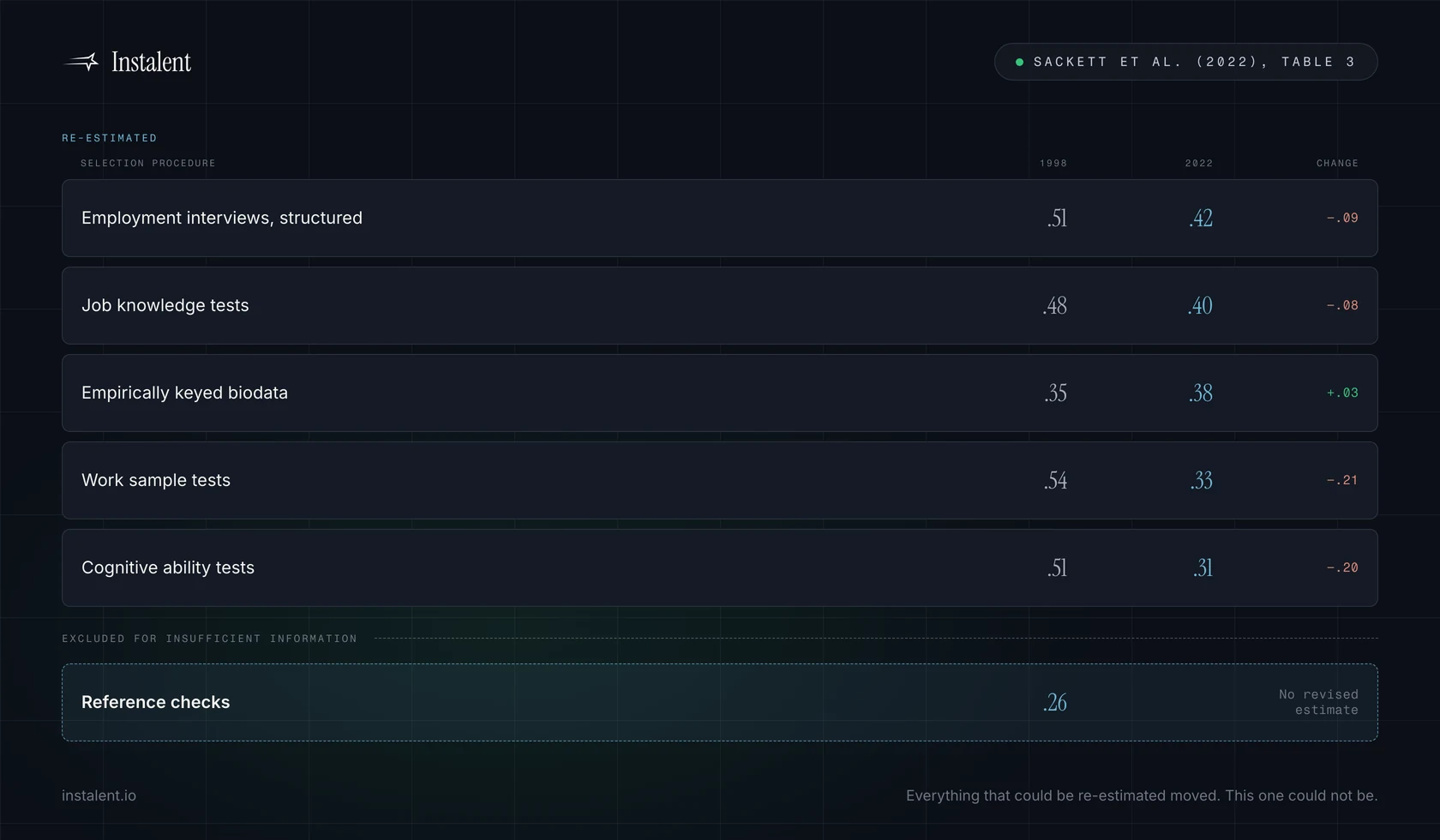
Almost everything moved down. In their Table 3, comparing the 1998 estimates with their own:
- Structured interviews: .51 becomes .42, the highest of any method they re-estimated
- Job knowledge tests: .48 becomes .40
- Work sample tests: .54 becomes .33
- Cognitive ability tests: .51 becomes .31
- Empirically keyed biodata: .35 becomes .38, one of the few that rose
- Job experience in years: .18
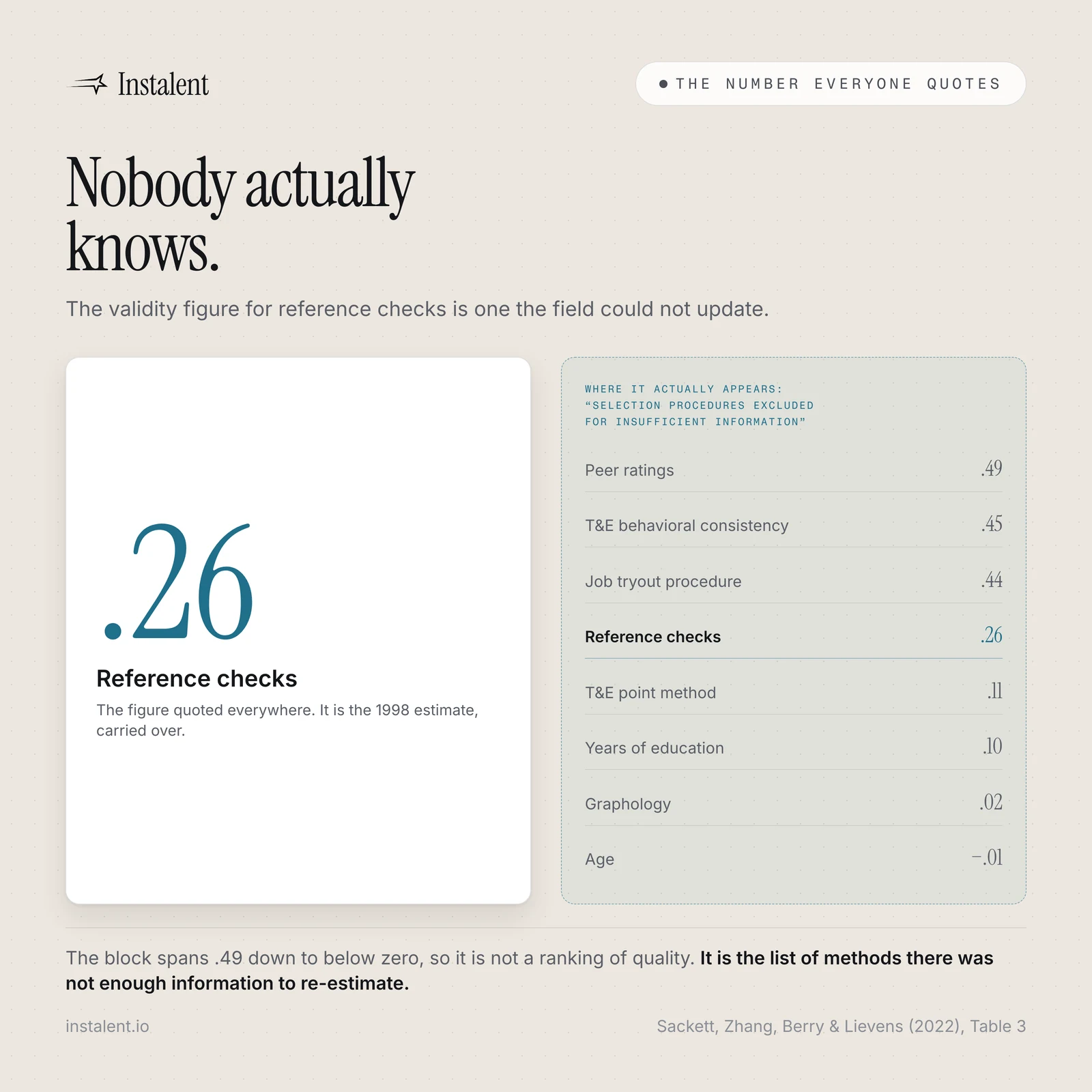
Reference checks appear in that table at .26. But they appear in a separate block headed "Selection procedures excluded for insufficient information", alongside years of education, graphology and age. That .26 is not a revised estimate. It is the older figure, carried over, because there was not enough to re-estimate it with.
So the number you will find if you go looking is not really a finding about reference checks. It is a placeholder that the most careful recent re-analysis in the field declined to stand behind, sitting next to methods whose figures all fell once they were examined properly.
This is not an argument for skipping references
Unknown predictive validity is not the same as zero value. What follows from the evidence is narrower and more practical: the reference call is not a measuring instrument, so it should not be scored like one, weighted like one, or used to rank two finalists. Its value sits somewhere else entirely.
What the call is genuinely good for
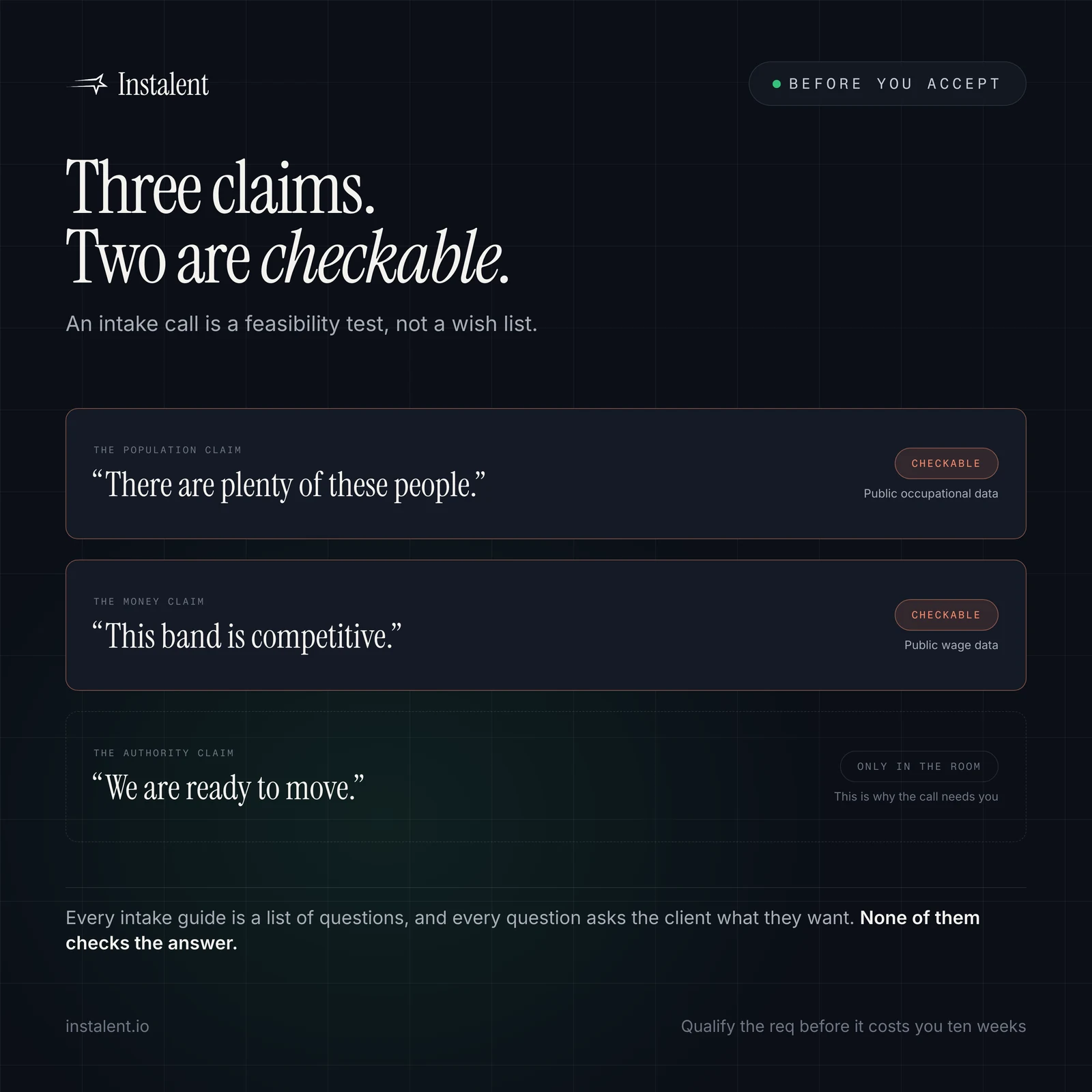
Stop asking whether the person is good. You already have better instruments for that, and the strongest of them is the structured interview you control. Use the call to test specific claims that are already load-bearing in your decision and would change it if they turned out to be false.
That gives it three honest jobs:
- Confirm facts. Dates, scope, reporting line, team size, whether the budget number was theirs or their director's, why they left. Dull, checkable, and the most reliable thing the call produces.
- Disconfirm a specific claim. The candidate said they led the migration. The referee describes a team of nine and a different name as the lead. That is the single highest-value outcome available from a reference call, and you only get it if you went in with the claim written down.
- Surface what you did not know to ask. Occasionally a referee volunteers the thing that reframes the hire. You cannot plan for it, but you can leave the silence that allows it.
Ask for specifics and comparisons, never for assessments
This is the whole technique, and it is why most reference calls return nothing. "Was she good?" has one socially available answer. Questions that ask for detail or for a comparison have to be answered with information.
- "What was she actually responsible for on that project?" A fact, and it either matches the CV or it does not.
- "Who else was involved in that decision?" Establishes scope without ever asking how senior someone was.
- "If you were staffing that project again, what would you want her to have more of?" The only form of the weakness question that reliably gets answered, because it is framed as a staffing judgement rather than a criticism.
- "Where would you not put her?" Asks about fit rather than quality, which referees answer freely and which is usually what you actually need.
- "Who else should I speak to about that period?" The one question that can get you past the referee the candidate selected.
Then stop talking. The most useful sentence in most reference calls arrives after an uncomfortable pause, and recruiters fill that pause more often than referees do.
The problem nobody designs around
The candidate picks the referee. That single fact caps how much signal the exercise can produce, and no amount of question craft repairs selection bias at the source. Anyone who tells you their reference script solves this is selling something.
Two honest consequences. First, a glowing reference is close to uninformative, because it is the expected outcome of a process the candidate controlled; only a specific answer carries weight. Second, the chain question above is worth more than the rest of the script combined, because it is the only legitimate route to someone the candidate did not choose.
A note on limits. Many employers have a policy of confirming dates and title and nothing else, and what you may ask, record and act on varies by jurisdiction and by role. That is a question for your own counsel, not for a blog post, and this one does not attempt to answer it.
Where it belongs in the process
Late, targeted, and not as a gate.
Running references as a final pass or fail invites the worst version of the step: a call made after the decision, which finds nothing, and changes nothing. Running them as a check on two or three written claims gives you a real chance of catching the one thing that should stop an offer.
Put the weight where the evidence is. Structured interviews are the strongest method in the revised table at .42, which argues for spending the hour you were going to spend on a fourth reference on making the interview itself structured instead. Interview questions to ask candidates covers that, and scoring a shortlist covers why some requirements are gates and others are weighted points. References belong in neither column: they are a verification step on facts, not a criterion.
Write down what you tested, not what you heard
"References clear" is not a record. It cannot be audited, it cannot be handed to a colleague, and six weeks later nobody can say what was actually asked.
Record the claims you went in to test, what came back on each, and who said it. That turns a social call into evidence, and it is the same discipline that makes the failed search post-mortem possible and that sourcing for judgment argues for everywhere else. On the platform side, candidate analysis keeps the per-criterion reasoning visible against the profile, which is where a tested claim should end up rather than in somebody's notebook. The executive-search view, where this step carries the most weight, is on executive search.
Want the evidence recorded against the person, not the notebook? Get started
Common questions
Are reference checks a good predictor of job performance?
The honest answer is that nobody currently knows. The widely quoted figure of .26 comes from the older 1998 summary, and when Sackett, Zhang, Berry and Lievens published their 2022 re-analysis in the Journal of Applied Psychology, reference checks were placed in a block headed "selection procedures excluded for insufficient information" rather than being given a revised estimate. Every method they could re-estimate moved, most of them downward.
Should recruiters still do reference checks?
Yes, but for a narrower purpose. Use the call to confirm facts, to disconfirm a specific claim the candidate has made that would change your decision if false, and occasionally to surface something you did not know to ask about. Do not use it to rank two finalists or to score the person, because it is not a measuring instrument.
What questions should you ask in a reference check?
Ask for specifics and comparisons, never for assessments. What was the person actually responsible for on a named piece of work, who else was involved in that decision, what would you want them to have more of if you were staffing it again, where would you not put them, and who else should I speak to about that period. Then stay silent and let the referee fill the pause.
Why are most reference checks useless?
Because the candidate chooses the referee, so a positive reference is the expected result rather than new information, and because most questions asked are assessments rather than facts. A question like "was she good?" has one socially available answer. Only specific, checkable answers carry weight.
Sources
- Revisiting meta-analytic estimates of validity in personnel selection: Addressing systematic overcorrection for restriction of range - Sackett, P. R., Zhang, C., Berry, C. M., & Lievens, F. (2022), Journal of Applied Psychology, 107, 2040-2068. Table 3 compares Schmidt and Hunter's (1998) estimates with the current meta-analysis: structured employment interviews .51 to .42, job knowledge tests .48 to .40, empirically keyed biodata .35 to .38, work sample tests .54 to .33, cognitive ability tests .51 to .31, job experience in years .18. Reference checks are listed at .26 under "Selection procedures excluded for insufficient information".
- Is Cognitive Ability the Best Predictor of Job Performance? New Research Says It's Time to Think Again - Society for Industrial and Organizational Psychology, on the Sackett et al. (2022) findings.
Find better candidates, faster
Source, verify and reach candidates on one engine. Get 25% off your first month.
Keep reading