The Intake Call Is a Feasibility Test, Not a Wish List
Most intake meetings collect requirements. The ones that prevent a dead search check whether the role is fillable, with public numbers, before you accept it.
Qualify the req before it costs you ten weeks.
You take the call. You write down the title, the reports-to, the eight must-haves, the band, the process and the timeline. You say leave it with me. Eight weeks later the role is still open, the client has gone quiet, and the honest explanation is one nobody wrote down at the time: this role was never fillable at that number, and it was knowable in the first half hour.
Every intake guide is a list of questions
Search for intake meeting advice and you will find the same article a dozen times: twenty-seven questions to ask the hiring manager. Title, team, reports-to, must-haves versus nice-to-haves, budget, timeline, process, who signs.
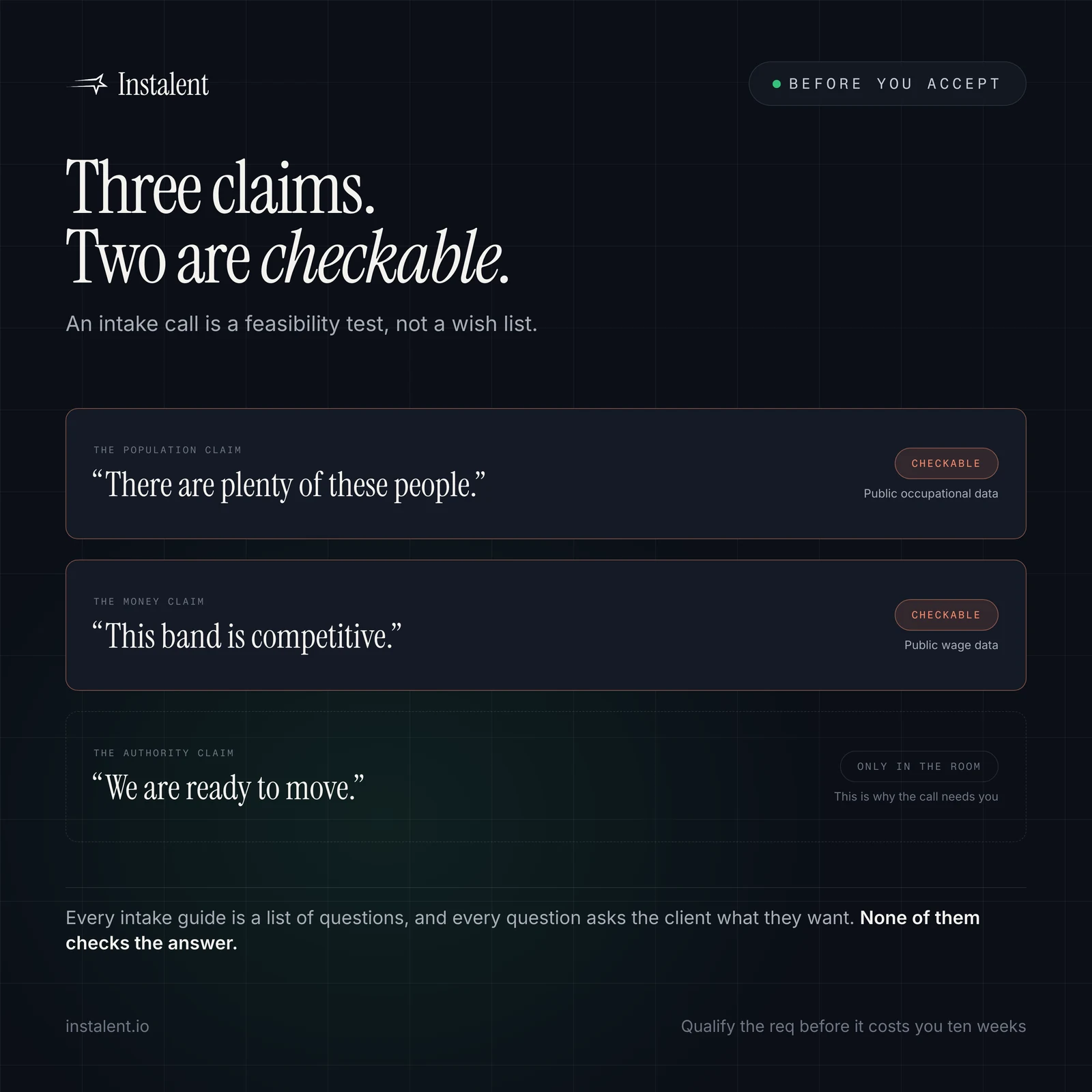
Those are good questions. Ask them. But notice what they have in common. Every one of them asks the client what they want, and not one of them checks the answer. An intake call made only of questions can produce a beautifully documented, completely unfillable role, and it will feel like a productive meeting while it does it.
The job of the intake call is not to collect requirements. It is to find out whether the thing being described exists, at that price, in that place, in the time available. Some of that is judgement. More of it than most desks realise is arithmetic you can do before you accept.
Three claims in every brief, and two of them are checkable
Strip any brief down and it makes three assertions:
- The population claim. "There are plenty of these people."
- The money claim. "This band is competitive."
- The authority claim. "We are ready to move."
The third is purely conversational, and it is where experience earns its money. The first two are public data, free, and almost nobody brings them to the meeting.
Bring the numbers to the meeting
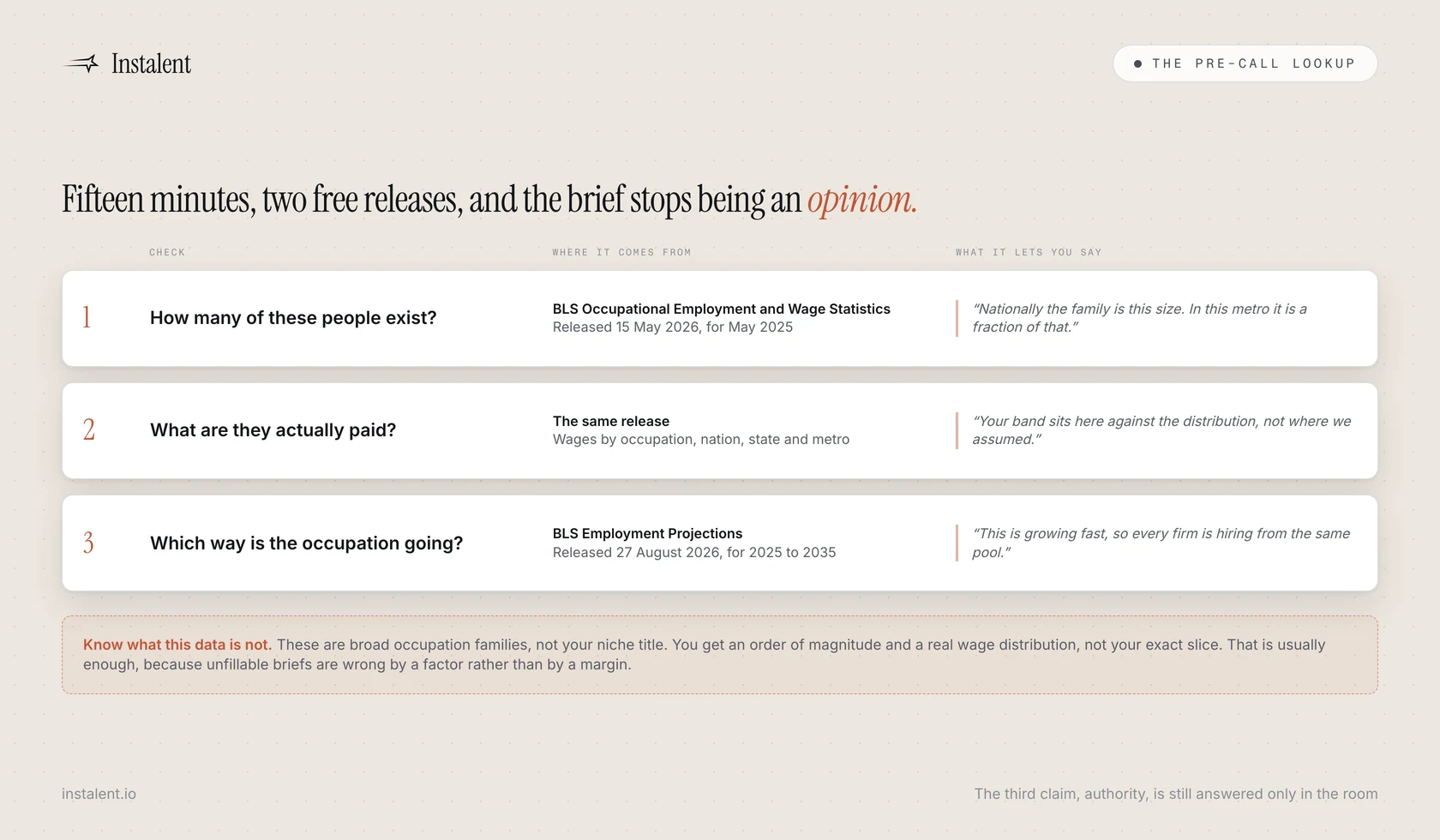
The Bureau of Labor Statistics publishes Occupational Employment and Wage Statistics, released 15 May 2026 for the May 2025 reference period. It covers roughly 830 occupations across the nation, the states and about 530 metropolitan areas, with employment counts and wages for each. To take one of its own examples, registered nurses number 3.4 million with a mean annual wage of $101,420, against a US average wage across all occupations of $69,770.
A second release answers the direction of travel. BLS Employment Projections, published 27 August 2026 for 2025 to 2035, has total employment rising from 170.3 million to 176.2 million, an increase of 5.9 million jobs, or 3.5 percent, which is well below the previous decade's 10.9 percent. Inside that slow average the spread is enormous: nurse practitioners are projected to grow 41.0 percent and data scientists 34.6 percent, while office and administrative support declines 4.0 percent, shedding 752,100 jobs.
Those two releases let you say something in an intake call that changes it:
"Nationally this occupation is roughly this size, and it is growing fast, so everyone is hiring from the same pool. In this metro it is a fraction of that number. Your must-haves cut it further. Let us talk about which one moves."
That is not a lecture. It is the difference between accepting a wish and agreeing a target.
Know what this data is not
These are broad occupation families, not your niche. The codes will never contain "platform engineer with Rust and payments exposure", and anyone who tells a client otherwise is overselling a free dataset. What you get is an order of magnitude and a real wage distribution for the family the role sits in. That is still enough to end a fantasy, because most unfillable briefs are not wrong by twenty percent. They are wrong by a factor.
Price the must-haves instead of arguing about them
The standard advice is to separate must-haves from nice-to-haves. The useful version is to attach a cost to each one in the room.
A must-have is not a standard, it is a purchase. Each one you keep shrinks the pool and raises the number it takes to move someone out of their current job. So put it in those terms:
- "Keep this requirement and we are working a pool this size, and the band has to move."
- "Drop it and the pool is several times larger at the band you have."
That converts a conversation about whether the client is being unreasonable, which nobody wins, into a trade the client can actually make. Once the list survives that test, the sourcing brief covers how to write the requirements as evidence rather than adjectives, and salary benchmarking covers assembling the comp evidence you are quoting.
Five questions the lists miss
Not another twenty-seven. These five are diagnostic rather than descriptive, and each one is designed to surface something the client would not volunteer.
- "Who has done this job here before, and where are they now?" If the last two left inside a year, you are not filling a role, you are refilling a problem, and the next person will ask.
- "What did the last candidate you rejected get rejected for?" The written bar and the real bar are different documents. This question returns the real one.
- "If we bring someone in at the top of the band, who else needs a raise?" The fastest way to learn whether the band can genuinely move, because internal parity is usually the true constraint.
- "Who signs, and what have they already said no to?" Authority and prior vetoes in one answer.
- "What happens to the work if this is still open in six months?" If the answer is "nothing", the role is real but not urgent, and you should price and prioritise it that way.
Write down what you were told, with dates
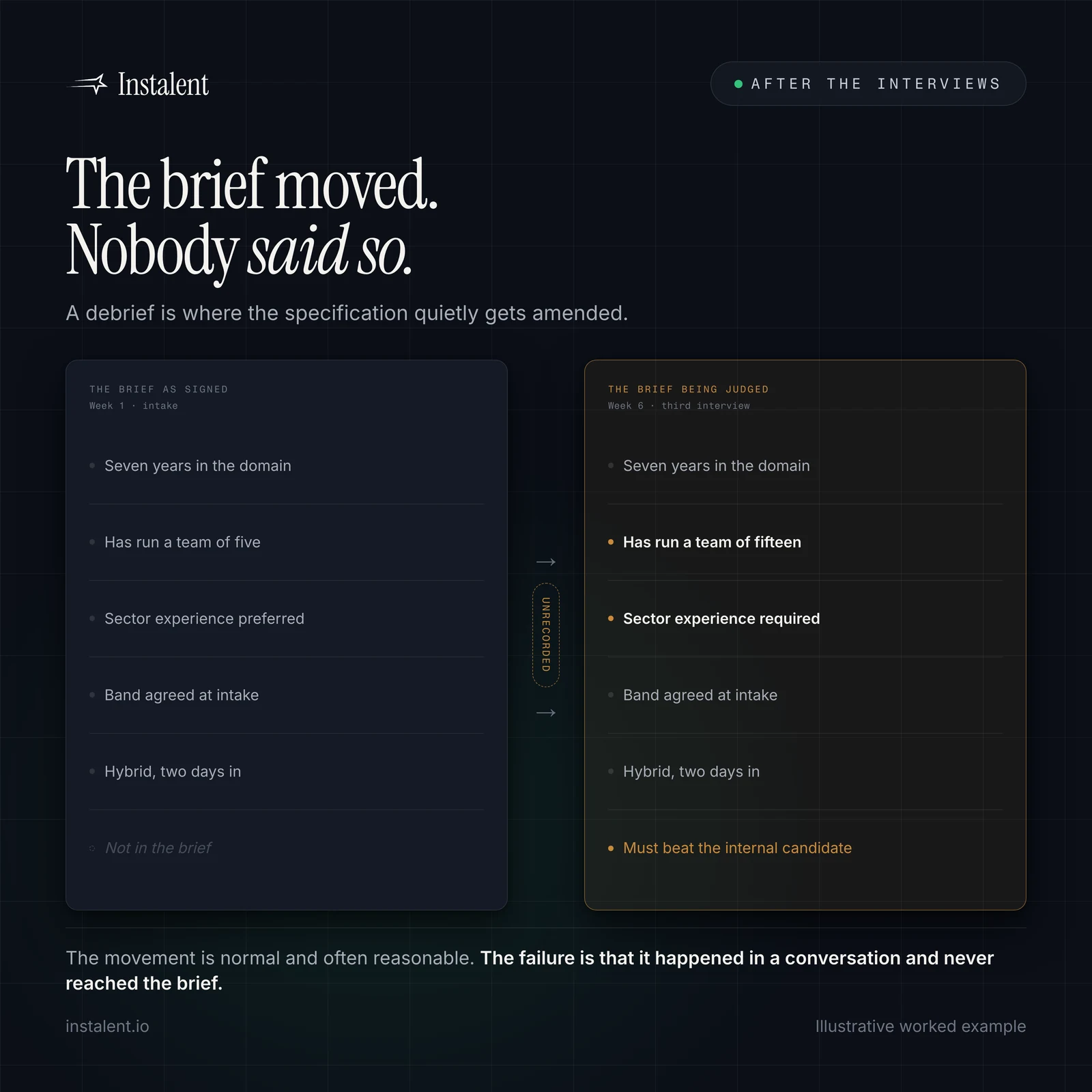
This is the part that pays off months later. The brief as agreed, the band as stated, the must-haves as signed, each with a date against it.
That record is what makes the failed search post-mortem possible at all. The two posts are the same discipline at opposite ends: that one diagnoses a search after it dies, by reading the record. This one is the pre-mortem, and it is where the record starts. A spec that moves in week five is a normal event. A spec that moves in week five with nothing written down in week one is an argument you will lose.
Knowing when to decline
The uncomfortable commercial point. Declining a role feels like refusing revenue. Working an unfillable role for ten weeks and billing nothing is also refusing revenue, and it costs you the capacity you would have spent on something that closed.
Three signals worth taking seriously: the population numbers and the band cannot be reconciled and the client will not move either; nobody in the meeting can name who signs; or the role has been open with two other firms for months and nothing about the brief has changed. The commercial model that should follow from this conversation is in retained versus contingency.
When the brief does survive, the work that follows is mechanical: search the live market, verify the contact details, and score the slate against the criteria you just agreed. AI candidate sourcing and candidate analysis are built for that half, and the agency view sits on solutions for recruitment agencies.
Want the search to start from a brief that holds? Get started
Common questions
What is a recruitment intake call?
The meeting where a recruiter takes a role from a client or hiring manager. Most guidance treats it as a requirements-gathering exercise, a list of questions about title, team, must-haves, band, process and timeline. The more useful framing is a feasibility test: establishing whether the role as described exists, at that price, in that location, in the time available.
What should you check before accepting a role?
Three claims sit in every brief. The population claim, that enough of these people exist. The money claim, that the band is competitive. The authority claim, that the client is ready to move. The first two are answerable from free public data before you accept; only the third requires judgement in the room.
How do you prove a role is unfillable?
Use public occupational data. BLS Occupational Employment and Wage Statistics, released 15 May 2026 for May 2025, covers about 830 occupations across the nation and roughly 530 metropolitan areas with employment counts and wages. BLS Employment Projections, published 27 August 2026, shows direction of travel for 2025 to 2035. These are broad occupation families rather than niche titles, so they give an order of magnitude and a wage distribution, not your exact slice. That is usually enough, because unfillable briefs tend to be wrong by a factor rather than by a margin.
How should you handle must-haves in an intake meeting?
Price them rather than debate them. Each must-have shrinks the pool and raises the number needed to move someone, so state it as a trade: keep this requirement and the pool is this size and the band has to move, drop it and the pool is several times larger at the band you already have. That turns an argument about standards into a decision the client can make.
Sources
- Occupational Employment and Wages Summary - U.S. Bureau of Labor Statistics, released 15 May 2026 for the May 2025 reference period (about 830 occupations across the nation, states and roughly 530 metropolitan areas; registered nurses 3.4 million employed with a mean annual wage of $101,420; US average wage across all occupations $69,770).
- Employment Projections 2025-2035 - U.S. Bureau of Labor Statistics, released 27 August 2026 (total employment projected to rise from 170.3 million to 176.2 million, an increase of 5.9 million jobs or 3.5 percent, against 10.9 percent the previous decade; nurse practitioners +41.0 percent, data scientists +34.6 percent; office and administrative support -4.0 percent, shedding 752,100 jobs).
Find better candidates, faster
Source, verify and reach candidates on one engine. Get 25% off your first month.
Keep reading