Retained vs Contingency Search: Which One the Search Actually Needs
Retained search vs contingency search, decided from the desk: what each model really buys, why the usual fill-rate claims do not hold up, and the two questions that settle it.
Instalent runs the search either way, on one record.
Almost every page written about retained search versus contingency search is written by a firm that sells one of them. That is not a conspiracy, it is just who bothers to write about it, and it is why the same two or three fill-rate statistics circulate without anyone being able to say where they came from. The choice is real and it matters. It is also decidable from first principles, using facts you already have on your own desk.
The two models, stated plainly
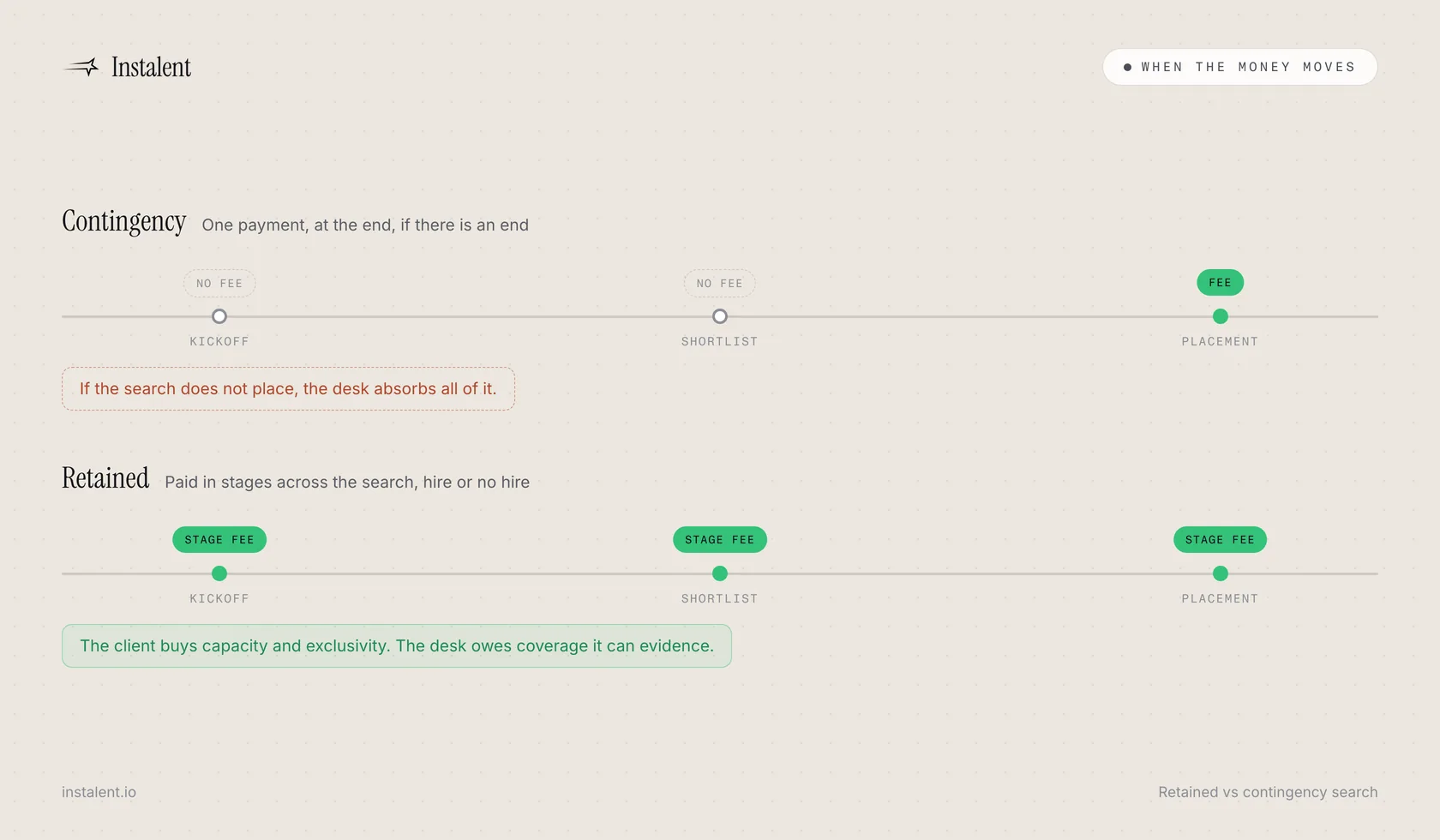
Strip away the positioning and the difference is about when the money moves and what it buys.
Contingency. The fee is paid on placement and only on placement. The client usually has the right to work with other agencies and with their own team at the same time. You are one of several routes to the same outcome, and you carry the risk of doing the work for nothing.
Retained. The fee is paid in stages across the search, whether or not it ends in a hire. In exchange the client commits exclusivity and the agency commits capacity. You carry less risk and more obligation, including the obligation to keep going when the search turns out to be hard.
Everything else follows from that. Contingency is priced as a portfolio bet: you take on more briefs, you accept that some will not close, and speed is how you win. Retained is priced as a capacity commitment: you take on fewer briefs, you are expected to be exhaustive rather than fast, and the market map is part of the deliverable.
Why the usual comparison numbers do not hold up
If you search this question you will be told that retained searches fill at around 95% and contingency somewhere between 10% and 20%. You will also find the same pages quoting satisfaction figures that do not match each other.
Those numbers do not survive a check. They trace to vendor and firm blogs rather than to any published study, the versions contradict one another, and almost every source quoting them sells one of the two models. We looked for a primary source while writing this and could not find one, so there are no fill-rate statistics in this post.
A fill-rate comparison between these models is close to meaningless anyway
Retained searches are, by selection, the briefs a client cared enough about to pay for upfront and commit exclusively to. Contingency includes every speculative role a client floated to four agencies at once. Comparing completion rates across those two populations measures the briefs, not the model.
That is worth knowing before you take one of those numbers into a client conversation, because a client who checks will find the same lack of a source that you would.
The two questions that actually decide it
Not "which is better". Ask these:
- How scarce is the qualified population? Not the job title, the people who clear the must-haves. If the answer is in the low hundreds nationally, the search needs exhaustive coverage, and exhaustive coverage is not economic on a contingent basis.
- How committed is the client? Exclusivity is not a favour you ask for, it is a signal. A client who will not commit to one route is telling you their confidence in the brief, their timeline, or their budget is soft.
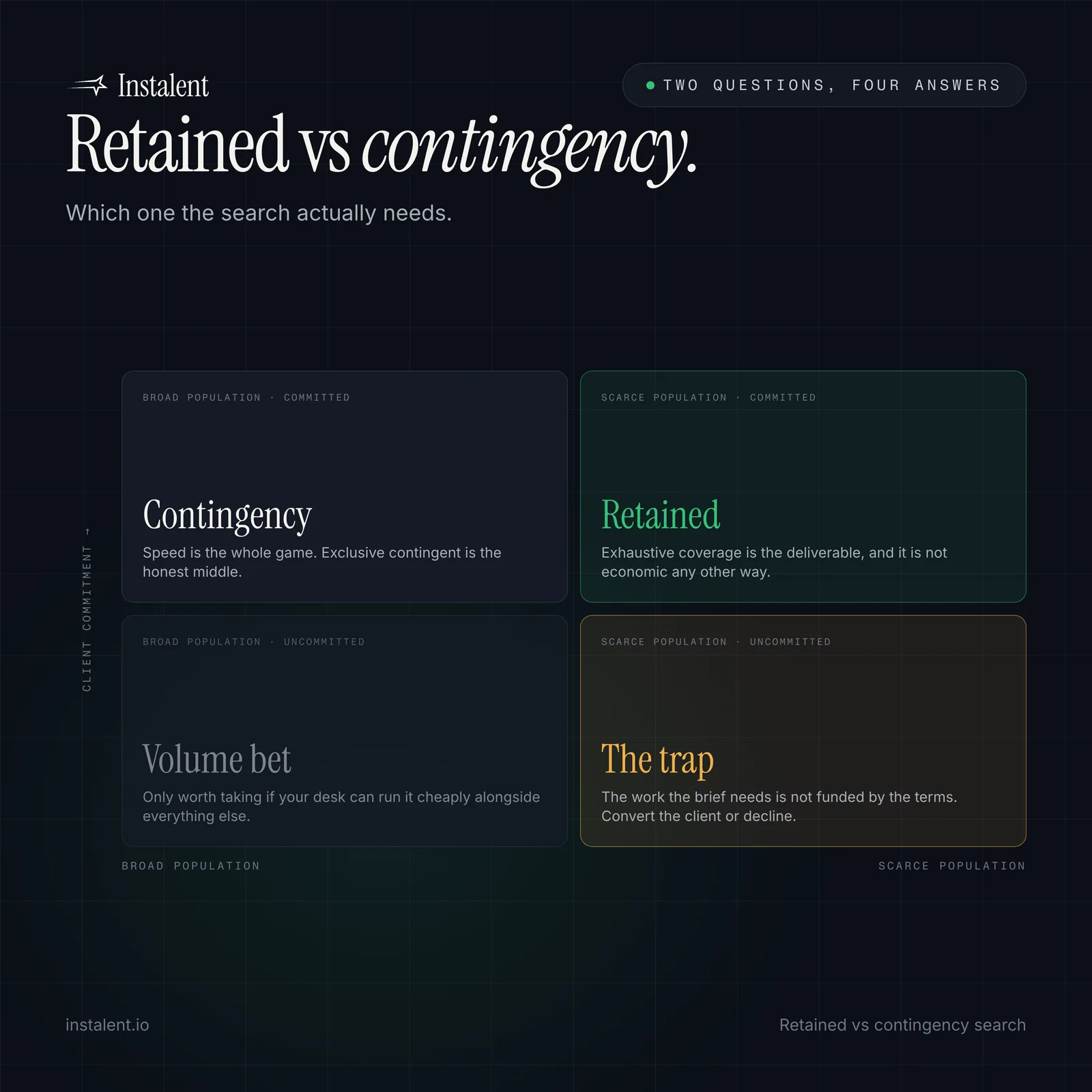
Those two answers give you four situations, and the model follows from where you land.
- Scarce population, committed client. Retained. This is what the model exists for. The work is market mapping and sustained outreach, and neither is economic without the retainer.
- Scarce population, uncommitted client. The dangerous quadrant, and the one most agencies lose money in. The brief needs exhaustive work and the commercial terms will not fund it. Either convert the client or decline the brief. Running it contingently is a slow way to lose a quarter.
- Broad population, committed client. Contingency works, and speed is the whole game. An exclusive contingent arrangement is often the honest middle: the client keeps the outcome-based fee, you get the exclusivity that makes it worth prioritising.
- Broad population, uncommitted client. A volume bet. Only worth taking if your desk can run it cheaply alongside everything else, which is a question about your tooling rather than your terms.
What each model changes on the desk
The model does not only change the invoice. It changes the work.
Under contingency, the constraint is time to first credible slate. Bullhorn's 2026 GRID Industry Trends report, published 25 February 2026 from nearly 2,300 recruitment professionals surveyed in November and December 2025, found that 56% of the highest-growth firms report average placement times under ten days. That is the pace contingency rewards, and it is only reachable when the sourcing, the contact details and the outreach are not three separate systems.
Under retained, the constraint is coverage you can evidence. The client is paying for the map, not just the hire, so you need to be able to show the population you searched, who was excluded and why. Talent mapping covers building that, and talent intelligence covers answering the scarcity question in the first place, which is the input to this entire decision.
The market context sharpens both. SHRM's 2026 Talent Trends report, published 27 April 2026 from a survey of 2,094 HR professionals fielded 9 to 20 February 2026, found 68% of HR professionals reported difficulty recruiting for full-time roles, and 53% of those said it had become harder than a year before. Harder searches make the scarce-and-uncommitted quadrant more common, which is exactly the one to be disciplined about.
Running both without running two systems
Most agencies run a mix, and the operational cost of that mix is usually invisible. The retained searches need depth and an auditable trail. The contingent roles need speed and volume. A desk that switches tooling between them pays for the switch twice.
That is the practical argument for keeping both on one record: AI candidate sourcing to establish the population, with the same search doubling as the coverage evidence a retained client is paying for, and multichannel outreach to work the shortlist at whatever pace the model demands. The full picture for agency desks is on solutions for recruitment agencies, and how recruitment agencies win clients covers the BD side of getting to the commitment conversation earlier.
Want the coverage and the speed to come out of the same search? Get started
Common questions
What is the difference between retained and contingency search?
Contingency means the fee is paid only on placement, usually without exclusivity, so the agency carries the risk of working for nothing. Retained means the fee is paid in stages across the search whether or not it ends in a hire, in exchange for exclusivity and a commitment of capacity.
Is retained search better than contingency?
Neither is better in general. The model should follow the search. A scarce population with a committed client needs retained, because exhaustive coverage is not economic on contingent terms. A broad population with a committed client suits contingency, where speed is the advantage.
Are the fill-rate statistics comparing the two models reliable?
No. The widely quoted figures trace to vendor and firm blogs rather than a published study, the versions contradict each other, and most sources quoting them sell one of the two models. The comparison is also structurally unfair, because retained briefs are pre-selected for client commitment.
What is the worst situation to take on?
A scarce population with an uncommitted client. The brief needs exhaustive work and the commercial terms will not fund it. Either convert the client to exclusivity or decline the brief.
Sources
- Bullhorn GRID report: Staffing firms using AI see stronger growth, faster placements - Bullhorn, 25 February 2026 (nearly 2,300 recruitment professionals, fielded November to December 2025; 56% of the highest-growth firms report average placement times under ten days).
- SHRM Unveils 2026 Talent Trends Report - SHRM, 27 April 2026 (survey of 2,094 HR professionals fielded 9 to 20 February 2026; 68% reported difficulty recruiting for full-time roles, 53% of those said it had become harder than a year before).
- 2026 Recruitment Industry Trends Report - Bullhorn GRID, 2026 (full report landing page).
Find your next client before your competitors do
Spot companies that are hiring, reach the decision-maker and win the brief. Get 50% off your first month.
Keep reading