Diversity Recruiting Is a Sourcing Problem Before It Is a Screening One
Diversity recruiting starts in the pool, not the shortlist: why single-channel sourcing narrows a slate, how pedigree proxies compound it, and what tooling cannot fix.
Instalent builds the pool from many sources, not one.
Most diversity recruiting effort lands at the end of the process, where the shortlist already exists and the options are already fixed. By that point the composition of the slate was decided upstream, by the channel the pool came from and the criteria used to filter it. You cannot screen your way to a different shortlist than the pool allows. This is a sourcing argument, not a screening one.
The slate is decided before anyone reviews it
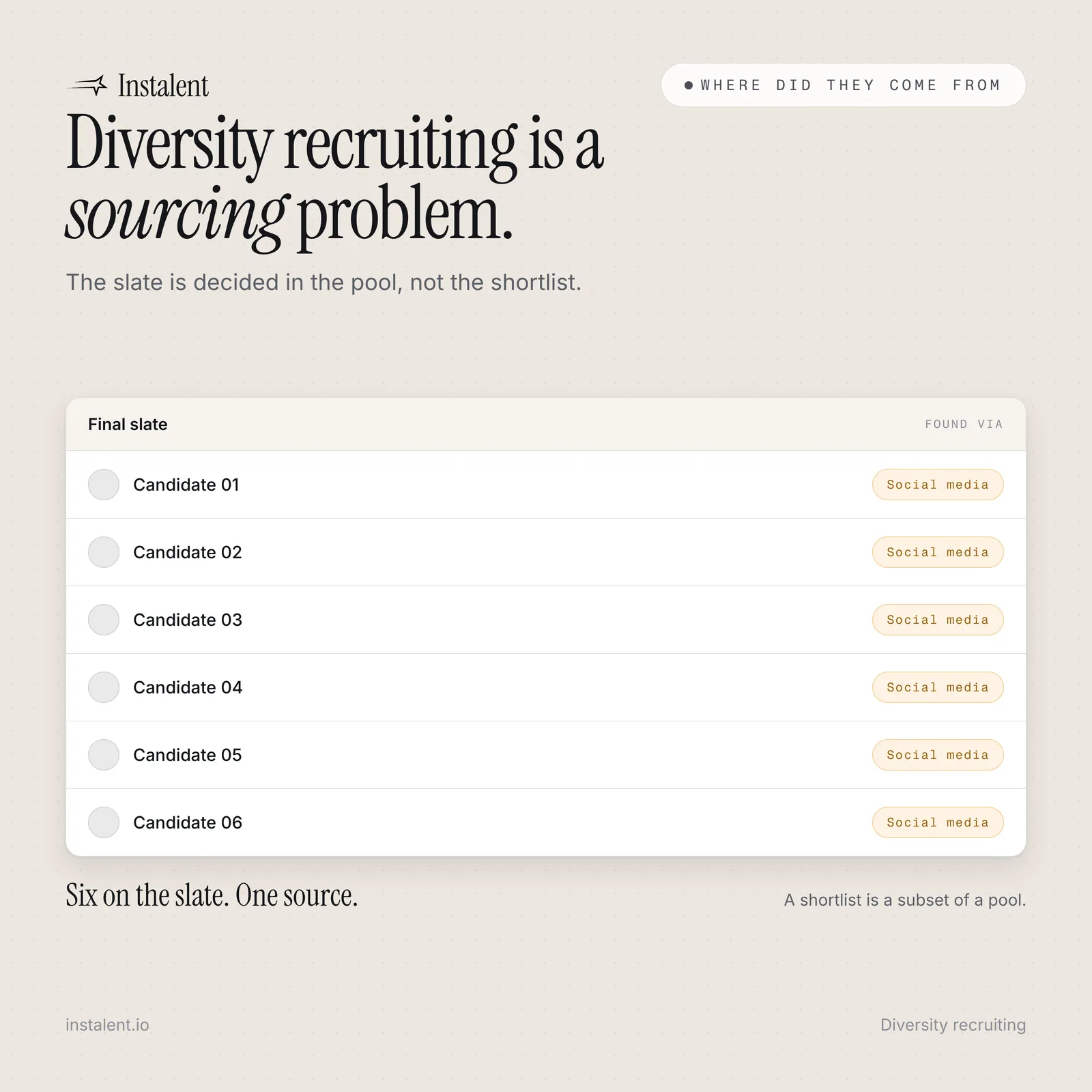
A shortlist is a subset of a pool. If the pool was drawn from one place, the shortlist inherits whatever that place contains, and no amount of care at the review stage adds people who were never in the set.
That makes the interesting question an upstream one: where did these candidates come from, and what does that source systematically contain and omit?
One channel is the most common narrowing force
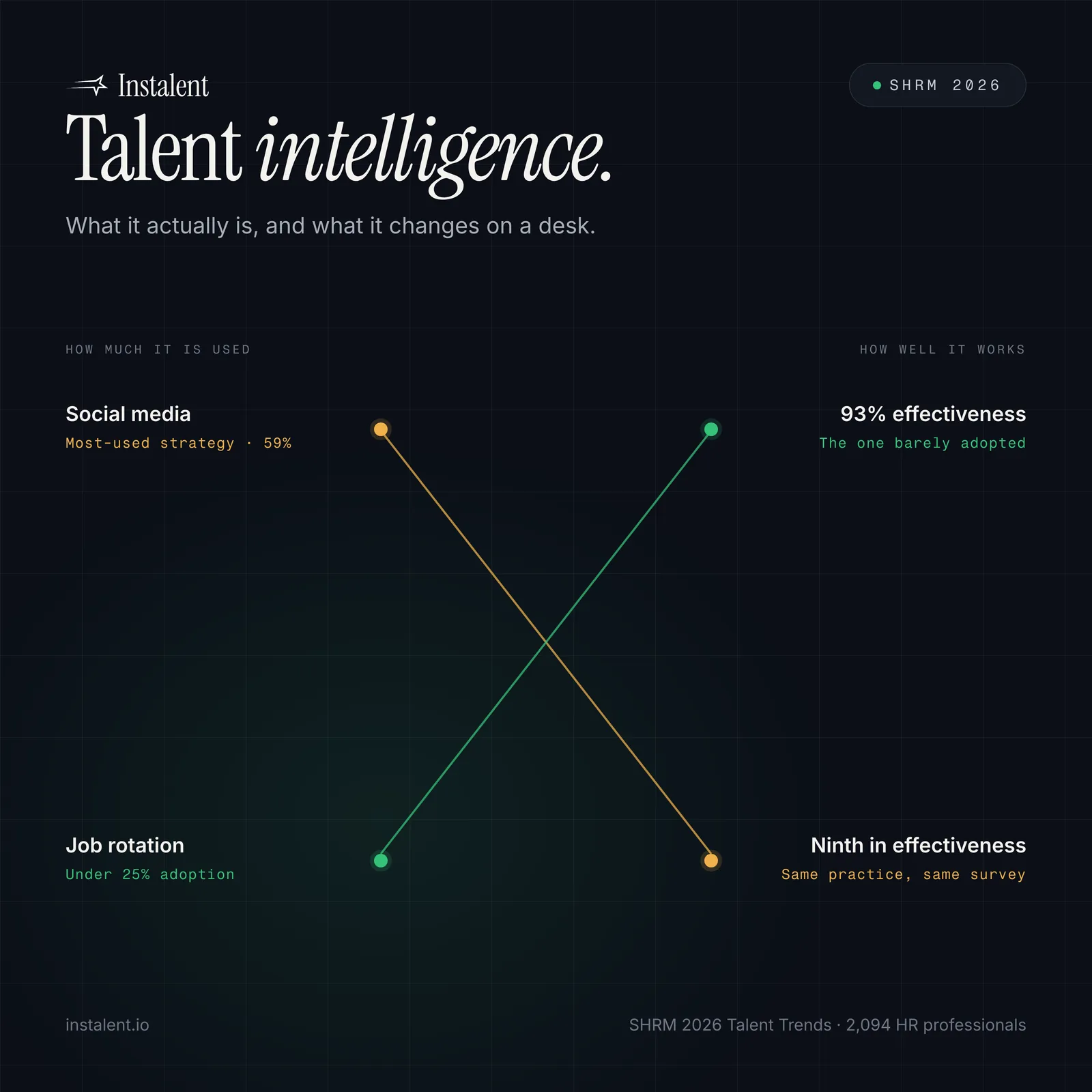
The relevant measurement here is about effectiveness generally, not about any group. SHRM's 2026 Talent Trends report, published 27 April 2026 from a survey of 2,094 HR professionals fielded 9 to 20 February 2026, found that social media is the most-used recruiting strategy at 59% and ranks ninth in effectiveness.
A profession concentrated on one channel has a pool shaped by who is active on that channel. That is a composition fact before it is anything else, and it affects far more than demographics: it also skews toward people who market themselves well, who are currently visible, and who keep a profile current. Plenty of strong candidates do none of those things.
The practical move is not to abandon a channel that works. It is to stop letting one channel define the whole population.
A useful diagnostic
Take a filled role from the last quarter and ask where each person in the final slate was found. If the answer is the same source for all of them, the slate was a sample of one channel, and you have a sourcing question to answer rather than a screening one.
Pedigree proxies narrow it a second time
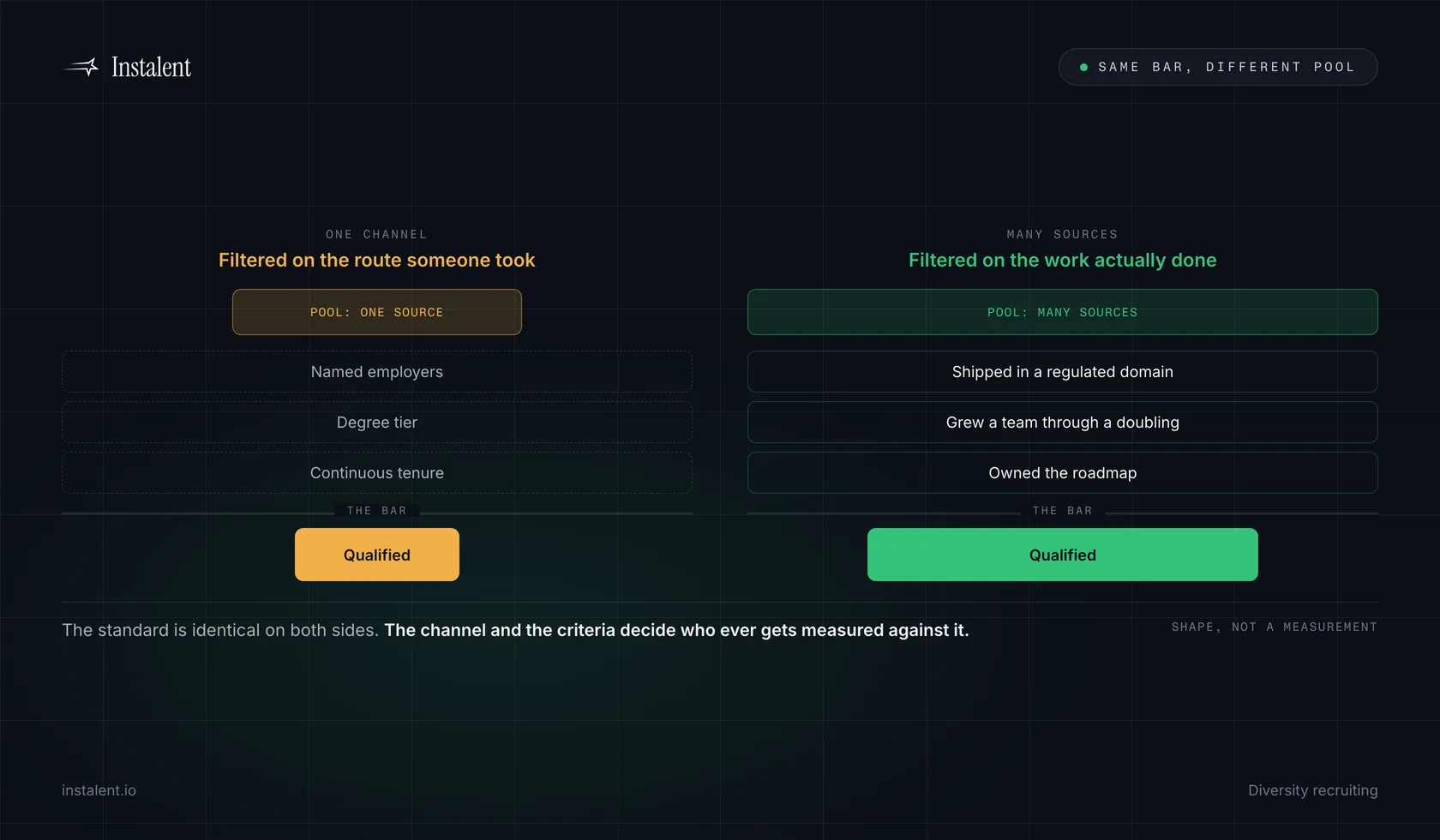
The other compounding force is in the criteria. A requirement written as a proxy filters on the path someone took rather than on what they can do:
- A named set of employers, rather than the work done at any employer.
- A degree from a particular tier, rather than the capability the degree is standing in for.
- Continuous tenure, which quietly filters out carers, immigrants re-qualifying, and anyone who changed field.
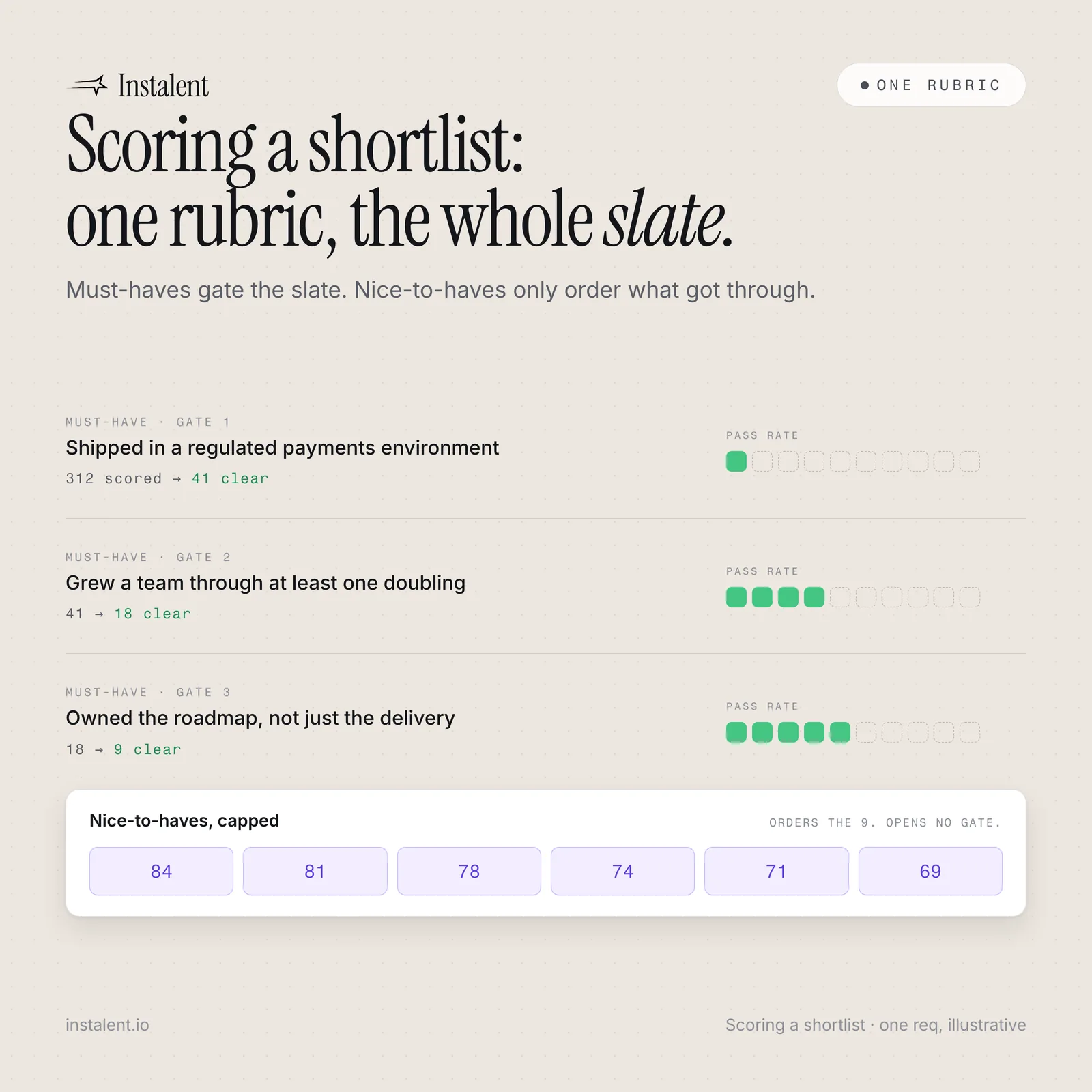
Rewriting those as evidence is the same discipline that makes a rubric scoreable at all, and it widens who qualifies without moving the bar. "Has grown a team through at least one doubling" admits anyone who has actually done it. "Ex-big-tech" admits a list. Scoring a shortlist covers the writing test in full, and skills-based hiring covers why the standard moved upstream.
What actually widens a pool
Four changes, in rough order of how much they move the number:
- Search many sources, not one network. The single highest-leverage change, because it addresses the narrowing at its origin rather than compensating for it later.
- Write requirements as evidence. Every proxy you remove returns qualified people who were being filtered on their route rather than their capability.
- Search the pool you already own. Old exports and a neglected database were usually built from different channels over several years, which makes them more varied than anything you source this week.
- Check which requirement is doing the eliminating. If one line removes most of the pool, that line deserves a conversation with the hiring manager before it silently shapes the slate.
None of that lowers a standard. All of it changes who gets measured against the standard.
What tooling cannot do
This is the part most vendors skip, so it is worth stating plainly.
Software can widen a pool and apply criteria consistently. It cannot tell you whether your criteria are the right ones. A rubric applied uniformly is more auditable than a series of individual judgement calls, because you can inspect the criteria and see which one is doing the eliminating. That is a genuine improvement, and it is not the same as being free of bias. The criteria themselves still encode whatever assumptions were written into them, and reviewing them stays a human job.
Nor is any of this a compliance position. Legal requirements around hiring vary by jurisdiction and change; treat this as craft and take the legal question to someone qualified to answer it.
Measuring it without gaming it
The number worth watching is pool composition by source, not slate composition at the end. Slate composition is an outcome you can hit by adjusting the last step, which teaches you nothing. Source composition tells you whether the change happened where it matters.
Consistency is the other half. ATLAS's State of Agency Recruitment benchmark, published 16 March 2026 from a survey of more than 1,000 agency recruiters, found only 34.72% describe their processes as "very well-defined and consistent", with a further 22.22% defined but inconsistently followed. A criterion applied to the first twenty candidates and abandoned by the sixtieth is not a criterion, and the drift is invisible unless the standard is written down.
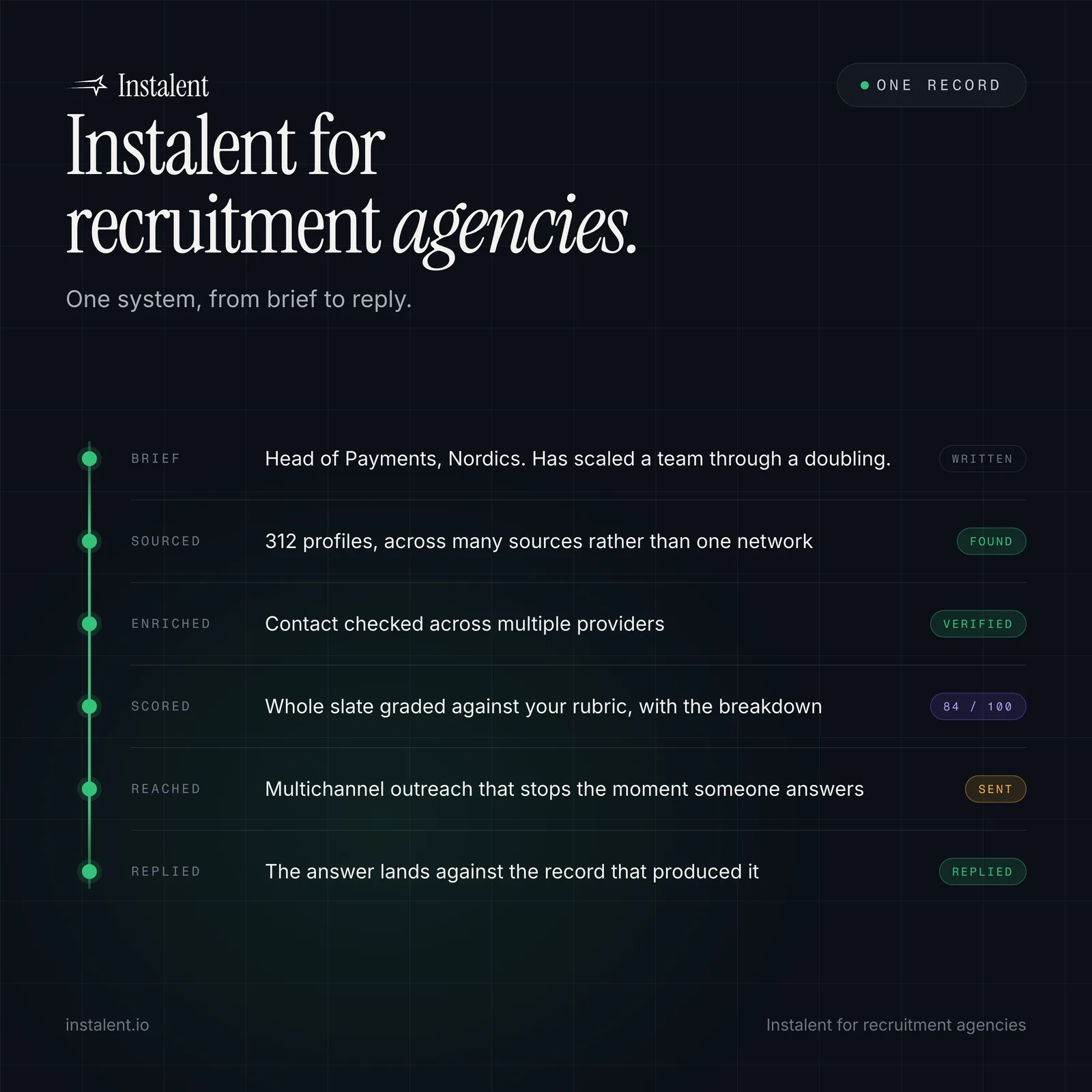
In Instalent the pool comes from searching many sources rather than one network, candidate analysis applies your criteria to the whole slate in one pass with the breakdown visible, and any list you already own can be brought in and searched alongside it. The related approach for mapping a market properly is in talent mapping, and the in-house view is on solutions for in-house talent acquisition.
Want a pool that is not a sample of one channel? Get started
Common questions
What is diversity recruiting?
It is the practice of making sure a hiring process considers the full set of qualified people rather than a subset produced by one channel and a set of proxy requirements. Most of the work is upstream, in how the pool is built.
Does widening the pool mean lowering the bar?
No. Writing requirements as evidence of work actually done, rather than as proxies like named employers or degree tier, keeps the standard identical and changes who gets measured against it.
Can software remove bias from hiring?
No. Software can widen a pool and apply criteria consistently, which makes a process more auditable than a series of individual judgement calls. It cannot tell you whether the criteria are the right ones, and reviewing them stays a human job.
What should you measure?
Pool composition by source, rather than slate composition at the end. Slate composition can be hit by adjusting the final step, which teaches you nothing about whether the sourcing actually changed.
Sources
- SHRM Unveils 2026 Talent Trends Report - SHRM, 27 April 2026 (survey of 2,094 HR professionals fielded 9 to 20 February 2026; social media most-used recruiting strategy at 59% and ninth in effectiveness).
- The State of Agency Recruitment: 2026 Benchmark Report - ATLAS, 16 March 2026 (survey of 1,000+ agency recruiters; 34.72% "very well-defined and consistent" processes, 22.22% defined but inconsistently followed).
Find better candidates, faster
Source, verify and reach candidates on one engine. Get 50% off your first month.
Keep reading