Scoring a Shortlist: One Rubric, the Whole Slate
How to score a shortlist against the brief instead of the keyword: rubric design, evidence over adjectives, calibration, and defending a slate to the client.
Instalent scores the whole slate against one rubric, in a single pass.
Every desk has a scoring system. Most of them live in one consultant's head, get applied to the first twelve profiles with real care, and then degrade into a gut call somewhere around profile forty. The slate still goes out. What the client cannot see is that the last third of it was judged by a tireder person against a looser standard than the first third.
The problem is consistency, not judgement
Recruiters are good at reading a profile. What no one is good at is reading three hundred of them the same way.
ATLAS's State of Agency Recruitment benchmark, published 16 March 2026 from a survey of more than 1,000 agency recruiters, found only 34.72% describe their processes as "very well-defined and consistent". A further 22.22% have processes that are defined but inconsistently followed - the rubric exists, it just is not what actually decides the slate.
That second number is the interesting one. It is not a knowledge gap. It is a throughput problem wearing a process costume.
Score against the brief, not the keyword
A shortlist scored on keyword overlap ranks the people who described themselves in your vocabulary. That is a writing-style filter, not a fit filter.
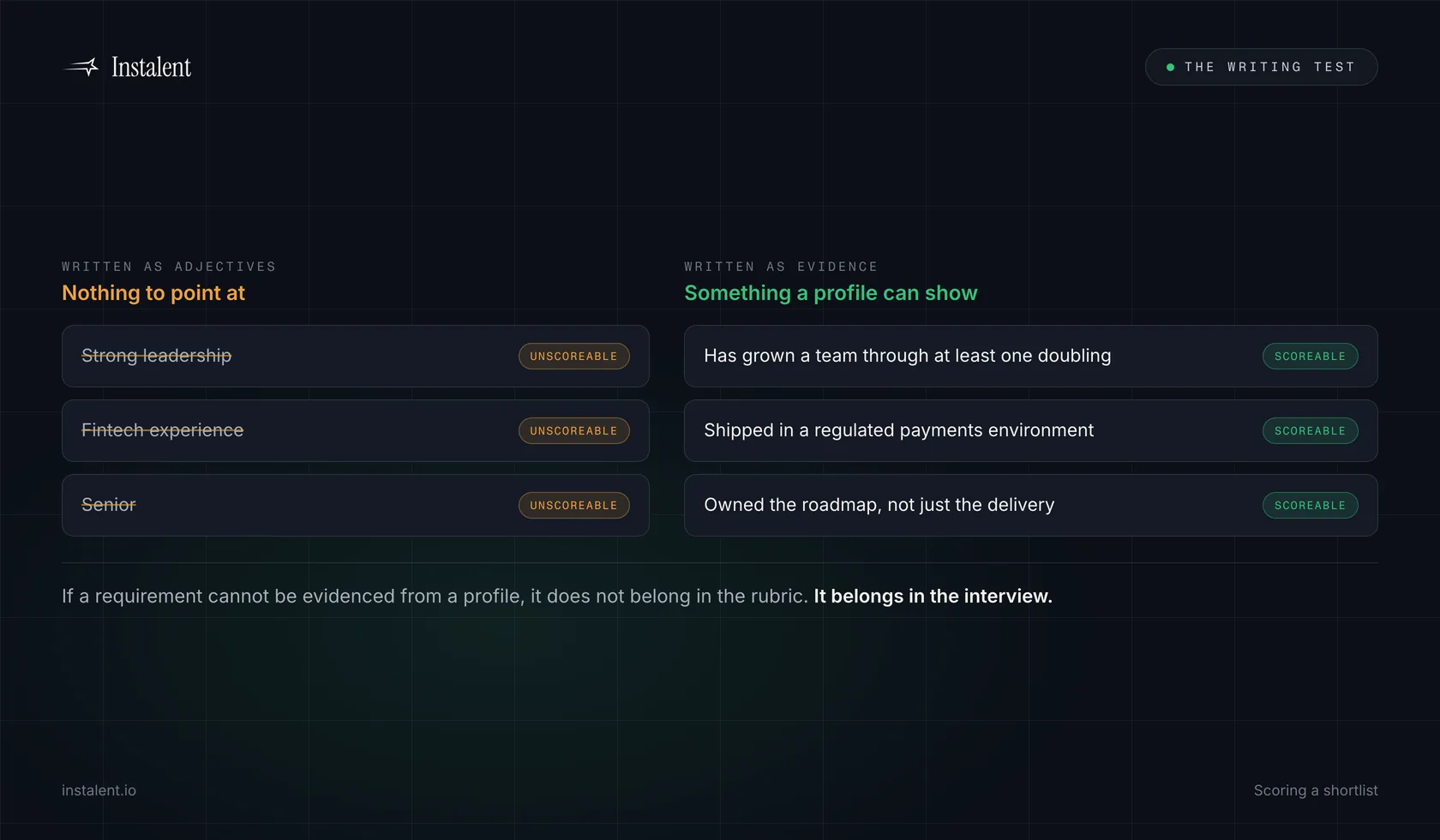
The fix is to score against the brief's actual requirements, and to write each requirement as evidence you could point at:
- Not "strong leadership" but "has grown a team through at least one doubling".
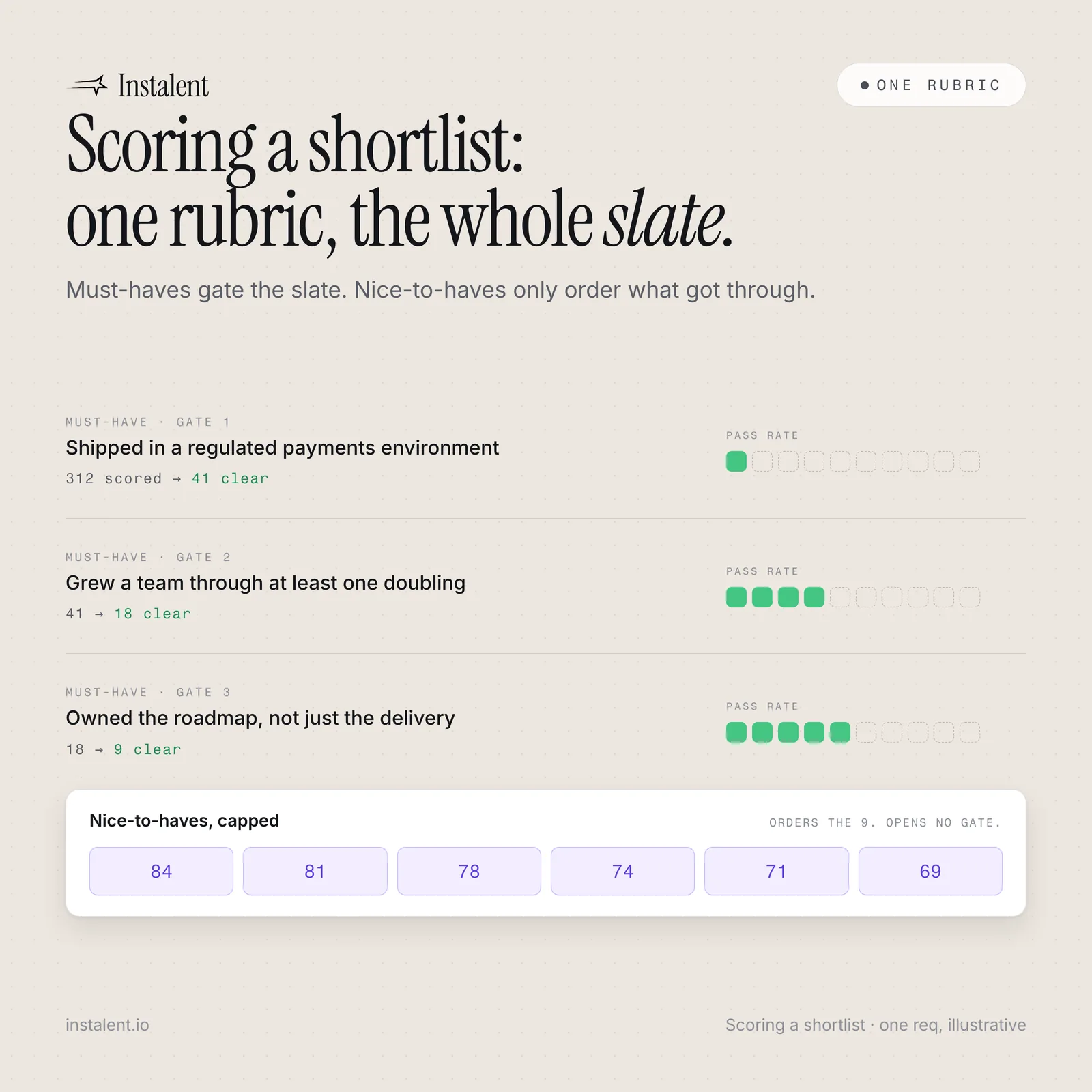
- Not "fintech experience" but "shipped in a regulated payments environment".
- Not "senior" but "owned the roadmap, not just the delivery".
If a requirement cannot be evidenced from a profile, it does not belong in the rubric. It belongs in the interview. Writing an AI sourcing brief covers getting the spec right upstream of this, which is where most scoring problems are actually created.
A score you cannot open is a score you cannot defend
The moment a client asks "why is she second and he fourth", an unexplained number is worse than no number. Any scoring step has to return the reasoning alongside the figure, or it will not survive its first difficult conversation.
Weight the must-haves, cap the nice-to-haves
Most rubrics fail because everything counts a little. Three nice-to-haves stack up and outrank a missing must-have, and a plausible-looking candidate arrives at the top of a slate they should not be on.
A structure that holds up on a live desk:
- Must-haves are gates, not points. Miss one and the candidate is out of the slate, not down it.
- Nice-to-haves are points, and they are capped. They order the people who already cleared the gates. They never promote someone past a gate.
- One tiebreaker, chosen before you start. Usually recency of the relevant evidence, or depth in the specific market.
That ordering is what stops a rubric drifting into a popularity contest.
Calibrate on ten before you trust three hundred
Score ten profiles by hand first, including two you are certain about and two you would reject. Then check whether the rubric agrees with you.
If it disagrees on the certain ones, the rubric is wrong, not the candidate. Usually one requirement is doing too much work, or a must-have is really a nice-to-have that you feel strongly about. Fix it on ten. Never discover it on three hundred.
Where the machine earns its place
This is the step that scales badly by hand and scales well when a system does it. Bullhorn's 2026 GRID Industry Trends report, published 25 February 2026 from nearly 2,300 recruitment professionals surveyed in November and December 2025, found 55% of firms using AI screening reported KPI improvements of more than 25%, and 46% said it cut screening time in half or better.
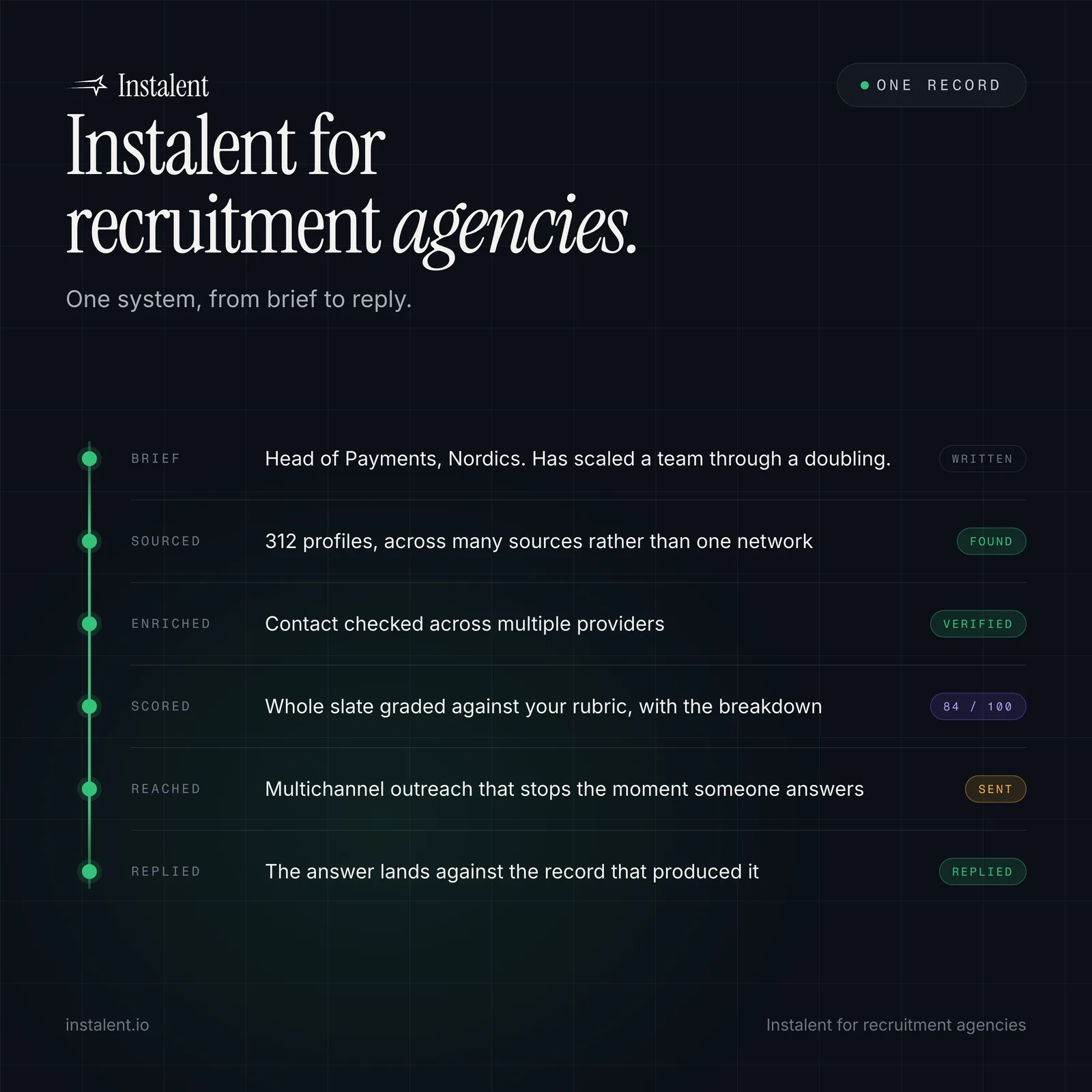
Candidate analysis in Instalent runs your criteria across the whole slate in one pass and returns a score, a breakdown per criterion, and a written description of the match. The breakdown is the part that matters: it is what lets you disagree with the score, correct the rubric, and run it again.
Two things worth being clear about:
- The rubric is yours. A scoring step that invents its own criteria is not scoring your brief.
- The gates still belong to you. A machine applying a rubric consistently is doing the job a tired human does badly. It is not deciding who to hire.
What a scored slate changes with the client
A slate of six with a visible standard behind it is a different conversation from a slate of six. You can say why the sixth is on the list, what the third is missing, and which requirement is costing you the most candidates.
That last point is the one that earns repeat business. If "shipped in a regulated payments environment" is eliminating four out of five otherwise strong people, that is not a sourcing failure. That is a calibration conversation to have in week one rather than week five, and it matters most on the searches where the slate is small to begin with, such as executive search.
Scoring also does not replace the interview. It decides who gets one. Interview questions and how to score the answers covers the stage after this, and it is a separate rubric with separate evidence.
Want the whole slate scored against one rubric? Get started
Common questions
How many criteria should a rubric have?
Three to five must-haves and no more than four nice-to-haves. Beyond that the weights stop meaning anything and the score becomes an average of everything, which ranks nobody usefully.
Should the rubric come from the client or the desk?
From the client, translated by the desk. Clients give you adjectives and priorities, and your job is to turn those into evidence a profile can actually show. That translation is also how you find out a brief is unfillable before you have spent three weeks on it.
Does scoring work on a list we already have?
Yes, and it is usually the fastest win available. An old export or a long-neglected pool can be structured, searched and scored against a current brief without sourcing anything new.
What about bias?
A written rubric applied consistently is more auditable than forty separate gut calls, because you can inspect the criteria and see which one is doing the eliminating. That is a real improvement, and it is not the same as being bias-free. The criteria themselves still need reviewing, and evidence-based requirements are easier to review than adjectives.
Sources
- The State of Agency Recruitment: 2026 Benchmark Report - ATLAS, 16 March 2026 (survey of 1,000+ agency recruiters; 34.72% "very well-defined and consistent" processes, 29.17% partially defined, 22.22% defined but inconsistently followed).
- Bullhorn GRID report: Staffing firms using AI see stronger growth, faster placements - Bullhorn, 25 February 2026 (nearly 2,300 recruitment professionals, fielded November to December 2025; 55% of firms report AI screening improved KPIs by more than 25%, 46% say it cut screening time in half or better).
- 2026 Recruitment Industry Trends Report - Bullhorn GRID, 2026 (full report landing page).
Find better candidates, faster
Source, verify and reach candidates on one engine. Get 50% off your first month.
Keep reading