Pay Transparency: Your Posted Range Is Doing Three Jobs at Once
Most US postings now show pay. The range attracts, filters and anchors at once, and the wide band that attracts best wastes the most time.
Price the role once, honestly, and let the band do the filtering.
Someone asks what range to put on the advert. The answer is usually whatever the client said, widened a little at the top to keep options open. That single line now does more work than the rest of the advert combined, and widening it is the one change that makes it worse at almost everything it is supposed to do.
First, what this post is not
This is not a compliance post. What a given jurisdiction requires you to publish, for which roles, and with what penalties, varies by state and country, changes regularly, and is a question for your own counsel rather than a blog. Nothing here is legal advice.
What follows is about something that is true regardless of what the law says where you sit: what the number does to your pipeline once it is public.
Showing pay is now the majority condition, and the growth has stalled
Indeed's research arm has tracked the share of US job postings that include salary information, and the shape of that series matters more than any single figure.
- September 2023: 52.2% of US postings on Indeed carried salary information
- September 2024: 57.8%
- May 2025: 59%
The direction is up and the slope is flattening. Indeed's own analysis in October 2024 said the pace had slowed against the prior year, attributing it partly to the fact that the large markets with established requirements had already moved.
The variation underneath that average is far more useful than the average. In September 2024 childcare postings disclosed pay 81.7% of the time while physicians and surgeons disclosed 39.1% of the time, and pharmacy moved 24 percentage points in a single year, from 46.5% to 70.4%.
Work out which market you are actually in
If you work a sector where nearly everyone posts a range, omitting one is a signal, and not a good one. If you work a sector where most do not, posting one is still a genuine differentiator for attention. The national average tells you almost nothing about which of those two situations you are in. Look at your own last twenty competing adverts and count.
The range is doing three jobs, and they pull against each other
Here is the part almost nobody separates out. A posted band performs three different functions at the same time:
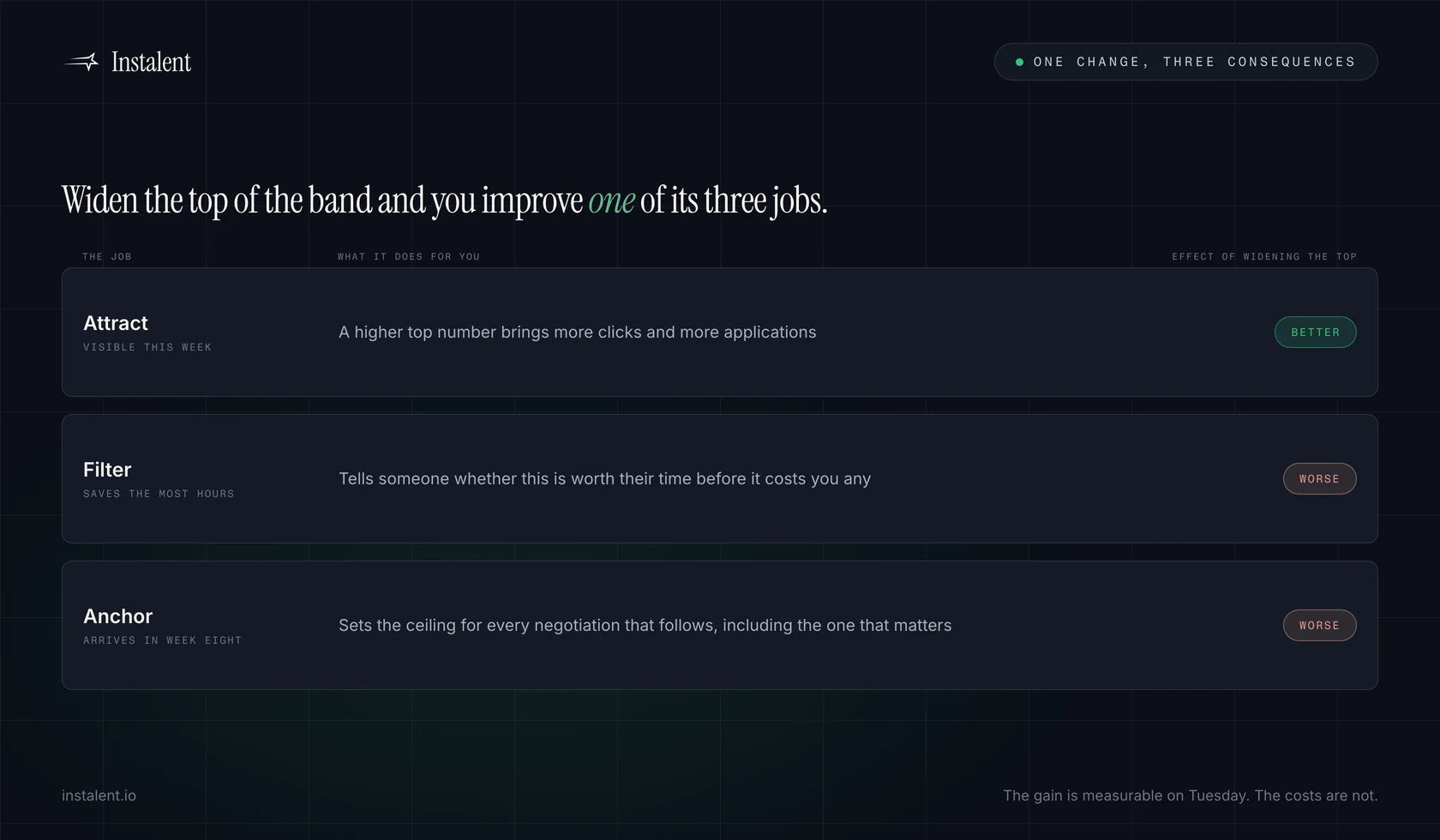
- It attracts. A higher top number gets more clicks and more applications. This is the job most people optimise for, because it is the only one with immediate visible feedback.
- It filters. The band tells someone whether this is worth their time before they spend any of yours. Done well, this is the function that saves a desk the most hours in a week.
- It anchors. Whatever you publish sets the ceiling for every conversation that follows, including the one you will have in week eight when the only viable candidate wants more.
Widening the top end improves the first and damages the other two. That trade is almost always made without being noticed, because attraction is measurable on Tuesday and the cost of the other two arrives weeks later as wasted calls and a negotiation you have already lost.
Why the wide band is the expensive option
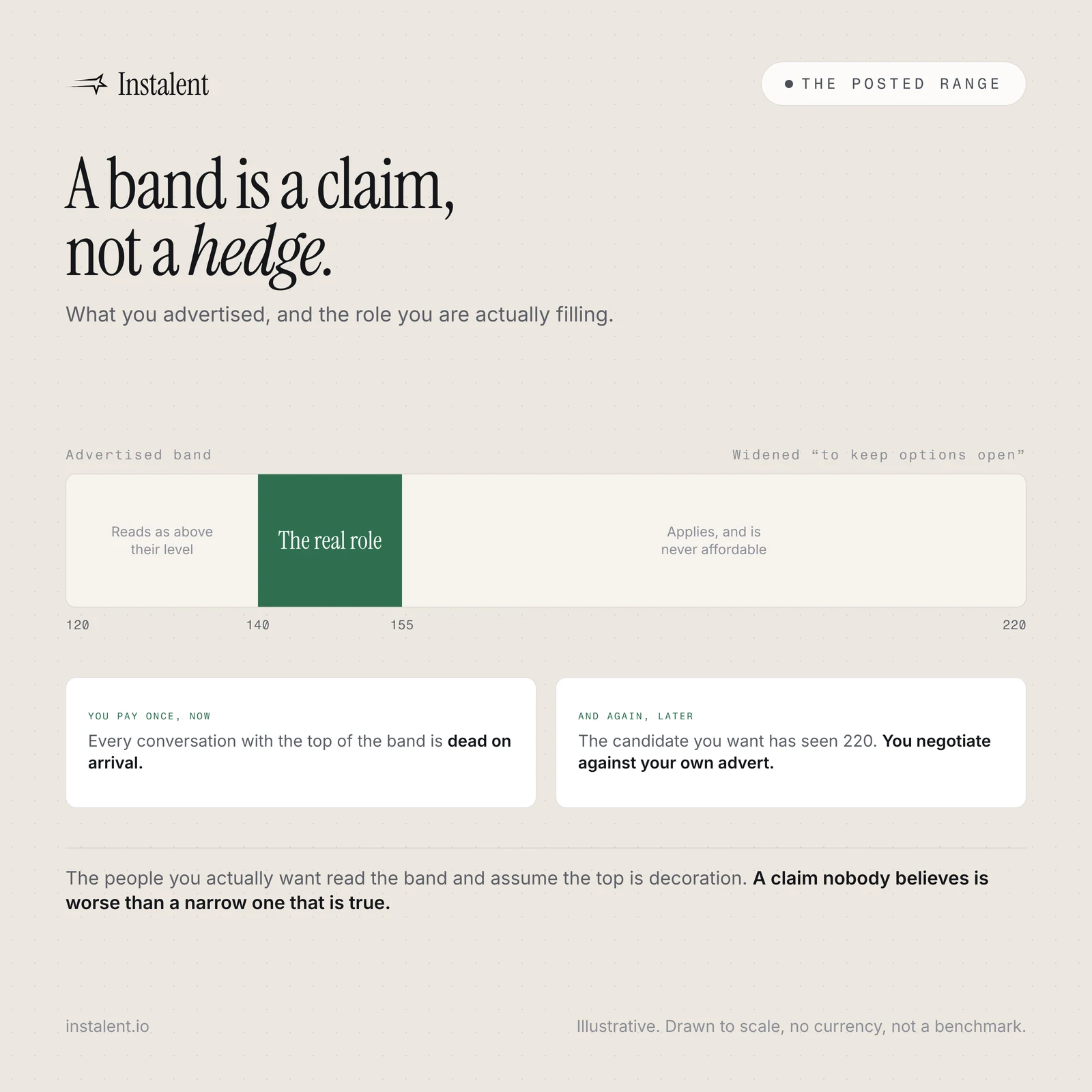
Take a band advertised at 120 to 220 when the role is genuinely a 140 to 155 role.
- The people at the top of the band apply, and every one of those conversations is dead on arrival. You pay for that in hours.
- The people you actually want, at 140 to 155, read the band and conclude one of two things: that the role is above their level, or that the real number is at the bottom and the top is decoration. Either way a share of them do not apply.
- The candidate you eventually want to hire has seen 220. You will negotiate against your own advert.
A band is not a hedge. It is a claim about what you will pay, and a claim nobody believes is worse than a narrow one that is true.
Decide the number at intake, not at advert-writing time
If the range is being invented while someone writes the advert, it was never priced. That decision belongs earlier, in the conversation where you took the role.
The intake call is where the money claim should be tested rather than accepted, and salary benchmarking is how you arrive at a number you can defend rather than one you were handed. Three questions settle most of it:
- What did the last person in this seat actually cost, including the parts nobody mentions?
- What does the market evidence say, as opposed to what the budget says?
- If you hire at the top of the band, who internally needs a rise the following quarter?
That third question is the one that most often reveals the band cannot move, which is far better known in week one than week eight.
What changes in the first conversation
Two practical things, both of which catch out desks still running the old script.
Asking what somebody currently earns is finished. In a growing number of places it is restricted, and everywhere else it is increasingly pointless, because the candidate can see your range and has no reason to anchor themselves below it. The useful replacement is a question about the move rather than the history: what would have to be true for this to be worth doing.
Never write "competitive" or "DOE". To the audience you want, those read as "below market" or "we have not decided". The postings that filter well state a real band and, ideally, what moves someone within it.
When you genuinely cannot post a number
There are real cases. Confidential searches where the band would identify the role, equity-heavy packages where the cash number misrepresents the offer, and genuine outliers.
The answer is not silence. State the basis instead of the number: the band is set against a named benchmark, or the package is weighted to equity with a cash floor at a stated level. A candidate can decide against a described structure. They cannot decide against nothing, so they do what everyone does with nothing, and assume the worst.
AI candidate sourcing and candidate analysis sit downstream of this decision: a slate scored against criteria is only as useful as the band it was sourced into. The agency view is on solutions for recruitment agencies.
Want the band decided before the search runs, not after? Get started
Common questions
How many job postings show salary now?
Indeed's research found that 59% of US job postings included salary information as of May 2025, up from 57.8% in September 2024 and 52.2% in September 2023. Growth has slowed. The sector variation is much larger than the trend: in September 2024 childcare postings disclosed pay 81.7% of the time against 39.1% for physicians and surgeons.
Should you post a wide salary range?
Usually not. A posted band does three jobs at once: it attracts, it filters, and it anchors every later negotiation. Widening the top end improves attraction while damaging the other two, so you draw conversations you cannot afford, lose some of the people you actually want who assume the role is above them or that the top is decoration, and then negotiate against your own advert.
Can you still ask candidates what they currently earn?
In a growing number of jurisdictions the question is restricted, and the specifics are a matter for your own counsel rather than a blog. Practically it is also losing its point, because the candidate can see your published range and has no reason to anchor below it. Ask what would make the move worth doing instead.
What should you do when you cannot publish a range?
State the basis rather than the number. Say the band is set against a named benchmark, or that the package is weighted towards equity with a cash floor at a stated level. A candidate can evaluate a described structure, but faced with nothing at all they tend to assume the worst.
Sources
- Pay Transparency Across High-Earning Sectors - Indeed, published 2 July 2025 (as of May 2025, 59% of US job postings included salary information; software development 63%, accounting 62%, finance 58%, nurse roles 53%, physician roles 44%).
- Salary Transparency: Growth Slows, but Momentum Continues - Indeed Hiring Lab, 23 October 2024 (57.8% of US postings carried salary information in September 2024 against 52.2% in September 2023; childcare 81.7% and physicians and surgeons 39.1%; pharmacy rose 24 percentage points from 46.5% to 70.4% over the year; the pace of growth slowed against the prior year).
Find better candidates, faster
Source, verify and reach candidates on one engine. Start your 7-day free trial.
Keep reading