Money Is the Reason People Give, Not the Reason They Go
Low pay and no advancement tie as the top reasons people quit, with disrespect close behind. Two of the three are ones recruiters never ask about.
Record the condition that would move them, not the number they mentioned.
You ask what would make them consider a move. They say the right opportunity, and obviously the money would have to work. You write "wants about 15% more" in the notes, build the pitch around the number, and eight weeks later they turn down an offer that was 18% more. The reason they gave you was true. It just was not the reason.
The top three reasons are nearly tied, and two are not money
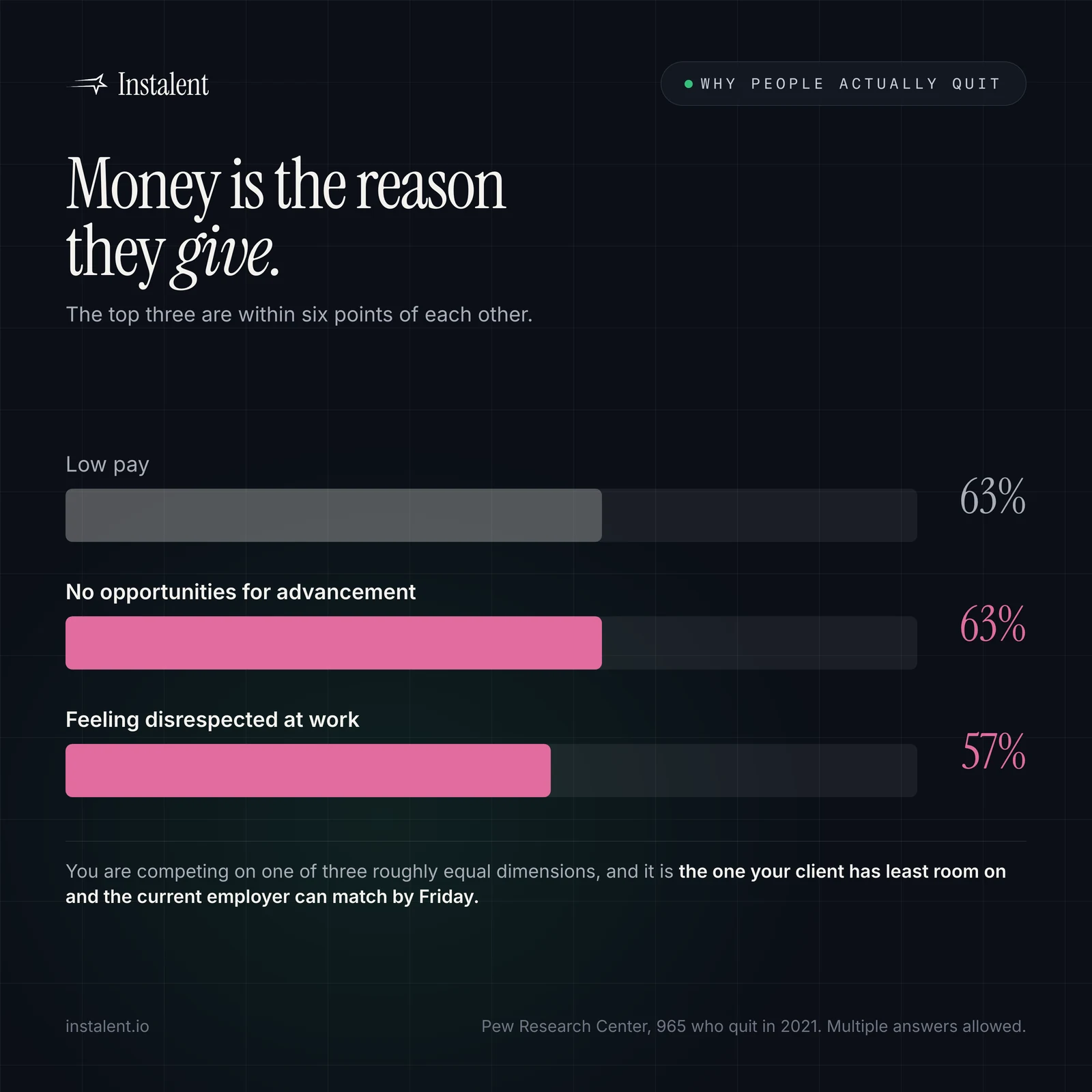
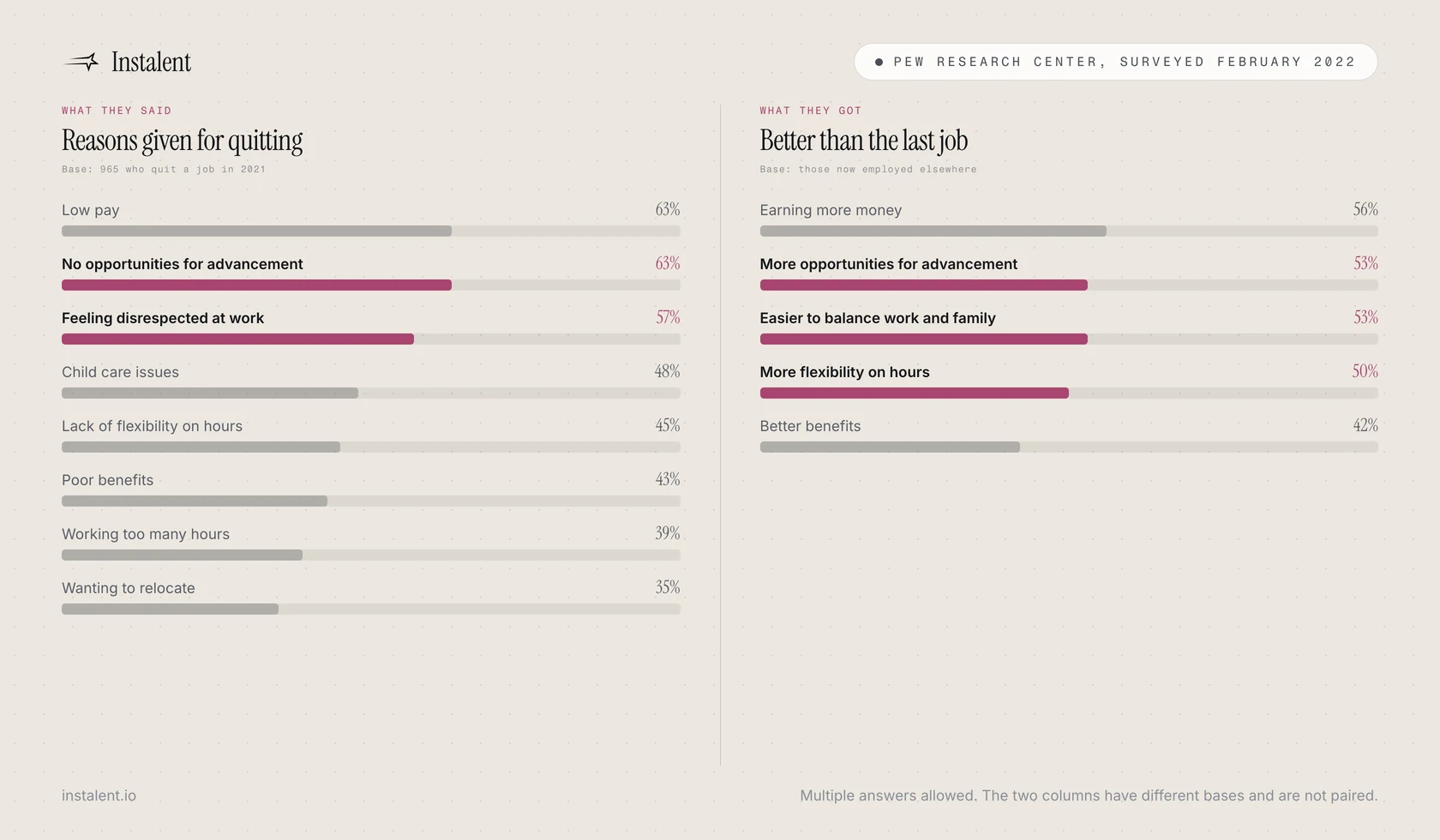
The most specific structured evidence on this comes from the Pew Research Center. In a survey of 965 workers who had quit a job in 2021, fielded 7 to 13 February 2022 and published on 9 March 2022, the reasons given were:
- Low pay: 63%
- No opportunities for advancement: 63%
- Feeling disrespected at work: 57%
- Child care issues: 48%
- Lack of flexibility on hours: 45%
- Poor benefits: 43%
- Working too many hours: 39%
- Wanting to relocate: 35%
Pay and advancement are tied exactly. Respect is six points behind. On a desk this is the whole argument: you are competing on one of three roughly equal dimensions, and it happens to be the one where your client has the least room and the current employer can respond fastest.
Read this data for its shape, not its levels
These numbers describe quitting behaviour in 2021, measured in early 2022, which was an unusual period in the labour market, and respondents could select more than one reason. Do not quote the levels as if they were current. The durable finding is the shape: the top three sit within six points of each other, and two of them have nothing to do with compensation.
The more useful half of that study is what people got
Among those who had changed jobs, the same research found that compared with their last role:
- 56% were earning more money
- 53% had more opportunities for advancement
- 53% found it easier to balance work and family
- 50% had more flexibility on hours
- 42% had better benefits
A successful move delivered on several dimensions at once. That is a direct warning about single-lever pitching. If your approach offers only money, you are competing on the one dimension a current employer can match in an afternoon, and you are leaving the other four unmentioned.
Why money is the answer you always hear
Two reasons, and neither is that money is the real driver.
It is the only socially acceptable answer. Telling a stranger on a first call that your manager treats you badly, or that you were passed over twice, is an admission about yourself. Saying the money could be better costs nothing and ends the question. You are not being lied to; you are being given the answer the format invites.
It is the only one with a number attached. A figure survives into your notes, your CRM and your pitch. "Feels invisible since the reorg" does not have a field to go in, so it evaporates, and three weeks later the only thing anyone can remember about the candidate is a percentage.
The result is a database full of salary expectations and empty of reasons, which is precisely the wrong way round. It is also why the posted range carries more weight than it should: when money is the only recorded dimension, the band becomes the entire pitch.
Half the market is not career-motivated at all
This is the finding that should change how a pitch is written. Pew's December 2024 report on how Americans view their jobs found that 50% consider their current job a career, 15% see it as a stepping stone to a career, and 35% describe it as just a job to get them by.
A growth narrative, ownership, scope, trajectory: these land with the half who see a career. For the third who are describing a job, those words are noise, and the levers that matter are conditions. Predictability, hours, commute, whether the place is pleasant to be in, whether they are treated like an adult.
Pitching high growth and high ownership at someone in that third is not persuasion. It is evidence you were not listening.
Finding the real reason without interrogating anybody
The technique is the same one that works in a reference call and in a debrief: ask for specifics and comparisons, never for a self-assessment.
- "What would have to be true for this to be worth doing?" The single best question available. It asks for conditions rather than complaints, and people answer it honestly because it is forward looking.
- "When did you last seriously think about leaving, and what stopped you?" Returns the push factor and the thing currently holding them, which is usually the thing that will hold them again.
- "What does a good week look like where you are now?" Gets at conditions without asking what is wrong, and the omissions are as informative as the content.
- "If your employer wanted to keep you, what is the one thing they could do?" This is the counter-offer, pre-tested, months before it arrives.
And one to retire: "why are you looking?" on a first call. It is the question the rehearsed answer was written for.
Record the condition, not the feeling
A move condition is a sentence with a test in it. "Wants 15% more" is a number without a reason. "Will move for a team lead title with real reports, and will not move for money alone" is a condition you can match a role against, hand to a colleague, and check at offer stage.
That is the same discipline the intake call applies to the client side of the same search, and it is what makes a slate defensible when someone asks why these six people. Candidate analysis keeps criteria and reasoning attached to the profile rather than in a notebook, and multichannel outreach is where a pitch written for the right dimension actually gets used. The agency view is on solutions for recruitment agencies.
One boundary worth drawing. Finding passive candidates is about reading who might be open, which is a signal question answered before you speak to anyone. This is the question underneath it: once they are talking, what would actually move them. The first gets you the conversation. The second decides whether it goes anywhere.
Want the reason recorded against the person, not the number? Get started
Common questions
Why do people actually change jobs?
Pew Research Center surveyed 965 workers who quit a job in 2021 and found low pay and no opportunities for advancement tied at 63%, with feeling disrespected at work at 57%. Child care issues, lack of flexibility on hours and poor benefits followed. Two of the top three reasons have nothing to do with compensation, and respondents could select more than one reason.
Is money the main reason people leave a job?
It is the reason most often given, but it is not dominant. In the same research it tied exactly with lack of advancement, and respect sat six points behind. Money is also the only socially acceptable answer to give a stranger and the only one with a number that survives into a recruiter's notes, which is why it is over-represented in what you hear.
What should you ask a candidate instead of why are you looking?
Ask what would have to be true for a move to be worth doing, when they last seriously considered leaving and what stopped them, what a good week looks like where they are now, and what one thing their employer could do to keep them. That last question gives you the counter-offer months before it arrives.
Do all candidates want career progression?
No, and assuming so is a common pitching error. Pew's December 2024 report found 50% consider their current job a career, 15% a stepping stone, and 35% describe it as just a job to get them by. For that last group the levers are conditions such as hours, predictability and how they are treated, not scope and trajectory.
Sources
- Majority of workers who quit a job in 2021 cite low pay, no opportunities for advancement, feeling disrespected - Pew Research Center, published 9 March 2022 (survey of 6,627 US adults fielded 7 to 13 February 2022, including 965 who quit a job in 2021; low pay 63%, no opportunities for advancement 63%, feeling disrespected 57%, child care issues 48%, lack of flexibility on hours 45%, poor benefits 43%, working too many hours 39%, wanting to relocate 35%. Among those now employed elsewhere: 56% earning more, 53% more advancement opportunities, 53% easier work and family balance, 50% more flexibility on hours, 42% better benefits).
- How Americans View Their Jobs - Pew Research Center, published 10 December 2024, American Trends Panel Wave 157 (50% consider their current job a career, 15% a stepping stone to a career, 35% just a job to get them by; 76% say they do more than what is expected of them).
Find better candidates, faster
Source, verify and reach candidates on one engine. Start your 7-day free trial.
Keep reading