How to Source Passive Candidates (and Actually Reach Them)
How to source passive candidates and engage them: natural-language sourcing, verified contact enrichment, and recruiting outreach that actually lands.
Do this in Instalent - source, verify and reach candidates in one flow.

Knowing how to find passive candidates is half the job. The other half - reaching them with a verified contact and a reason to reply - is where most pipelines quietly stall.
Passive candidates are not browsing job boards, so the question of how to find passive candidates is really a question of signals: who is doing the work you need, where, and how do you reach them off-platform. Active sourcing waits for applicants; passive sourcing goes looking for the people already proving they can do the job. The catch is that the strongest people you want are almost never the ones in your inbox - they are heads-down, employed, and not thinking about you. That is exactly why they're worth the extra steps.
What a passive candidate actually is
It's easy to treat "passive" as a binary: looking or not looking. In practice it's a spectrum, and where someone sits on it shifts week to week.
The spectrum of openness
- Closed. Happy where they are, no intention of moving. Most of the market lives here at any given moment.
- Quietly open. Not searching, but would take a good call if it landed at the right time. This is the sweet spot - and the largest group of strong hires.
- Tiptoeing. Updating a profile, taking a few conversations, but not announcing anything. Easy to miss because they're not in any applicant pool.
- Active. Applying, visible, and already being chased by everyone else.
The best hires are disproportionately passive for a simple reason: the people who are genuinely excellent at their jobs tend to be valued and retained, so they rarely hit the open market. If you only ever talk to applicants, you're fishing from the smallest and most-contested pond. Sourcing passively means meeting strong people before they decide to look - when there's far less competition and far more goodwill. Recruiting passive candidates is therefore a different job from processing applicants: nobody is waiting for your call, so relevance and timing carry the weight a job description carries with an active candidate.
Are passive candidates more expensive to hire?
They cost more effort per conversation, and not necessarily more money per hire. Reaching someone who is not looking takes research, a verified contact detail and a message worth answering, so the cost sits in recruiter hours rather than in fees.
Against that, passive hires come from a far less contested pool. Fewer competing processes usually means fewer competing offers and less bidding pressure at the close - the stage where hiring costs actually escalate. The honest way to put it is that the cost moves rather than grows: from the offer stage to the sourcing stage, where you control it.
Passive candidate signals: reading who might be open
You can't know who's open, and you shouldn't pretend to. What you can do is read public, professional context for moments when a move becomes more likely - then reach out with respect and let the person decide. This is inference from things people share openly, not surveillance.
Timing signals worth watching
- Long tenure approaching a natural move. Someone three or four years into a role, past the point where they've shipped their big projects, is statistically nearer to a change than someone who started last quarter.
- A team reorg or a new manager. Reporting-line changes unsettle even content people. A fresh manager is one of the most common reasons a quietly-content person starts listening.
- A project wrap-up. People often re-evaluate right after a launch, an acquisition close, or the end of a multi-year program - the natural "what's next" moment.
- Company turbulence. Funding gaps, leadership churn, or hiring freezes shift a whole team from closed to quietly open at once.
- Skill drift. Someone whose recent work has moved past what their current role asks of them is often hungry for a bigger problem.
Signals are invitations, not verdicts
A signal tells you when a conversation might land, never that someone wants to leave. Treat it as a reason to be relevant and well-timed - then let the person decide. Anything that feels like monitoring an individual will cost you the relationship.
Passive candidate sourcing across many sources, not one network
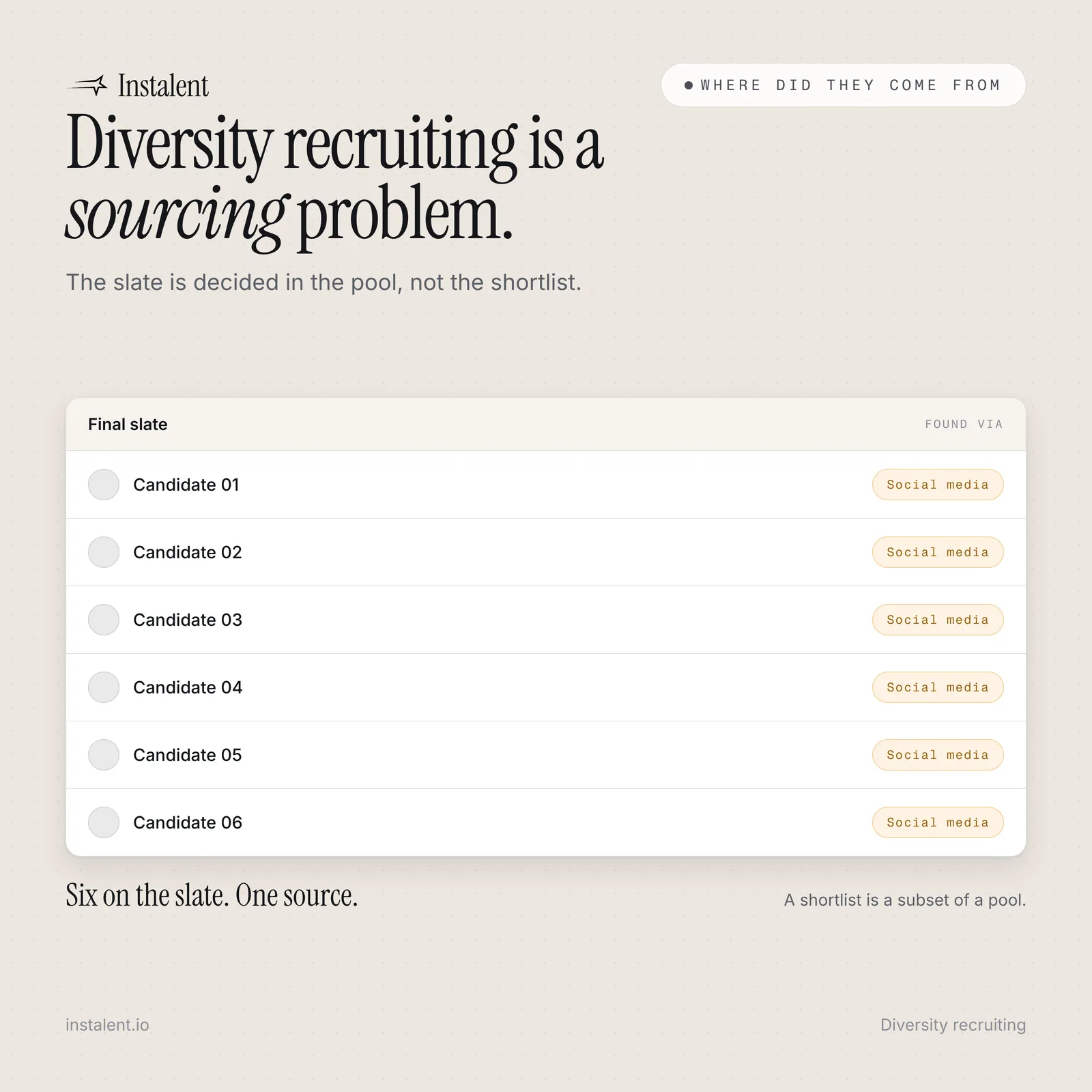
A single network only shows you the slice of people who keep that profile current. Strong passive candidates often have a thin presence on the obvious site and a rich one somewhere else - a maintained open-source repo, conference talks, a portfolio, published writing, patents, professional history. The trick is to describe the work and then sweep wide.
Active vs passive sourcing
| Active sourcing | Passive sourcing | |
|---|---|---|
| Who you reach | People applying now | People doing the work, not looking |
| Signal | Application, resume | Code, projects, role + tenure, history |
| Contact | On file | Must be enriched (email / phone / other channels) |
| Reply rate driver | Job relevance | Personalization + the right channel + timing |
Describe the work, not a title
Titles are noisy - two people with the same title can do wildly different work, and the person you want may carry a title you'd never search for. Describing the work in plain language casts a better net. "Engineer who maintains an open-source data library" or "ops lead who's scaled a support team through a Series B" finds people no job-title filter would surface. This is where natural-language sourcing earns its keep: you state the problem, and the system pulls matching people from across multiple sources rather than one network.
Getting a verified contact you can actually use
A perfect shortlist you can't reach is just a list. Passive people won't come to you, so the contact step is not optional - it's the whole game. Pulling a verified email or phone from multiple vendor sources, rather than guessing a pattern, is the difference between a message that arrives and one that bounces into a filter nobody checks.
- Verify before you write. A bounced first email burns the one clean shot you get with a busy person.
- Pick the channel to the person, not your habit. Some people answer email at 7am; others ignore it entirely and respond on another channel. Match the channel to where they actually are.
- Keep the contact fresh. Roles change; re-check before a second attempt months later.
Passive candidate outreach that earns a reply from a busy person
Active candidates forgive a generic note because they want the job. Passive people don't - they owe you nothing, and a templated blast reads as exactly that. The bar is higher, but the rules are simple.
What works
- Genuine relevance. Lead with the specific work you found - the repo, the talk, the thing they shipped - and why it maps to your role. One concrete sentence beats three paragraphs of flattery.
- Brevity. Respect that they're busy. A note they can read in fifteen seconds and reply to in one line gets answered; a wall of text doesn't.
- A real reason now. "I came across your work on X and we're solving a harder version of the same problem" gives them something to be curious about.
- Good timing and an easy out. Catch a natural moment, make the first ask small (a short call, not a commitment), and make it painless to say "not now."
Common mistakes to avoid
- Spraying the same template wide. It scales nothing but your unsubscribe rate.
- Leading with the job, not the person. Passive candidates aren't reading your job description; they're deciding whether you're worth a reply.
- Over-following-up. Two thoughtful touches beat six nags. Persistence past politeness costs you the relationship.
- Treating a signal as a fact. Don't open with assumptions about why they'd leave - you'll be wrong, and it shows.
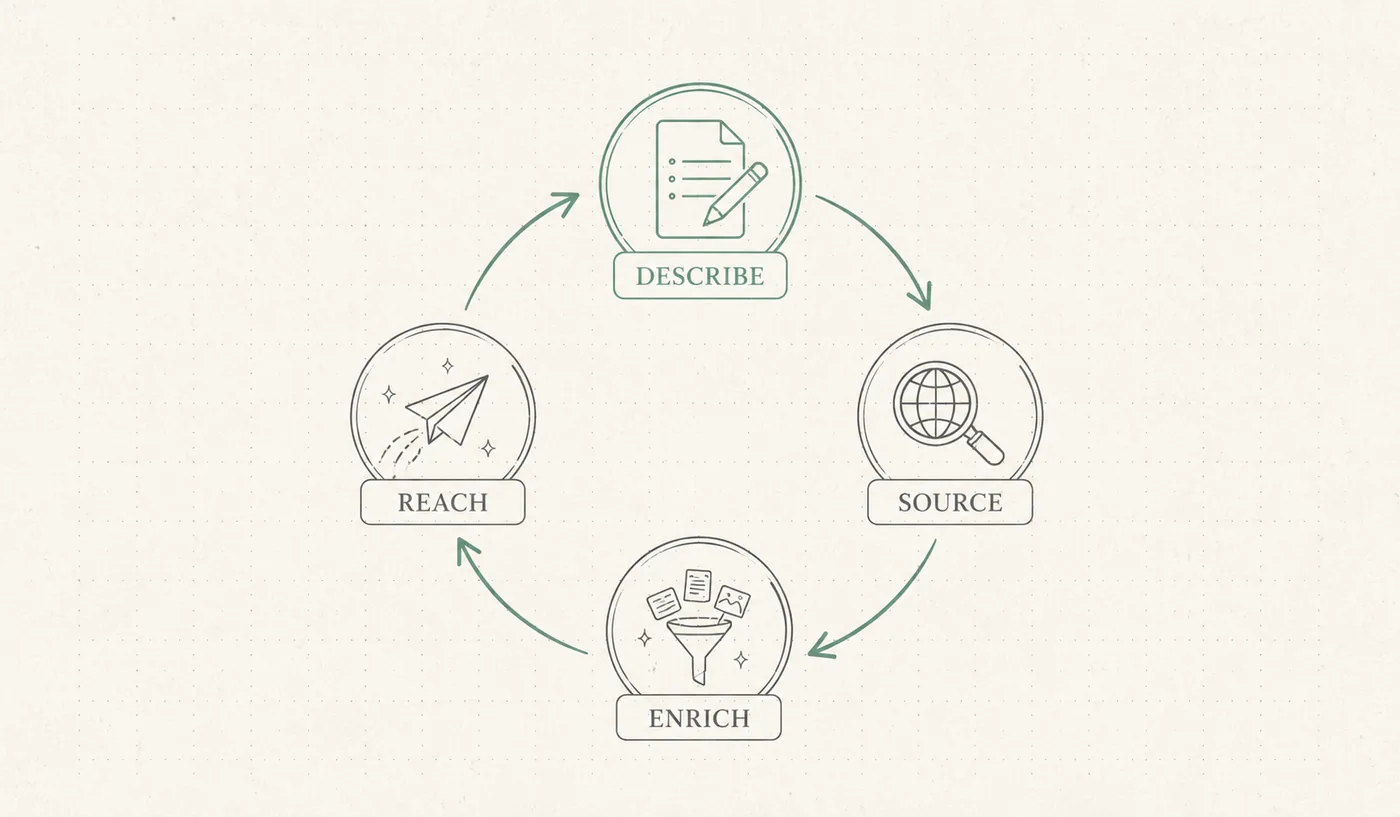
Worked end to end, it's a loop: describe the work, source across signals, enrich a verified contact, then reach out with genuine relevance and good timing.
Instalent runs that loop in one place: natural-language search across multiple sources, dynamic waterfall enrichment for verified email and phone, company buying signals and decision-maker identification, AI scoring against your criteria, then multichannel outreach. Early customers report 74% less time on search. Passive sourcing is one strategy of several - seven candidate sourcing strategies that actually fill roles sets it in context alongside referrals, granted evidence and the warm bench. More on the about page and blog, and the numbers on pricing.
Try a free search - paste your role and watch Instalent source, enrich and score candidates in seconds. Start free →
Related reading: social media recruiting covers which platforms are worth reading as an evidence surface, and which are only good for reach.
Related reading: what is headhunting covers the method behind executive search and how it differs from recruiting.
Sources
Find better candidates, faster
Source, verify and reach candidates on one engine. Get 50% off your first month.
Keep reading