Boolean Search Is Dying: How Natural-Language Sourcing Finds People Boolean Misses
Boolean search forces you to guess the words a candidate used. Natural-language sourcing reads intent - and surfaces the strong profiles Boolean strings skip.
Do this in Instalent - source, verify and reach candidates in one flow.

Boolean search is dying not because the syntax is hard, but because it asks the wrong thing: match my keywords, instead of match my intent.
Boolean search assumes the perfect candidate described themselves with your exact words. Real people don't. A backend engineer who rebuilt a checkout system may never write "payments infrastructure," and a great hire who calls themselves a "generalist" vanishes from a tightly-quoted string. Every AND, OR and NOT you add to fix precision quietly buries someone good. The string isn't broken - the premise is. You're searching for the words people chose, not the work they actually did.
For two decades that trade-off was acceptable because there was no alternative. You learned the operators, built your library of strings, and accepted that some good people would slip through. That floor has moved. Natural-language sourcing now reads a role the way a colleague would, and the gap between "what I asked for" and "who I got back" is closing fast.
What is Boolean search?
Boolean search is a way of querying a database or search engine using logical operators - AND, OR, NOT - to combine and exclude terms, so the results contain exactly the combination of words you specified. The name comes from George Boole, the mathematician whose algebra of true/false values the logic is built on. In recruiting it is used to filter candidate profiles down to those matching a defined set of skills, titles and locations.
That is the whole idea: you are describing a set, not a person.
The Boolean search operators that matter
Five do almost all the work, and the rest is punctuation:
| Operator | What it does | Example |
|---|---|---|
AND | Both terms must appear | python AND django |
OR | Either term may appear | "data engineer" OR "analytics engineer" |
NOT (or -) | Excludes a term | engineer NOT recruiter |
" " | Locks an exact phrase | "machine learning" |
( ) | Groups logic so it evaluates in order | (python OR scala) AND spark |
Two more are worth knowing because they change where you are searching rather than what: site: restricts results to one domain, and intitle: requires the term in the page title.
A Boolean search example, built up in stages
Start with the role, then add constraints one at a time - and notice the cost of each:
"data engineer"                                   ← too broad
"data engineer" AND spark                         ← now a skill is required
("data engineer" OR "analytics engineer") AND spark   ← catches title drift
("data engineer" OR "analytics engineer") AND (spark OR dbt)
  AND "San Francisco" NOT intern                  ← location + exclusion
Each line is more precise and, quietly, smaller. That is the trade the rest of this article is about.
Google and LinkedIn behave differently
A Google Boolean search runs against public pages, so site: is the operator that matters most - site:github.com "data engineer" spark searches profiles Google has indexed rather than a candidate database. Note that Google dropped support for the + operator years ago and treats many strings loosely, so long queries degrade rather than fail loudly.
A LinkedIn Boolean search runs inside LinkedIn's own index and supports AND, OR, NOT, quotes and parentheses in the keyword field - but not site: or intitle:, because there is only one site. LinkedIn also caps how much of a long string it honours, which is why a query that looks rigorous can silently return a narrower slice than you intended.
X-ray search is Boolean pointed at someone else's site
X-ray search is the recruiter name for using site: to search a single platform through Google rather than through that platform's own search box - site:github.com "site reliability engineer" kubernetes, for example. It exists because a public search engine sometimes indexes pages that a platform's internal search hides behind filters, logins or result caps.
It is worth understanding because it is still genuinely useful for public-profile sites, and worth being realistic about because it inherits every weakness in this article plus one of its own: you are searching Google's cached idea of a page, so freshness is whatever the crawler last saw. A candidate who changed roles last month may still x-ray as their old title.
If you want the operator-level detail and the strings that still hold up, Boolean search strings for recruiters is the practical companion to this piece. What follows here is the argument about when it is the wrong tool.
What Boolean actually does well
It's worth being honest about why Boolean lasted this long. When you know exactly what you're looking for and the population uses consistent language, a tight string is fast, transparent, and repeatable.
- It's explicit. Every result is there because it matched a clause you can point to. Nothing is hidden behind a ranking you can't inspect.
- It's portable. A good string runs the same way across most search surfaces, so you can reuse it and hand it to a teammate.
- It's precise on hard constraints. A required certification, a specific clearance, an exact employer name - Boolean nails the things that genuinely are binary.
Keep that list in mind, because none of it disappears. The problem isn't that Boolean is bad at matching strings. It's that matching strings is the wrong job for most of the roles you're sourcing today.
Where Boolean breaks down
Synonyms and title drift
Job titles are local dialects. "Data engineer," "analytics engineer," "ETL developer," and "platform engineer" can describe overlapping work depending on the company. To catch them all you end up writing something like:
("data engineer" OR "analytics engineer" OR "ETL developer" OR "ELT developer"
 OR "data platform engineer" OR "BI engineer") AND ("Spark" OR "dbt" OR "Airflow"
 OR "Kafka" OR "streaming") AND ("Python" OR "Scala") NOT (intern OR junior OR student)
That string is already fragile, and it still misses the person who titles themselves "software engineer" but spent two years building the streaming layer you care about. Every synonym you forget is a candidate you never see.
False precision
A long string feels rigorous, but length is not the same as accuracy. Each NOT clause you add to clean up the noise also silently excludes legitimate profiles - exclude "junior" and you lose the senior person whose bio mentions mentoring juniors. The query looks tighter while quietly getting blinder. You can't tell the difference between "this returned a clean list" and "this returned a small list."
Constant maintenance
Tools, frameworks, and titles churn. A string that worked last year now over-indexes on a framework that's falling out of favor and ignores the one that replaced it. Maintaining a strong Boolean library is a real, recurring job - and it's invisible work that nobody schedules time for.
Knowledge locked in one person's head
The best Boolean operators on a team carry their craft in their heads. When that person is on leave, leaves the company, or just gets busy, the quality of sourcing drops with them. The strings might live in a doc somewhere, but the judgment about when to use which one doesn't transfer.
Boolean vs natural-language sourcing
| Boolean search | Natural-language sourcing | |
|---|---|---|
| You provide | Exact keywords + operators | A plain-English description of the role |
| Finds | Profiles that used your words | Profiles that match the intent |
| Synonyms / titles | You must list them all | Inferred automatically |
| Failure mode | Misses people who phrase it differently | Ranks by relevance, you refine in words |
| Who can run it | Whoever knows the syntax | Anyone who can describe the role |
| Maintenance | Strings rot and need rebuilding | You re-brief in words as the role shifts |
The test
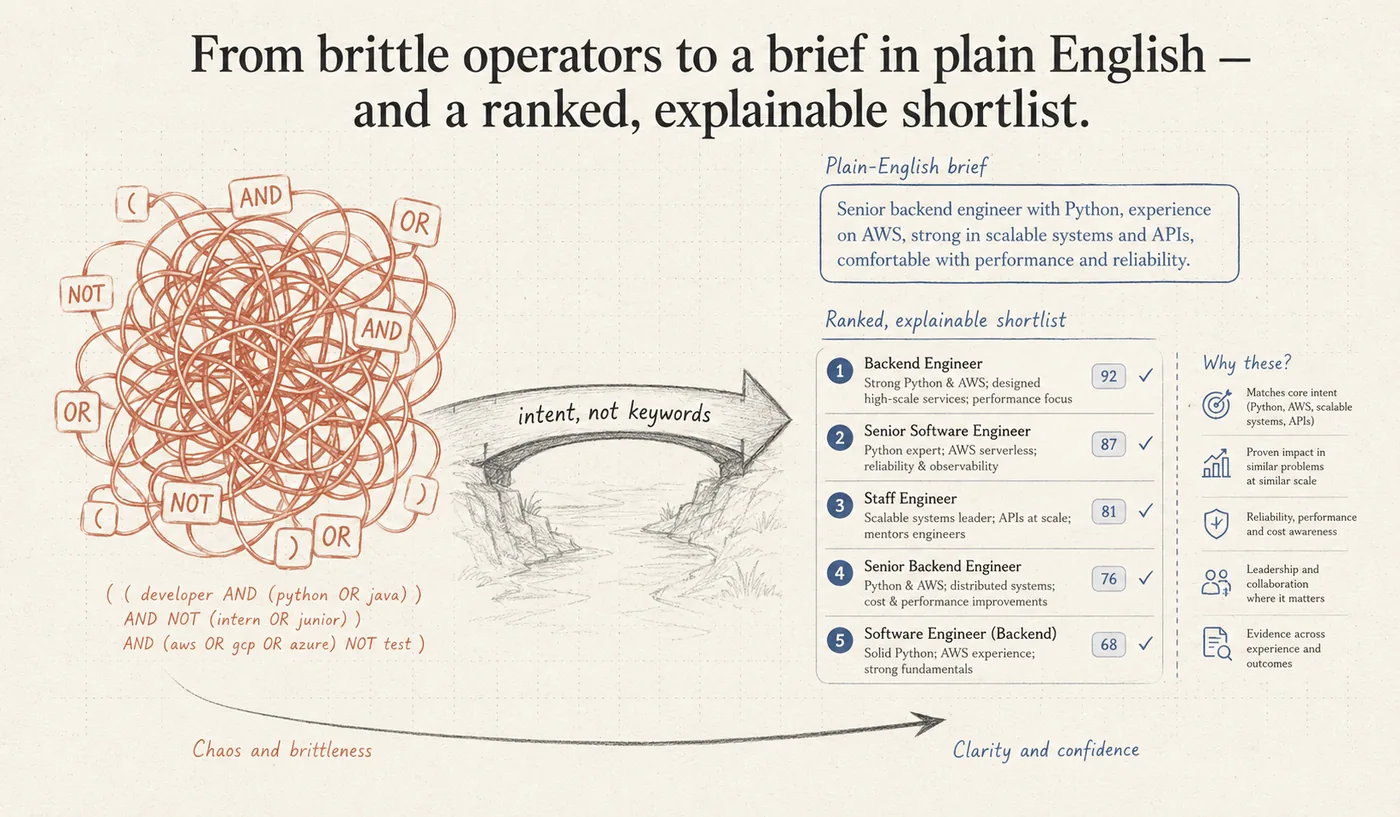
Write your search the way you'd brief a colleague: "senior data engineer who has scaled streaming pipelines at a startup." Boolean can't read that. Natural-language sourcing can - and so can Instalent.
What natural-language search changes for a recruiter
The shift is less about syntax and more about where your effort goes. Instead of translating a role into operators and then debugging the operators, you describe the role and spend your time judging the shortlist.
- You describe outcomes, not keywords. "Backend engineer who's owned a payments system at scale" captures the checkout-rebuild candidate that no title filter would have caught.
- Synonyms and adjacent titles come for free. You don't have to remember every label the market uses for the same work - the system infers the neighborhood instead of demanding the exact word.
- You refine in plain language. Too many agency-side profiles? Say so. Want more people from product-led companies? Ask. There's no string to surgically edit and re-test.
- The result is explainable. A ranked list with a reason beats a flat list with no order. You can see why someone surfaced and decide whether you agree.
The candidates Boolean misses are usually the passive ones - happy in role, not optimizing their profile for recruiter keywords. Natural-language search reads the shape of someone's experience across sources (code, projects, history), not just the nouns on a profile. You stop maintaining 200-character search strings and start describing who you actually want.
Where Boolean still earns its keep
This isn't a eulogy for keywords altogether. There are searches where a precise clause is exactly the right tool, and pretending otherwise just trades one blind spot for another.
- Hard, binary requirements - a specific license, a named former employer, a security clearance. When the constraint really is yes/no, say it explicitly.
- Compliance and audit trails - when you need to prove why a list was filtered the way it was, an explicit clause is easier to defend than a ranking.
- Known, stable populations - small fields with consistent vocabulary where a curated string still beats inference.
For the searches that still deserve a string, it's worth knowing which operators actually survive: Boolean search strings for recruiters covers the six refinements Google still documents, what changed when the results page shrank in 2025, and the strings that hold up in 2026.
The future isn't Boolean or natural language. It's describing intent first, then layering a few hard constraints on top - the plain-English brief does the sourcing, and the explicit filters handle the non-negotiables.
How to transition without losing rigor
You don't have to throw away years of craft to make this work. The judgment behind your best strings is the valuable part; the syntax was just the delivery mechanism.
Make the switch gradually
Run your trusted Boolean string and a plain-English brief side by side on the same role. Compare the shortlists. The profiles natural-language surfaces that your string missed are exactly the people the old method was costing you.
A few practical moves:
- Translate your intent, not your string. Don't paste the operators - write the sentence you'd say to a hiring manager about who's great in this role.
- Front-load the must-haves. Lead with the non-negotiables, then describe the nice-to-haves, so the ranking reflects what actually matters.
- Trust the list, then refine in words. Treat the first shortlist as a draft. Adjust by re-describing, not by re-engineering a clause.
- Keep your hard filters. Where a binary constraint matters, keep stating it explicitly - that's still the right tool.
Done this way, the rigor doesn't leave - it moves from the syntax into the brief, where the whole team can read it. Instalent turns that brief into a ranked table across the open web - GitHub, company profiles, forums, professional signals and more - identifies decision-makers and intent signals, then enriches verified contacts and scores each profile against your criteria - so the shortlist is ready to act on, not just to admire. More on how it works and the blog.
Try a free search - paste your role and watch Instalent source, enrich and score candidates in seconds. Start free →
Sources
Find better candidates, faster
Source, verify and reach candidates on one engine. Get 50% off your first month.
Keep reading