How to Reach the Actual Decision-Maker - With Verified Contacts
To reach the decision-maker - the VP of Engineering or Head of Talent who owns the hire - you need the right name and a verified email or phone, not a contact form.
Do this in Instalent - find companies hiring now and reach the decision-maker.
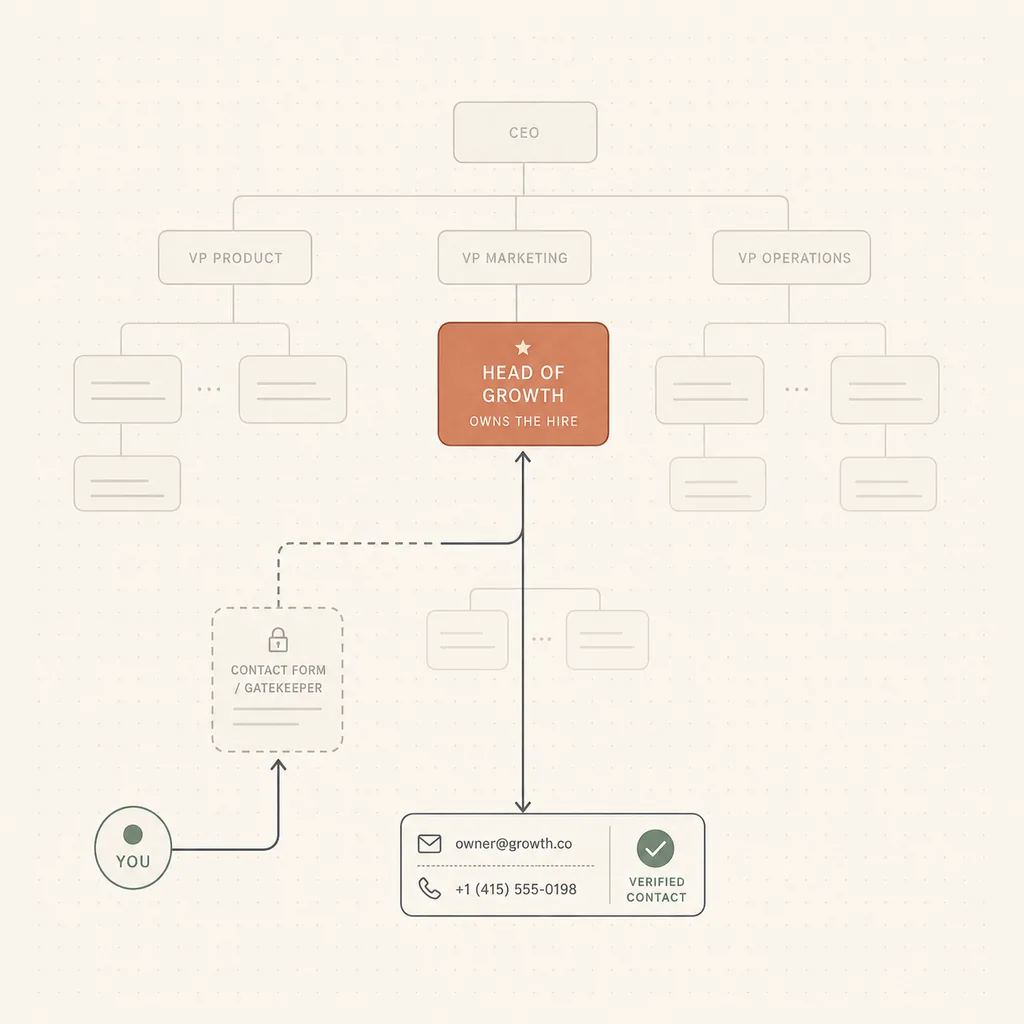
Most outreach dies one layer too low. To reach the decision-maker who actually owns the hire, you need two things: the right person, and a verified way to contact them directly.
You can write a flawless pitch and still lose if it lands in the wrong inbox. Pitch the wrong person and you don't just get ignored - you get politely forwarded into a queue you'll never climb out of. To reach the decision-maker - usually a VP of Engineering, Head of Talent, or founder - you have to do two unglamorous things in order: figure out who owns the decision for that specific role, then get a verified contact instead of a generic info@ address or a message that sits unread on a platform they barely check. Everything else in this post is detail on those two moves.
Who the real decision-maker is: who owns the hire
The first mistake recruiters make is assuming the owner is the same at every company. It isn't. Ownership of a hire shifts with company size and stage, and the title on the org chart tells you less than the headcount around it.
Read the size and stage first
- Seed and early stage (under ~30 people). The founder or CEO usually owns every senior hire personally, and often the junior ones too. There's no TA function to route around - you're talking to the person with the budget directly.
- Growth stage (~30–250). A first Head of Talent or in-house recruiter has usually appeared, but the hiring manager - the VP or Head of the function - still drives the decision. Talent runs the process; the manager picks the human.
- Larger companies (250+). A real TA org exists, with recruiters mapped to business units. Here the recruiter or TA lead is often your genuine entry point, not a gatekeeper to bypass - they shortlist, and the manager signs off.
Match the owner to the role
| Role you're filling | Likely decision-maker | What they care about |
|---|---|---|
| Engineering | VP/Head of Engineering | Speed, technical signal, low noise |
| Recruiting partnership | Head of Talent / TA Lead | Quality of shortlist, time saved |
| Exec / leadership | Founder / CEO | Trust, discretion, track record |
The table is a starting point, not a rule. At a 20-person startup, the "Head of Talent" column collapses into the founder. At a 2,000-person company, a single VP of Engineering may own none of the day-to-day hiring and a director two levels down owns all of it. The work is identifying which person holds the pen for the role in front of you - and that's a per-company question, not a per-title one.
Verified or it didn't send
A name without a working email or phone is a guess. Always confirm the contact is verified before you invest in a personalized message - otherwise your best outreach never arrives.
From a target company to a verified contact you can use
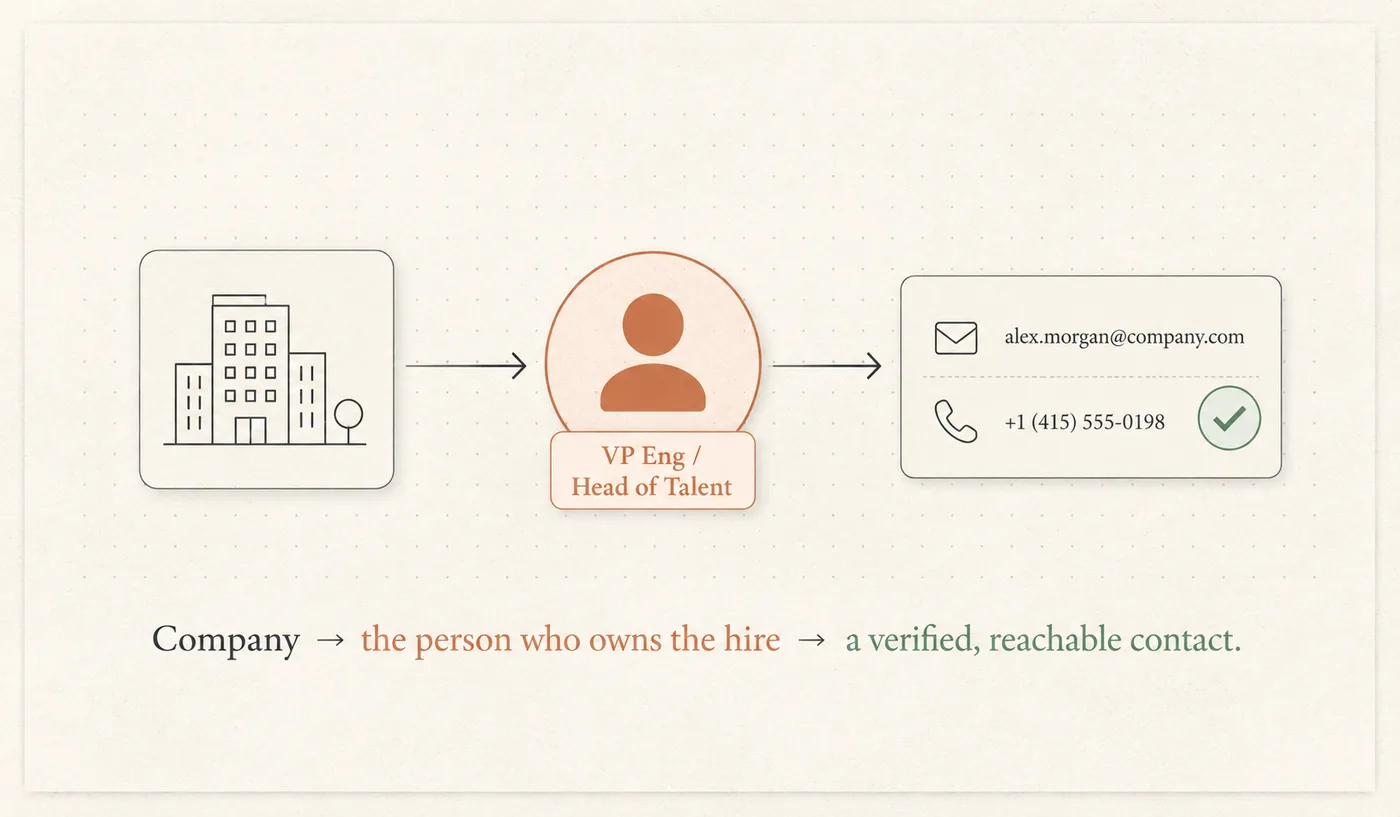
The chain is simple to describe and tedious to do by hand: identify the company, find the person who owns the decision, then get a verified email or phone for them. The bottleneck is almost never finding a name - it's getting a reachable one.
Why info@ is where outreach goes to die
A generic inbox is a shared resource, which means it's nobody's responsibility. Careers and info addresses are triaged by whoever has a spare ten minutes, filtered hard for anything that looks like a pitch, and rarely forwarded to the person who'd actually care. You can write the best opener of your career and it will still be read - if at all - by someone with no authority to act on it. A verified direct line skips that entire failure mode.
Where enrichment earns its keep
Instalent compresses the chain: surface the decision-makers behind a company's hiring, funding, or leadership-change signals, then run dynamic waterfall enrichment across multiple vendor sources to return a verified email or phone so your first touch reaches a real inbox. The point of pulling contacts from several sources and verifying them isn't volume - it's confidence. When you've spent twenty minutes crafting a message tied to a specific trigger, you want to know it's going somewhere a human will actually open it.
Decision-maker outreach: write an opener tied to a real trigger
Reaching the right inbox gets you nothing if the first line reads like a template. The decision-makers you most want to reach get the most cold outreach, so the bar for "worth replying to" is high. The thing that clears it is relevance they can verify in one glance.
Lead with the trigger, not your pitch
A buying signal - a fresh funding round, a sudden burst of hiring on a team, a new VP who just started - is a reason for the outreach to exist now. Open with it. Imagine writing to a fictional "Dana Okafor, VP of Engineering at Northwind Labs" who just closed a round and posted three backend roles: a line like "saw you're scaling the platform team after the raise - I work with backend engineers who've shipped at that stage" lands because it's specific and obviously not blasted to a thousand people. The opener proves you did the work before you asked for anything.
A quick checklist for the first message
- Name the trigger in the first sentence - the round, the role, the change. No trigger, no reason to read on.
- Be specific about what you bring, not generic about who you are. "Backend engineers who've scaled payments" beats "top talent."
- Make one small ask. A reply, not a meeting. Lower the cost of saying yes.
- Keep it short enough to read on a phone between meetings, because that's where it'll be read.
Follow up without becoming noise
One touch is not a campaign. The single most common reason good outreach fails is that it stops after the first email - the decision-maker was in a meeting, the message slipped down the inbox, and silence got read as a no. It usually wasn't.
Tasteful multichannel, not relentless
Use email and other channels in a measured sequence: space your follow-ups out, change the angle each time rather than resending the same note, and give every touch a fresh reason to exist. Instalent supports multichannel outreach so a sequence can run across email and other channels from one workflow - but the discipline is yours. Two or three thoughtful, well-spaced touches outperform a daily barrage every time, and they don't burn the relationship for the next role you'll want to fill at that same company.
The mistakes that quietly cost you replies
Pitching one rung too low and hoping it gets forwarded. Opening with a template instead of a trigger. Trusting an unverified address. And giving up after a single touch. None of these feel like errors in the moment - they just look like silence.
Skip the gatekeeper queue and open with the person who can actually say yes. More on the about page, pricing, and the blog.
Try a free search - paste your target and watch Instalent surface decision-makers and verified contacts in one workflow. Start free →
Sources
Find your next client before your competitors do
Spot companies that are hiring, reach the decision-maker and win the brief. Get 50% off your first month.
Keep reading