Candidate Enrichment & Buying Signals: A Plain-English Glossary for Recruiters
A recruiter's glossary of candidate enrichment, buying signals, natural-language sourcing and the other AI sourcing terms worth knowing in 2026.
Do this in Instalent - find and verify the contact details for your shortlist.
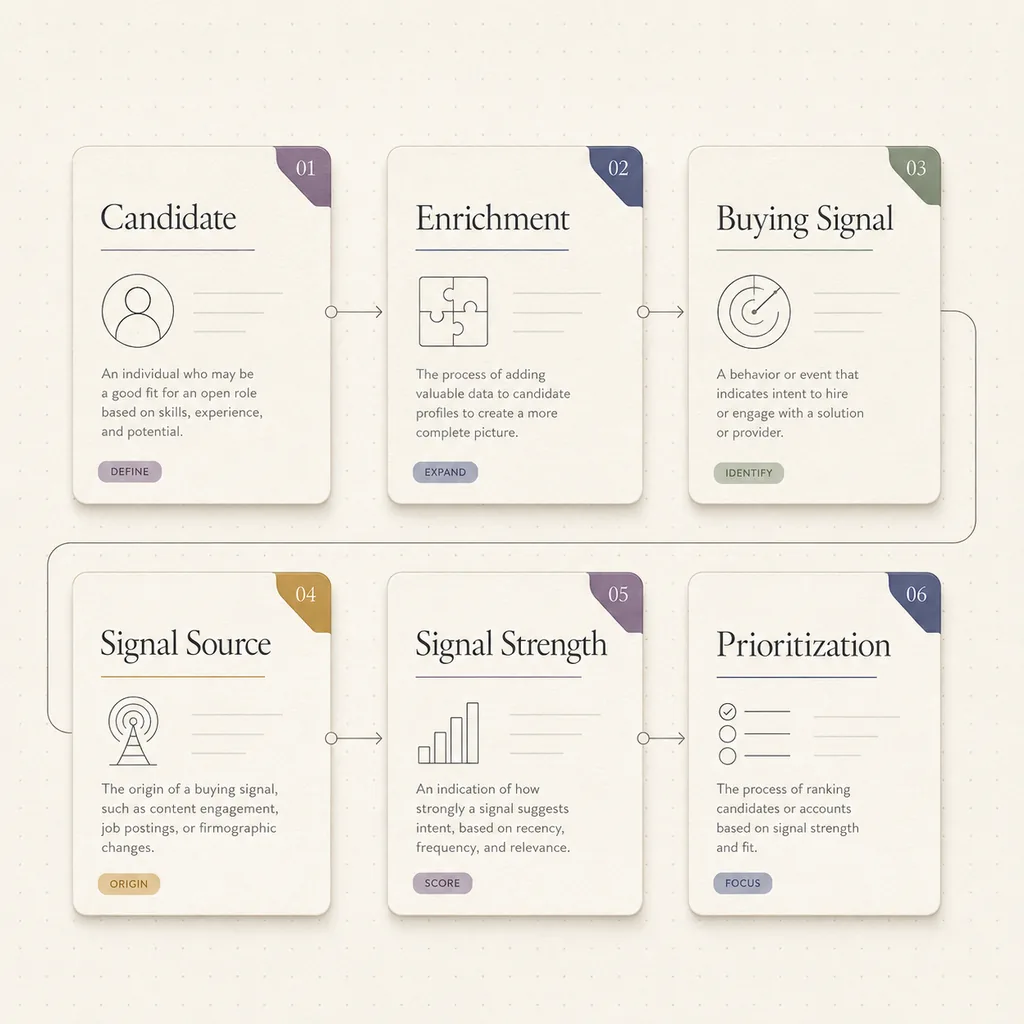
AI sourcing has its own vocabulary, and half of it gets used without ever being defined. This is a plain-English glossary of the terms that matter most - candidate enrichment and buying signals first - so the rest of the toolkit makes sense and you can tell a real capability from a buzzword.
When you move from Boolean strings to AI sourcing, the words change before the work does. The two phrases you'll hear constantly - candidate enrichment and buying signals - are also the two most loosely used. Below, each term gets a plain definition and a short note on why it actually matters to your day, grouped so related ideas sit together.
Candidate enrichment terms, defined
Candidate enrichment
Enrichment is the step of attaching reachable, verified contact details - primarily work and personal email and phone - to a profile you've already found. A name and a job title tell you who someone is; enrichment tells you how to reach them without guessing at an address. It runs after search, on the shortlist you actually care about, rather than on every result.
Why it matters: A shortlist without contacts is just a list of names. Most pipelines stall here, not at search, so the quality of your enrichment usually decides how many real conversations you start.
Verified contact
A verified contact is a piece of contact data - typically an email or phone number - that has been checked against a live signal rather than pattern-guessed from a name and company domain. Verification reduces the chance you're emailing an address that bounces or calling a number that's dead. It's the difference between "probably correct" and "checked."
Why it matters: Unverified guesses quietly inflate your bounce rate, which over time damages your sending reputation and gets your good emails filtered too. Verified contacts protect the channel, not just the single message.
Waterfall (multi-vendor) enrichment
No single data provider has everyone, so waterfall enrichment queries several vendors in priority order until a verified contact comes back, instead of betting everything on one source. If the first vendor has no record, the request moves to the next, and so on. Instalent runs this as dynamic waterfall enrichment across multiple vendors automatically, so you get the best available result without juggling tools yourself.
Why it matters: Coverage from any one source is patchy and uneven by region and seniority. Stacking vendors means fewer profiles end up unreachable, which is the entire point of enriching in the first place.
Match rate
Match rate is the share of profiles for which an enrichment process returns any usable contact detail. If you enrich 100 shortlisted people and get a working email or phone for 70, your match rate is 70%. It's a practical yardstick for how reachable a given pool will be before you start outreach.
Why it matters: It sets your realistic top-of-funnel. A low match rate means you'll need a bigger shortlist to hit the same number of conversations, so it's worth knowing per source and per role type rather than assuming.
Data coverage
Coverage describes the breadth and depth of a vendor's underlying data - which industries, geographies, seniority levels and contact types it actually holds. Two vendors can advertise the same features and still differ wildly in who they can find. Coverage is why one source nails European engineers and another shines for US sales leaders.
Why it matters: Coverage gaps explain mysterious misses. When a profile won't enrich, it's usually a coverage problem, not a broken tool - and the fix is a different source, which is exactly what a multi-vendor approach gives you.
Deliverability
Deliverability is the likelihood that a message you send actually lands in the recipient's inbox rather than bouncing or getting filtered to spam. It depends on contact accuracy, your domain reputation and how you send. Verified contacts and clean lists are the foundation; everything else is sending hygiene.
Why it matters: You can do everything upstream right and still get nowhere if messages don't arrive. Treating deliverability as part of sourcing - not a separate email problem - keeps your effort from leaking out at the last step.
Intent data and buying-signal terms, defined
Intent / buying signal
A buying signal is a public event that suggests an organization is more likely to hire or buy right now - a fresh funding round, a wave of open roles, a new leader, an expansion announcement. Intent is the broader idea: observable behavior that hints at timing. Signals don't guarantee a need, but they tell you where to look first.
Why it matters: Timing beats volume. Reaching a company in the window when it's actually expanding is far more productive than blasting a static list, whether you're sourcing candidates or finding clients.
Hiring signal
A hiring signal is evidence that a company is actively growing a team - a sudden cluster of open roles, repeated postings for the same function, or a stated plan to expand a department. It points to where headcount is moving before anyone updates their title.
Why it matters: For agency recruiters it flags accounts likely to have live reqs; for in-house teams it reveals competitors poaching from the same talent pool, so you can move before they do.
Funding signal
A funding signal is a newly announced raise - seed, Series A and beyond - that typically precedes a hiring spree, since fresh capital usually funds new headcount. The size and stage hint at how aggressive that growth might be.
Why it matters: A recently funded company is often weeks away from opening roles. Getting in early, before the job ads go live, is one of the cleanest timing advantages in sourcing.
Leadership-change signal
A leadership-change signal is a new executive or department head stepping into a role - a fresh VP of Engineering, Head of Talent or CRO. New leaders tend to restructure, backfill and build out their own teams within their first months.
Why it matters: A leadership change is a reliable precursor to a wave of hiring and to shifting priorities. It also tells you who now owns the decisions you care about.
Decision-maker
The decision-maker is the person who actually owns the outcome you want - the hiring manager for a role, or the budget holder for a deal - not the generic inbox you reach by default. On the talent side that's often a VP of Engineering or Head of Talent; on the client side, a department or revenue lead. Instalent helps identify these people and enrich a direct contact for them.
Why it matters: Reaching the right person turns a forwarded email into a real reply. Identifying the decision-maker is frequently the highest-leverage step between a signal and a conversation.
ICP (ideal candidate / customer profile)
Your ICP is a crisp description of who you're actually after - the candidate archetype for a role, or the company archetype for outreach - defined by the traits that genuinely predict fit. It's the standard everything else gets measured against. A sharp ICP makes natural-language sourcing and AI scoring far more accurate, because the tool has a clear target to match.
Why it matters: Without a defined ICP, "good fit" is a gut call that drifts from one recruiter to the next. Writing it down is what lets you score consistently and explain your shortlist.
Why enrichment is the bottleneck
Sourcing finds the person; enrichment makes them reachable. A shortlist without verified contacts is just a list of names - which is why enrichment, not search volume, is usually what slows a pipeline down.
How enrichment and buying signals fit together
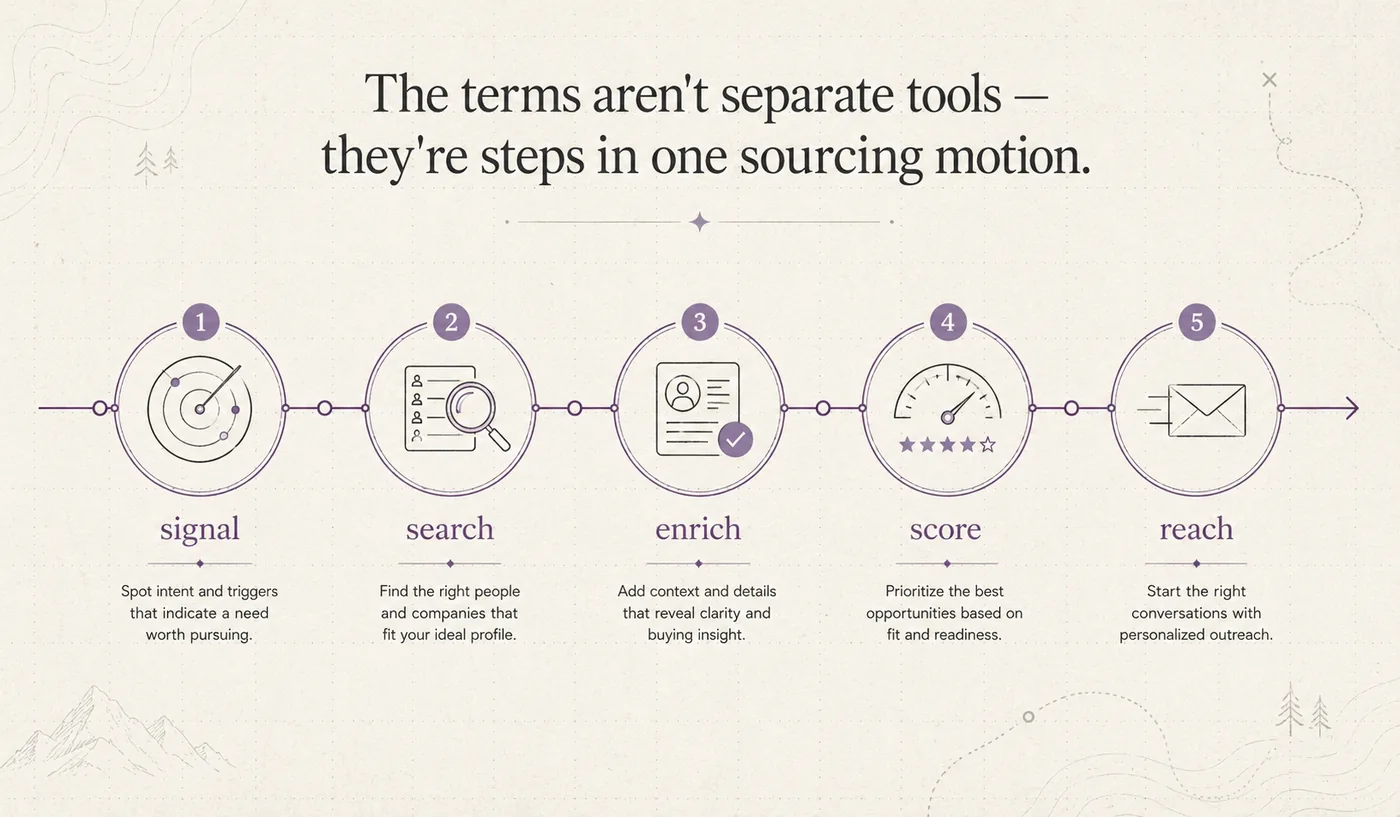
These aren't separate tools so much as steps in one motion: read the signal, find the person, enrich the contact, score the fit against your ICP, then reach out. Instalent runs that sequence end to end - natural-language search across multiple sources, multi-vendor enrichment, AI scoring against your criteria, ATS connections, and multichannel outreach - with company intent and decision-maker identification for the client side.
New to the method? Start with the sourcing playbook post, compare plans on pricing, see the full product, or read more about us.
Try a free search - paste your role and watch Instalent source, enrich and score candidates in seconds. Start free →
Sources
Verified contacts for your whole shortlist
Find and verify email and phone for the people you actually want to reach. Get 50% off your first month.
Keep reading