Recruiting Trends 2026: The Hiring Problem Is No Longer Access. It's Signal.
The recruiting trends 2026 data agrees on one thing: reach is solved and signal is scarce. Six shifts, each with a cited number, and what a signal-first desk does differently.
Better signals, not bigger lists. Instalent scores, verifies and reaches the people who fit.
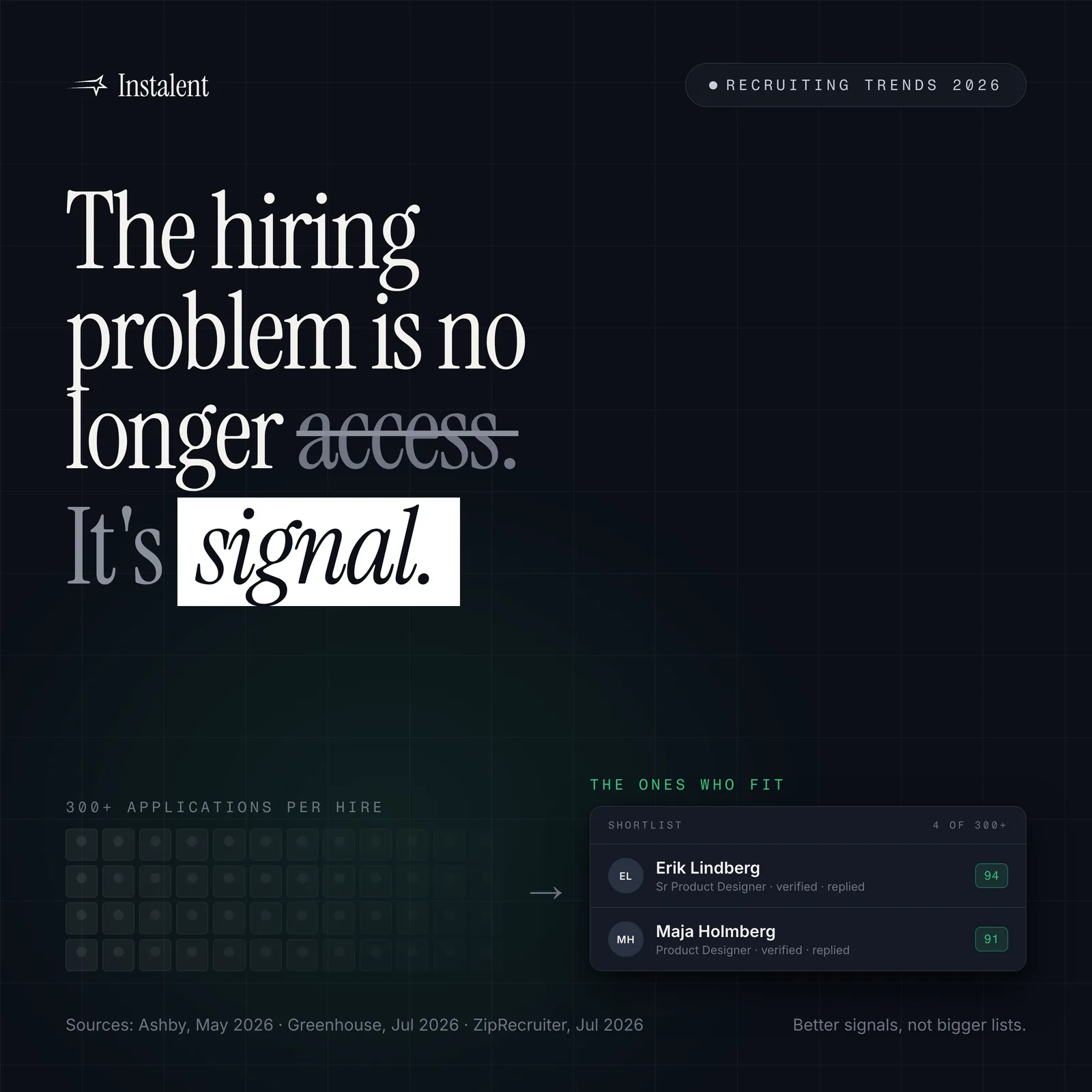
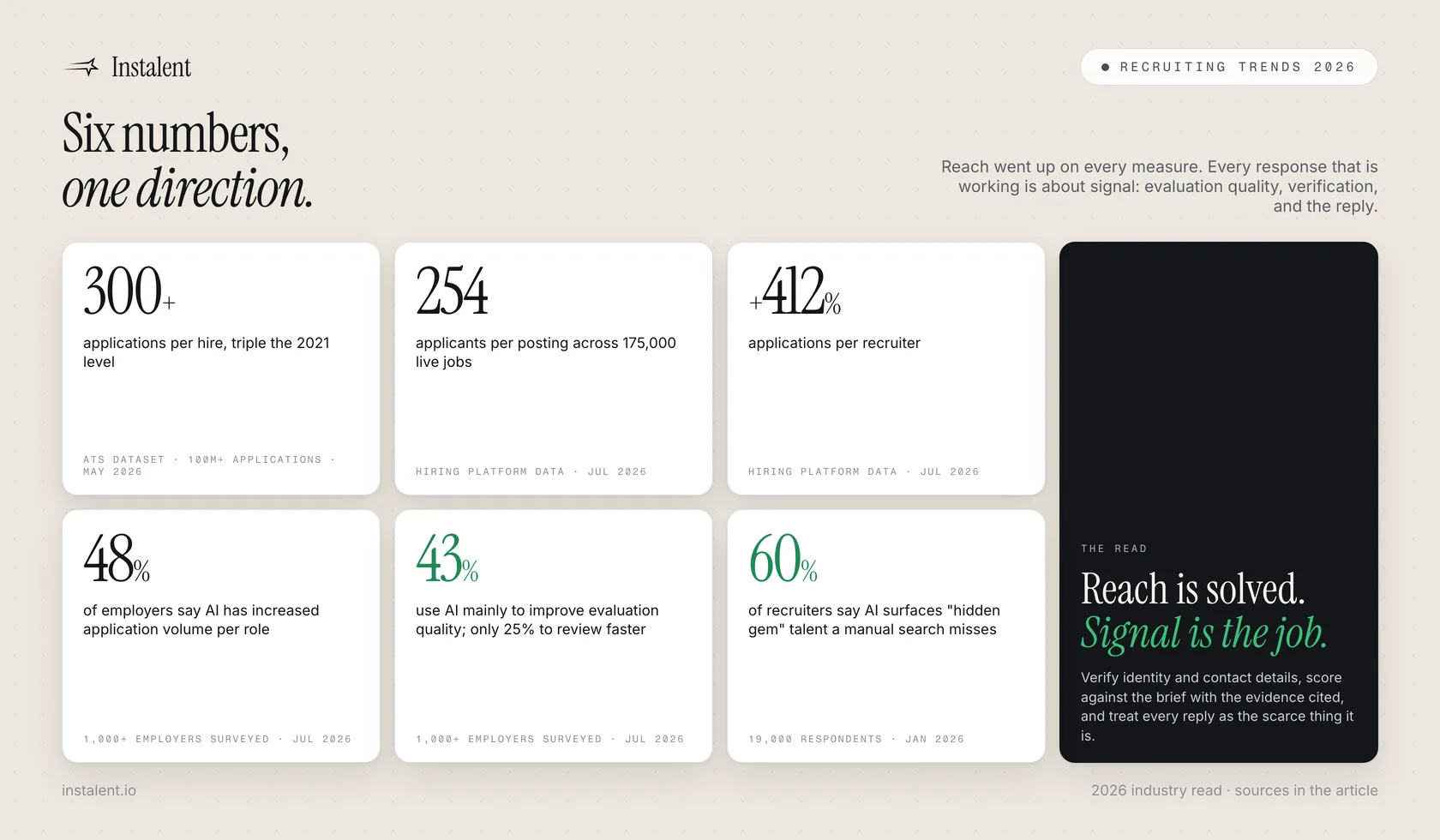
For most of the history of this trade, the hard part was access. Finding the people, getting a name, getting a number. That constraint is gone. Ashby's May 2026 analysis of more than 100 million applications across 200,000 jobs found roles now receive more than 300 applications per hire, triple the 2021 level. Greenhouse counts around 254 applicants per posting across 175,000 live jobs. LinkedIn's research says US applicants per open role have doubled since spring 2022. Every recruiting trends 2026 report reads the same way once you look past the headline: reach is abundant, and the scarce thing is signal. Who is real, who is right, who will actually move. That is now the job, and the desks that treat it as the job are pulling ahead.
Recruiting trends 2026, in one sentence
Every serious dataset this year tells the same story from a different angle. Volume is up, sharply, on the inbound side. The tooling that produced the volume is now being turned on it. And the people winning are not the ones with the biggest lists but the ones who can tell, fastest and most reliably, which of 300 applications and which of 3,000 search results are worth an hour of a hiring manager's time.
Here are the six shifts underneath that, each with the number that proves it.
1. Reach is solved
A recruiter in 2026 has more reach than at any point in the history of the job. More than 300 applications per hire on average, according to Ashby, from a dataset large enough to be believed. Around 254 applicants per posting on Greenhouse, with applications per recruiter up 412%. Applicants per open role in the US doubled since spring 2022, per LinkedIn. And on the outbound side, search and enrichment tools can put a verified email in front of you for almost anyone with a public professional footprint.
That is abundance, and it should be read as abundance. The desks that are struggling are not short of people. They are short of a way to sort them, which is a very different problem with a very different fix.
2. Employers are pointing AI at judgement, not at speed
ZipRecruiter asked more than 1,000 talent acquisition professionals and hiring managers in June 2026 what they actually use AI for. The top use case was improving the quality of candidate evaluations, at 43%. Using AI purely to review more candidates faster ranked lowest, at 25%. Just under half (48%) said AI had increased the volume of applications per role, and 34% said it had sped their process up.
Read those together and the industry's answer is clear: the flood is real, and the response is better evaluation rather than faster rejection. That is the right instinct. A screen that is only faster produces the same shortlist sooner. A screen that is better against a written brief, with the evidence cited, produces a different shortlist. That is the difference between candidate analysis that scores against your must-haves and a keyword filter that rewards whoever wrote the best-optimised résumé.
3. Verification is a recruiting skill now
Gartner's July 2025 research is the clearest statement of why. In its survey of 3,290 candidates, 39% said they used AI during the application process, most often to generate résumé and cover-letter text. In a separate survey of 3,000 candidates, 6% admitted to interview fraud, posing as someone else or having someone pose as them. Gartner's forecast is that by 2028 one in four candidate profiles worldwide will be fake.
None of this is a reason to distrust candidates. Most people using AI on an application are doing what LinkedIn's UK country manager advised candidates to do in January: use it to tailor the application to the role. It is a reason to treat verification as a step, not an afterthought. On a signal-first desk that means three things: verified identity, verified contact details from more than one source, and claims checked against evidence (the code they shipped, the deal they closed, the team they ran) rather than the sentence that describes it. Contact enrichment that confirms a number is live and a mailbox exists is the least glamorous part of that and the part most desks skip.
4. Outbound is where the signal lives
There is a pool the flood has not reached: the people who never applied. LinkedIn's research, quoted by its UK country manager in January 2026, found 60% of recruiters saying AI is now surfacing "hidden gem" talent, people a manual search would have overlooked because the match was in the skills rather than the title. In the same research, 93% of recruiters said they plan to increase their use of AI in 2026.
Ashby's numbers show why the inbound funnel alone cannot carry a desk: candidates today are roughly 50% less likely to receive an interview than they were five years ago, because the same number of interview slots is being divided among three times the applicants. The passive candidate who is found, scored against the brief and contacted with a specific reason is a stronger signal at every stage than the 301st applicant. We set out the yield maths in outbound recruiting in 2026; the short version is that AI candidate sourcing against a written brief is the cheapest signal you can buy.
5. Speed is a signal, and the good desks are getting faster
The same Ashby report has the positive half of the story. Hires per recruiter have recovered to roughly seven a quarter despite the volume. Offer conversion rates have surpassed 2021 levels. Time to first fill has settled at about eight weeks for business roles and ten for technical ones.
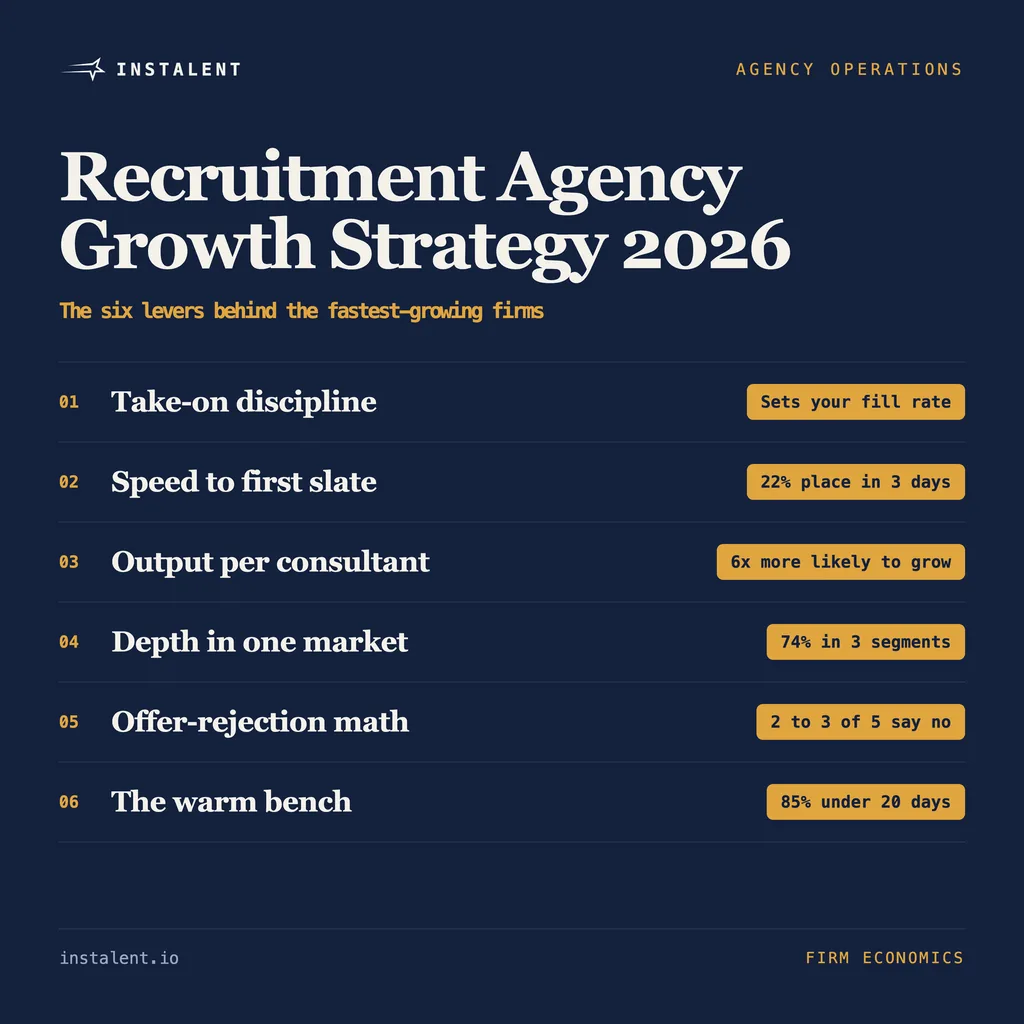
That is what it looks like when a function adapts to its new constraint. Speed to a credible shortlist, rather than speed to the first submittal, is the metric that separates the agencies growing from the ones treading water; we built the agency growth strategy around it. A hiring manager who receives four verified, scored, reachable people in three days is receiving a signal about the recruiter as much as about the candidates.
6. Intent is the scarcest signal of all
Greenhouse CEO Daniel Chait put it plainly in July 2026: "This is the first time when really both sides have been unhappy. The market just isn't working for either side." His answer is the same one this post has been circling. When effort is scarce it forces real intent, and intent becomes a signal employers can trust.
On a desk that means the reply is the asset. A candidate who answers a specific, well-timed message has told you something no application can. Treat it accordingly: stop the sequence the moment they reply, answer the same day, and route every response into one place where nobody's "not now, ask me in March" gets lost. That is a workflow problem more than a tooling one, and recruitment reply management covers how to run it.
What the numbers do not say
None of these sources measure quality of hire, and none of them can tell you whether the 300 applications on a given role contain the right person. They measure volume, process speed and adoption. The argument of this post is an inference from them: when reach becomes cheap, the value moves to whatever is still expensive, and in 2026 that is judgement, verification and a real conversation.
What a signal-first desk does on Monday
| The volume habit | The signal habit |
|---|---|
| Post the role and wait for the pile | Write the brief first, then source against it |
| Sort applications by keyword match | Score every profile against the same rubric, evidence cited |
| Send whatever contact detail the profile shows | Verify identity and contact details from more than one source before the first touch |
| Measure messages sent | Measure verified reach, reply rate and speed to a credible shortlist |
| Chase everyone who applied | Answer everyone who replied, the same day |
| Report activity to the client | Report signal: who is real, who fits, who will move |
Most of the right-hand column is craft that experienced recruiters already have. What changed in 2026 is that the left-hand column stopped working, so the craft is now the whole job.
Want to run the right-hand column without adding headcount? Instalent finds the people who fit a written brief, verifies how to reach them, scores them with the evidence cited, and runs the outreach and the replies in one place. Get started, or see how it fits an agency desk.
Related reading: the state of AI sourcing in 2026 for the adoption data, skills-based hiring for sourcers for what "hidden gem" matching actually looks like, and candidate engagement for the four metrics worth keeping.
Sources
- Ashby - New Data from Ashby Reveals Surge in Applications, Rising Selectivity, and Shifting Recruiter Workloads (7 May 2026; more than 100 million applications and 200,000 jobs: applications per hire tripled since 2021 to more than 300; candidates roughly 50% less likely to receive an interview than five years ago; hires per recruiter recovered to roughly seven a quarter; offer conversion above 2021 levels; time to first fill about 8 weeks for business roles and 10 for technical)
- Fortune - Greenhouse CEO Daniel Chait on the AI "doom loop" (27 July 2026; 175,000 live jobs on Greenhouse, around 254 applicants per posting, applications per recruiter up 412%; the quotes on both sides being unhappy and on scarcity forcing intent)
- ZipRecruiter Economic Research - More Jobs, Higher Bar: The 2026 AI Employer Report (29 July 2026; 1,000+ talent acquisition professionals and hiring managers surveyed 11 to 18 June 2026: 48% say AI increased application volume per role; top AI use case is improving the quality of candidate evaluations at 43%, reviewing faster lowest at 25%; 34% say AI sped up their recruiting)
- CNBC - AI will dominate hiring in 2026. LinkedIn exec's top tips to stand out (11 January 2026; LinkedIn research quoted by Janine Chamberlin, LinkedIn UK country manager: US applicants per open role doubled since spring 2022; 60% of recruiters say AI surfaces "hidden gem" talent; 93% of recruiters plan to increase AI use in 2026; global survey of 19,000 respondents)
- Gartner - Gartner Survey Shows Just 26% of Job Applicants Trust AI Will Fairly Evaluate Them (31 July 2025; 4Q24 survey of 3,290 candidates: 39% used AI in the application process; 2Q25 survey of 3,000 candidates: 6% admitted interview fraud; prediction that by 2028 one in four candidate profiles worldwide will be fake)
Find better candidates, faster
Source, verify and reach candidates on one engine. Get 50% off your first month.
Keep reading