Recruitment Agency Growth Strategy for 2026: The Six Levers Behind the Fastest-Growing Firms
A recruitment agency growth strategy built on 2026 data: what separates firms compounding at 15%+ organic from firms holding flat, and the six levers.
Run the whole desk - find, verify, score and reach - on one platform.
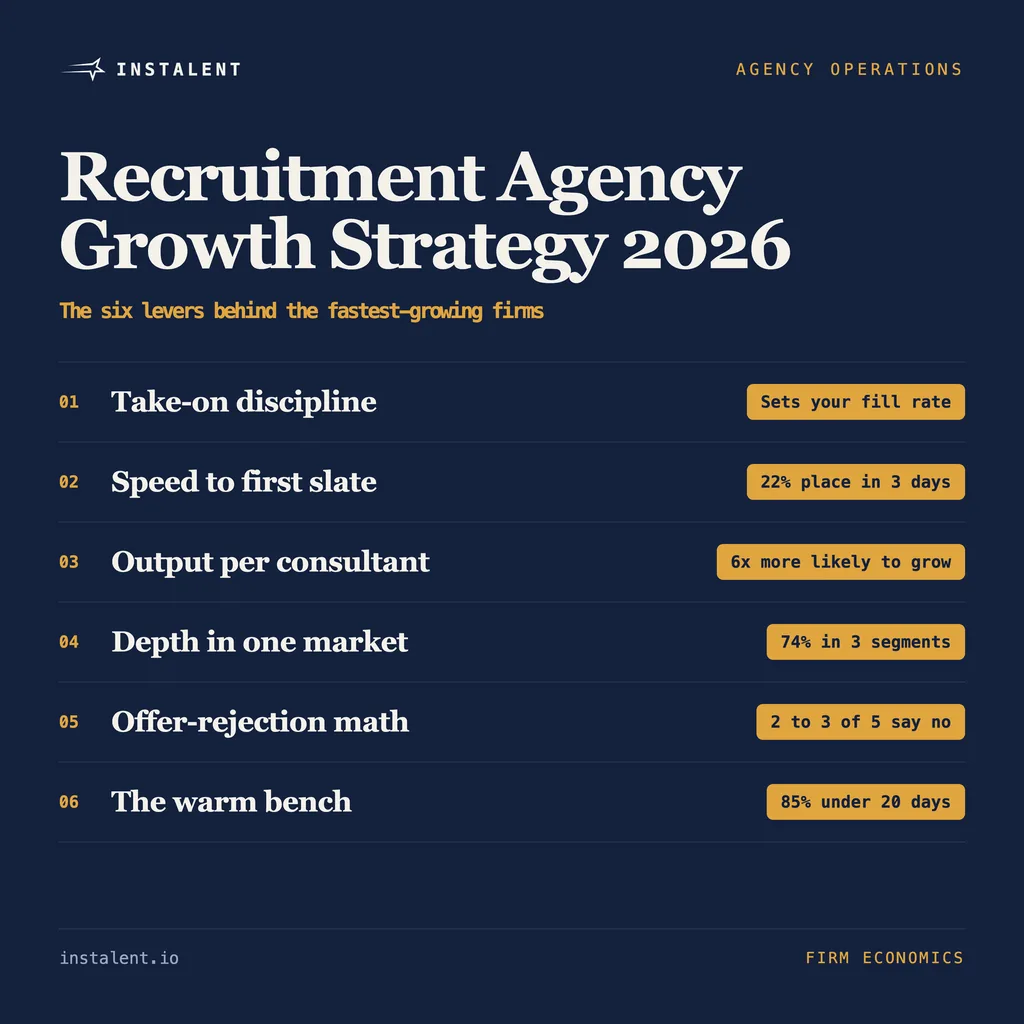
Most growth advice aimed at agency founders is a motivation problem dressed as a strategy: bill more, call more, hire more. The 2026 data says something far more useful. Growth is broadly available right now, the firms compounding hardest are not the ones working the most hours, and the spread between a firm that grows and a firm that holds flat comes down to a small number of operating decisions a founder actually controls. Here are the six, with the numbers behind each one.
The market stopped being the variable
Start with the fact that reframes everything else. In Bullhorn's 2026 GRID report - the industry's largest annual agency survey, nearly 2,300 recruitment professionals across North America, the UK and Ireland, Benelux, DACH and APAC - 56% of firms grew revenue in 2025, up from 40% the year before, and the highest share since 2022. Thirteen per cent grew by more than 25%.
That matters because it removes the easiest explanation. When 40% of firms grow, "the market is tough" is a reasonable account of a flat year. When 56% grow and one in eight grows by a quarter or more, the interesting question moves inside the business.
The same pattern shows up in the firms that compound over years rather than quarters. SIA's 2026 Fastest-Growing US Staffing Firms list ranks firms on organic compound annual growth over four years, which strips out anyone who bought their growth. Fifty-eight firms cleared the bar. All of the top ten grew 55% or more; the top five grew over 65%. The number one firm did 102% CAGR on $30m of revenue, and the fifth did 68.8% on $278m - so this is not a small-firm phenomenon or a big-firm one. It is an operating-model phenomenon.
Lever 1: Fill rate is decided at take-on, not at sourcing
This is the single most expensive lesson in agency operations and almost nobody teaches it, because it looks like turning away money.
Every role you accept spends capacity you cannot get back. A speculative contingent vacancy with four other firms on it, no access to the hiring manager, an uncalibrated brief and a salary band the market left behind is not revenue. It is a lottery ticket you paid for with a consultant's week. Fill rate is not something sourcing rescues later. It is set the moment you say yes.
The competitive picture makes this sharper. GRID has firms naming competition from other agencies as their second biggest obstacle going into 2026. When five firms work the same role, the expected value of your effort divides by five before you have made a single call.
The discipline is a written take-on standard, applied by everyone, with the founder willing to lose a role over it.
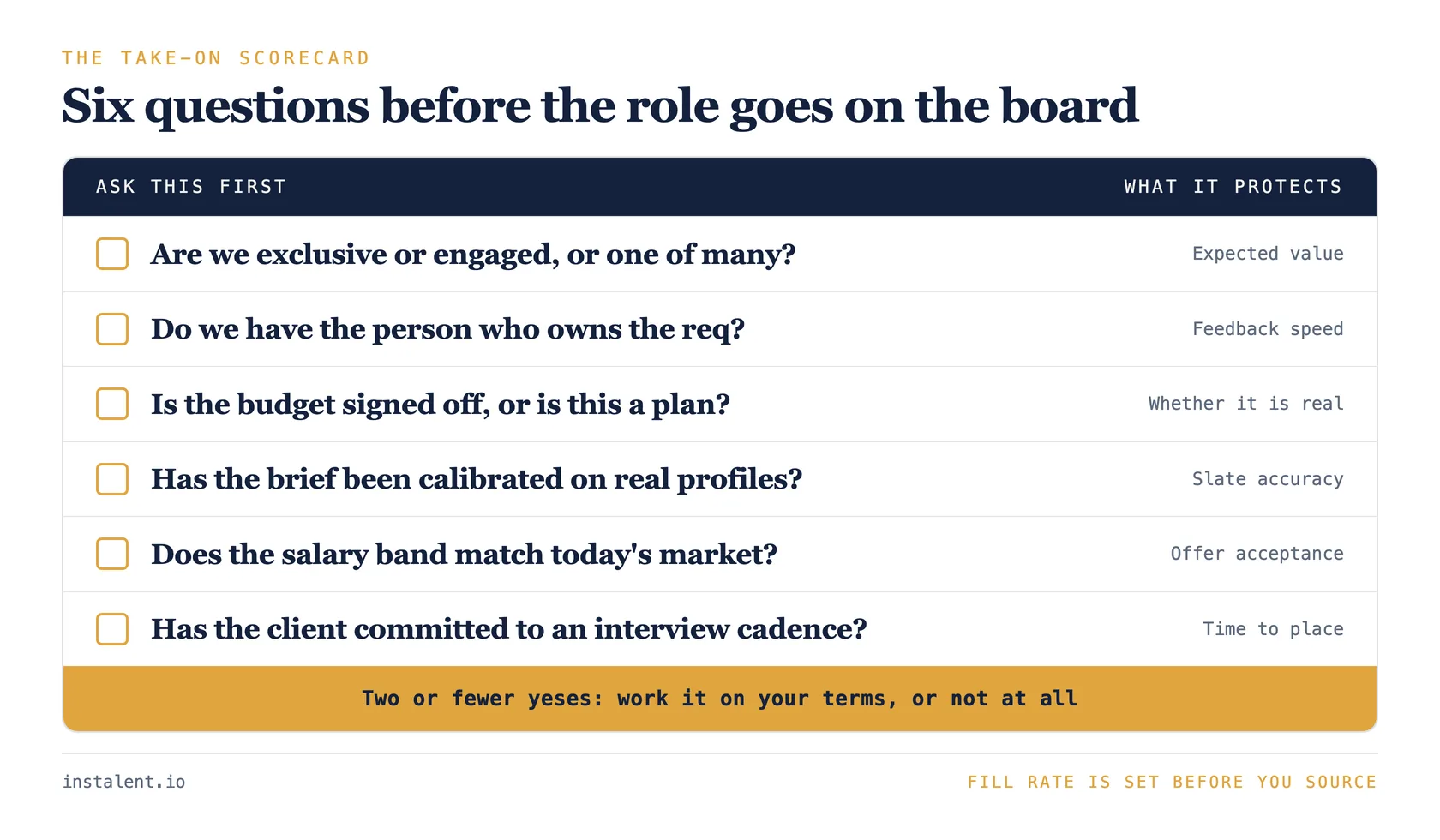
Ask, in order: Are we exclusive or engaged, or one of many? Do we have direct access to the person who owns the req? Is the budget signed off, or is this a plan? Has the brief been calibrated against real profiles, or is it a wishlist? Does the salary band match what the market pays today? And has the client committed to an interview cadence?
Two or fewer yeses does not always mean no. It means you work that role on your terms - a smaller slate, a later slot in the queue, or a conversation about exclusivity before you start.
The number that makes the argument for you
Work out your fill rate on roles where you were exclusive or engaged, and on roles where you were one of several. Most firms have never split it. The gap is almost always large enough to end the debate without you having to win it.
Lever 2: Speed to first credible slate is the whole moat
In contingent recruitment, the firm that gets there first with a credible shortlist usually wins the role, and everyone else works for free. That has always been true. What is new is how far the leaders have pushed it.
56% of the top-performing firms in GRID report an average time to place under ten days. Twenty-two per cent place in three days or less.
Read that again as an operator. Three days is not a faster version of the normal process. It is a different process. You cannot reach three days by starting a search when the role lands. You reach it because the market map already exists, the people in it are already identified, the contact details are already verified, and nothing is waiting on a handoff between a search tool, a spreadsheet, a sequencer and the CRM.
That is the real reason speed correlates with growth. Time to place is a summary statistic for how much of your process is built rather than improvised.
Lever 3: Output per consultant, not headcount
Here is where most growth plans quietly become headcount plans.
Adding a consultant does not add capacity on the day they start. It removes some, then adds it back slowly - a manager's time to train, a desk that produces nothing for months, and a gross profit per head that falls before it climbs. Hire three at once and you have bought a dilution you now have to grow out of. That is a fine decision made deliberately. It is a painful one made because growth was assumed to mean people.
The alternative lever is output per existing consultant, and the 2026 data is unusually direct about where that comes from. GRID finds that firms seeing AI make a difference to both candidate screening and recruiter ramp-up are up to six times more likely to have increased revenue. Ramp-up is the tell. A firm where a new consultant reaches productivity quickly is a firm where the knowledge lives in the system rather than in the heads of the two people who have been there longest.
Retention is the other half of the same lever, and SIA's list contains the most quietly impressive statistic in this whole piece: 33% of the fastest-growing US staffing firms have won SIA's Best Staffing Firms to Work For award at least once since 2021. A third of the firms compounding hardest are also independently recognised as good places to work. Consultant churn is not an HR line item. It is the capacity constraint.
Lever 4: Depth in one market beats coverage of five
Every founder feels the pull to widen. A client asks for a role outside your patch, you take it, and a year later the firm covers five markets shallowly and owns none.
The data pushes hard the other way. Of SIA's 58 fastest-growing firms, 74% serve one of just three segments - healthcare at 34%, IT at 27%, industrial at 14%. Sustained organic growth clusters in firms that went deep.
The mechanics are obvious once you say them out loud. Depth is what gives you a market map you did not have to build from scratch, a candidate network that refers, a real view of what roles pay, and the credibility to charge for judgement rather than for CVs. That last part shows up in what the leaders do next: GRID's top performers are expanding into adjacent services, with 44% adding consulting and 40% adding candidate reskilling. Those are things you can only sell in a market you genuinely know.
If you run a small desk, the solo recruiter's playbook covers the same focus argument at one-person scale.
Lever 5: Price the offer-rejection tax into the slate
An advanced concept that most pipeline planning ignores completely.
GRID reports that firms are seeing two to three out of every five candidates reject offers. If that is anywhere near your reality, then a process built to produce exactly one acceptable candidate converts to a placement somewhere around half the time, and the failure arrives at the most expensive possible moment - after the client has invested interview time and after you have stopped sourcing.
The operating change is to size the slate backwards from the acceptance rate rather than forwards from the shortlist, and to keep a second-choice candidate genuinely warm until the contract is signed. It also raises the value of everything upstream: a calibrated brief, an honest salary conversation on the first call, and a close plan that starts before the final interview rather than after it.
Where the rejection actually happens
An offer turned down at the end is usually a conversation that did not happen at the beginning - comp, counter-offer risk, competing processes, what would actually make them move. Rejection rates are a top-of-funnel measurement wearing a bottom-of-funnel costume.
Lever 6: The warm bench is the cheapest pipeline you own
The fastest source of a placement is nearly always someone you have already met, and it is the source most firms let rot.
GRID's redeployment finding puts a number on it: 85% of firms with a redeployment plan report placement times under 20 days. A redeployment plan is just a structured version of knowing who is coming free, who was a strong runner-up last quarter, and who took a counter-offer eighteen months ago and is now ready to listen.
The blocker is rarely intent. It is that the records decay. A contact detail from two years ago is a guess, a note from a consultant who left is an archaeological artefact, and "we already have them in the system" is the most expensive sentence in an agency - it stops you sourcing and then hands you a number that no longer connects. A warm bench only works if it is actively maintained, which means re-verifying contact data and re-engaging people on a cadence rather than when a role lands.
What "embedded" actually means, and why the window is still open
Now put the six levers together, because they all point at the same underlying variable: how much of your firm runs as a system rather than as a set of habits.
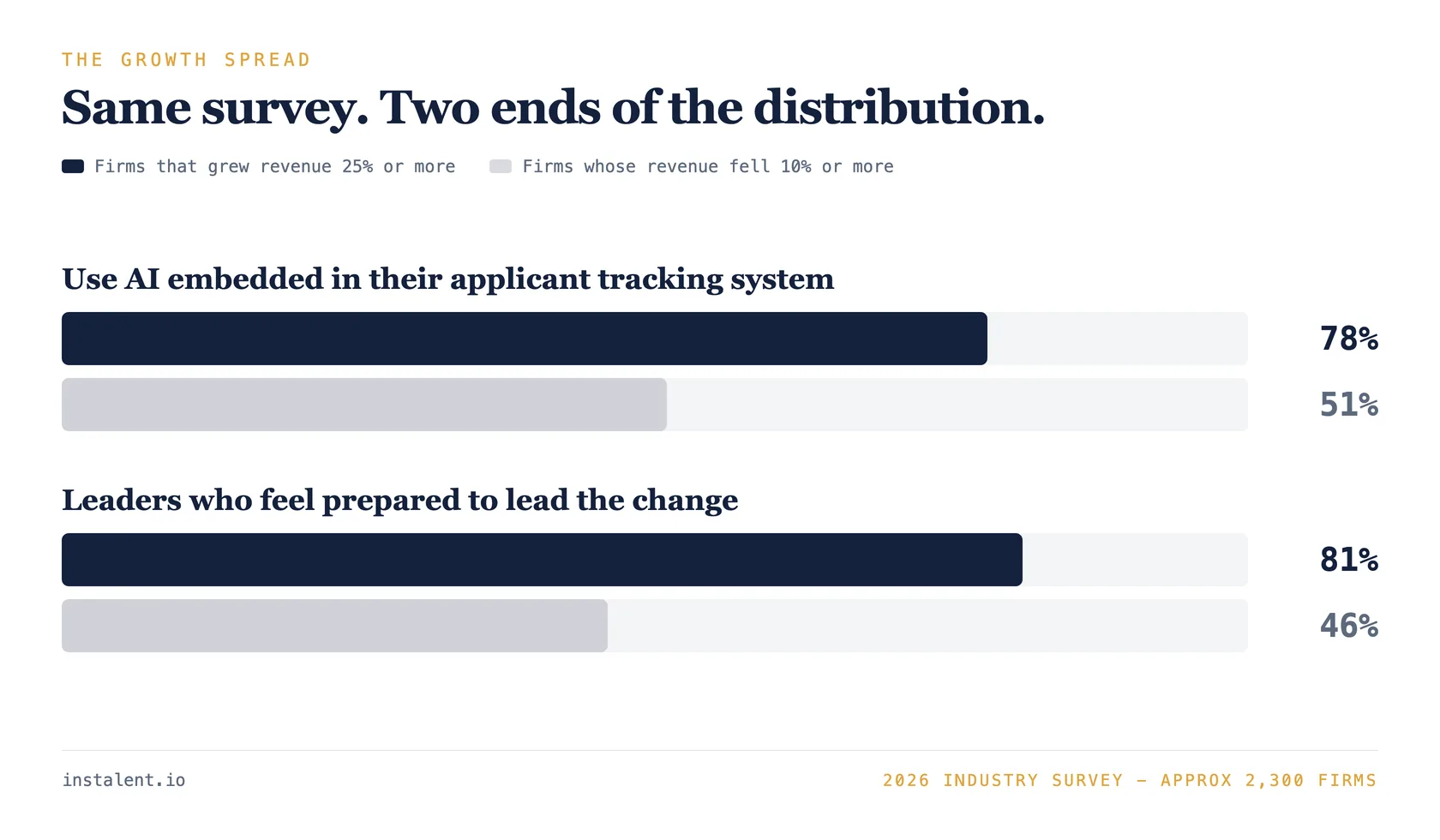
GRID separates the ends of the distribution cleanly. Among firms that grew revenue by more than 25%, 78% use AI embedded in their applicant tracking system. Among firms whose revenue fell by more than 10%, it is 51%. Firms using AI at any stage are 3.5 to 4.5 times more likely to have grown. Leadership tracks it too: 81% of leaders at the highest-growth firms feel prepared to lead the change, against 46% at the weakest performers.
And then the number that should get a founder's attention: only 10% of firms have it embedded across the full workflow. Adoption is broad, integration is rare. Most of the industry is running assistants beside the process rather than inside it - and that is why the advantage is still available rather than already priced in.
The distinction that matters is not whether your people use AI. It is whether the work runs end to end without a handoff. A search that ends in an export, a list that gets pasted into a sequencer, a reply that lands in a personal mailbox, a record updated by hand at the end of the week - each of those is where the ten-day placement becomes a thirty-day one.
The six numbers that tell you if it is working
None of this is worth much as an opinion. Each lever has a number, most firms already hold the data, and almost nobody splits it the way that makes the lever visible.
| Lever | The number to watch | The split that makes it useful |
|---|---|---|
| Take-on discipline | Fill rate | Exclusive or engaged roles vs one-of-many roles |
| Speed to first slate | Days from role accepted to first slate sent | By consultant, and by whether the market was already mapped |
| Output per consultant | Gross profit per head | By tenure band, so ramp is visible instead of averaged away |
| Depth in one market | Share of gross profit from your top segment | Against the share of your time that segment takes |
| Offer-rejection math | Offer acceptance rate | By whether comp was discussed on the first call |
| The warm bench | Placements from people already known to you | Against placements from cold search |
Pick the two you are worst at and run them for a quarter. A number you look at weekly changes behaviour long before any project does. If you want the arithmetic rather than the strategy, recruiting metrics: the formulas and what each one hides has the calculation for each of these and the specific way each one can be gamed.
Where Instalent fits
That end-to-end path is the thing we build. Describe a role or an ideal client the way you would brief a colleague, and Instalent sources real people across sources rather than one index, verifies contact details from multiple sources, scores the slate against your criteria with the evidence shown, runs multichannel outreach with you approving anything sent under your name, brings every reply into one shared inbox the whole team can see, and pushes the result to RecruiterFlow, Greenhouse, Lever or TeamTailor. The same engine points at companies for client prospecting, because take-on discipline is worth very little if your pipeline of clients is thin.
We are not your ATS and we do not want to be. We are the layer between the role landing and the slate going out - which is exactly the stretch where a ten-day firm is separated from a thirty-day one.
Want to see what your desk looks like without the handoffs? Get started and a live req is the honest test.
Going further: why client acquisition became the bottleneck covers the BD side of lever four, how recruitment agencies win clients is the process behind it, and buying signals for recruiters is how you find the firms that are hiring before the role is advertised. If you are weighing tooling, enterprise recruitment software is the same argument written for larger buyers, and recruitment agencies is where our own coverage is laid out.
Related reading: recruitment strategies applies the same trade-off thinking to filling individual roles rather than growing the firm.
Sources
- Bullhorn GRID 2026 Industry Trends Report - 16th annual survey, nearly 2,300 recruitment professionals across North America, UK and Ireland, Benelux, DACH and APAC, fielded November to December 2025
- Bullhorn press release: staffing firms using AI see stronger growth, faster placements - 25 February 2026
- SIA: 2026 Fastest-Growing Staffing Firms in the United States - 14 July 2026
Find better candidates, faster
Source, verify and reach candidates on one engine. Get 25% off your first month.
Keep reading