Recruitment Strategies: The Five Choices That Are Actually Strategic
Most recruitment strategies lists are tactics. A real strategy is a choice that excludes something - here are the five forks, what each costs, and how to pick.
Run the outbound half of your strategy without adding a head.
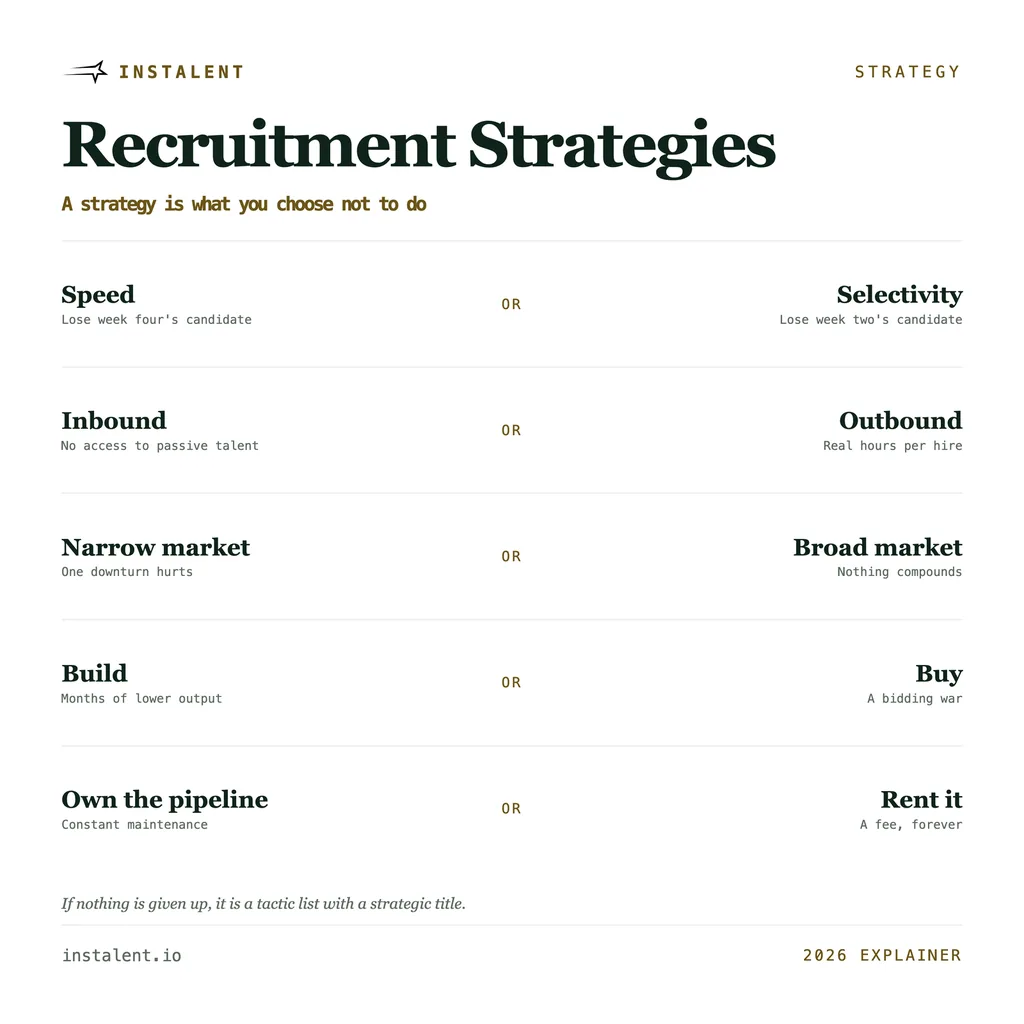
Search "recruitment strategies" and you get lists of twenty-one things to do. None of them is a strategy. A strategy is a choice that excludes something else, and a list where every item is worth doing has excluded nothing - which is why teams read those lists, nod, and change nothing. There are about five decisions in recruiting that genuinely qualify, and each one costs you something real.
Why lists of recruitment strategies do not work
The standard article gives twenty-one recruitment strategies. Improve your employer brand. Use referrals. Write better job ads. Build a talent pipeline. Every item is defensible, and that is exactly the problem: a list where nothing is ruled out asks you to do more of everything with the same team and the same week.
Strategy is subtraction. If your recruitment strategy does not name something you are deliberately going to be worse at, you have written a to-do list and put a strategic title on it.
What follows are the five decisions in recruiting that actually force a trade-off.
1. Speed or selectivity
You cannot maximise both. Every extra day of consideration is a day the candidate is in someone else's process, and every extra candidate you wait for is time on the clock.
SHRM's recruiting benchmarking research, drawn from over 4,600 organizations, reports a median time to fill of 39 calendar days for nonexecutive roles. Whether you should be faster than that depends entirely on which fork you have chosen - and note that you cannot compare yourself to that figure without matching how it was measured, which is the trap recruitment analytics goes into.
Choose speed when the population is large, the skills are checkable, and the cost of a mediocre hire is recoverable. Choose selectivity when the role is small-population, the mistake is expensive, and the seat can stay empty without the business stopping.
What it costs: speed costs you the candidate who would have appeared in week four. Selectivity costs you the candidate who accepted elsewhere in week two. Pick which loss you prefer, because you will have one of them.
2. Inbound or outbound
Inbound means people come to you: job ads, careers page, brand, referrals. Outbound means you go and find people who were not looking.
The honest asymmetry: inbound is cheaper per hire and worse at the top end, because the strongest people in most markets are employed, busy and not reading job ads. Outbound is more expensive per conversation and is the only way to reach them.
What it costs: inbound costs you access to the passive market. Outbound costs you real hours per hire, and it fails badly if you cannot reach people or cannot say anything specific when you do.
Most teams claim both and run only inbound, because outbound is the one that requires someone to actually do it on a Tuesday. Candidate sourcing strategies is the method for the outbound half.
3. Narrow or broad
Do you go deep in one market, or wide across several?
Narrow means you know the companies, the titles, the pay and the people. Every search gets cheaper because the map already exists, and your name starts arriving before you do. Broad means you can take whatever comes in, and no single market downturn removes your business.
What it costs: narrow costs you optionality, and it hurts badly when your one market freezes. Broad costs you the compounding - you pay full research price on every search forever, and you are never the obvious person to call.
For agencies this is the single highest-leverage choice on the list, and it is usually made by accident.
4. Build or buy
Hire people who can already do the job, or hire for trajectory and train.
Buying is faster and the market prices it. Building is slower, cheaper per head, and only works if you actually have the capacity to develop someone - which most teams claim and few have.
What it costs: buying costs money and puts you in a bidding war for a small population. Building costs months of reduced output and carries the risk that you train someone and they leave.
The honest test is not philosophical. It is whether anyone on your team has time to mentor. If not, you are a buyer, whatever the strategy deck says.
5. Own the pipeline or rent it
Renting means job boards, agencies and paid platforms produce your flow. Owning means you keep a warm pool of people who already know who you are.
The economics have shifted here, and it is measurable. Gem's 2026 Recruiting Benchmarks Report, built on over 165 million applications and 1.2 million hires between June 2021 and May 2025, finds that 46% of sourced hires now come from rediscovered candidates - past applicants, runners-up and earlier outreach already sitting in a CRM or ATS. In 2021 that was 26%.
Close to a doubling in four years. Owning the pipeline stopped being a nice-to-have and became roughly half the sourced-hire yield.
What it costs: renting costs a fee per hire forever and gives you nothing that accumulates. Owning costs continuous maintenance - and a pipeline nobody maintains decays into a list of dead phone numbers, which is what talent pipeline is about.
Pick your fork from your own evidence, not from an article
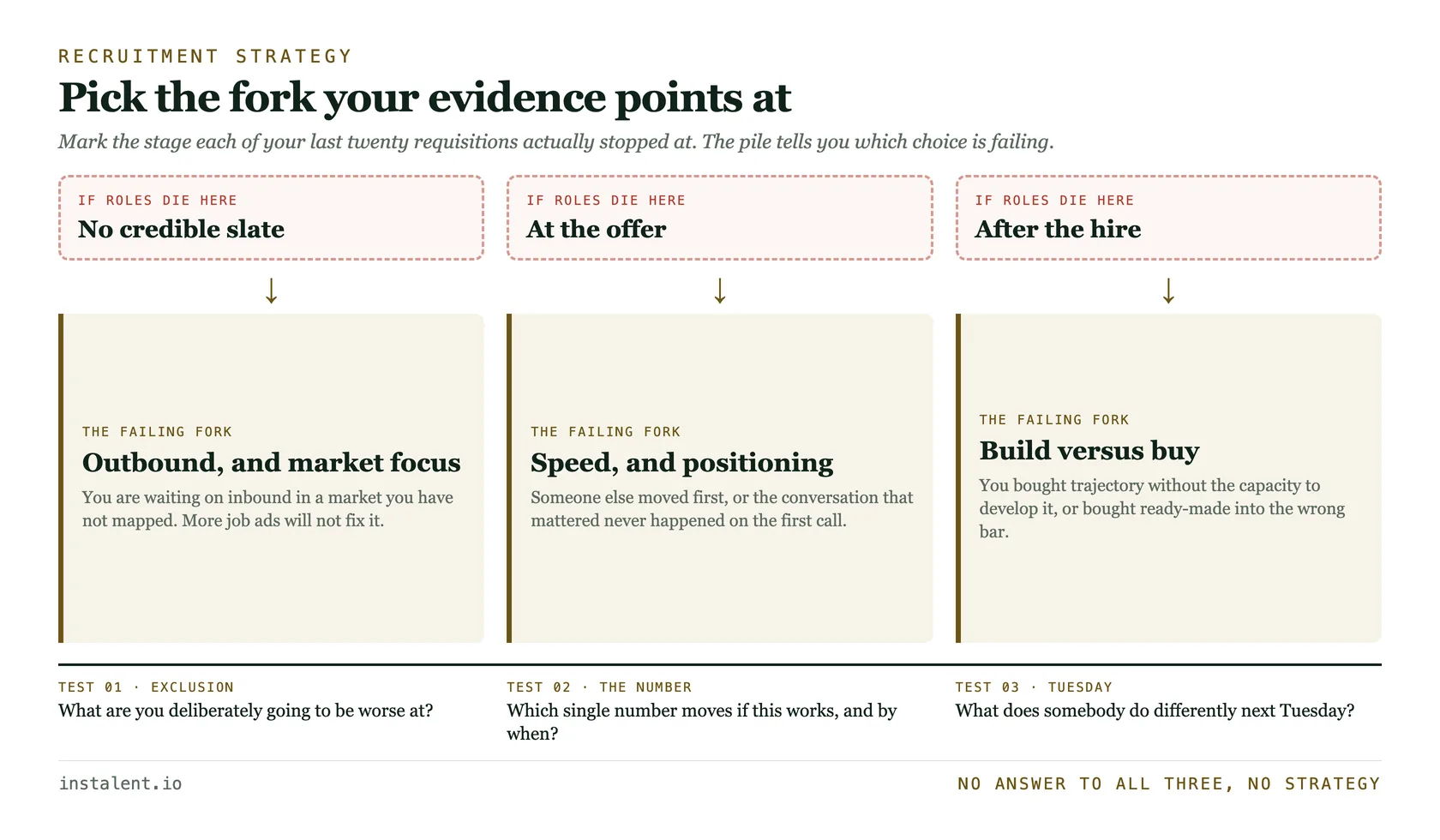
Take the last twenty requisitions you closed or abandoned and mark the stage each one actually stopped at. Roles dying for lack of a credible slate are an outbound and market-focus problem. Roles dying at offer are a speed or positioning problem. Roles dying after the hire are a build-versus-buy problem. Most teams have never done this and are surprised by where the pile sits.
Telling a recruitment strategy from an activity
The difference between a recruitment strategy and a recruitment tactic is what you give up. A strategy is a choice with a cost you accept on purpose. A tactic is an activity you add.
"Post to more job boards" is a tactic: nothing is given up, so nothing has to be decided. "We compete on speed, so we will interview less thoroughly and make offers in two weeks" is a strategy, because it names what gets worse. Almost every list published as recruitment strategies is a list of tactics - which is why they are easy to agree with and change nothing. Tactics are not the enemy here; they are how a strategy gets executed. They are just not a substitute for making the choice.
Three tests, all fast.
The exclusion test. What are you deliberately going to be worse at? If the answer is nothing, it is a tactic list.
The number test. Which single number should move if this works, and by when? A strategy with no number attached was a preference.
The Tuesday test. What will somebody do differently next Tuesday? Strategies that change nobody's week are decks.
Where the tooling actually helps
Only one of the five forks has a tooling answer, and it is worth being clear about which.
Speed, build-versus-buy and market focus are decisions about your business. No software makes them. What software changes is the cost of the outbound fork and the maintenance cost of owning your pipeline - the two places where teams choose the cheaper option because the better one is too much manual work.
Instalent is aimed at exactly that: describe the population in plain English and get people from across sources, with verified contact details, scored against your criteria with the evidence shown, reached through multichannel outreach, and every reply in one shared inbox - syncing with RecruiterFlow, Greenhouse, Lever or TeamTailor. It makes outbound and pipeline maintenance affordable enough to actually choose. It does not choose for you.
Want the outbound half without adding a head? Get started and run one real role end to end.
Related reading: the hiring process is the sequence these choices run inside, talent acquisition vs recruitment defines the two functions these choices sit across, candidate sourcing strategies is the method behind the outbound fork, talent pipeline is the asset behind the own-versus-rent fork, recruitment agency growth strategy for 2026 applies the same thinking to a firm rather than a role, and recruiting metrics has the numbers each choice should move.
Sources
- SHRM - Recruiting Benchmarking research - data from over 4,600 organizations; median time to fill of 39 calendar days for nonexecutive positions
- Gem - Key takeaways from the 2026 Recruiting Benchmarks Report - over 165 million applications, 15 million candidates and 1.2 million hires, June 2021 to May 2025
Find better candidates, faster
Source, verify and reach candidates on one engine. Get 25% off your first month.
Keep reading