Candidate Sourcing Strategies for 2026: Seven That Actually Fill Roles
Seven candidate sourcing strategies that hold up in 2026 - sourcing channels ranked by what they cost you, and the talent sourcing strategy behind a warm bench.
Run these sourcing strategies on one platform - search, verify, score, reach out.
Most lists of candidate sourcing strategies are a list of places to look. That is not a strategy, it is an inventory. A real sourcing strategy answers three questions: which pool you are fishing in, what evidence you will accept before you spend a call on someone, and what happens to the people you do not place this month. Here are seven that hold up in 2026, with the numbers behind them and an honest note on where each one stops working.
What is a candidate sourcing strategy?
A candidate sourcing strategy is the repeatable method you use to find, qualify and engage people who are not applying to your job ad. It covers the sourcing channels you work, the signals you screen on, the order you contact people in, and how you keep the pool warm between roles. It is distinct from recruitment marketing, which pulls inbound applicants, and from screening, which happens after someone is already in your pipeline.
The reason it matters more than the channel list: two recruiters working the same channels with different strategies get very different fill rates. Asked how to source candidates, most people answer with a tool. The answer that actually moves fill rates is an order of operations, which is what the seven plays below set out.
Direct sourcing, and where it sits
Direct sourcing means approaching candidates yourself rather than going through an agency, a job board or any other intermediary. You identify the person, get a way to reach them, and make the approach directly. In staffing it usually carries a second meaning as well: building a pool of known talent you can redeploy, instead of paying a third party each time a similar role opens.
The trade-off is honest and worth stating. Going direct removes the intermediary's margin, but it does not remove the work - it moves the research cost onto your desk. That is why direct sourcing pays in a market you work repeatedly, where the second search reuses most of the first one's research, and rarely pays on a one-off role in a market you will never touch again. The seven plays below are, in effect, how you make that research cost compound instead of repeat.
1. Decide the pool before you decide the channel
The most common failure is starting with a tool. Start with the population.
Write down who actually does this work today: which companies employ them, what the job is called in each of those companies, what they had to have done to be credible, and roughly what the market pays. That description is what makes every later step cheap. Without it you are searching for job titles, and job titles are local dialects - "data engineer", "analytics engineer" and "platform engineer" can all describe the same work depending on who is writing the org chart.
The one-line test
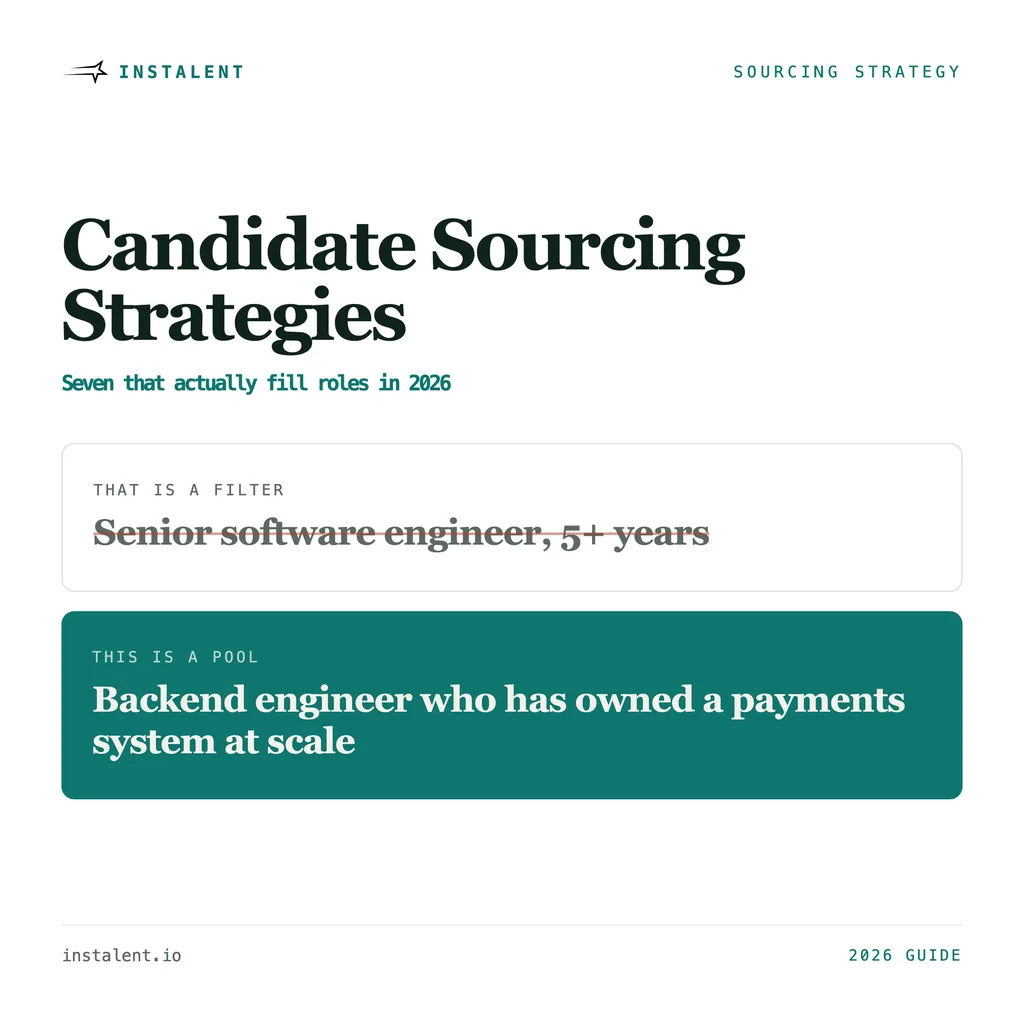
If you cannot describe the target in a sentence a hiring manager would recognise, you are not ready to source. "Backend engineer who has owned a payments system at scale" is a pool. "Senior software engineer, 5+ years" is a filter.
2. Source on granted evidence, not self-description
A profile is written by the candidate. The strongest signals are the ones someone else had to grant: a conference that accepted the talk, a maintainer who merged the pull request, a regulator that lists the licence, a co-author on the paper.
This matters more every year because volume signals have inflated. GitHub's Octoverse 2025 reports 36 million new developers joined in 2025 and nearly a billion commits were pushed, up 25.1%. When everyone's activity graph is green, activity stops discriminating and endorsement starts.
The honest limit: the same report finds 81.5% of all contributions now happen in private repositories. Public evidence is a slice, not the whole picture, so absence of it is never evidence of absence of skill. Judge on what you find.
3. Treat sourcing channels as a cost hierarchy
Rank your sourcing channels by what each one actually costs you in time, not by how many profiles it returns.
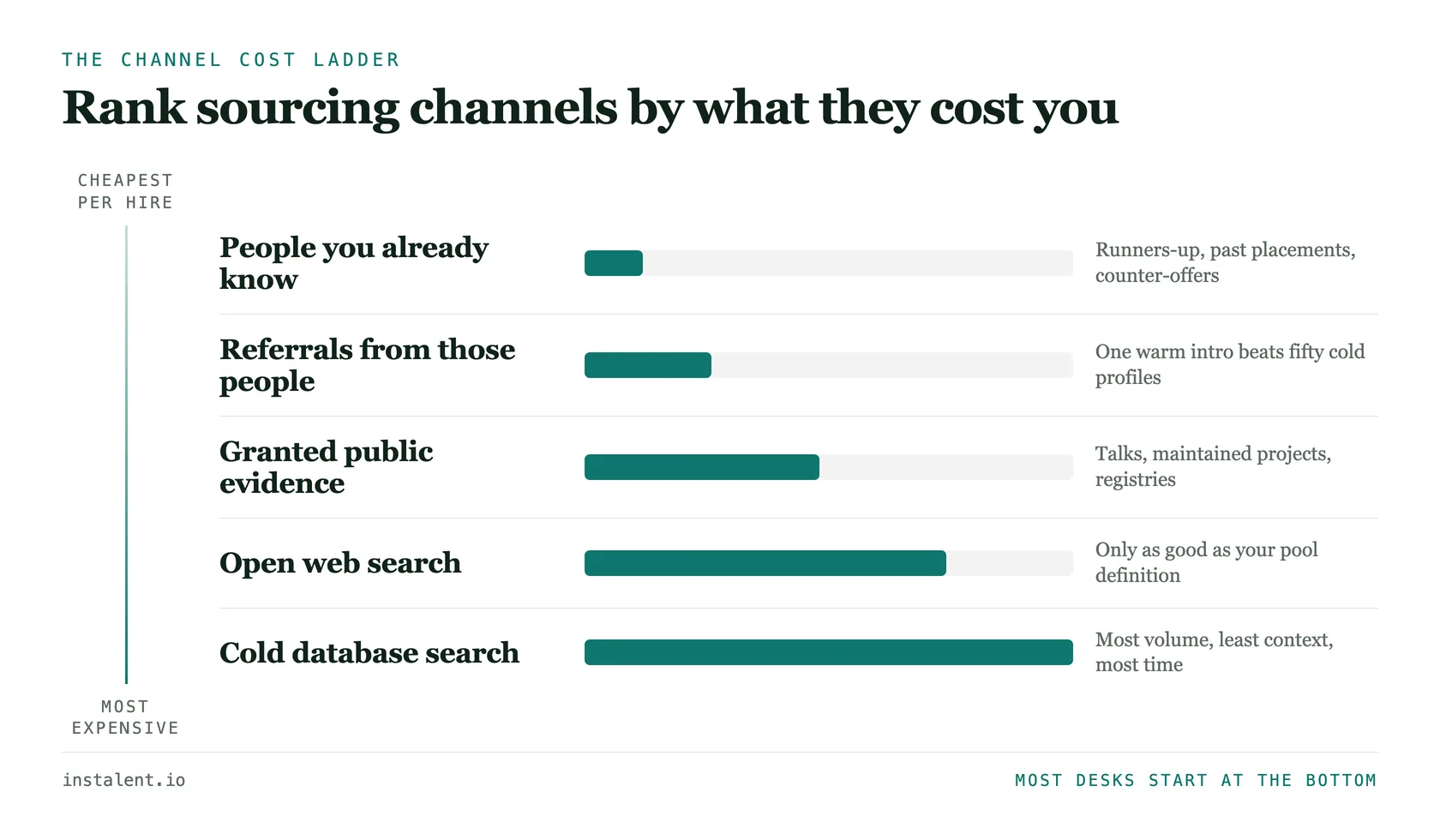
- People you already know - previous runners-up, past placements, people who took a counter-offer. Cheapest by a distance.
- Referrals from those people - one warm introduction beats fifty cold profiles.
- Granted public evidence - talks, maintained projects, registries, publications.
- Open web search - broad, unfiltered, needs the pool definition from step 1 to be useful.
- Cold database search - highest volume, lowest context, most time per hire.
Most desks invert this because the database is the thing with a login screen.
4. Build the warm bench on purpose
The fastest source of a placement is nearly always someone you have already met. In Bullhorn's 2026 GRID report - nearly 2,300 recruitment professionals - 85% of firms with a redeployment plan report placement times under 20 days. The firms that keep a structured view of who is coming free, who was a strong runner-up last quarter, and who is now ready to listen place faster than the firms that start every search cold.
That bench is the start of a talent pipeline, and the difference between the two words is maintenance. The blocker is decay, not intent. A contact detail from two years ago is a guess, and "we already have them in the system" is the most expensive sentence on a recruiting desk - it stops you sourcing and then hands you a number that no longer connects. A warm bench only works if contact data is re-verified and people are re-engaged on a cadence.
5. Size the pipeline backwards from acceptance
Most sourcing plans are sized forwards: find ten, screen five, submit three, place one. That model breaks at the end, where it is most expensive.
The same GRID data has firms seeing two to three out of every five candidates reject offers. If that is near your reality, a pipeline built to produce exactly one acceptable candidate converts to a placement roughly half the time - and you discover it after the client has spent interview time. Size the slate from the acceptance rate backwards, keep a genuine second choice warm until the contract is signed, and have the comp conversation on the first call rather than the last.
6. Make speed a sourcing decision, not a delivery one
Speed is usually treated as a delivery problem. It is decided during sourcing.
GRID has 56% of top-performing firms placing in under ten days, and 22% in three days or less. You do not reach three days by working faster once a role lands. You reach it because the pool from step 1 already exists, the people in it are already identified, the contact details are already verified, and nothing waits on a handoff between a search tool, a spreadsheet and a sequencer.
7. Go deep in one market rather than wide across five
Focus is the strategy that compounds. Of the 58 firms on SIA's 2026 Fastest-Growing US Staffing Firms list - ranked on four-year organic growth - 74% serve one of just three segments: healthcare 34%, IT 27%, industrial 14%.
Depth is what makes every other strategy on this list cheaper. You already know the companies, the titles, the pay, and who moved where. A generalist desk rebuilds that context for every role.
How to tell a working strategy from a busy one
Four checks, none of which require new software:
- Split your fill rate by roles where you were exclusive or engaged versus one of several. Most desks have never split it, and the gap usually ends the argument about which roles to accept.
- Count placements that came from people you already knew against placements from cold search.
- Measure days from role accepted to first credible slate, not time-to-fill. Time-to-fill hides where the delay is.
- Track offer acceptance by whether comp was discussed on the first call.
If a sourcing strategy is not moving one of those four, it is activity.
Where the strategy meets the tooling
Every strategy above needs the same four things done in sequence: find the right people, get a contact detail that actually connects, judge fit on evidence rather than keywords, and reach out without losing the thread. Instalent does that in one place - describe the pool in plain English, get people from across sources rather than one index, verified contact details from multiple sources, fit scored against your criteria with the evidence shown, and multichannel outreach with every reply in one inbox, syncing to RecruiterFlow, Greenhouse, Lever or TeamTailor.
Want to run one of these strategies on a live req? Get started and run one real role end to end.
Going deeper on individual strategies: what a sourcing recruiter actually does is the role that runs these end to end, talent mapping is strategy one built as a durable asset, how to source passive candidates covers strategy two and four in practice, Boolean search strings for recruiters covers the open-web channel, how to source software engineers applies the granted-evidence idea to one vertical, and recruitment agency growth strategy for 2026 puts sourcing alongside the other levers that decide whether a firm compounds.
Related reading: social media recruiting covers reading those platforms as evidence rather than broadcast, recruitment strategies is the layer of choice above these plays, interview questions to ask candidates covers assessing the slate once it exists, talent pipeline covers keeping the people you do not place, and recruiting metrics has the arithmetic behind sizing any of this.
Sources
- GitHub Octoverse 2025 - 28 October 2025
- Bullhorn GRID 2026 Industry Trends Report - nearly 2,300 recruitment professionals, fielded November to December 2025
- SIA: 2026 Fastest-Growing Staffing Firms in the United States - 14 July 2026
Find better candidates, faster
Source, verify and reach candidates on one engine. Get 25% off your first month.
Keep reading