Social Media Recruiting: A Research Surface, Not a Broadcast Channel
Social media recruiting works as research, not broadcast. What each platform is actually good for, why posting jobs fails, and the line you should not cross.
Search what people published, not what they posted about themselves.
Almost every social media recruiting guide is a posting schedule. Post the role, add hashtags, build the employer brand, repeat. That advice quietly assumes your posts get seen, which for a company account is mostly untrue - and it misses the thing social platforms are genuinely excellent at. They are the largest public record of what people actually do at work. Read them as a research surface and they are extremely useful. Treat them as a megaphone and you are shouting into a feed nobody is scrolling for you.
Why most social media recruiting fails: the broadcast assumption
The standard advice rests on a premise nobody states: that when you post a role, people see it.
For a company account this is usually false. Feeds are ranked by engagement, and a job post is close to the least engaging thing an organisation publishes - it asks for effort, it is relevant to a tiny fraction of any audience, and it looks like an advert because it is one. The account most likely to see it is a competitor's recruiter.
There is a version that works, and it is worth separating cleanly: individual people posting to their own networks. A recruiter writing in their own voice about a role they are genuinely interested in, or an engineer saying their team is hiring, gets distributed as a person rather than as a brand. That is a real channel. It is also not scalable in the way "we will post more" implies, because it depends on individuals having something to say.
What social recruiting is actually good at
They are the largest public record of what people do at work that has ever existed. Not what they claim in a profile - what they produced, and what other practitioners thought of it.
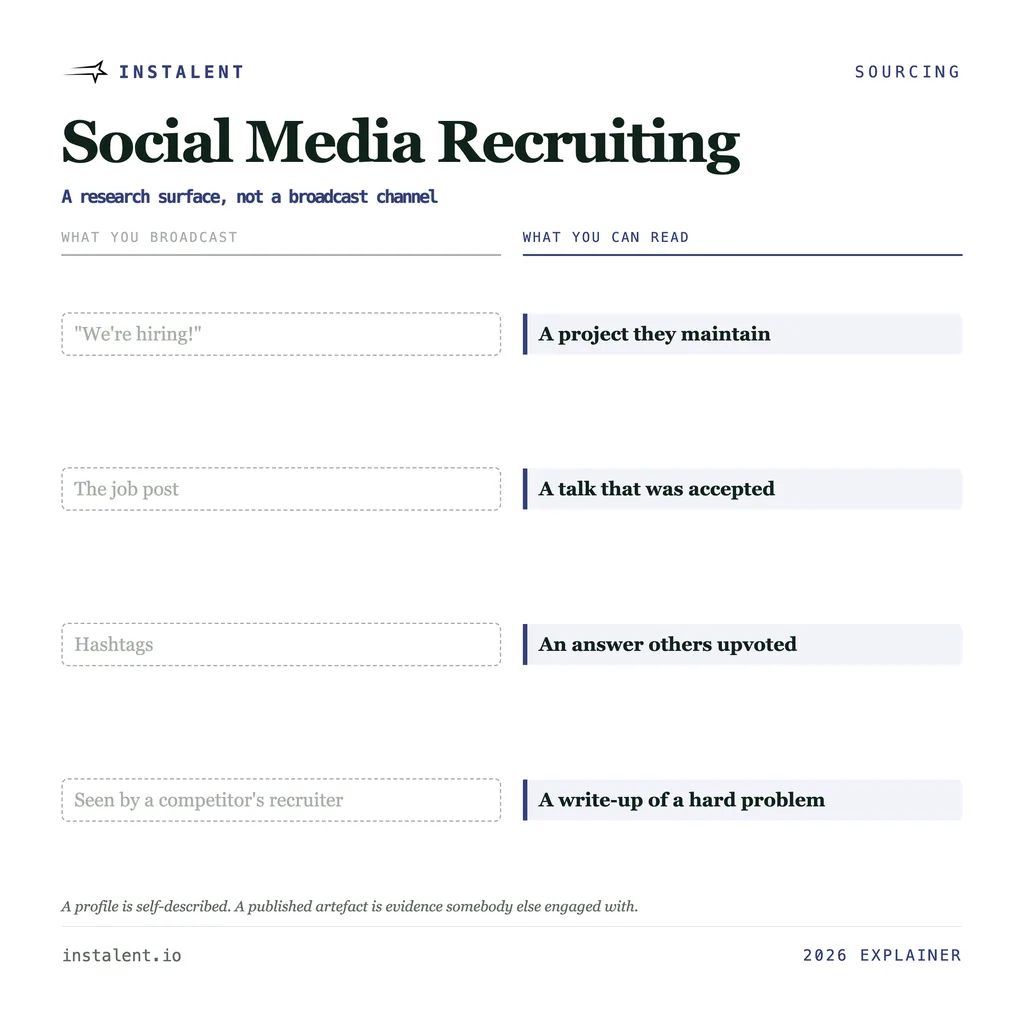
That distinction is the whole argument. A profile is self-described and optimised for being found. A published artefact is evidence someone else engaged with: a maintained project, a conference talk that was accepted, an answer other practitioners upvoted, a write-up of a hard problem. This is the same principle behind sourcing on granted evidence - social platforms just happen to be where a lot of that evidence now lives.
Social media recruiting platform by platform, honestly
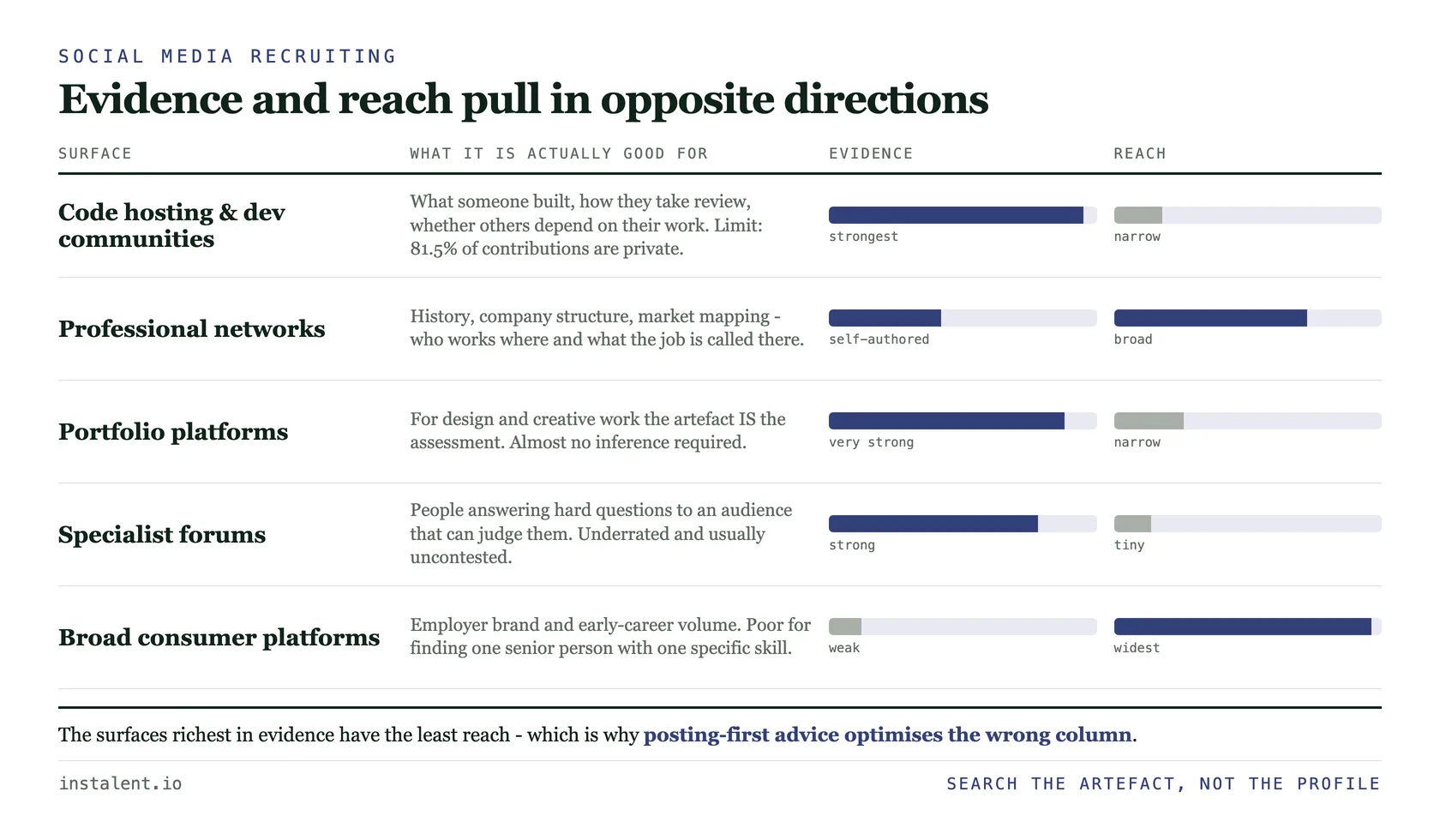
Code hosting and developer communities. The strongest evidence surface that exists for technical roles. You can see what someone built, how they respond to review, and whether other engineers rely on their work.
The honest limit, and it is a big one: GitHub's Octoverse 2025 reports that 81.5% of all contributions now happen in private repositories. Most of the work is invisible. Absence of public code is not evidence of absence of skill, and screening on it systematically excludes people who work in regulated industries, at secretive companies, or who simply have a life. Use it to find people, never to rule them out. How to source software engineers goes into what still discriminates.
Professional networks. Best for professional history, company structure and market mapping - who works where, what the job is called there, who moved recently. Weakest for judging whether somebody is actually good, because the content is self-authored.
Portfolio platforms. For design, creative and front-end work, the artefact is the assessment. Little inference required.
Specialist forums and communities. Underrated and usually uncontested. The people answering hard questions in a niche community are demonstrating expertise to an audience that can judge it, which is a stronger signal than any headline.
Broad consumer platforms. Genuinely useful for employer brand and for reaching early-career candidates at volume. Poor for finding a specific senior person with a specific skill.
The line between research and surveillance
Public, professional, work-related content is fair research. Personal accounts, private groups and anything touching protected characteristics are not - and in many jurisdictions simply viewing them creates legal exposure whether or not you act on it. A useful test: could you say out loud, to the candidate, where you found the thing you are referencing? If not, do not use it.
A repeatable social recruiting strategy
Four steps, and none of them involve a posting calendar.
1. Describe the work, not the title. "Engineer who maintains a widely used data library" finds people that no title filter surfaces.
2. Search the artefacts, not the profiles. Most of this evidence sits on public, indexed pages, which means an ordinary search engine reaches it with a site: query. Boolean search strings for recruiters has the working set, including the honest note about which operators are actually documented.
3. Get a contact that is not the platform. This is where social sourcing usually dies. You found the right person inside a network that limits messaging, throttles you, or buries the message in a tab nobody opens. A verified email or phone turns a find into a conversation.
4. Reference the specific thing. One concrete sentence about the work you actually read beats three paragraphs of enthusiasm, and it proves the message was not sent to four hundred people.
Where this connects to the tooling
The research half is human judgement. The mechanical half - sweeping several sources at once, deduplicating the same person found in three places, and turning a profile into a way to reach them - is exactly the part that eats a week and produces no relationship.
Instalent covers that half: describe the population in plain English and get people from across the open web, public code and professional signals, with verified contact details so the conversation happens off-platform, fit scored against your criteria with the evidence shown, and multichannel outreach with every reply in one shared inbox - syncing to RecruiterFlow, Greenhouse, Lever or TeamTailor.
Want the evidence without the week of tab-switching? Get started and run one real role end to end.
Related reading: candidate sourcing strategies puts this in the wider channel hierarchy, how to source passive candidates covers reaching the people you find here, and talent mapping turns one search into a reusable market view.
Sources
- GitHub Octoverse 2025 - 28 October 2025; 81.5% of contributions now occur in private repositories
Find better candidates, faster
Source, verify and reach candidates on one engine. Get 25% off your first month.
Keep reading