Boolean Search Strings for Recruiters: What Still Works in 2026
Boolean search strings for recruiters in 2026: the Boolean search operators Google still documents, copy-paste examples, and where a string stops paying.
Skip the string - describe the role and get a ranked, contactable shortlist.
Nearly every Boolean cheat sheet in circulation is the same artefact: a list of operators pointed at one network's search box. That was a fine bet for fifteen years. It is a worse bet now, because the operator list is shorter than the cheat sheets admit, the result page got smaller last September, and the evidence worth finding sits in places a profile search was never going to index. This is the working set - the strings still worth keeping in the library, and the honest point where a string stops paying.
The Boolean search operators Google actually documents
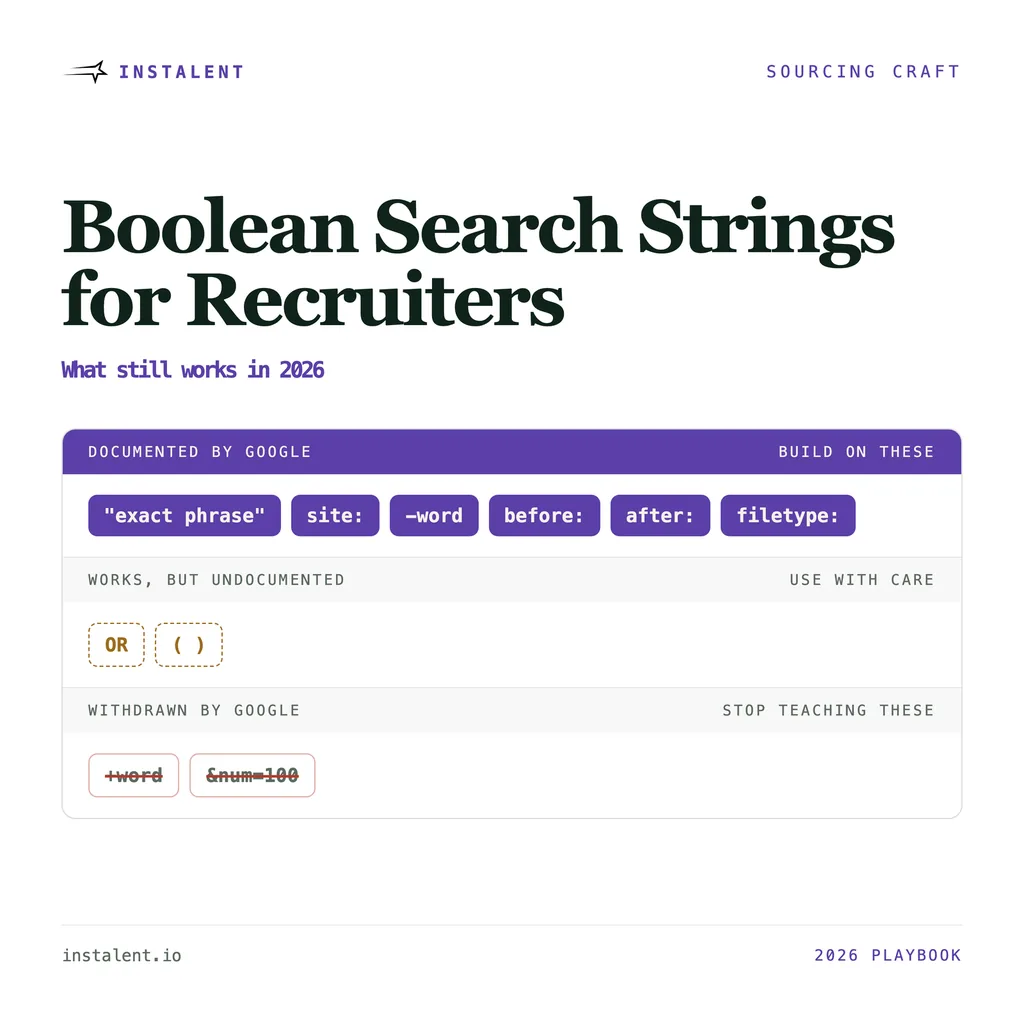
Google's own Refine Google searches help page lists six refinements. That is the whole supported surface:
"exact phrase"- the words as written, no stemming, no helpful synonymsite:- one domain, subdomain or path-- leave a word outbefore:andafter:- filter on a page's date, and combine them for a rangefiletype:- the artefact itself, not the page describing it
OR and parentheses still behave the way you expect, but they are not on that page. The + operator is gone, and Google's own help article links a community thread asking why it was removed without ever answering it.
Treat that as the tell. Anything off the documented list is a convenience you are borrowing, and it can be withdrawn without notice. Which is precisely what happened next.
What quietly changed last year
In mid-September 2025 Google stopped honouring &num=100, the URL parameter that returned a hundred results on one page. Practitioners spotted it on 12-14 September; the tools that depended on it confirmed it within days. There was no announcement post.
For an SEO team that broke rank tracking. For a sourcer it broke something more basic. A broad X-ray used to be one scan of a hundred URLs, which is why loose strings were survivable. Ten results a page turns a loose string into a click-through job, and the cost of imprecision lands on you.
Google also introduced AI Mode in March 2025, which fans a question out into several searches at once. Whatever you make of it, the read for a sourcing desk is the same: the ten blue links are no longer the whole page, and the page you scan with your eyes keeps changing shape.
The habit to retire
Paging through a broad string looking for someone interesting is now the most expensive thing you can do with an hour. Write narrower strings, run more of them, and let the width come from the number of sources you point at - not from the looseness of any one query.
Point the string at the work, not at the profile
Here is the shift that matters more than any syntax. A profile is self-described. The work is published by someone else - a conference that accepted the talk, a maintainer who merged the pull request, a regulator that lists the licence, a co-author on the paper. Those pages are public and indexed, and almost nobody X-rays them, because the cheat sheets never mentioned them.
That is where a string still buys you an edge: conference and meetup programmes, package registries and changelogs, professional registers and licence directories, university group pages, standards bodies, patent and publication indexes, and the write-ups people publish about work they are proud of.
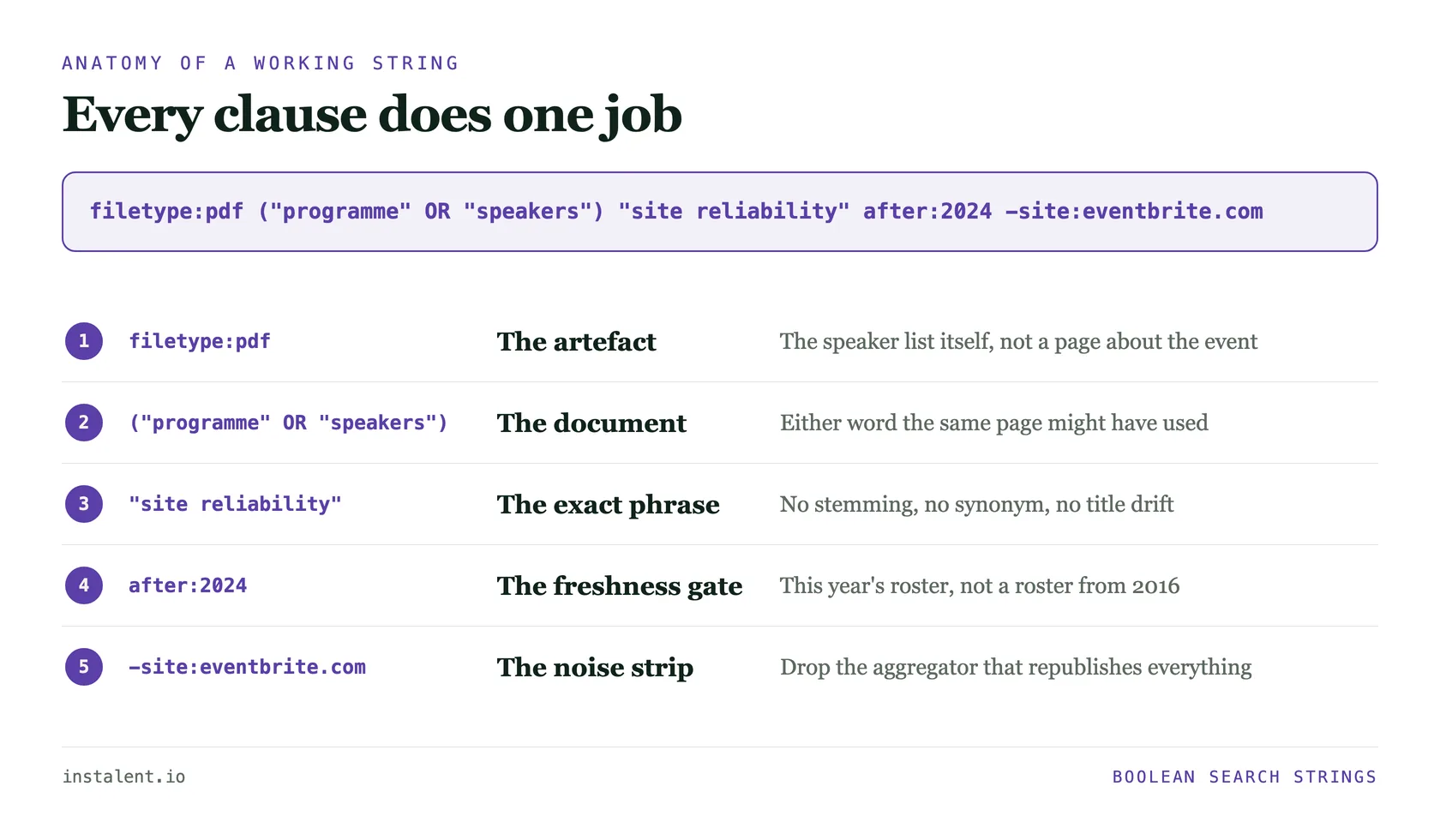
Four Boolean search string examples worth keeping in the library
Conference programmes. Speaker lists are published as PDFs, they carry employers and job titles, and getting on one is a signal somebody else granted.
filetype:pdf ("programme" OR "speakers") "site reliability" after:2024 -site:eventbrite.com
Written evidence of the exact work. People describe hard problems in public far more precisely than they describe themselves on a profile.
("postmortem" OR "we rebuilt" OR "lessons learned") "payments platform" after:2025 -site:medium.com
Regulated and credentialled populations. Where a register exists, it is the cleanest source there is - current, verified by the body that maintains it, and stable.
site:org.uk ("register" OR "directory") "chartered" "structural engineer" "Manchester"
GitHub, on its own qualifiers rather than Google's. GitHub's user search takes location:, language:, followers: and repos: with comparison operators, which is far sharper than X-raying it from outside.
language:Go location:Berlin followers:>50 repos:>10
Be honest about what that last one does: it searches profile fields, so it inherits every weakness of self-description. It is a way in, not a shortlist. The signals that actually discriminate for engineers are the ones another engineer had to grant.
Know which door you are walking through
X-raying pages that anyone can load in a logged-out browser is ordinary search. Pulling data from behind a login, or automating a session on a network you are a member of, is governed by that network's terms and is a different decision with different consequences. Decide which one you are doing before you build a workflow on it.
Stop writing longer strings. Define a corpus instead.
This is the biggest craft gap between a good sourcer and a great one, and it costs nothing.
Once you know which twenty or two hundred sites hold your market's real evidence, stop retyping site: clauses and build the list once. Google Programmable Search Engine lets you define your own set of sites and search only those, free. Now your string carries the role, and the corpus carries the market. A three-clause query against a curated corpus beats a two-hundred-character monster against the whole web, every time.
Three more worth the setup cost. SerpApi gives you 250 searches a month free and 1,000 for $25, which puts collection in a notebook where you can dedupe and sort instead of reading a page at a time. RecruitEm builds network X-ray strings for you, free and with no registration. And freesourcingtools.com is 18 sourcing utilities behind no paywall and no signup, built by two working sourcers.
Where the string stops paying
Two limits, and neither is fixable with better syntax.
The first is coverage. GitHub's Octoverse 2025 reports that 81.5% of all contributions now happen in private repositories. Public work grew too - 1.12 billion public contributions, up 13%, with 36 million new developers joining in 2025 - so there is more to find than ever. But your string only ever sees the public slice, and absence of public evidence is not absence of skill. Judge on what you find, never on what you did not.
The second is the deliverable. A string returns URLs. A desk needs people: deduplicated across sources, with a verified way to reach them, ranked against the brief, and recorded somewhere the next person can pick up. That gap is where sourcing hours actually go, and no operator closes it. It is also the argument in why Boolean search is dying - not that the syntax stopped working, but that matching strings was always the smaller half of the job.
From a list of URLs to a shortlist
This is the part Instalent does. Describe the role the way you would brief a colleague, and it searches across sources rather than one index, resolves the same person appearing in three places into one record, verifies contact details from multiple sources, scores every profile against your criteria with the evidence shown, pushes the shortlist to RecruiterFlow, Greenhouse, Lever or TeamTailor, and runs multichannel outreach with you approving anything sent under your name. Your Boolean judgement does not go to waste - it becomes the brief, and the hard constraints stay explicit.
Keep the strings for the searches only a string can do: a named employer, a specific licence, one exact phrase on one document. Hand the volume work to something that returns people instead of pages.
Want the shortlist instead of the search results page? Get started and you can run your current req through it in an afternoon.
Going further: how to write an AI sourcing brief covers the spec that replaces the string, the best tools, techniques and hacks for recruiters in 2026 has the wider free stack, and recruitment agencies points the same search craft at companies rather than people.
Related reading: social media recruiting covers which platforms are worth reading as an evidence surface, and which are only good for reach.
Sources
- Google Search Help: Refine Google searches - the six documented refinements, accessed 22 August 2026
- LOCOMOTIVE Agency: Google removes the &num=100 parameter - 15 September 2025
- Seobility: Google drops support for &num=100 - 17 September 2025
- Google: Expanding AI Overviews and introducing AI Mode - 5 March 2025
- GitHub Octoverse 2025 - 28 October 2025
- GitHub Docs: Searching users - accessed 22 August 2026
- Google Programmable Search Engine - accessed 22 August 2026
- SerpApi pricing - accessed 22 August 2026
Find better candidates, faster
Source, verify and reach candidates on one engine. Get 25% off your first month.
Keep reading