How to Write an AI Sourcing Brief That Returns the Right People
Most AI sourcing misses because the brief is vague, not because the model is weak. The six blocks of a sourcing brief that returns a slate you can defend.
Do this in Instalent - source, verify and reach candidates in one flow.

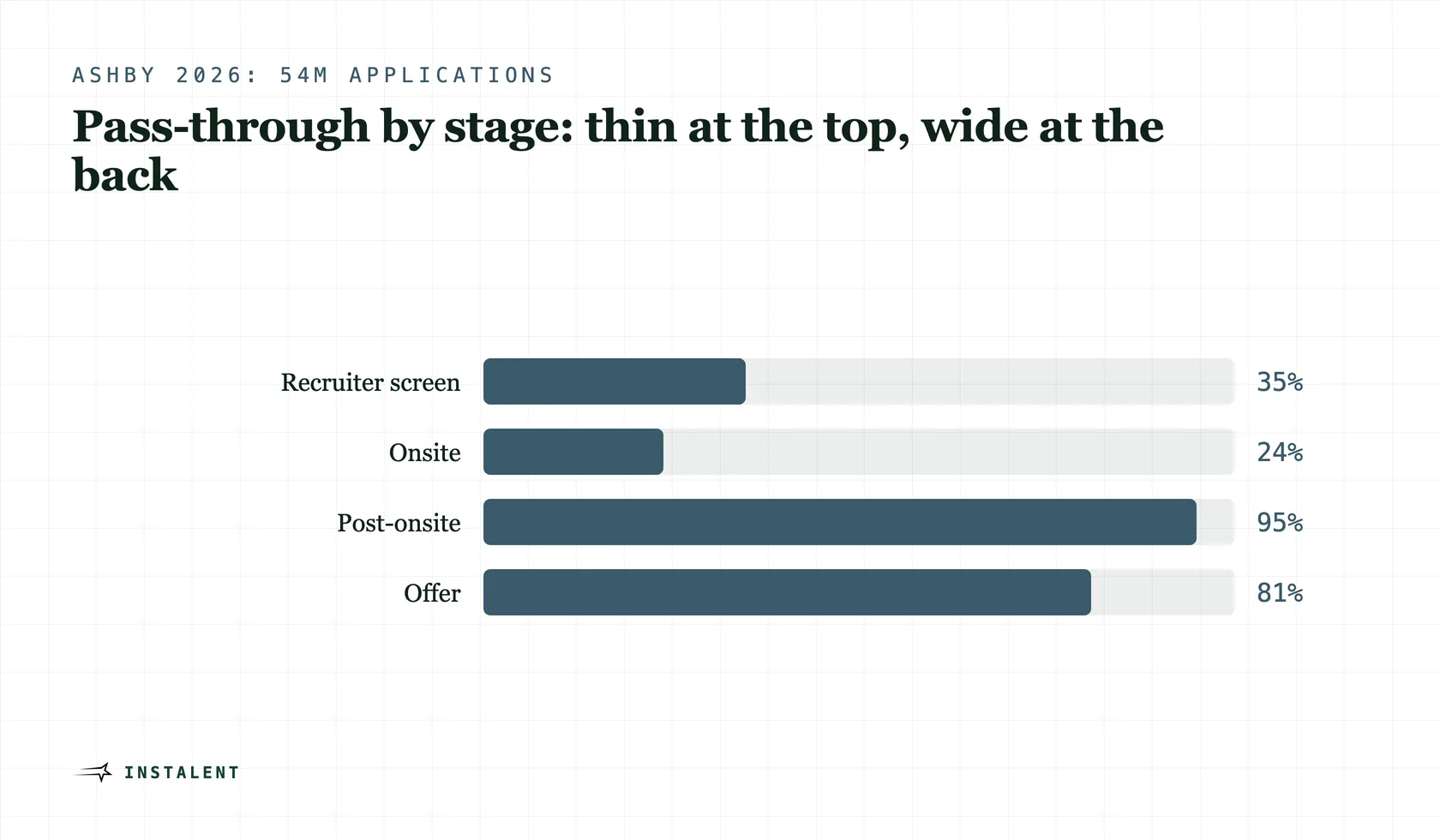
Ashby's 2026 benchmark data has a shape worth staring at. Across 54 million applications, 35% of candidates get past the recruiter screen and 24% get past the onsite. At the back of the loop the numbers invert: 95% pass the post-onsite stage and 81% pass at offer. Interviewing is not where hiring breaks. The break is upstream, in the decision about who was worth an hour, and that decision lives in a document most desks never write.
Every sourcer now runs some version of AI search. Describe the role in plain language, get a slate back. When the slate comes back wrong, the reflex is to blame the model. Usually the model did exactly what it was told. "Senior backend engineer, fintech, Berlin" is not a specification. It is a title with adjectives, and a title with adjectives returns everyone.
What returns the right people is a sourcing brief: the written spec your search runs on. It takes twenty minutes. It is the difference between a slate you can defend to a hiring manager and a list of names you hope they like.
The funnel fails at the top, where the spec lives
Ashby's May 2026 operations benchmark covers 54 million applications across 93,000 jobs since January 2021. Read the pass-through rates in order and the story is obvious: the losses are concentrated at the screen and the onsite, and almost nothing is lost after that. By the time a person reaches the back of the loop, the organisation agrees. The disagreement all happens earlier, when nobody has written down what good looks like.
The same report puts a number on that disagreement. When interviewers score the same candidate, they land on the exact same rating 62.5% of the time and differ by one point in another 33.5%. That is not an interviewing problem you can train away. It is what happens when three people apply three private definitions of the bar.
A brief is the cheapest fix available. It moves the bar out of everyone's head and onto one page, before the search runs.
A brief is not a job description
They are written for different readers and they fail in different directions.
A job description is a marketing document aimed at applicants. It is deliberately broad, it lists things nobody actually screens on, and it is written to attract. A brief is a search spec aimed at you, your hiring manager and your tooling. It is deliberately narrow, it lists only what you will really judge, and it is written to exclude.
Feed a job description into an AI search and you get the job description back as people: broad, plausible, unfalsifiable. Feed a brief in and you get a pool you can argue with.
This is also why keyword strings stopped working. A boolean is a spec compressed into syntax, and the compression throws away the part that mattered - what counts as proof.
The six blocks of a working brief
Keep it to one page. Six blocks, in this order.
- The pool. Where do these people actually work today? Name feeder companies, adjacent industries, the team types, and the real titles the work carries rather than the title on the req. If you cannot name twenty companies, you have a market mapping problem, and no search will rescue it.
- Must-haves, written as evidence. Three to five, no more. Each one has to be something you could point to on a profile and say yes or no.
- Nice-to-haves, with weight. Say out loud which ones you would trade against each other. A nice-to-have with no weight becomes a hard filter the moment volume gets uncomfortable.
- Exclusions. What takes a profile out, stated in terms of the work.
- Evidence rules. What counts as proof for each must-have, and what does not. A title is not evidence. A skill tag is not evidence. Scope, duration, and outcome are.
- Tie-breakers. When two profiles are equal on the rubric, what wins? Decide it now, not at 4pm on a Friday with a shortlist due.
Write must-haves as evidence, not adjectives
This is the block that decides everything. Adjectives cannot be scored, so they get scored inconsistently, which is exactly the 62.5% problem.
| Vague | Evidence-anchored |
|---|---|
| Strong Python engineer | Owned a production Python service end to end for 2+ years |
| Startup experience | Joined below roughly 200 people and stayed through a funding stage |
| Good stakeholder management | Ran a function that reported into two or more executives |
| Fintech background | Shipped in a regulated payments or lending environment |
The right-hand column has a property the left-hand column does not: someone can disagree with you about it. That is the whole point. A criterion nobody can fail is not a criterion.
The exclusion list does the most work
Every desk writes must-haves. Almost nobody writes exclusions, and exclusions are what actually shrink a pool to something a human can read.
Useful exclusions sound like: not agency-side only, no more than two roles under eighteen months in the last five years, not purely people-management with no hands-on delivery in three years. Each one is a statement about the work, and each one is arguable, which means a hiring manager can push back on it before you have wasted a week.
Exclude on work, never on proxies
An exclusion list is also where bias walks in wearing a lanyard. School names, company prestige, career gaps, and "culture fit" are proxies, not evidence about the work. Write exclusions you would be comfortable reading aloud to the candidate. If one only makes sense unsaid, it does not belong in the brief.
Calibrate on ten before you run three hundred
Do not run the full search first. Pull ten profiles you already have opinions about - a couple you would obviously interview, a couple you would obviously pass, and a few genuinely borderline. Score all ten against the brief.
You are checking one thing: does the brief produce the answers you already believe? If your obvious yes scores badly, a must-have is wrong. If your obvious no scores well, an exclusion is missing. If the borderline cases all cluster in the middle, your tie-breakers are not doing anything.
Fix the brief, then run it wide. Ten profiles of calibration costs an hour and saves a week of reviewing the wrong pool. It also gives you something to show the hiring manager that is not a slate: here is the bar, agree with it now or change it now.
What to measure so you know the brief worked
Most teams never find out. SHRM's State of AI in HR 2026, fielded in December 2025 across 1,908 HR professionals, found 39% of organisations have AI running in HR and recruiting is the single biggest use case at 27%. It also found that 56% do not formally measure whether the AI investment worked at all. Adoption without measurement is just a faster way to be wrong.
Three numbers tell you whether a brief is any good:
- Screen pass-through of your sourced slate. Against Ashby's 35% baseline. Below it, the brief is too loose. Far above it, it is probably too tight and you are missing people.
- Scorecard agreement across interviewers. If it is drifting below Ashby's 62.5%, the bar is still living in people's heads.
- Rejection reasons that were not in the brief. The single best signal. Every rejection for a reason you never wrote down is a missing block, and it should go into version two before the next req.
Briefs are versioned documents. The one you write for the second req in a family is worth more than the one you wrote for the first, because it has been beaten up by real rejections.
Want the brief to be the thing your search actually runs on? Instalent takes a plain-language brief and builds the pool from it, adds verified enrichment from multiple sources, then scores every profile against the same rubric in one pass so the bar stays identical from profile one to profile three hundred. Get started, or see how it fits your team. If you want the channel maths behind all this, we covered why outbound outperforms inbound in 2026.
Sources
- Ashby - Recruiting Operations Benchmarks, 2026 Talent Trends Report (May 7, 2026; 54M applications, 93K jobs, January 2021 to March 2026: pass-through recruiter screen 35%, onsite 24%, post-onsite 95%, offer 81%; scorecard alignment 62.5% exact match, 33.5% differ by one point; median time to first fill 71 days senior vs 52 days junior)
- SHRM - The State of AI in HR 2026 (February 2026; n=1,908 HR professionals, fielded December 5-23, 2025: 39% of organisations have AI adopted in HR, recruiting the highest practice area at 27%, 56% do not formally measure AI investment success)
- Gem - Key takeaways from the 2026 Recruiting Benchmarks Report (December 1, 2025; 165M applications, 1.2M hires: 8% of applicants pass the initial screen, 0.5% receive an offer)
- Greenhouse - Hiring benchmarks 2026: The Hire Standard (March 2026; 6,000+ companies, 640M+ applications: applications per recruiter rose from 146 to 746 between 2022 and 2025)
Find better candidates, faster
Source, verify and reach candidates on one engine. Get 50% off your first month.
Keep reading