Talent Pipeline: What It Is, and How to Build One That Does Not Go Stale
What a talent pipeline is, how it differs from a talent pool, the five steps to building one, and the two clocks that quietly turn a strong one into a list.
Keep the people you already met contactable - re-verify details and re-open conversations in one place.
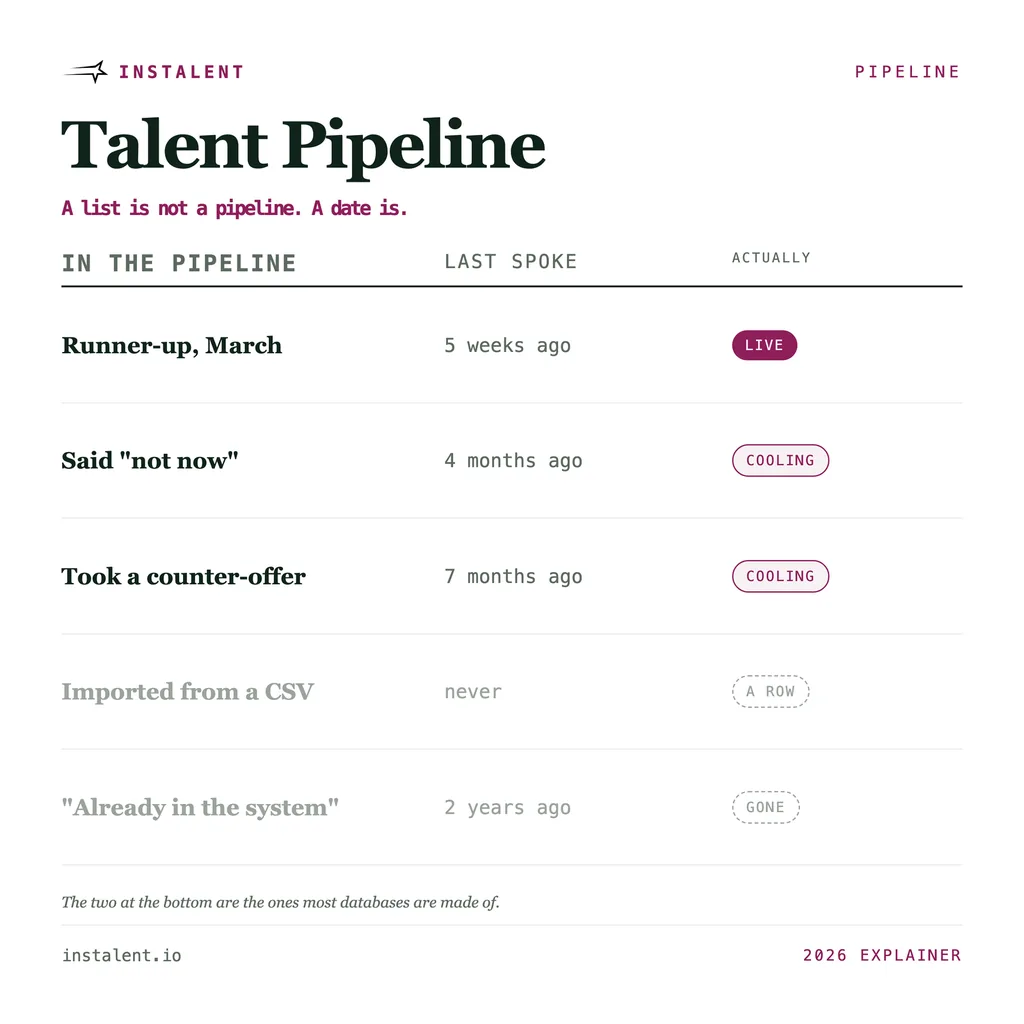
Most things called a talent pipeline are a saved search plus optimism. A real one is a set of relationships you can date: for every person in it you can say when you last spoke, what was said, and what you would open with next. That test sounds trivial and almost no pipeline passes it, which is why so many desks start each search cold while holding a database of people who already know who they are.
What is a talent pipeline?
A talent pipeline is the group of people you have already engaged who could fill roles you expect to work, held in a state where you could restart the conversation today.
The load-bearing words are already engaged and restart. A pipeline is defined by relationship state, not by volume. Ten thousand profiles you have never contacted is a search result. Forty people who took your call in the last year, with a note on each, is a pipeline, and it is worth considerably more.
Here is the test, and it is stricter than it sounds. Pick five names at random. For each, can you say when you last spoke, what was said, and what you would open with tomorrow? If not for at least four of them, you have a database.
What talent pipeline development means
If a talent pipeline is the asset, talent pipeline development is the ongoing work of maintaining it: adding to it, qualifying who is in it, and re-engaging the people already there between searches. The distinction matters because most teams treat it as a one-off exercise - build a list when a role opens, let it decay, build another list next quarter.
The version that works is small and continuous. A standing block of time each week, spent on people you already know rather than on people you have never contacted, is worth more than a quarterly push. Every conversation you have while not under pressure is a deposit into the search you have not been briefed on yet.
Talent pipeline vs talent pool vs talent map
These three get used interchangeably and they are different objects with different maintenance costs.
| What it is | Built from | Goes stale when | |
|---|---|---|---|
| Talent pool | Everyone who could plausibly do the work | The market | The market shifts |
| Talent map | Research on where those people are and what the work is called there | Deliberate market research | Companies restructure |
| Talent pipeline | The subset you have actually engaged, ordered by readiness | Conversations you had | You stop having them |
The map is the subject of talent mapping, and it is the layer most desks skip. The pipeline is what the map becomes once you have spoken to people. You can have a map with no pipeline. You cannot have a good pipeline without something map-shaped behind it, because otherwise you do not know who is missing from it.
Why this pays more than it used to
The share of hires coming from people already known to the organisation has moved sharply, and it is measured rather than asserted.
Gem's 2026 Recruiting Benchmarks Report, built on over 165 million applications and 1.2 million hires between June 2021 and May 2025, finds that 46% of sourced hires now come from rediscovered candidates - past applicants, runners-up and people from earlier outreach who were already in a CRM or ATS. In 2021 that figure was 26%.
That is close to a doubling in four years, and it reframes what a pipeline is for. It is not a nice-to-have you get to when things are quiet. It is now approaching half the sourced-hire yield.
The speed argument points the same way. In Bullhorn's 2026 GRID report - nearly 2,300 recruitment professionals - 85% of firms with a redeployment plan report placement times under 20 days. Redeployment is just a pipeline with a policy attached.
The most expensive sentence on a recruiting desk
"We already have them in the system." It stops the search and then hands you a phone number that stopped working eighteen months ago. A name in a database is only an asset if the way to reach them still works, and nothing in your ATS will tell you when that stopped being true.
Building a talent pipeline, in five steps
1. Pick the roles you actually repeat. Two or three. A pipeline for a role you fill once every three years is a hobby. If you cannot name the repeat roles, look at your last twenty placements rather than your ambitions.
2. Define what qualifies someone before you meet them. The same discipline as defining the pool before the channel. Without it the pipeline fills with everyone who was pleasant on a call.
3. Add people from work you are already doing. This is the step that decides whether the thing survives. Every search produces runners-up, people who were strong but not available, and people who said "not now". Those go in with a date attached. Talent pipeline development as a separate project fails; as a by-product of searches you were running anyway, it compounds.
4. Record two facts per person. When you last spoke, and what was said. Everything else is optional. Elaborate schemas do not get maintained, and an unmaintained field is worse than a missing one because someone will trust it.
5. Set a re-contact cadence you will keep. Quarterly for the top of the pipeline, twice a year for the rest, is more than most desks manage. A cadence you keep at half the intended frequency beats an ambitious one you abandon in March.
The two clocks that kill a pipeline
This is the part that separates a strong talent pipeline from a large one, and it is the reason most pipelines fail silently rather than visibly.
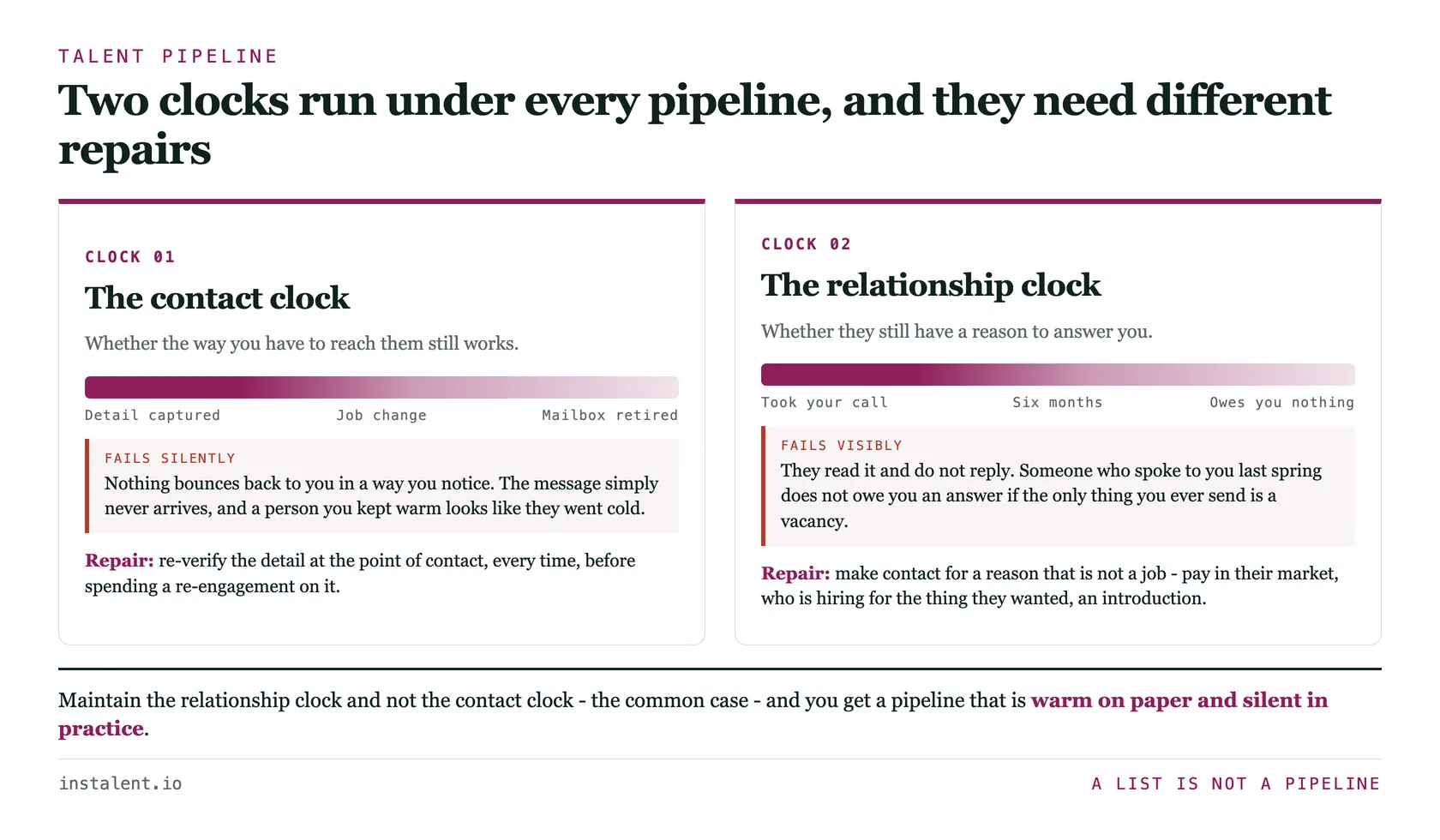
The contact clock. People change employers, mailboxes get retired, numbers get reassigned. A detail captured eighteen months ago is a guess. The failure mode is invisible: your re-engagement does not bounce back to you in any way you notice, it just never arrives, and the person you carefully kept warm looks like they went cold.
The relationship clock. Even with a working address, the conversation itself decays. Someone who took your call last spring does not owe you a reply this autumn if the only thing you have ever sent is a job.
They need different repairs. The contact clock is fixed by re-verifying details before a second approach, mechanically, at the point of contact. The relationship clock is fixed by having something to say that is not a vacancy - what you are seeing on pay in their market, who is hiring for the thing they said they wanted, an introduction that costs you nothing.
Maintain one and not the other and you get a characteristic failure: a pipeline that is warm on paper and silent in practice.
What a strong talent pipeline actually looks like
Four honest tests, none of which involve counting rows.
- The five-name test above. Relationship state you can recall or read, for most of them.
- Re-engagement rate. Of the people you contacted six or twelve months ago, how many answer when you come back. This is the number that tells you whether you own an asset or an archive, and it is covered with the rest of them in candidate engagement.
- Share of placements from people you already knew. Track it as its own line. Most desks have never split it and are surprised, usually pleasantly, and then discover it is falling because nobody maintains the source.
- Time to first credible slate on a repeat role. If a pipeline is real, that number is days rather than weeks. If it is not, having the database changes nothing.
Where the tooling helps, and where it does not
No system fixes an unkept cadence. That part is a decision about how a desk spends Friday afternoons.
What tooling can genuinely do is the mechanical half: re-verifying whether a stored detail still connects before you spend a re-engagement on it, finding the people who are missing from the pipeline rather than re-reading the ones already in it, and keeping every reply in one place so the "when did we last speak" answer is a fact rather than a memory.
Instalent re-verifies contact details from multiple sources at the point you need them, finds the people the map says should exist but who are not in your records yet, and runs multichannel outreach with every response landing in one shared inbox - alongside RecruiterFlow, Greenhouse, Lever or TeamTailor, which is where the pipeline itself should live.
Want the people you already met to still be reachable? Get started and run one real role end to end.
Related reading: talent acquisition vs recruitment covers the function this asset belongs to, recruitment strategies covers the own-versus-rent choice this asset sits under, talent mapping is the research layer underneath a pipeline, candidate sourcing strategies covers filling it, candidate engagement covers measuring whether it is alive, and recruiting CRM vs ATS covers which system should hold it.
Sources
- Gem - Key takeaways from the 2026 Recruiting Benchmarks Report - over 165 million applications, 15 million candidates and 1.2 million hires, June 2021 to May 2025
- Bullhorn GRID 2026 Industry Trends Report - nearly 2,300 recruitment professionals, fielded November to December 2025
Find better candidates, faster
Source, verify and reach candidates on one engine. Get 25% off your first month.
Keep reading