Talent Acquisition vs Recruitment: The Difference That Changes Your Week
Talent acquisition vs recruitment, without the vague strategic-versus-tactical framing. The one testable difference, and what each actually costs to run.
Do the before-the-req work without adding a head - map, verify and warm in one place.
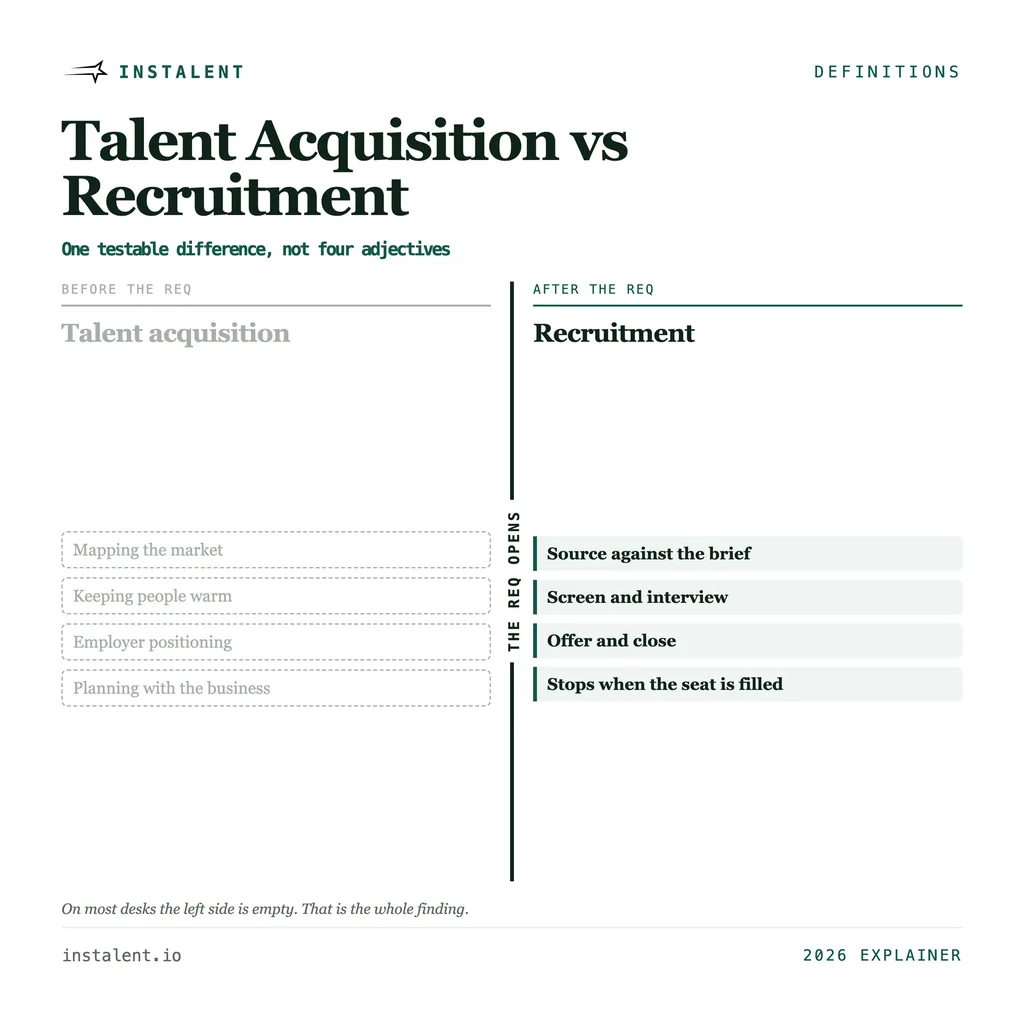
Almost every answer to this question is the same sentence: recruitment is tactical and short-term, talent acquisition is strategic and long-term. That distinction is true and completely useless, because it tells you nothing you could check on a Monday. There is a sharper version, and it is testable in about ten minutes: the difference is whether any of the work starts before the vacancy exists.
The useless distinction, and the useful one
The standard answer is a pair of adjectives. Recruitment is reactive, tactical, short-term. Talent acquisition is proactive, strategic, long-term. Nobody disagrees, and nobody can act on it.
Here is the version you can test. Recruitment is triggered by a vacancy. Talent acquisition runs whether or not one is open.
That single difference in timing produces every other difference people list. Reactive versus proactive is a consequence of it. So is short-term versus long-term. So is transactional versus relationship-driven. They are not four distinctions; they are one distinction described four ways.
The ten-minute audit that settles it
Open last month's calendar and mark every hour that would still have been spent if no requisition had been open. Market research, keeping in touch with people who are not candidates right now, employer positioning, workforce planning with the business. If that total is close to zero, you are running recruitment - competently, perhaps, but the rename to talent acquisition was cosmetic.
What each one actually is
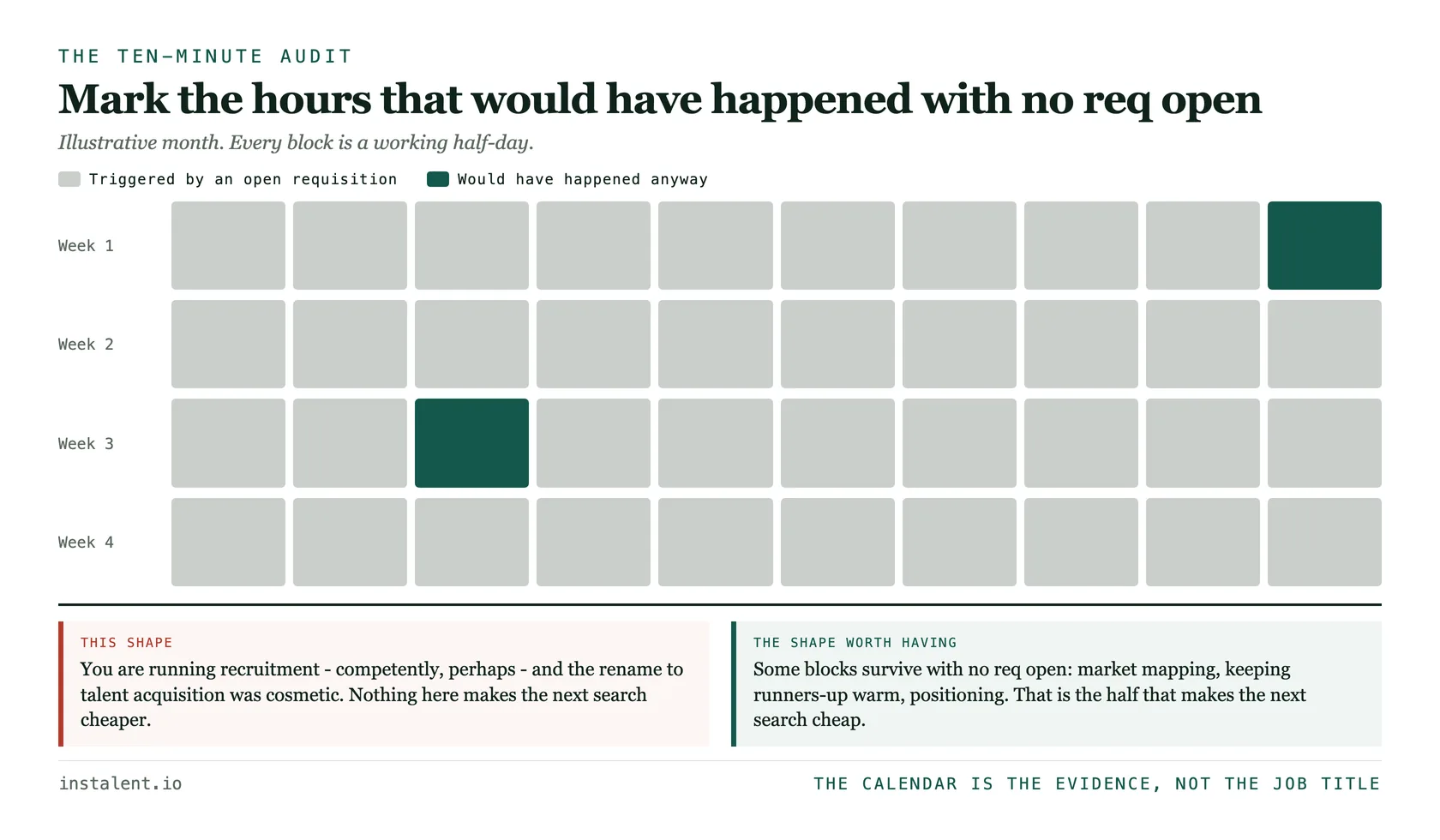
Recruitment is the execution chain: take the brief, source against it, screen, interview, offer, close. It has a start (the req) and an end (the acceptance). Done well it is a genuinely skilled job, and it is what most people are paid for.
Talent acquisition is the standing capability underneath it: knowing the market before you need it, holding relationships with people who are not currently looking, being a company or firm people have heard of, and planning capacity with the business rather than reacting to it.
The relationship between them is not hierarchy - one is not a more senior version of the other. It is that the second makes the first cheaper. Every hour of before-the-req work is an hour you do not spend after the req opens, when the clock is running and the cost is highest.
Why the before-the-req half pays
It is measurable now, which it was not five years ago.
Gem's 2026 Recruiting Benchmarks Report, built on over 165 million applications and 1.2 million hires between June 2021 and May 2025, finds that 46% of sourced hires now come from rediscovered candidates - past applicants, runners-up and earlier outreach already sitting in a CRM or ATS. In 2021 that figure was 26%.
Read that as a direct measurement of the talent acquisition half. Rediscovered candidates only exist because somebody did work that was not attached to the req currently open. Close to half of sourced hires now come from that work, and the share nearly doubled in four years.
The speed argument runs the same way. SHRM's benchmarking research across more than 4,600 organizations puts median time to fill at 39 calendar days for nonexecutive roles - though you cannot compare yourself to it without matching how it was measured, which is the trap recruitment analytics covers. What closes that gap is not sourcing faster once the req lands. It is having already mapped the market and already verified the contacts.
The two comparisons people actually mean
Talent acquisition vs recruitment as JOB TITLES. Usually nothing. Titles in this profession drift with seniority and fashion, and "talent acquisition specialist" frequently describes a recruiter. Judge the role by whether the calendar contains before-the-req work.
Talent acquisition vs recruitment as FUNCTIONS. A real and useful distinction, and the one this whole article is about. It decides where your hours go and whether the next search is cheaper than the last one.
For an agency desk
The distinction is usually framed for in-house teams, which is why agency owners skip it. That is a mistake, because the economics are sharper on an agency desk.
Filling a client's role is recruitment, and it is what you are paid for. But the firm that already knows the market when the brief arrives places faster than the firm that starts cold, and it does so on the same fee. That before-the-brief knowledge is the agency version of talent acquisition: talent mapping is the research asset, and talent pipeline is the set of relationships built on top of it.
The reason most desks do not do it is not disagreement. It is that the work is invisible this month and only pays next quarter, so it loses every time it competes with a live req. Which is exactly why it needs to be somebody's actual job, or to be cheap enough that it survives a busy week.
How a small team should split it
Do not attempt a standing capability across everything you might ever hire.
- Name the two or three roles you genuinely repeat. Look at your last twenty placements rather than your ambitions. A pipeline for a role you fill once every three years is a hobby.
- Do the before-the-req work only for those. Map the companies, learn what the job is called in each of them, and keep the runners-up contactable.
- Keep everything else purely reactive, and stop feeling bad about it. Reactive recruitment on a role you fill twice a decade is the correct strategy.
- Measure one number: the share of placements that came from somebody you already knew. If it is not rising, the before-the-req work is not happening, whatever the calendar claims.
Where the tooling changes the maths
Nothing here is a software decision. But the reason before-the-req work does not happen is almost always cost, not disagreement - it is research and maintenance, it takes hours, and it produces nothing this week.
That is the part worth making cheap. Instalent covers the mechanical half: describe a population in plain English and get people from across sources, keep contact details verified so a warm pool stays reachable rather than rotting, score fit against your criteria with the evidence shown, and run multichannel outreach with every reply in one shared inbox - alongside RecruiterFlow, Greenhouse, Lever or TeamTailor. It does not make the strategic choice for you. It makes the choice affordable enough to survive a busy week.
Want the before-the-req work to actually happen? Get started and run one real role end to end.
Related reading: talent mapping is the research asset, talent pipeline is the relationship set built on it, recruitment strategies covers the wider set of choices, and candidate sourcing strategies is the execution method.
Sources
- Gem - Key takeaways from the 2026 Recruiting Benchmarks Report - over 165 million applications, 15 million candidates and 1.2 million hires, June 2021 to May 2025
- SHRM - Recruiting Benchmarking research - data from over 4,600 organizations; median time to fill of 39 calendar days for nonexecutive positions
Find better candidates, faster
Source, verify and reach candidates on one engine. Get 25% off your first month.
Keep reading