Candidate Engagement: What It Is, and the Metrics That Actually Track It
What candidate engagement means, why activity metrics mislead, the four numbers that actually track it, and the candidate engagement best practices that move them.
Keep every reply in one place so no engaged candidate goes quiet.
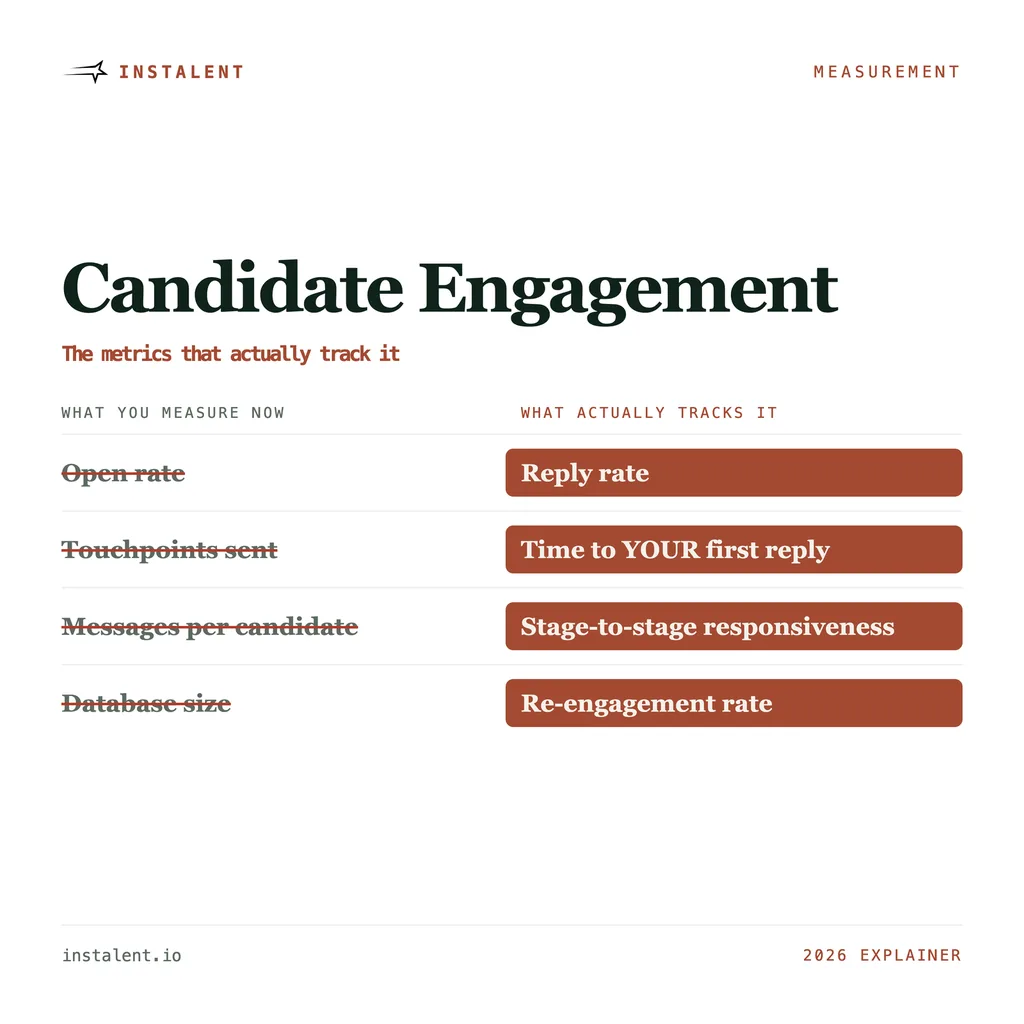
Candidate engagement is the most measured thing in recruiting that almost nobody measures correctly. Most teams track sends, opens and touchpoints - all of which are things you did, not things that happened. Engagement is a property of the candidate, not of your outreach volume, and the moment you measure it that way the levers change completely.
What is candidate engagement?
Candidate engagement is the degree to which the people in your process are actually responsive and still interested. It is a property of the candidate. Your sequence, your cadence and your message count are inputs; engagement is the output.
That distinction matters because it decides what you measure. If engagement is something the candidate does, then sends, opens and touchpoints cannot measure it - they measure effort. The observable signals are narrower and harder: replies, continued responsiveness across stages, and whether people stay contactable once a role closes.
Why activity metrics mislead
Three reasons, and each one has cost somebody a pipeline.
Opens have been unreliable for years. Inbox privacy protections pre-fetch images, so open rates now measure a mail client rather than a human. Any engagement dashboard leaning on them is reporting noise with a trend line.
Volume metrics reward the wrong behaviour. "Touchpoints per candidate" goes up when you chase people who already answered. That is not engagement; it is the thing that ends engagement.
Ratios improve when you shrink the top. A recruiter who contacts only the ten most obvious people posts a beautiful reply rate and a thin slate. Any engagement rate has to be read next to the volume it came from, or it flatters exactly the behaviour you do not want.
The metric that quietly means the opposite
If your follow-up automation does not hard-stop the instant someone replies, your "touchpoints per candidate" number is partly counting messages sent to people who already said yes. That metric going up is a warning, not a win.
The four numbers that actually track it
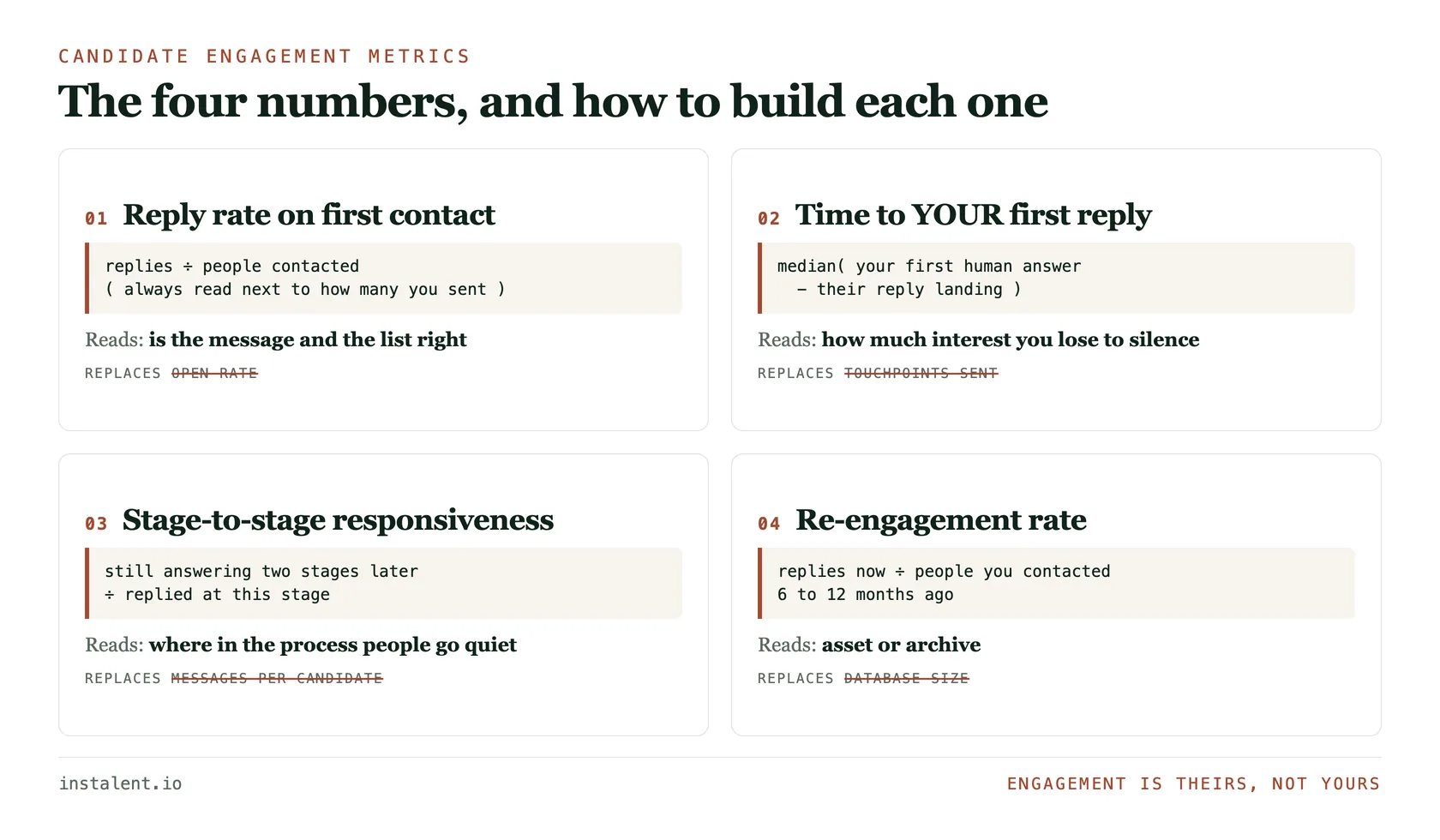
1. Reply rate on first contact. Replies per hundred sent, read alongside how many you sent. This is the only top-of-funnel engagement number worth keeping.
2. Time to first human reply - yours. Measured from when the candidate answers to when a person answers back. This is the metric almost nobody keeps and the one that explains the most lost candidates.
3. Stage-to-stage responsiveness. Of the people who replied, how many are still answering two stages later. Engagement decays, and the shape of that decay tells you where your process loses people.
4. Re-engagement rate. Of the people you contacted six or twelve months ago, how many answer when you come back. This is the number that tells you whether your database is an asset or an archive, and it is the single best health check on a talent pipeline.
How to improve candidate engagement
The instinct is to write better messages. The bigger lever is usually answering faster.
Reply before you send more. A candidate who answered and then waited four days is lost regardless of how good the original outreach was. In Bullhorn's 2026 GRID report - nearly 2,300 recruitment professionals - 56% of top-performing firms place in under ten days and 22% in three days or less. You cannot run that clock while replies sit unread in one person's mailbox. Every reply belongs somewhere the whole desk can see it, which is the argument in the reply problem.
Stop the sequence on reply, immediately and on every channel. Being chased after you have already answered is the fastest way to turn an interested person into a non-responder. Candidate follow-up automation covers doing that properly, including what should never be automated.
Make the first message specific to evidence you actually found. Passive people owe you nothing, and a templated note reads as exactly that. One concrete sentence about their work beats three paragraphs of enthusiasm.
Keep the people you did not place. GRID finds 85% of firms with a redeployment plan report placement times under 20 days - the fastest pipeline is usually people who already know who you are. That only holds if contact details are re-verified rather than left to rot, which is what talent mapping treats as a maintained asset rather than a one-off project.
Size the slate for the acceptance rate. The same report has firms seeing two to three of every five candidates reject offers. Engagement that collapses at the offer stage is usually a conversation that did not happen on the first call - comp, counter-offer risk, competing processes.
Engagement vs candidate experience
Worth separating, because they get used interchangeably and they are not the same thing.
Candidate engagement is behavioural and measurable while the process is running: are they replying, are they still interested. Candidate experience is how the process felt, usually captured afterwards by survey. Engagement is the leading indicator; experience is the lagging one. A team with good engagement numbers and bad experience scores is usually moving fast and communicating badly. A team with the reverse is being pleasant to a pipeline that has already gone quiet.
Where the tooling helps, and where it does not
Candidate engagement software mostly automates the sending. That is the half that was never the constraint.
What actually moves the four numbers above is: replies landing somewhere the whole team can see them, sequences that stop the instant a person answers, contact details that are verified so the first message arrives at all, and a pool that stays reachable between roles. Instalent puts every reply across channels into one shared inbox, runs multichannel outreach that stops on reply, and keeps verified contact details attached to the people you have already met - alongside RecruiterFlow, Greenhouse, Lever or TeamTailor rather than replacing them.
Want every reply in one place so nobody goes quiet by accident? Get started and run one real role end to end.
Related reading: candidate experience is the lagging half of this, interview questions to ask candidates covers what happens once someone is engaged, candidate follow-up automation is the automation half done honestly, recruiting metrics has the formulas for the wider set, recruitment analytics covers why these numbers usually break before they reach a dashboard, and candidate sourcing strategies covers filling the top of the funnel this measures.
Sources
- Bullhorn GRID 2026 Industry Trends Report - nearly 2,300 recruitment professionals, fielded November to December 2025
Find better candidates, faster
Source, verify and reach candidates on one engine. Get 25% off your first month.
Keep reading