Candidate Experience: What It Costs, and Why Your Survey Cannot See It
What candidate experience is, what a bad one costs in revenue, the survey bias that hides it, and the metrics and moments that actually move it.
Answer faster - keep every reply in one place so nobody waits on silence.
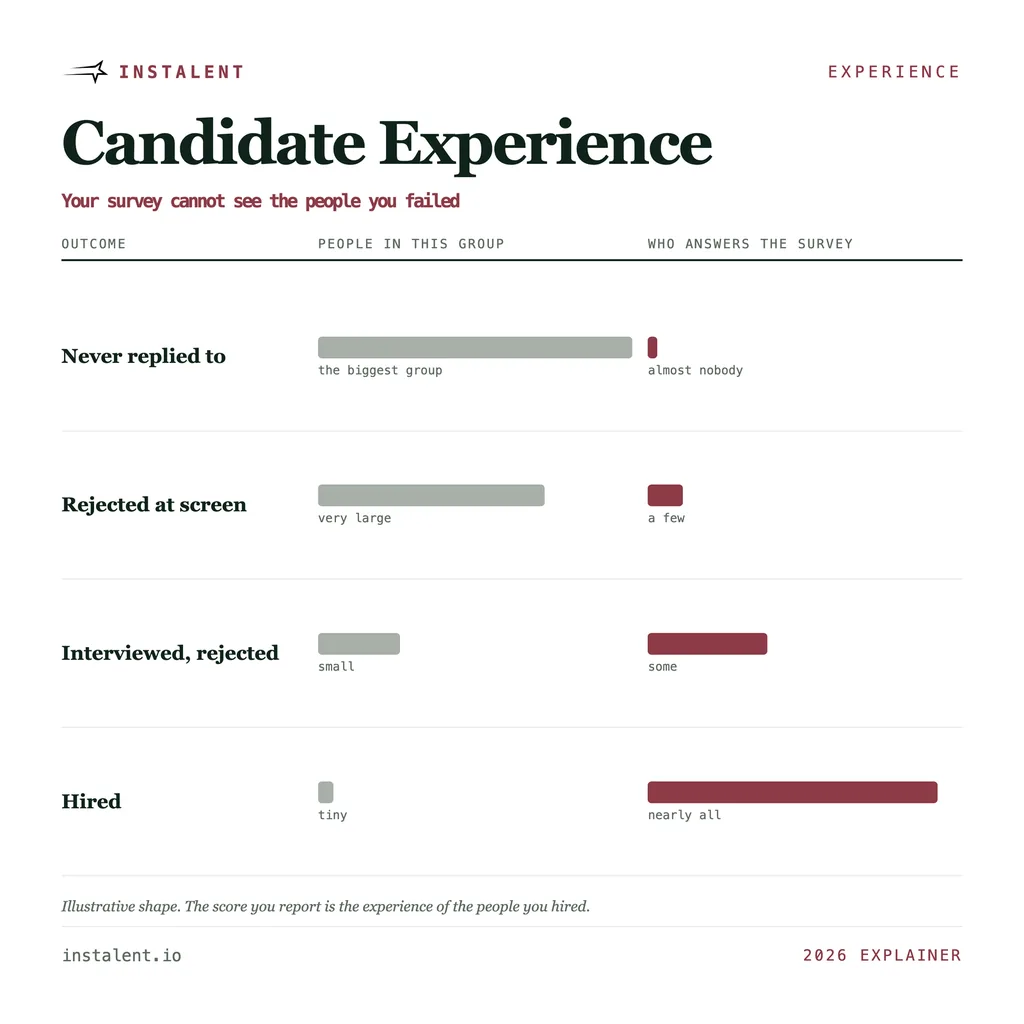
Candidate experience gets discussed as an ethics problem and measured as a survey problem. It is neither. It is a revenue problem with a measurement problem sitting on top of it - because the people who had the worst experience are precisely the people who never answer your survey. Most candidate experience programmes are quietly reporting the experience of the people who got hired.
What candidate experience actually is
Candidate experience is how the process felt to the person in it: finding the role, applying, waiting, interviewing, and receiving an answer. Crucially it includes everyone you rejected and everyone you never got back to, who are the overwhelming majority of the people who touched your process.
It is worth separating from a term it gets used interchangeably with. Candidate engagement is behavioural and measurable while the process is running - are people replying, are they still interested. Candidate experience is how it felt, usually captured afterwards. Engagement is the leading indicator; experience is the lagging one. Candidate engagement covers the leading half.
What a bad one costs
The reason this belongs in a commercial conversation rather than a values statement.
PeopleScout's 2026 research - more than 1,000 job seekers across 10 markets, alongside an audit of employer hiring processes in over 20 industries - found that 36% of candidates with a negative experience say they would stop purchasing from that company, and 37% say they would tell others not to apply.
Read that as two separate bills. The first is revenue, and it scales with how many people you reject: a company that turns down two thousand applicants a year is running a campaign against itself. The second is future pipeline, and it compounds - the people telling others not to apply are talking to exactly the population you will need next year.
The same research found just 11% of candidates globally rate their most recent application experience as excellent. This is not a hard bar to clear. It is a low one that most processes are walking under.
The measurement problem nobody puts on the slide
Here is why the numbers on your candidate experience dashboard are probably fine while the experience is not.
Survey response is not random. It rises with how well the process went. Someone you hired will answer; someone you interviewed three times and then rejected might; someone auto-rejected in four hours generally will not; and someone you never replied to at all has no reason and often no route to tell you anything.
So the average score you report is dominated by the people who had the best possible outcome. The worse your process is at the bottom of the funnel, the better your survey looks, because failing people harder makes them less likely to respond. That is not a subtle bias. It is a metric that moves the wrong way on purpose.
A rising candidate experience score can be a warning
If your survey average improves while your response rate falls, the most likely explanation is that fewer unhappy people are answering - not that fewer people are unhappy. Always report the score next to the response rate and next to the share of respondents who were rejected. A survey with no rejected candidates in it is a customer satisfaction survey for new hires.
Four metrics that survive the bias
Take these from your own system, where everyone is counted whether or not they volunteer feedback.
1. Time to first human reply. From their application or reply to a response written by a person. This is the single number most correlated with how the process feels, and almost nobody tracks it.
2. Closure rate. The share of applicants who receive any final answer at all. Against a 64% ghosting rate this is the metric with the most room in it, and it is entirely within your control.
3. Stage-to-stage drop-off. Where people withdraw rather than get rejected. Voluntary withdrawal is candidate experience data that arrives without a survey.
4. Application completion rate. How many people who start your application finish it. A long form is the first thing a candidate experiences and the easiest thing to fix.
The four moments that decide it
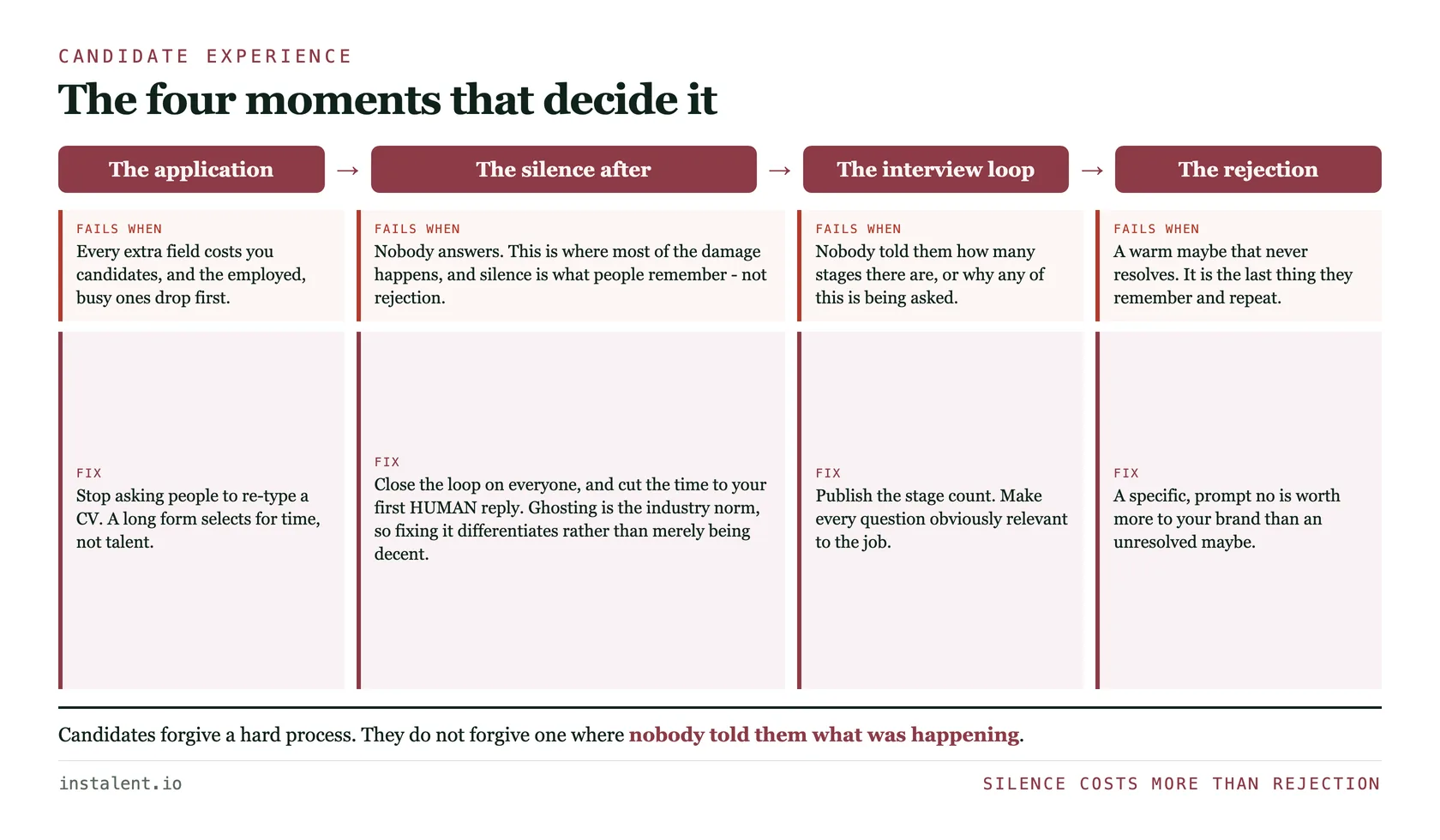
The application itself. Every field you add costs you candidates, and the strongest people - who are employed and busy - drop first. If you re-type a CV into a form, you are selecting for people with time rather than people with options.
The silence after. This is where most damage happens, and it is silence rather than rejection that people remember. The 64% ghosting figure is a description of an industry norm, which means fixing it is differentiating rather than merely decent.
The interview loop. Relevance and predictability. Candidates forgive a hard process; they do not forgive one where nobody told them how many stages there were or why they were being asked any of this. Interview questions to ask candidates covers making the loop worth their time.
The rejection. The last thing that happens is the thing they remember and repeat. A specific, prompt no is worth more to your brand than a warm maybe that never resolves.
Designing a survey that is worth running
Short, immediate, and sent to everyone.
- Send it at the outcome, not weeks later. Memory decays and so does response rate.
- Send it to rejected candidates, explicitly. If they are not in the sample, you have not measured candidate experience.
- Three or four questions. Did the process take about as long as you expected? Did you know what was happening next? Did the interviews feel relevant to the job? Plus one open field, which is where the actual information is.
- Report the response rate next to the score, always, and segment by outcome. A score that only holds up unsegmented is not a finding.
That is the entire template. Anything longer is a survey designed for the people who already like you.
Where tooling helps, and where it does not
Most of this is decisions, not software: how long your form is, whether you close the loop, whether hiring managers commit to a stage count.
The one part that is genuinely a systems problem is speed of reply, because it fails for a structural reason rather than a moral one. Replies scatter across mailboxes and channels, one person owns a thread and is away, and a candidate waits four days for an answer somebody would have given in four minutes if they had seen it.
Instalent puts every reply across channels into one shared inbox tied to the campaign and profile, so the desk can see what is waiting rather than each person seeing their own corner - and multichannel outreach stops the moment somebody answers, so nobody gets chased after they have already replied. It runs alongside RecruiterFlow, Greenhouse, Lever or TeamTailor rather than replacing them.
Want to stop losing people to silence? Get started and run one real role end to end.
Related reading: the hiring process maps where these moments sit in the wider sequence, candidate engagement is the leading indicator this lags, candidate follow-up automation covers automating the answer without automating the judgement, and recruiting metrics has the wider set of formulas.
Sources
- PeopleScout - AI and the Candidate Experience: New Research - 2026; more than 1,000 job seekers across 10 markets, plus an audit of employer hiring processes across more than 20 industries
Find better candidates, faster
Source, verify and reach candidates on one engine. Get 25% off your first month.
Keep reading