Candidate Follow-Up Automation: Automate the Answer, Not the Judgement
Candidate follow-up automation done properly, and how to improve candidate engagement: what should run on its own, and what must stay human.
Do this in Instalent - source, verify and reach candidates in one flow.

PeopleScout's 2026 candidate experience research, across more than 1,000 job seekers in ten markets, found a 64% ghosting rate: that is the share of candidates who were ghosted in more than half of their applications. Just 11% rate their most recent application experience as excellent. Greenhouse's May 2026 survey of 2,950 candidates found that of those who completed an AI interview, 51% received no feedback whatsoever. The dominant candidate experience in hiring right now is not a bad answer. It is no answer at all.
That is worth sitting with before deciding what to automate, because it reframes the question. The problem on most desks is not that machines are talking to candidates too much. It is that nobody has the hours to talk to all of them, so the ones who are not this week's priority hear nothing, and the recruiter takes the reputational hit for a capacity problem.
Candidate follow-up automation is the right answer to that. It just has to be pointed at the correct half of the job.
What candidates actually object to
It is easy to read "candidates dislike AI in hiring" and conclude that anything automated will damage your brand. The research is more specific than that, and the specificity is the useful part.
Greenhouse surveyed 2,950 candidates in May 2026, 1,200 of them in the US plus respondents in the UK, Germany, Australia and Ireland. Sixty-three percent had faced an AI interview, up thirteen percentage points in six months. Seventy percent were never clearly told upfront that AI would evaluate them. Twenty-one percent only found out once the interview had begun. Thirty-eight percent walked away from a process because of it.
Look at what they asked for instead: 44% want upfront disclosure, 46% want the option to request a human interview, 38% want human review before decisions are made.
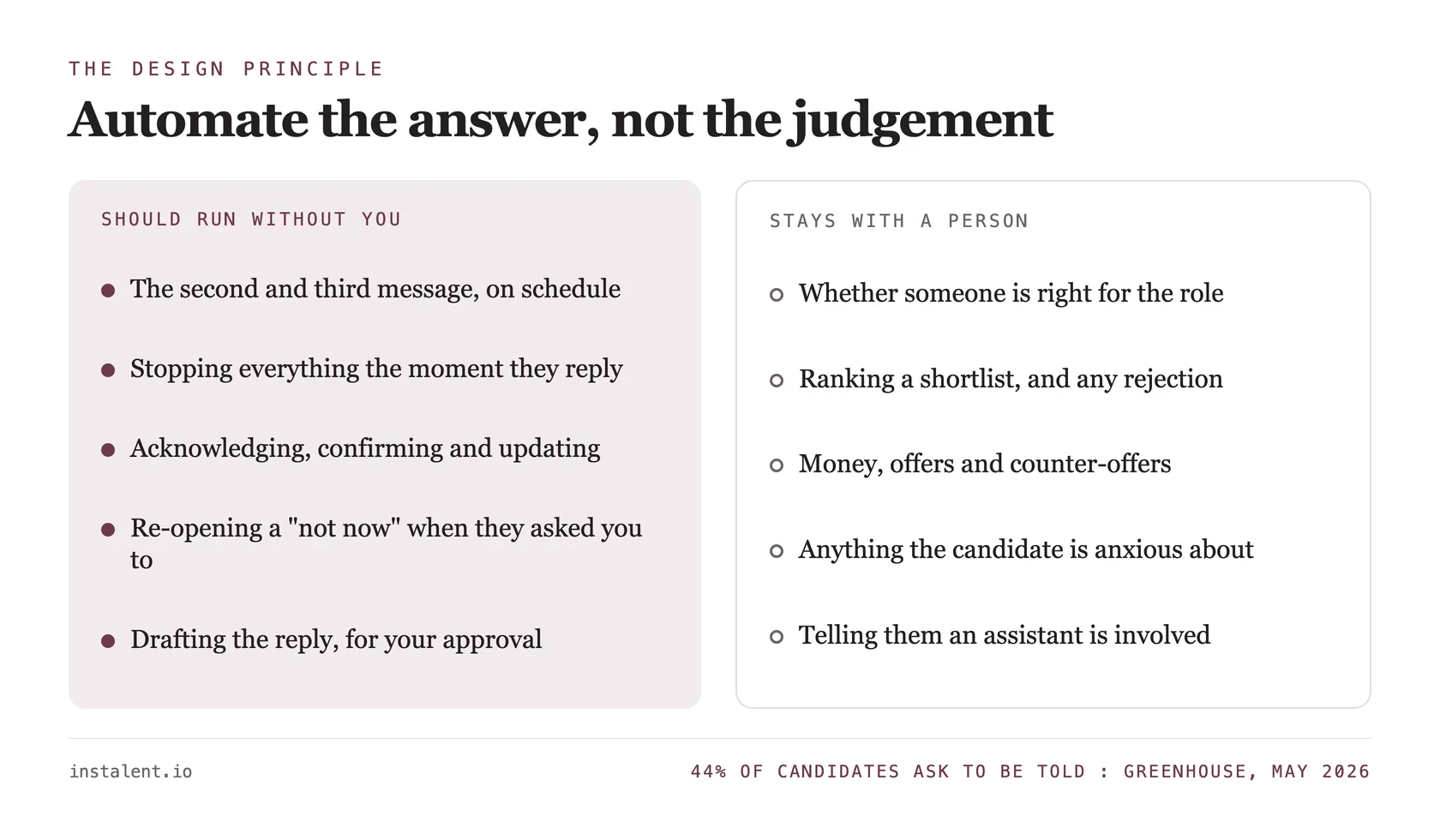
None of that is an objection to being contacted, updated or followed up with. It is an objection to being judged by a machine, without being told. Those are different things, and the difference is the whole design principle:
Automate the answer. Keep the judgement human, and say so.
How to improve candidate engagement: the follow-up is where the outcome actually is
Any experienced recruiter already knows that one message is not outreach. The reply you want usually arrives after the second or third touch, from someone who was interested but busy on the day the first one landed.
The problem has never been believing in follow-up. It is that following up properly across a live desk means remembering, for every person, what was sent, when, what they said back, and whether they are still worth chasing. That is bookkeeping, and bookkeeping is exactly what a busy week deletes first.
So the first job of follow-up automation is unglamorous: send the second and third message on schedule, and stop the entire sequence the instant someone replies. Instalent's sequences do that by default across every channel you use, and the reason it matters is not efficiency. It is that being chased after you have already answered is the fastest way to make an interested candidate stop being one.
Where most setups break: the reply
Here is the pattern we see most often, and it is not a tooling failure so much as a seam failure.
A sequence goes out. It follows up correctly. Someone replies. That reply lands in one person's mailbox, on whichever channel they chose to answer on. If that person is on holiday, in back-to-back interviews or simply not looking at that account today, the conversation you spent money creating sits unopened. Nobody on the team knows it exists.
Every reply belongs in one inbox the whole desk can see, tied to the campaign and the profile it came from, so the state of a conversation is a fact rather than something living in a colleague's head. We wrote about that as its own problem in the reply problem.
Once replies are in one place, something more useful becomes possible.
What follow-up automation should actually do
Five properties. If a setup does not have all five, the gaps will show up as candidates who went quiet.
- It stops on reply. Immediately, across every channel, not at the end of the current step.
- It knows the context. The role, what was already sent, what the person said, and where they are in the process. Follow-up written blind is just a reminder with your name on it.
- It drafts, and you decide how far it goes. Instalent's agent can draft a reply for your approval or handle a conversation under a persona you define, and you set which steps it may take on its own and which need your sign-off. Start on drafts. Move the dial when you have read enough of them to trust it.
- It escalates rather than guesses. An offer question, a counter-offer, anything about money or a start date, anything emotional: those go to a person. A good setup knows the difference between answering a question and making a decision.
- It leaves a record. What went out, when, and who approved it. If you cannot reconstruct a conversation, you cannot defend it to a client or improve it next quarter.
Disclose it, and never let it decide
Two rules that follow directly from the research. Tell candidates when they are talking to an assistant, because 44% of them are explicitly asking for that disclosure and hiding it is what produced the 38% walk-away rate. And keep every judgement about a person with a person: an automated message should answer, schedule, update or acknowledge, never screen out, rank or reject.
What this frees up
The argument for automating follow-up is not that you send more messages. Volume is not the constraint on a good desk and never was.
It is that the fifty people you contacted three weeks ago and never got back to stop being a source of quiet reputational damage. It is that a candidate who replies at nine on a Sunday night gets an answer before Monday's inbox buries them. It is that the person who said "not now, ask me in the spring" is actually asked in the spring.
Those are the conversations experienced recruiters lose to capacity, not to skill. Getting them back is worth considerably more than shaving a few minutes off a search.
Run it on one campaign
You do not need to change how the desk works to test this.
- Take one live campaign, not your most important one.
- Turn on sequenced follow-up with a hard stop on reply, and check that the stop works by replying to yourself.
- Route every reply into one shared queue.
- Let the agent draft responses for a fortnight. Read every draft before it goes. Keep a note of which ones you rewrote and why.
- Measure two things only: how many conversations got a same-day answer, and how many people who had gone quiet came back.
If the drafts are good enough that you are approving most of them unchanged, widen the dial. If they are not, you have learned exactly which situations need a human, which is the whole point of running it on one campaign first.
Both of the things you are measuring there are engagement numbers rather than activity numbers, which is the distinction most desks get wrong. Candidate engagement sets out the four that are worth keeping and the formulas behind them.
Want the follow-up handled and the judgement left to you? Instalent runs personalised multichannel sequences that follow up on their own and stop the moment someone replies, brings every response into one shared inbox tied to the campaign and profile, and lets an agent draft or handle replies under the approval settings you choose. Get started for seven days, or see how it fits an agency desk.
Related reading: candidate experience covers what the silence costs commercially.
Sources
- Greenhouse - 63% of Job Seekers Have Faced an AI Interview. Most Haven't Had a Good One Yet (May 1, 2026; 2,950 candidates surveyed, 1,200 US-based plus UK, Germany, Australia and Ireland: 63% have faced an AI interview, up 13 percentage points in six months; 70% were never clearly told upfront that AI would evaluate them; 21% found out only once the interview began; 38% walked away from a process including an AI interview; of those who completed one, 51% received no feedback whatsoever; 44% want upfront disclosure, 46% want the option to request a human interview, 38% want human review before decisions)
- PeopleScout - AI and the Candidate Experience: New Research (2026; more than 1,000 job seekers across 10 markets: a 64% ghosting rate, the share of candidates ghosted in more than half their applications; just 11% rate their most recent application experience as excellent; 52% used AI in their job search; 36% of candidates with a negative experience would stop purchasing from that company and 37% would tell others not to apply)
Find better candidates, faster
Source, verify and reach candidates on one engine. Get 50% off your first month.
Keep reading