The Reply Problem: Why Multichannel Outreach Needs One Inbox
Run outreach on several channels and the replies scatter. The pain points that quietly cost you placements, and how a unified inbox for recruiters fixes them.
Do this in Instalent - source, verify and reach candidates in one flow.

Multichannel outreach solved a real problem. One channel was never enough to reach a senior candidate or a busy hiring manager, so desks started running two or three. What nobody planned for is the other end of it: if you send on several channels, people answer on several channels. Each one has its own app, its own notification, its own unread badge, and none of them can tell you which one is holding the reply that actually matters today.
The sending got sophisticated. The answering never did. That gap is where placements quietly leak.
Why recruitment reply management breaks: replies arrive where you are not looking
Start with the background noise, before a single outreach channel is added. Microsoft's Work Trend Index, published in June 2025 from telemetry and a survey of 31,000 knowledge workers, found the average worker receives 117 emails a day and 153 chat messages every weekday. Among the most heavily messaged, interruptions land every two minutes during core hours.
That is the ordinary day of the person you are asking to spot a candidate reply within the hour. Now add a second outreach channel, a third, a shared team address and two colleagues working the same accounts.
The reply does not go missing because anyone is careless. It goes missing because there is no single place where "someone answered you" is a fact the system knows.
Five ways a candidate reply gets lost
Every desk running multichannel outreach has had all five, usually without noticing:
- It landed on the channel you check least. You have a favourite. Everyone does. The others get checked when you remember, which is not a schedule.
- The sequence kept sending. They replied on one channel and your follow-up went out on another. This is the fastest way to tell a senior candidate they were on a list, and on a client it is worse.
- Nobody owned the thread. Two people answer, or each assumes the other did. From the outside both look the same.
- The thread had no history. You reply without knowing what a colleague already promised. On a shared desk this happens weekly.
- It was in a personal account. Nobody else can see it, cover it, or pick it up when that person is on holiday.
Why this bites recruitment harder than most
Two reasons.
First, you are running two funnels at once. Candidate replies and client replies arrive on the same channels, into the same working day. Most desks handle them in different tools for no better reason than that candidate software and business development software were bought at different times by different people. Operationally they are the same problem: an unscheduled message, needing fast judgement, attached to a thread with history.
Second, a reply is genuinely rare. Gem's 2026 benchmarks, built on 165 million applications and 1.2 million hires, put the offer rate at 0.5%, roughly one per 200 applications. Outbound numbers look different, but the shape holds: a week of work manufactures a small number of real conversations. Losing one to an unchecked tab is an expensive way to lose it.
And speed compounds. Harvard Business Review's audit of 2,241 companies found firms replying within an hour were nearly seven times more likely to qualify a lead, and 23% never replied at all. That is 2011 data about sales, not recruiting, so treat it as a shape rather than a benchmark. The shape is still right.
Why we built this: our users asked for it
The inbox was not on our original roadmap. It came from the desks using us.
Instalent started with the front of the job: find the right people, reach them, run the campaign. As customers moved more of their outreach onto more than one channel, the request that kept coming back had nothing to do with sending. It was about what happened after someone answered.
The pattern was consistent. A recruiter would launch a campaign in one place, then spend the rest of the week answering in several others, opening each account in turn to be sure nothing had been missed. On a solo desk that is friction. On a team it is a risk, because a reply sitting with one consultant is invisible to everyone else, and there is no way to cover it when they are on holiday.
So we brought the reply into the same product as the send: every response from a campaign arriving in one queue, tied to the campaign and profile it belongs to.
Then teams asked for the next step. A shared inbox, where everyone in the organization can see and answer conversations rather than only their own. That is how it works today.
The lesson we took: outreach software is only half a product. The half that decides a recruiter's week is the reply.
How Instalent handles it
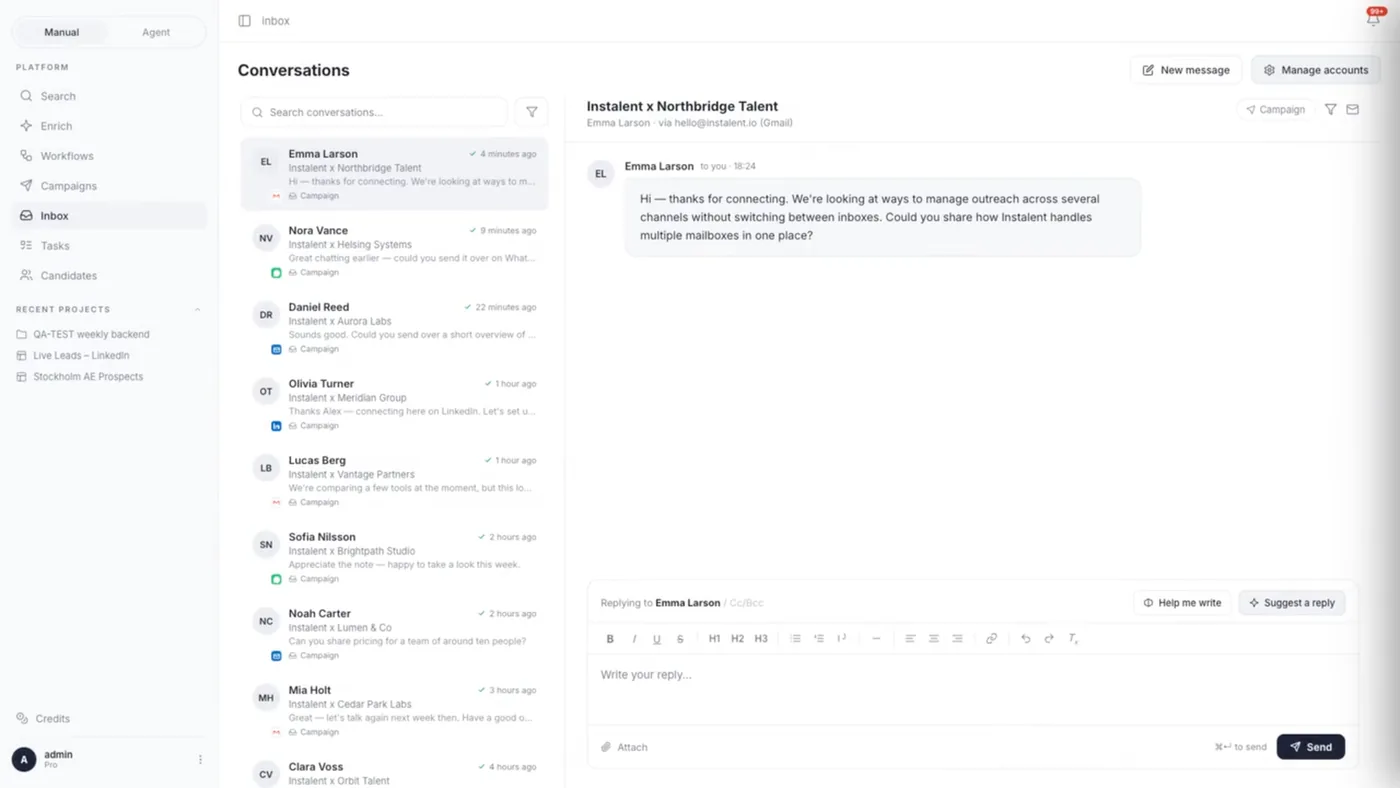
One list, one clock, one place to look. The channel becomes a property of the message rather than a separate app you have to remember to open. The unified inbox rests on a few decisions that matter more than they sound:
- Every channel lands in the same queue. Whatever channels your multichannel outreach runs on, the replies arrive in one list, with a badge saying where each came from.
- A reply stops the sequence automatically. Not flagged for review. Stopped. This is what protects your reputation while you are busy doing something else.
- The thread carries its context. Which campaign, which profile, what was already sent. A reply without its history is just an email.
- Candidates and clients in one place. The same engine runs candidate sourcing and client prospecting, so both sides of the desk share one queue and one clock.
- Shared, not personal. Threads live on the desk, so cover works and nothing is invisible while a colleague is away.
- AI drafting built into the composer. Two modes, both reading the thread and the profile. Suggest a reply writes a full answer from the conversation with nothing typed. Help me write takes your intent in a line or two and turns it into the finished reply.
They cover different halves of a day. Suggest a reply handles the routine ones, where the answer is obvious from the thread and the only cost is typing it again. Help me write handles the ones where you know what to say and would rather not spend four minutes phrasing it. Either way the draft lands in the box and you press send, so nothing goes out under your name unread. The AI agent can work a whole queue under the same rule.
Test the auto-stop rule before you test anything else
Trialling any outreach tool? Reply to your own sequence from a second address and watch what happens next. If a follow-up still goes out, no amount of personalisation upstream will save you. Anyone who has sent "just floating this to the top of your inbox" to someone who answered two days ago knows the cost.
A reply management workflow: three buckets and a clock
One queue is the tooling. What you do with it is the skill. Triage every reply into one of three buckets and leave no fourth option:
- Answer now. Interested, asking a question, or asking to talk. Target under an hour inside working hours.
- Schedule. Not now, wrong role, or a referral. This must create a dated task, not a mental note. "Later" without a date is a decline you have not logged yet.
- Close. A no. Log the reason as a code, not free text. After a quarter the codes tell you whether you have a targeting problem or a messaging problem.
Publish a time-to-first-reply target to the team. An unpublished SLA is a preference.
Then measure four numbers most desks do not have: median time to first reply, using the median because one holiday week ruins an average and hides a real problem; share answered within the hour, counted inside working hours only or you are measuring your timezone; threads with no owner over 24 hours old; and double-touch rate, the replies that still received a follow-up. The last two should be zero, and rarely are.
Want every reply from both funnels in one place? Get started and run a search-to-reply pass end to end, or see how it fits your team. On the sending side, protecting your sender reputation covers deliverability, candidate follow-up automation covers automating the answer without automating the judgement, candidate engagement covers the four numbers that measure whether people are actually responding, and how agencies win new clients covers what to do once the client replies start arriving.
Related reading: the hiring process puts the reply gap in the wider sequence, and interview questions to ask candidates covers the stage those replies are heading toward.
Sources
- Microsoft - Breaking down the infinite workday (Work Trend Index) (June 17, 2025; Microsoft 365 telemetry through February 15, 2025 plus a survey of 31,000 knowledge workers across 31 markets: average worker receives 117 emails a day and 153 chat messages per weekday; among the top 20% of users by ping volume, interruptions arrive every two minutes during core hours, 275 times a day)
- Harvard Business Review - The Short Life of Online Sales Leads (March 2011; James Oldroyd, Kristina McElheran and David Elkington; audit of 2,241 US companies: 23% never responded, and firms responding within an hour were nearly seven times more likely to qualify the lead)
- Gem - Key takeaways from the 2026 Recruiting Benchmarks Report (December 1, 2025; 165 million applications and 1.2 million hires: 0.5% of applicants receive an offer, roughly one per 200 applications)
Find better candidates, faster
Source, verify and reach candidates on one engine. Get 50% off your first month.
Keep reading