How Recruitment Agencies Find and Win New Clients in 2026
A client prospecting playbook for recruitment agencies: find companies that are hiring, reach the decision-maker, and turn signals into signed clients.
Do this in Instalent - find companies hiring now and reach the decision-maker.
Most recruitment agencies are excellent at finding candidates and mediocre at finding clients. The agencies that grow in 2026 treat business development like sourcing: find the companies that need you, reach the person who signs off, and do it before your competitors even know the role exists.
Candidate sourcing is a solved discipline for good recruiters. Client acquisition usually isn't. It leans on referrals, a personal network, and the occasional burst of cold outreach when the desk goes quiet - which is exactly when it's hardest to win new business. This guide lays out a repeatable way to find and win clients: identify companies that are likely hiring, reach the decision-maker with something worth reading, and run it as a system rather than a scramble.
Why client acquisition is the real bottleneck for recruitment agencies
A recruiter's revenue is capped by two things: how many good candidates they can place, and how many good clients they can place them with. Agencies pour tooling and process into the first and improvise the second. The result is a feast-or-famine desk - too busy to prospect when things are good, too anxious to prospect well when they're not.
The shift worth making is simple to say and hard to do: treat client business development with the same rigor as candidate sourcing. That means a defined ideal client profile, a way to find matching companies at the moment they need you, verified contacts for the person who owns the requisition, and personalized outreach that runs whether or not you feel like prospecting today.
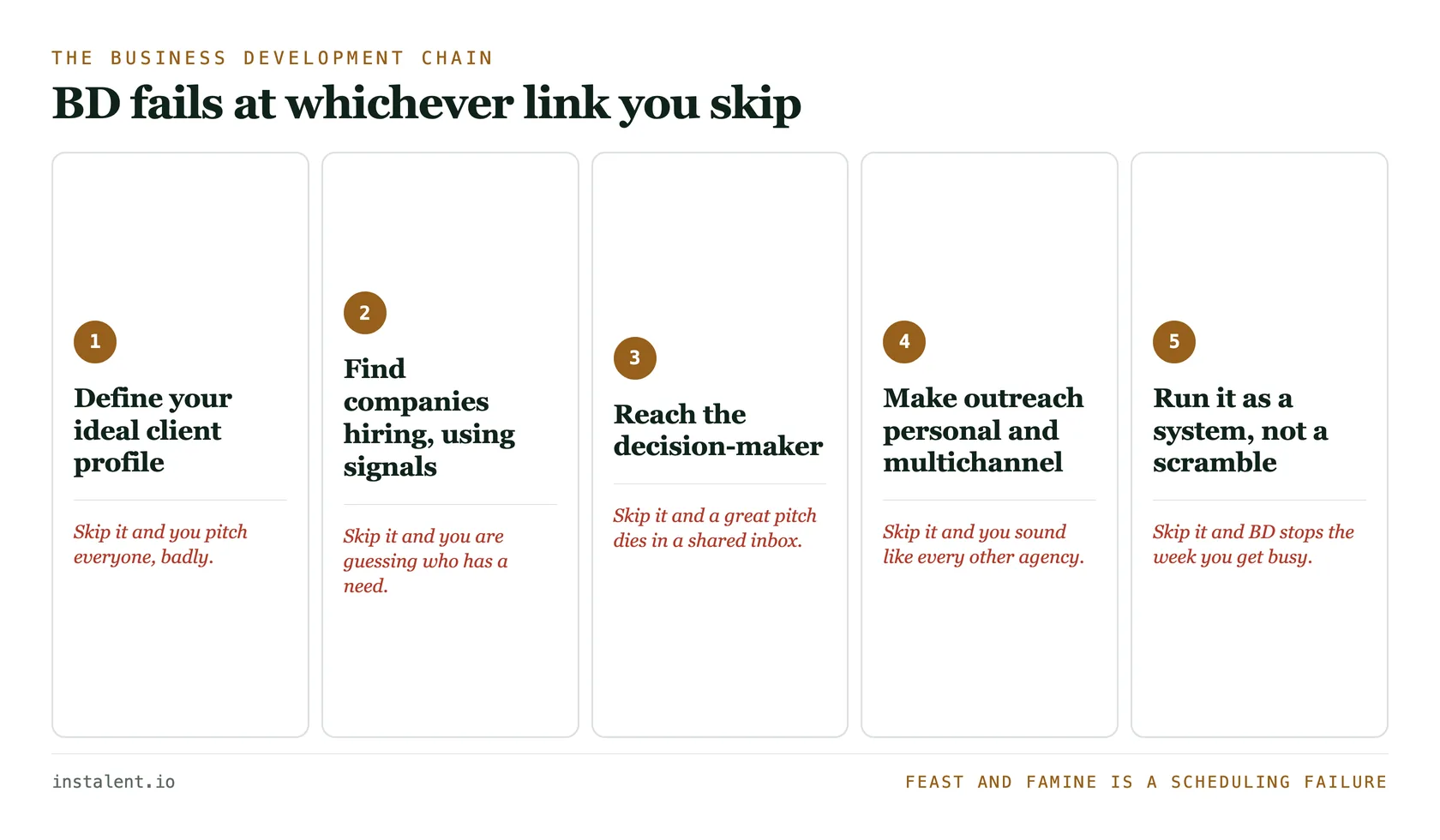
1. Define your ideal client profile
Before you find companies, define which companies are worth your time. A recruitment agency's ICP is more than an industry and a headcount band. The useful version answers:
- Where you actually win. The roles, seniorities and sectors where your placements stick and your fees are healthy.
- Who feels the pain. Companies whose hiring is urgent, specialized, or larger than their internal team can handle alone.
- Who can say yes. The title that owns the hiring decision - a founder, a hiring manager, a talent lead - not a generic "careers@" inbox.
Write it down. A vague ICP produces vague prospecting, and vague prospecting is how you end up emailing companies that will never pay an agency fee.
2. Find companies that are hiring - using signals, not luck
The best time to reach a company is the moment its hiring need appears and before it has committed to a supplier. That moment is visible if you know what to look for. These buying signals are the leading indicators of recruitment demand:
| Signal | Why it matters |
|---|---|
| A live or repeated job posting | The most direct signal - they're hiring right now, and repeated posts hint the role is hard to fill |
| Recent funding | New capital almost always turns into headcount within a quarter |
| Leadership changes | A new VP or department head usually arrives with a mandate to build a team |
| Expansion or a new office | Growth into a new market means roles that internal teams may not be staffed to fill |
| Multiple open roles in one function | A hiring spike a lean internal team can't absorb alone |
Manually tracking these across job boards, news and company pages is a full-time job nobody has time for. This is where client prospecting earns its place: describe the kind of company you want in plain language, and let the system surface the ones showing hiring signals - so your list is companies with a reason to talk, not a random export.
Prospect the role, not just the company
A company isn't a lead - a specific hiring need is. "Series B fintech in the Nordics that just posted two senior backend roles" is a lead you can open a conversation about tomorrow. "Fintech companies" is a list you'll never work.
3. Reach the decision-maker, not the inbox
A great lead dies at a generic contact form. Winning the business means reaching the person who owns the requisition - the founder at a small company, the hiring manager or head of talent at a larger one. That takes two things: the right name, and a verified way to reach them.
Contact enrichment turns a company and a role into a verified email and phone for the actual decision-maker, so your first message lands with a person instead of bouncing off an alias. Reaching the right individual is the single biggest lever in agency BD - more than volume, more than clever copy. A mediocre message to the right person beats a brilliant one to nobody.
4. Make the outreach personal and multichannel
Recruiters know how to write to candidates and often forget to apply the same craft to clients. The winning client message is short, specific, and about them:
- Lead with the signal. Reference the thing that made them a lead - the roles they posted, the round they raised, the leader who just joined. It proves you did the work.
- Show relevant proof, briefly. One line on a similar placement or a candidate you already know in their space is worth more than a paragraph about your agency.
- Make the next step small. A fifteen-minute call about one specific role converts better than "let's explore a partnership."
- Follow up like it matters. Most client business is won on the second, third or fourth touch, not the first - so multichannel outreach with automatic, well-spaced follow-ups is what separates a system from a one-shot blast.
Personalization at scale used to be a contradiction. It isn't anymore - the reference points (the signal, the role, the person) can be pulled per prospect, so a hundred tailored messages take the effort that ten used to.
5. Run recruitment business development as a system, not a scramble
The agencies that grow don't prospect harder - they prospect continuously. A working client-acquisition system looks like this:
- A standing ICP that filters every prospect.
- A live feed of companies showing hiring signals, refreshed automatically.
- Verified decision-maker contacts for the ones worth pursuing.
- Personalized, multichannel outreach that follows up on its own.
- A single place where replies land and conversations continue.
Instalent is built to run that whole loop - candidate sourcing on one side of the desk and recruitment client prospecting on the other, from one platform, alongside the ATS you already use. The point isn't to replace the recruiter's judgment. It's to make sure the recruiter is always talking to the right companies at the right time, without the desk ever going quiet.
The takeaway
Candidate sourcing gets an agency paid on the work it already has. Client acquisition decides how much work there is. Treat it as a discipline - a clear ICP, hiring signals, verified decision-maker contacts, personalized follow-up, and a system that runs whether or not the desk is busy - and business development stops being the thing you do in a panic and becomes the thing that compounds.
Ready to see it end to end? Explore client prospecting or how Instalent works for recruitment agencies.
Find your next client before your competitors do
Spot companies that are hiring, reach the decision-maker and win the brief. Start your 7-day free trial.
Keep reading