Interview Questions to Ask Candidates, and How to Score the Answers
The interview questions to ask candidates that actually predict performance, the ones to retire, and how to score answers so two interviewers reach the same verdict.
Fill the top of the funnel so your interview slots go to people worth interviewing.
Most interview question lists are a pile of questions with no way to tell a good answer from a fluent one. That is the actual problem. A question is only worth asking if you can say, before the interview starts, what a strong answer contains and what a weak one is missing - and if you cannot, you are not assessing anyone, you are having a conversation and calling it a decision.
The test a question has to pass
Before a question earns a slot, answer this: what does a strong answer contain, and what is a weak one missing?
If you cannot write both in one line each, the question is not assessing anything. It is generating conversation, and conversation is where interviews go wrong - articulate people do well, quiet people do badly, and neither fact is about the job.
This single test retires most of what circulates. "Where do you see yourself in five years" has no strong answer, only a well-prepared one. "Tell me about a time you disagreed with your manager and what you did next" has an obvious strong answer shape: a real disagreement, a specific action, a named outcome, and some evidence the person learned the difference between being right and being effective.
The evidence says structure, not instinct
Worth knowing before you defend your process to a hiring manager who prefers to "just get a feel for people".
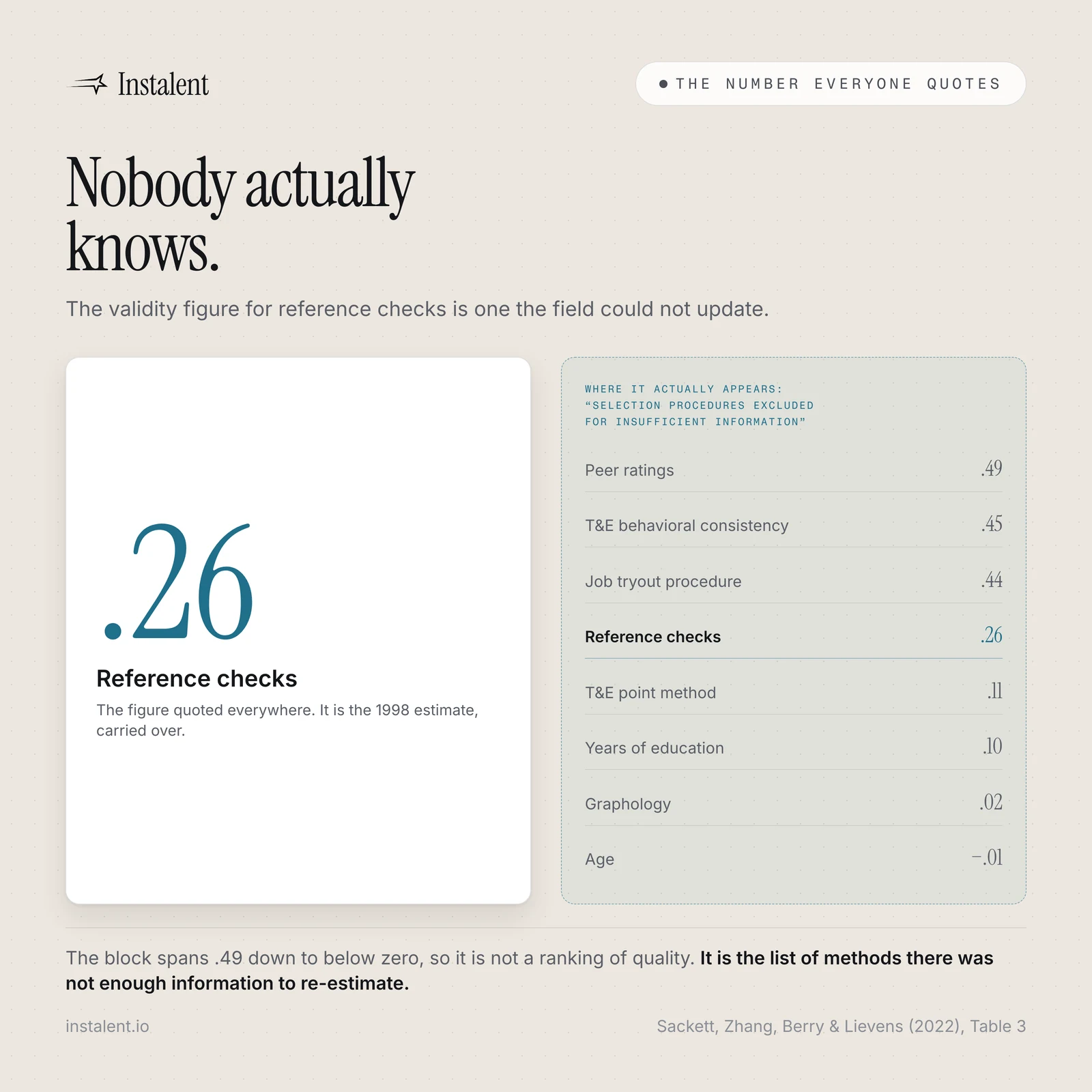
The selection-methods literature was re-analysed by Sackett, Zhang, Berry and Lievens in 2022, after they found that earlier meta-analyses had systematically over-corrected for range restriction and so overstated how well most selection tools predict performance. Their corrected figures moved almost everything down - but they also reordered the list. The structured interview came out at an operational validity of .42, ahead of cognitive ability at .31, making it the strongest single predictor in the revised analysis.
Two honest readings of that. First, structure is the thing doing the work - not the interview itself, and certainly not the interviewer's intuition. Second, .42 is a correlation, not a guarantee: it means a well-run structured interview meaningfully beats chance, not that it is right most of the time. Anyone quoting these numbers as proof their process works has misread them.
Beware the numbers still circulating
Most interviewing advice online quotes validity figures from a 1998 meta-analysis. Those are the estimates the 2022 re-analysis found to be inflated by a correction error. If an article tells you a selection method predicts performance far better than the figures above, check its date and its source before you build a process on it.
Four question types that carry signal
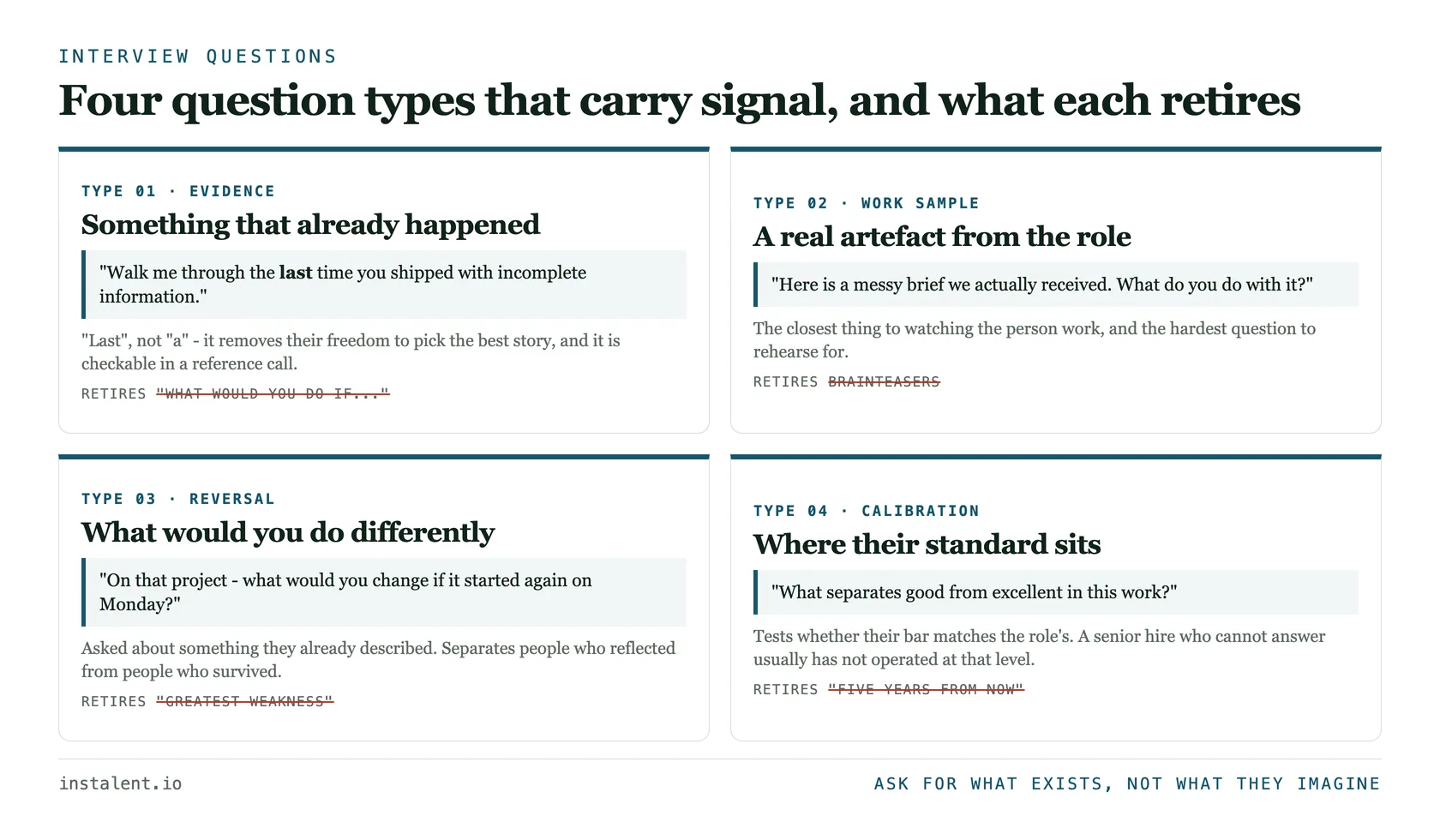
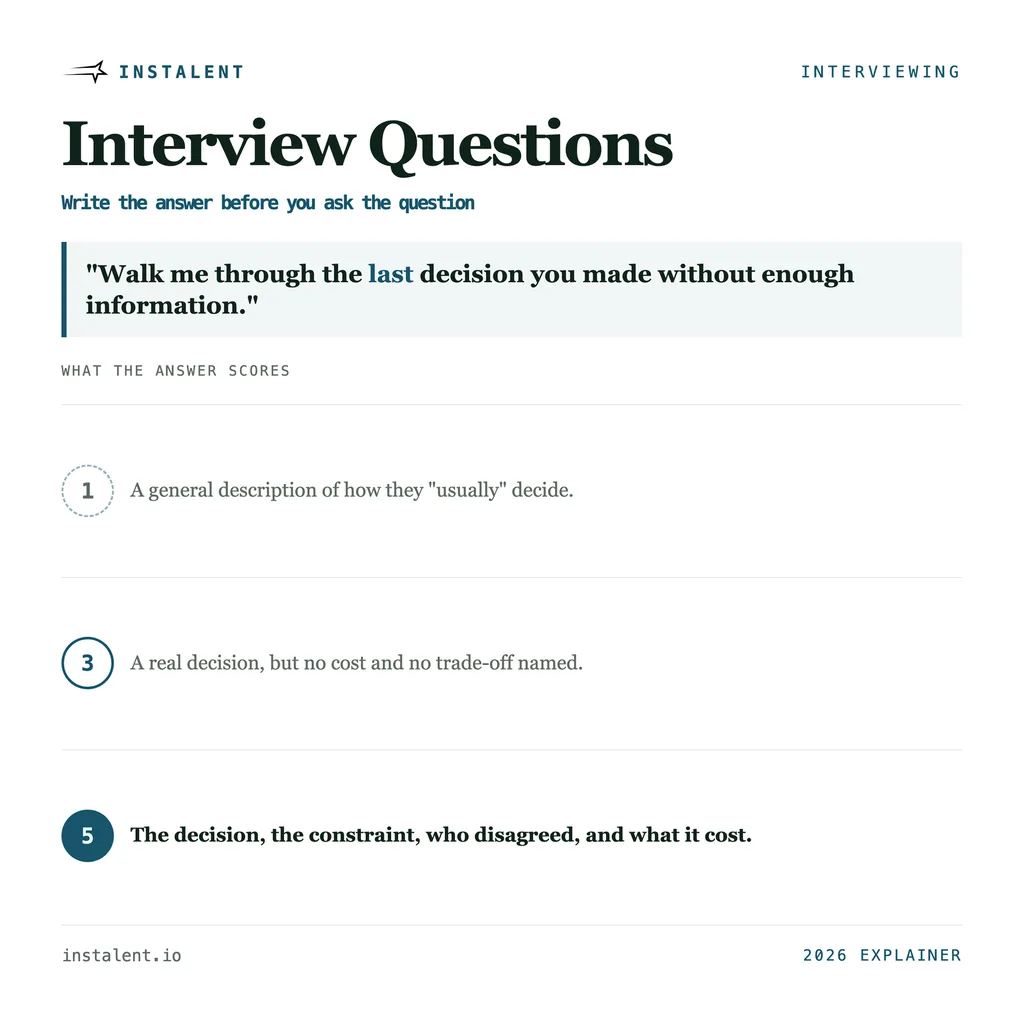
1. Evidence questions. "Walk me through the last time you..." The word doing the work is last, not a. Asking for the most recent instance removes the candidate's freedom to pick their best story, and the answer is checkable in a reference call.
2. Work-sample questions. Put a real artefact from the role in front of them - a messy brief, a failing dashboard, a rejected shortlist - and ask what they would do with it. This is the closest thing to watching the person work.
3. Reversal questions. "What would you do differently?" Asked about something they already described. Strong candidates answer specifically and without defensiveness; the answer reveals whether they have actually reflected or simply survived.
4. Calibration questions. "What separates good from excellent in this work?" You are testing whether their standard matches the standard of the role. A senior hire who cannot articulate the difference usually has not operated at the level you are hiring for.
Questions worth keeping, by what they reveal
Ownership and judgement
- Walk me through the last decision you made without enough information. What did you decide, and what did it cost?
- Tell me about something you shipped that did not work. What did you do next?
- What is something in your current role that is broken and nobody is fixing? Why not?
Depth in the actual craft
- What is the hardest problem you have solved in this area? What made it hard rather than just long?
- What do people outside your function consistently misunderstand about this work?
- Show me something you built or wrote that you are proud of, and tell me what you would change.
How they work with other people
- Tell me about the last time you disagreed with a decision. What did you do?
- Who is the best person you have worked with, and what specifically made them good?
- When did you last change your mind because of something a colleague said?
Motivation, without the theatre
- What made you take the call about this role?
- What would have to be true in twelve months for you to say this was the right move?
- What are you looking for that your current role cannot give you?
That last group is where most interviews get lazy. "Why do you want this job?" invites flattery. "What would have to be true in twelve months" invites a real answer, and it also tells you whether the role can deliver it - which is the question that predicts whether they accept the offer and stay.
The ones to retire, and why
- Hypotheticals. "What would you do if two priorities collided?" measures how well someone imagines a situation, which is a different skill from handling one.
- Brainteasers. Long since abandoned even by the companies that popularised them. They measure practice at brainteasers.
- "What is your greatest weakness?" So thoroughly gamed that a candid answer is now a disadvantage, which is the opposite of what you want to select for.
- "Where do you see yourself in five years?" Rewards preparation over capability, and in most markets the honest answer is "I do not know".
- Anything touching protected characteristics. Age, family status, health, religion, nationality and their proxies. This is a legal question, not a style question, and the rules differ by jurisdiction - check yours.
Scoring, which is where the process usually collapses
Good questions with bad scoring produce the same outcome as bad questions.
Write the anchors first. For each question, one line describing a 1, a 3 and a 5, in the concrete language of your role. "A 5 names the trade-off, the person who disagreed, and what it cost" is an anchor. "Strong communication skills" is a mood.
Score independently, then compare. If interviewers talk before scoring, you get agreement rather than accuracy, because the most senior or most confident voice moves everyone else. Independent scores that disagree are useful information; a room that agreed instantly usually just deferred.
Ask the same questions in the same order. Comparison is the entire point. If every candidate got a different interview, you have five impressions and no basis for choosing between them.
Keep the count low. Four to six substantive questions with real follow-up beats twelve asked at a sprint. The first answer is rehearsed; the third follow-up is not.
Interviews cannot fix the shortlist
The uncomfortable part. A well-structured interview improves how reliably you choose among the people in front of you. It does nothing about who is in front of you, and most bad hires are decided long before the interview - in a slate that was too thin, too late, or drawn from whoever happened to be applying.
That is a sourcing problem, not an interviewing one. Instalent works on that half: describe the role in plain English, get people from across sources with verified contact details, scored against your criteria with the evidence shown, and reached through multichannel outreach - alongside RecruiterFlow, Greenhouse, Lever or TeamTailor. Your interview slots then go to people worth the hour.
Want a slate worth interviewing? Get started and run one real role end to end.
Related reading: candidate experience covers how the loop feels from the other side, candidate sourcing strategies covers filling the slate these questions assess, recruiting metrics has quality-of-hire and the rest of the arithmetic, and candidate engagement covers keeping people responsive between stages.
Sources
- SIOP - Is Cognitive Ability the Best Predictor of Job Performance? New Research Says It's Time to Think Again - on Sackett, P. R., Zhang, C., Berry, C. M., & Lievens, F. (2022), Journal of Applied Psychology, 107, 2040-2068
Find better candidates, faster
Source, verify and reach candidates on one engine. Get 25% off your first month.
Keep reading