The Hiring Process: The Stages, and the Gaps Where It Actually Fails
The hiring process stage by stage - and why the failures are almost never in the stages themselves but in the unowned gaps between them.
Close the gap that costs most - every reply in one place, answered the same day.
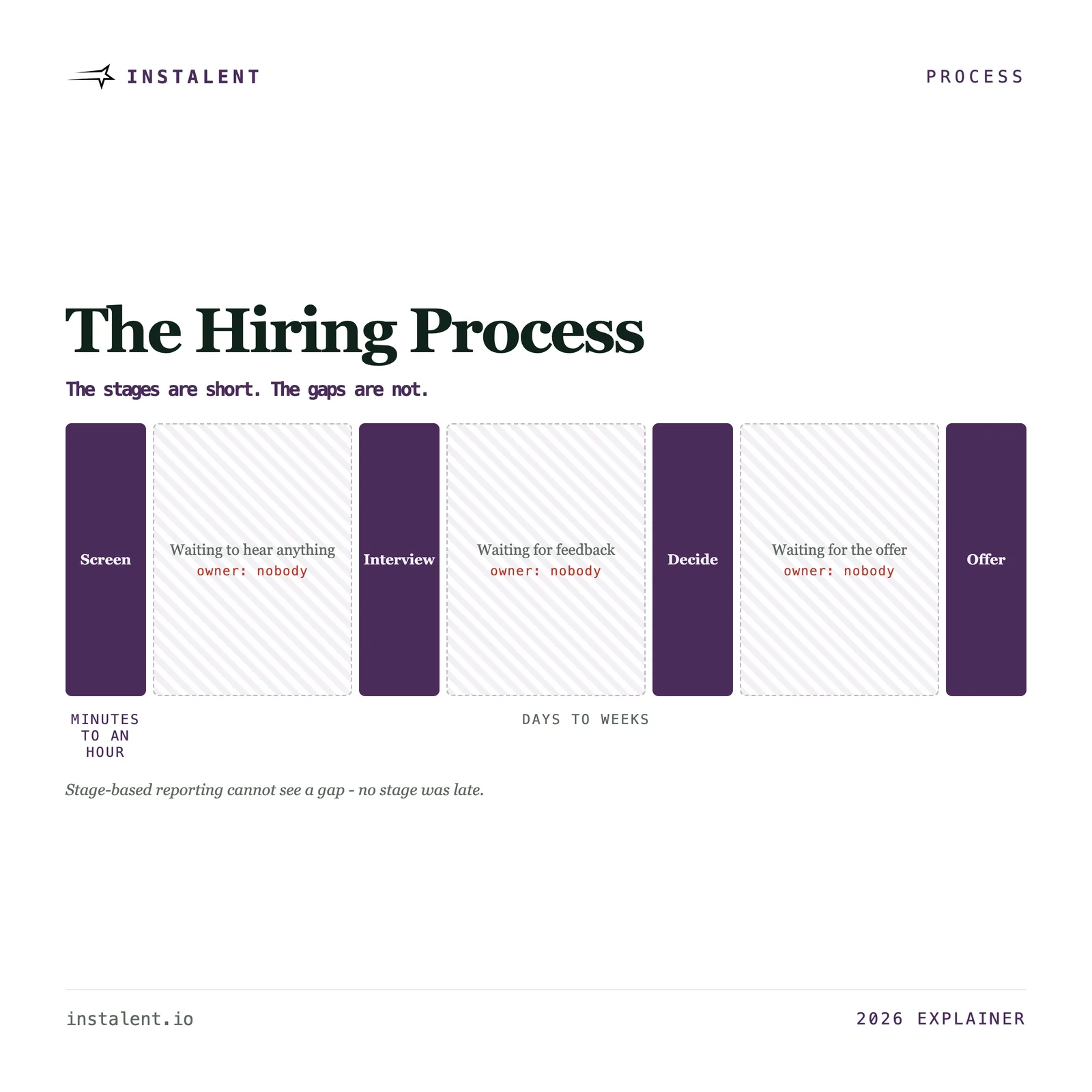
Every article on the hiring process gives you the same seven boxes: define the role, post it, screen, interview, decide, offer, onboard. The boxes are correct and they are not where anything goes wrong. Processes fail in the spaces between the boxes - the handoffs where the candidate belongs to nobody, the clock keeps running, and no stage is technically late.
Hiring process vs recruitment process: is there a difference?
In everyday use, nothing - they are used interchangeably for the same sequence, and nobody outside a textbook will correct you.
Where people do draw a line, recruitment covers finding and attracting candidates, and hiring covers the selection and closing that follows. That split is tidy and largely academic, because on a real desk the same person owns both and the handover is invisible.
The distinction that actually changes behaviour is a different one: whether any work happens before the vacancy exists at all. A team that only starts when a req opens is running a process. A team that already knows the market, has spoken to people in it, and can name three candidates on day one is running something else - and it will beat the first team on every stage below, without changing a single stage.
The hiring process stages, briefly - because they are not the interesting part
- Define the role - what the work actually is, what makes someone credible, what it pays.
- Open it - approval, budget, and a written brief somebody agreed to.
- Source and attract - inbound applicants plus the people you go and find.
- Screen - reduce a long list to a slate worth interviewing.
- Interview - assess against consistent criteria.
- Decide and offer - make a call, make it fast, close it.
- Onboard - the point at which the hire becomes a result.
Nobody disagrees with that list, which is a clue that it is not where the difficulty lives.
Where the time in the hiring process actually goes
Here is the diagnostic that reframes the whole thing, and you can run it on your own data this afternoon.
Take time to fill (requisition approved to offer accepted) and time to hire (candidate first entered your process to that same acceptance). The difference between those two numbers is not a stage. It is the period before you found the person who eventually took the job - and on most desks it is the largest single block of elapsed time. Recruiting metrics: the formulas covers both calculations and what each hides.
For scale: SHRM's benchmarking research across more than 4,600 organizations puts median time to fill at 39 calendar days for nonexecutive roles. Very little of that is somebody reading a CV.
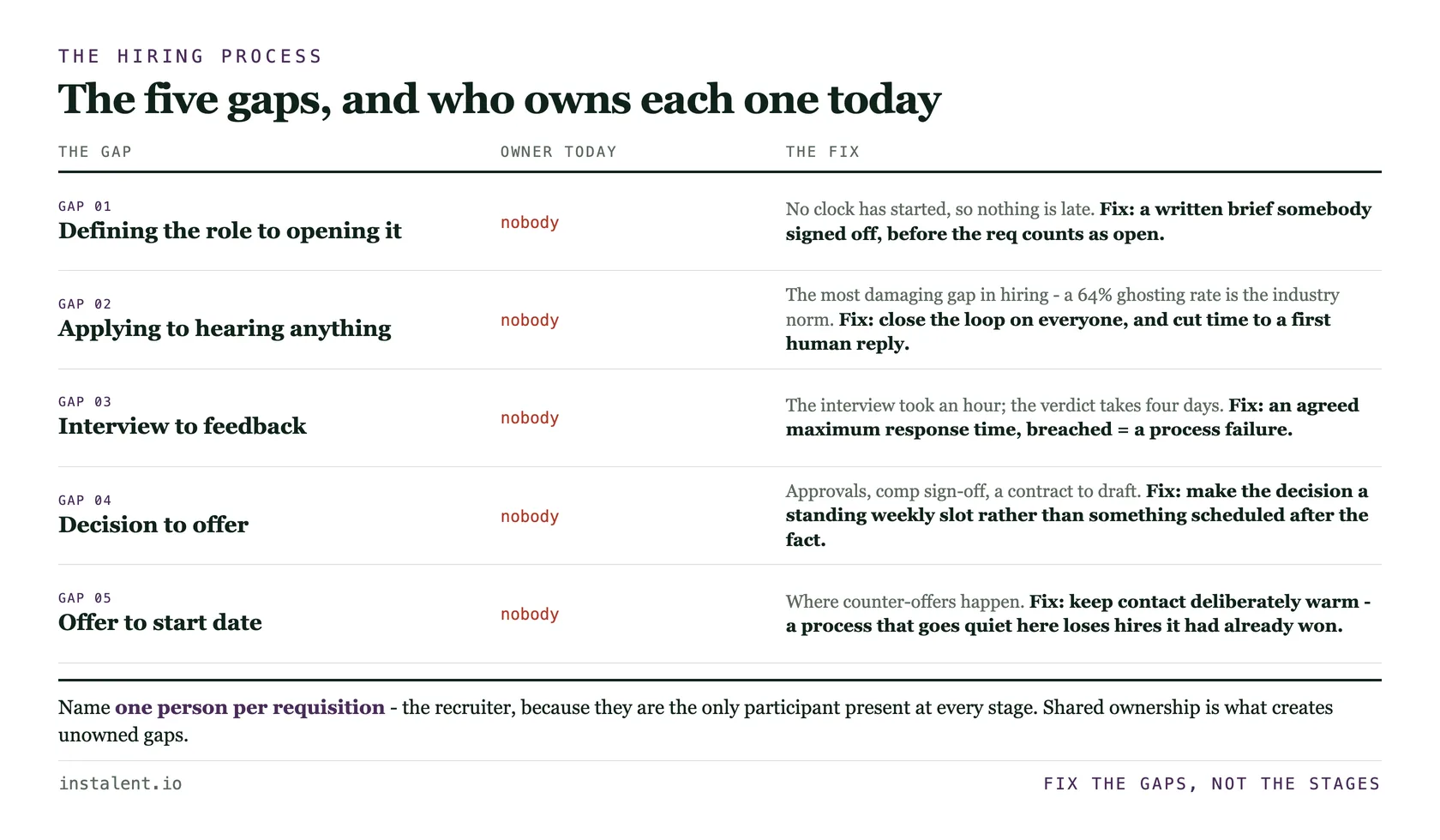
The five gaps in the hiring process, and who owns each
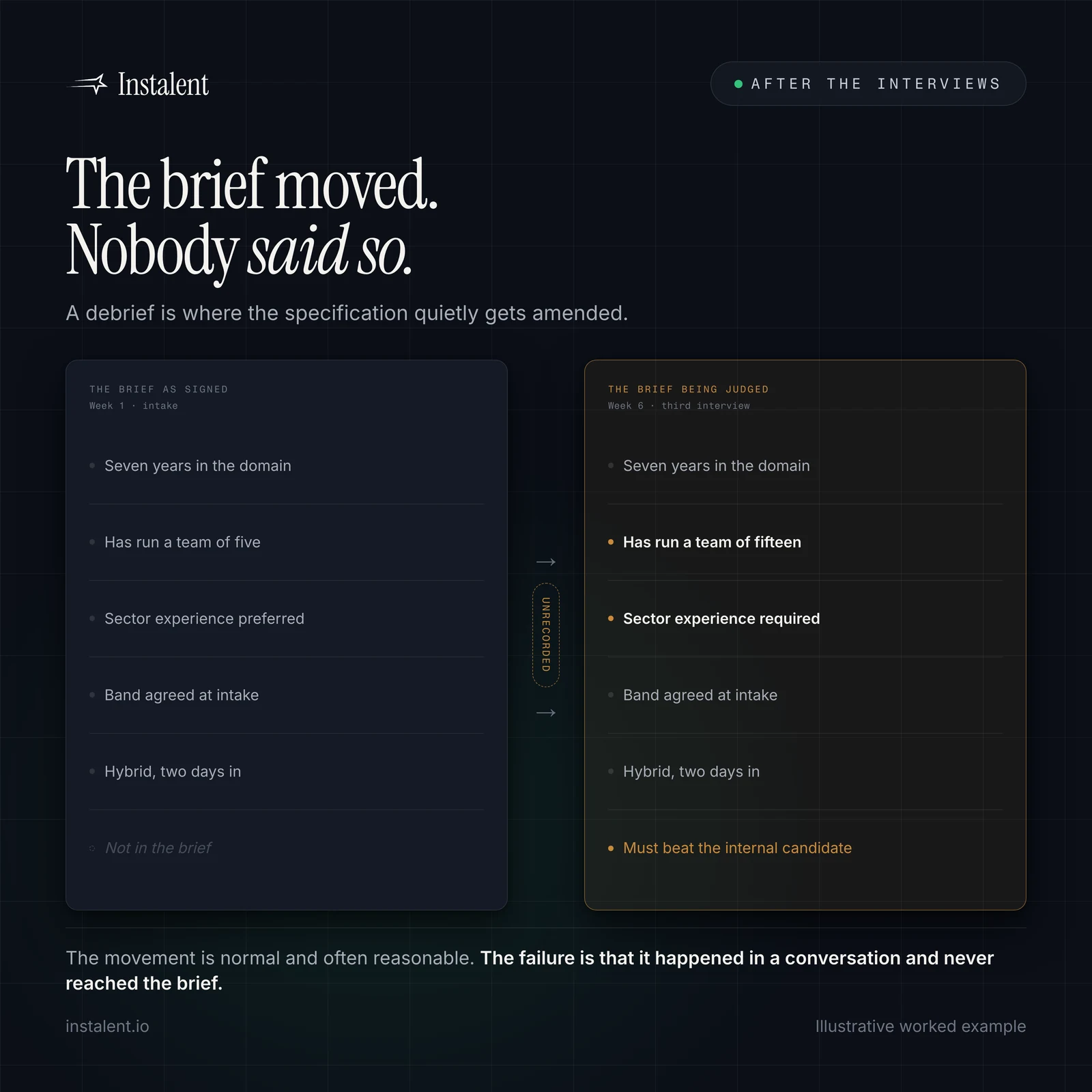
Gap 1: between defining the role and opening it. The brief exists in somebody's head and gets agreed over three conversations. Owner: usually nobody, because the req is not open yet so no clock has started.
Gap 2: between applying and hearing anything. The most damaging gap in hiring, and the most common. PeopleScout's 2026 research found a 64% ghosting rate - the share of candidates ghosted in more than half their applications. That is an industry norm, which is exactly why fixing it differentiates rather than merely being decent. Covered properly in candidate experience.
Gap 3: between interview and feedback. The interview took an hour. The verdict takes four days because two people need to compare notes and neither has a slot. Meanwhile your candidate is in someone else's process, and candidate engagement decays measurably across exactly this gap.
Gap 4: between decision and offer. Approval chains, comp sign-off, a contract someone has to draft. Invisible to every stage-based report because no stage is running.
Gap 5: between offer and start date. The period in which counter-offers happen. A process that goes quiet here loses hires it had already won.
Stage-based reporting cannot see any of this
If your reporting measures how long each stage took, every gap is invisible by construction - the clock is only running when somebody is actively doing something. That is why processes can look healthy stage by stage and still take 39 days end to end. Measure the elapsed time between stage transitions, not the duration of stages.
How to improve your hiring process: fix the gaps, not the stages
Four changes, none of which lowers the bar.
Name one owner per requisition. Not a function, a person - and specifically the person present at every stage, which is nearly always the recruiter. Shared ownership is what creates unowned gaps.
Agree a maximum response time for feedback, and treat breaching it as a process failure rather than a personal one. Two working days is achievable almost everywhere and is faster than most competitors.
Pre-book the interview slots. Hold recurring calendar blocks before you have anyone to put in them. Scheduling is pure gap: it produces no assessment and consumes days.
Make the decision a standing meeting. A weekly slot that exists whether or not there is anything to decide removes the single most common multi-day delay in hiring.
Where hiring process software helps, and where it does not
Three of the five gaps are calendar and ownership decisions. No software fixes an unagreed brief or an approval chain.
Gap 2 is the exception, and it is the one that costs most. It fails structurally rather than culturally: replies scatter across mailboxes and channels, a thread belongs to one person who is away, and a candidate waits four days for an answer somebody would have given in four minutes if they had seen it.
Instalent puts every reply across channels into one shared inbox tied to the campaign and profile, so the desk sees what is waiting instead of each person seeing their own corner - and multichannel outreach stops the moment someone answers. On the front of the process, sourcing with verified contact details shortens the gap that time-to-fill minus time-to-hire actually measures. It runs alongside RecruiterFlow, Greenhouse, Lever or TeamTailor.
Want the expensive gap closed? Get started and run one real role end to end.
Related reading: recruitment strategies covers the choices this process runs inside, candidate experience covers how the gaps feel from the other side, interview questions to ask candidates covers stage five, and talent acquisition vs recruitment covers the work that happens before stage one.
Sources
- SHRM - Recruiting Benchmarking research - data from over 4,600 organizations; median time to fill of 39 calendar days for nonexecutive positions
- PeopleScout - AI and the Candidate Experience: New Research - 2026; more than 1,000 job seekers across 10 markets
Find better candidates, faster
Source, verify and reach candidates on one engine. Get 25% off your first month.
Keep reading