Recruiting CRM vs ATS: What Each One Is Actually For
Recruiting CRM vs ATS without the sales pitch: what an applicant tracking system does, what candidate relationship management software does, and where sourcing sits.
Add sourcing, enrichment and outreach alongside the ATS you already run.
Almost every explainer on recruiting CRM vs ATS is published by a company selling one of them, which is why they all end with "you need ours". We sell neither. Instalent is not an applicant tracking system and not a CRM - we run alongside both - so here is the distinction written by someone with no reason to blur it, including the part most articles skip: the work that belongs to neither system.
What is an ATS?
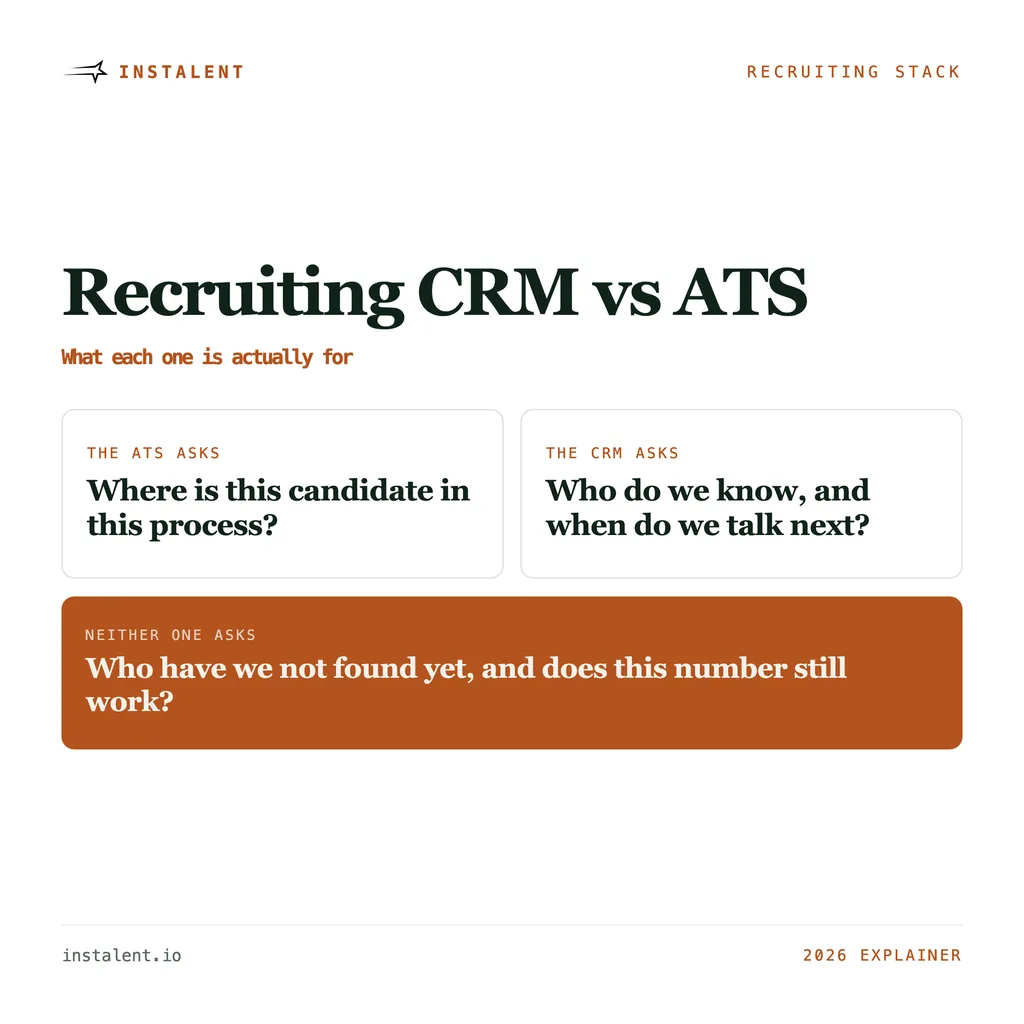
An applicant tracking system is the system of record for people who are already in a hiring process. It holds the requisition, the applications against it, the stages each candidate has moved through, interview feedback, offer status and the compliance trail. Its core question is where is this candidate in this process?
An ATS is organised around the job. Open a req, and everything hangs off it.
What is a recruiting CRM?
A recruiting CRM - candidate relationship management software - is the system for relationships that are not yet attached to a live job. It holds people you have met, talked to, shortlisted before or want to keep warm, plus the notes and touchpoints that make the next conversation sensible. Its core question is who do we know, and when should we speak to them again?
A CRM is organised around the person, and increasingly around the client company too, which is why agencies lean on it for business development as well as candidates.
Recruiting CRM vs ATS: the actual difference
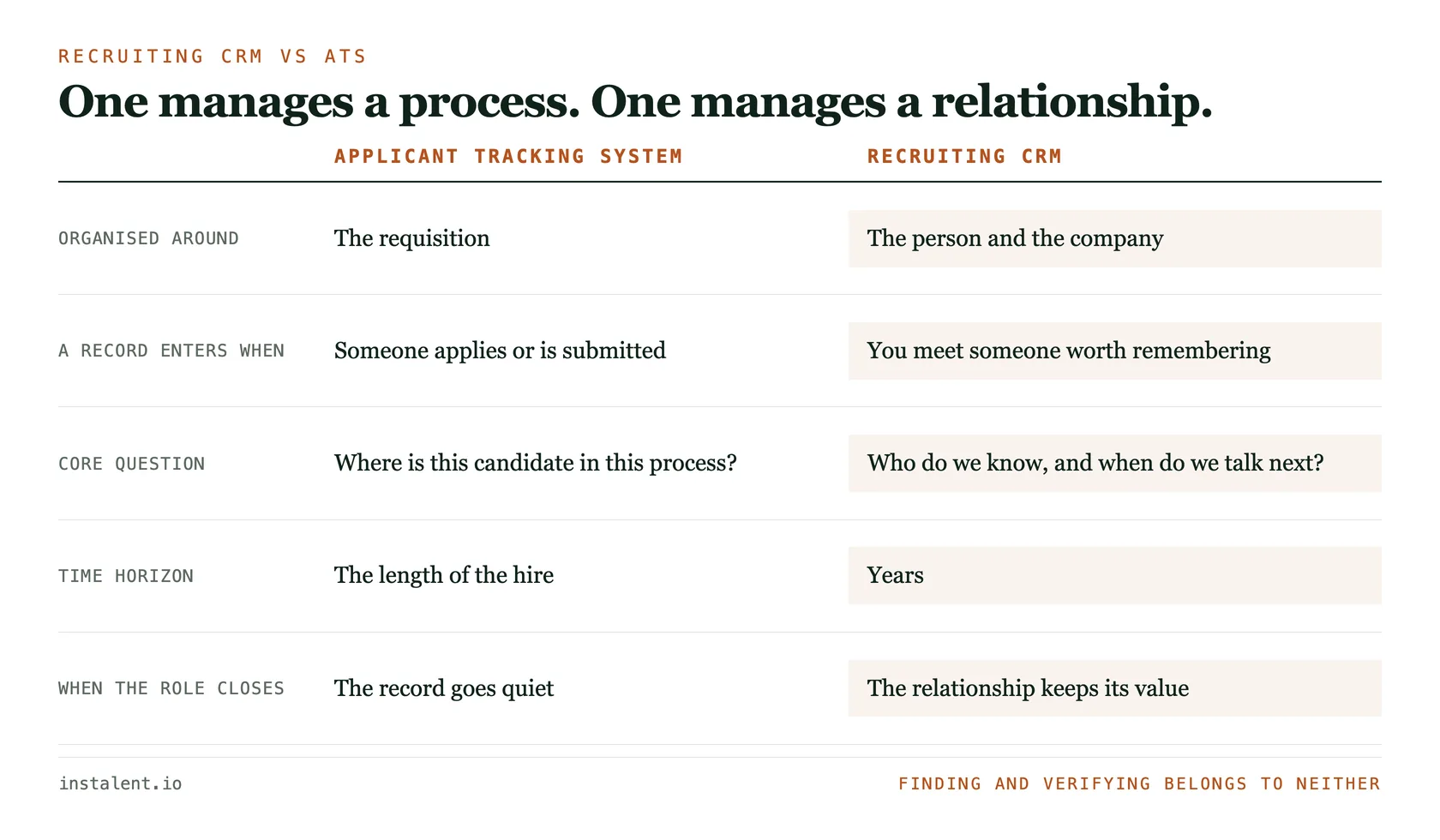
| Applicant tracking system | Recruiting CRM | |
|---|---|---|
| Organised around | The requisition | The person and the company |
| A record enters when | Someone applies or is submitted to a role | You meet someone worth remembering |
| Core question | Where is this candidate in this process? | Who do we know, and when do we talk next? |
| Time horizon | The length of the hire | Years |
| When the role closes | The record goes quiet | The relationship keeps its value |
| Compliance role | Primary - audit trail, EEO/GDPR records | Secondary - consent and contact preferences |
The distinction that matters in practice is the time horizon. An ATS is built around a process with an end. A CRM is built around a relationship without one. That is why using an ATS as a talent pool tends to fail: records that entered against a closed req sit there with no reason to be revisited and no cadence attached.
Do you actually need both?
Honestly, it depends on the shape of the desk, and plenty of teams run one well rather than two badly.
You can run on an ATS alone if your hiring is reactive, roles are filled largely from applicants, and you rarely re-engage people you did not hire. Adding a second system you do not maintain is worse than not having it.
You need CRM behaviour once you are sourcing proactively, re-engaging past candidates, running an agency where the client relationship is as valuable as the candidate one, or building pools ahead of roles. At that point the "who do we know" question stops being answerable from a req-shaped database.
Most modern agency platforms now bundle both, which is why the category names blur. The useful test is not what the vendor calls it - it is whether the system can answer both questions well.
The question that settles it
Ask: "Can I list everyone we have spoken to in this market in the last two years, with a verified way to reach them and a reason to call?" If your ATS cannot answer that, you have an ATS, not a CRM - whatever the pricing page says.
The work that belongs to neither
Here is the part most CRM-vs-ATS articles leave out, and it is where the actual hours go.
Both systems are records of things that already happened. An ATS records the process you ran. A CRM records the relationships you already have. Neither one finds a person who is not in either database, and neither one verifies that the contact detail you stored eighteen months ago still connects.
So the sequence at the front of the work - find the right people, get a contact detail that works, judge fit on evidence, reach out and handle the replies - sits outside both systems. On most desks it happens in a search tool, a spreadsheet, a contact-data tool and a sequencer, and then gets typed back in by hand. That handoff is the reason a talent pool goes stale and the reason a "CRM vs ATS" decision often does not fix the problem people bought it to fix.
How to choose
Four questions, in this order:
- What is your system of record, and is anyone arguing about it? Pick one place where the truth lives. Two systems of record is the worst outcome available.
- Is your pipeline reactive or proactive? Reactive hiring is an ATS problem. Proactive sourcing is a CRM-and-sourcing problem.
- Do you sell to clients? If yes, you need company-side relationship management, which most in-house-oriented ATSs treat as an afterthought.
- Who maintains the data, and when? A CRM nobody updates is an expensive archive. If there is no cadence and no owner, buy the simpler thing.
If you are weighing a migration specifically, Bullhorn alternatives is an honest look at what switching your system of record does and does not fix - written, deliberately, as a case where Instalent is not the alternative.
Where Instalent sits
We are not an ATS and we are not trying to become your system of record. Instalent covers the layer in front of both: describe a role or an ideal client in plain English and get real people or companies back, verified contact details from multiple sources, fit scored against your criteria with the evidence shown, multichannel outreach and every reply in one shared inbox - then it syncs two-way with RecruiterFlow, Greenhouse, Lever or TeamTailor so your system of record stays the system of record.
That is the honest division of labour: your ATS owns the process, your CRM owns the relationships, and the finding, verifying and reaching happens before either of them has a record to hold.
Want the front half without the copy-paste? Get started and it runs alongside whatever you already use.
Related reading: talent mapping is how you build the pool a CRM is supposed to hold, candidate sourcing strategies covers the work in front of both systems, recruiting automation in 2026 looks at which handoffs between them are worth automating, and recruitment analytics covers what either system can actually tell you once the data is in it.
Source into the ATS you already use
Add AI sourcing, enrichment and outreach alongside your ATS with two-way sync. Get 25% off your first month.
Keep reading