Recruiting Automation in 2026: Automate the Chain, Not the Copy
Most recruitment automation software in 2026 aims at writing and chat. The chain from brief to reply is where recruitment automation tools should go instead.
Do this in Instalent - source, verify and reach candidates in one flow.

Recruiters are having a strong run on the numbers. Greenhouse's March 2026 benchmark report has monthly hires per recruiter up 122% since 2022, on smaller teams, and its own summary of the data is blunt: "Recruiters are making more placements, not getting buried under volume." SHRM's 2026 benchmarking puts median time-to-fill for nonexecutive roles at 39 days, down from 44 a year earlier. Output per desk is up. The open question for 2026 is where recruiting automation should go next, because the obvious targets have mostly been hit.
Ask recruiting leaders what they expect to automate and the answers cluster in a revealing place. In SHRM's Recruiting Executives Priorities and Perspectives 2026, surveyed between January 21 and February 4 across 298 heads of recruiting, 92% expect generative AI to be used more for writing job descriptions and recruiting content, 72% expect real-time feedback tools during the application, and 67% expect chatbots and virtual assistants. Eighty-seven percent expect more AI and automation in recruiting generally.
Read that list again. Writing. Feedback. Chat. Every item sits at the edge of the process, facing the candidate or facing a blank page. Almost none of it touches the chain in the middle: search, verify, score, send, reply, record. That chain is where a recruiter's day actually goes, and it is the part still moving by copy-paste.
What recruitment automation actually means
Recruitment automation is the use of software to carry out the repeatable parts of hiring without a person driving each step - searching for candidates, verifying contact details, ranking applicants against criteria, sending and following up on outreach, and keeping records in sync. Recruitment automation software is the category of tools that does this; it is not a single product type, which is why two vendors both calling themselves that can automate completely different stretches of the work.
The distinction that matters is what gets automated. Most tools automate a step. The expensive problem is the gap between steps.
The bottleneck is the handoff, not the step
Each step in sourcing already has good software behind it. Search is fast. Contact data is a lookup. Sequencers send. Scoring is a model call.
What nobody automates is the space between them. A list gets exported. A CSV gets cleaned. Names get pasted into the next tool. Someone reconciles who has been contacted, who replied, and what the ATS thinks is true. The recruiter is the integration layer, and integration work does not show up on any dashboard as work.
That is also why per-step automation plateaus. Cutting a five-minute task to thirty seconds saves four and a half minutes. Removing the handoff either side of it saves the context switch, the re-checking, and the twenty minutes at 6pm spent working out where the list got out of sync.
Three layers of recruiting automation, and the one that spans them
Most teams are running some mix of these already. They are not competing with each other so much as covering different stretches of the same road.
| Layer | Examples | What it automates | What still lands on you |
|---|---|---|---|
| Applicant tracking | Greenhouse, Lever, RecruiterFlow, TeamTailor | Everything after a person is in the pipeline | Filling the pipeline |
| Sourcing platforms | hireEZ, SeekOut, Gem | Finding and organising people | Moving that list into live outreach |
| Sales sequencers | lemlist, Apollo | Sending and following up | Building, verifying and scoring the list |
| One recruiting platform | Instalent | The chain from brief to reply, synced back to the ATS | The judgement calls you choose to keep |
The ATS row is the one people misread. An applicant tracking system is a system of record, and a good one is doing exactly what it should. It is not built to go and find people, and it should not be replaced to solve a sourcing problem. That is why Instalent syncs two-way with RecruiterFlow, Greenhouse, Lever and TeamTailor rather than asking you to move.
What "the whole chain" means in practice
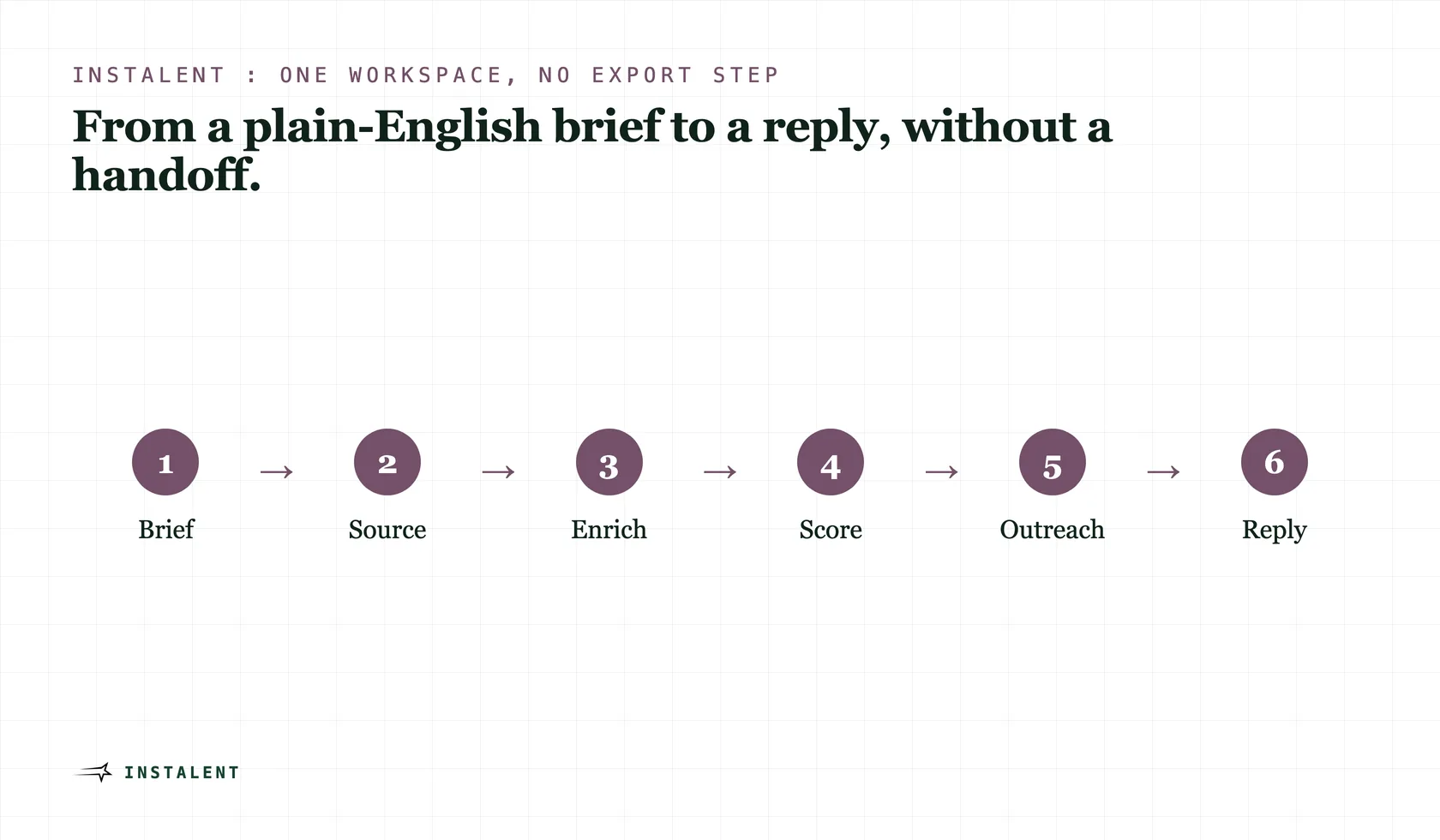
Concretely, inside Instalent that chain runs like this:
- A brief, not a Boolean string. Describe the role in plain English and the search runs from that, across the open web, public code and professional signals. It is also the mechanism that lets you source on the skill rather than the job title.
- Verified contacts, without a second tab. Enrichment queries multiple independent sources in a waterfall, keeps the first verified result, and returns email, phone and social details with a confidence signal.
- Scoring with the evidence attached. Every profile is scored against your criteria with a breakdown of which criteria were met and why, including how the companies in someone's background classify, so "senior at a startup" and "senior at a large enterprise" do not read as the same line.
- Outreach that stops when someone answers. Multichannel sequences personalise from the data already in the workspace, follow up on your schedule, and stop the moment a person replies.
- One place for the replies. Every response lands in the unified inbox, tied to the campaign and the profile it belongs to.
- Your ATS stays current. Candidates and activity sync both directions, and an outbound webhook API emits candidate, task and campaign events for the rest of your stack.
Then two things sit on top of the chain. Scheduled tasks keep searches refreshing and shortlists topping up between your calls. And the agent can drive the whole sequence on instruction, in the app or from ChatGPT, Claude and Gemini, with per-step control over what it may do alone.
Where automation should stop
The useful question is not how much can be automated. It is which decisions you are willing to have made while you are not looking.
Automate the assembly, gate the send
Searching, enriching, scoring, scheduling and syncing are assembly. They are repetitive, checkable, and boring in a way that rewards a machine. Anything that goes out under your name, and any judgement a hiring manager will hold you to, deserves a gate. Set the agent's autonomy per step rather than as one switch, and keep sign-off where a mistake would be expensive.
The same logic applies to scoring. A ranked slate is a starting point for your judgement, not a verdict, which is why the score arrives with its evidence rather than as a bare number you would struggle to defend on a calibration call.
Five questions before you automate anything
- How many exports does a candidate go through between first appearing and first being contacted? Every one is a place the process stalls when you get busy.
- What happens when someone replies? If a reply does not automatically stop the sequence, automation is actively creating work.
- Can it run when you are not there? Scheduled refreshes are the difference between a pipeline and a to-do list.
- Where does the record end up? If the system of record needs manual updating, you have automated the fun part and kept the admin.
- What can it do without asking? You want per-step control, not an all-or-nothing autonomy toggle.
Want the chain to run instead of the copy? Instalent takes a plain-language brief through sourcing, verified enrichment from multiple sources, scoring and multichannel outreach, brings the replies into one inbox and keeps your ATS in sync. Get started for 7 days, no card, or read how the same chain applies to agency business development. For the volume story behind all of this, we covered what changed at the top of the funnel in 2026. For what an agent can and cannot be trusted to run unattended, see AI recruiting agents: capabilities, workflows and risks, and for the follow-up half specifically, candidate follow-up automation.
Related reading: the hiring process covers which parts are worth automating - the gaps, not the stages - and recruitment analytics covers measuring whether any of it worked. AI recruiting tools applies the same "automate the chain" test to the tools themselves, by asking which of them your assistant can call without you opening a tab.
Sources
- Greenhouse - The Hire Standard, benchmark report March 2026 (March 2026, North America edition: monthly hires per recruiter up 122% from 2022 to 2025 to 4.9, jobs closed with a hire up nearly 8%, annual applications per recruiter up 411.8% from 146 to 746, 56.7 days to fill a job)
- SHRM - 2026 Recruiting Executives Benchmarking: Attracting Critical Talent (2026; n=4,657 SHRM members, fielded November 24, 2025 to January 23, 2026: median time-to-fill 39 calendar days for nonexecutive positions in 2026 vs 44 days in 2025; median cost-per-hire for nonexecutive positions $1,300 vs $1,200)
- SHRM - Recruiting Executives Priorities and Perspectives 2026 (2026; n=298 heads of recruiting, surveyed January 21 to February 4, 2026: 87% expect increased use of AI and automation in recruiting; 92% expect more generative AI for job descriptions and recruiting content; 72% real-time feedback tools; 67% chatbots and virtual assistants)
Find better candidates, faster
Source, verify and reach candidates on one engine. Get 50% off your first month.
Keep reading