AI Recruiting Tools: The Ones You Open and the Ones Your AI Runs
Most AI recruiting tools still need you to open them. A few can be called directly by your assistant. That line now decides which ones earn a seat.
One platform for the whole desk - find, verify, score and reach out.
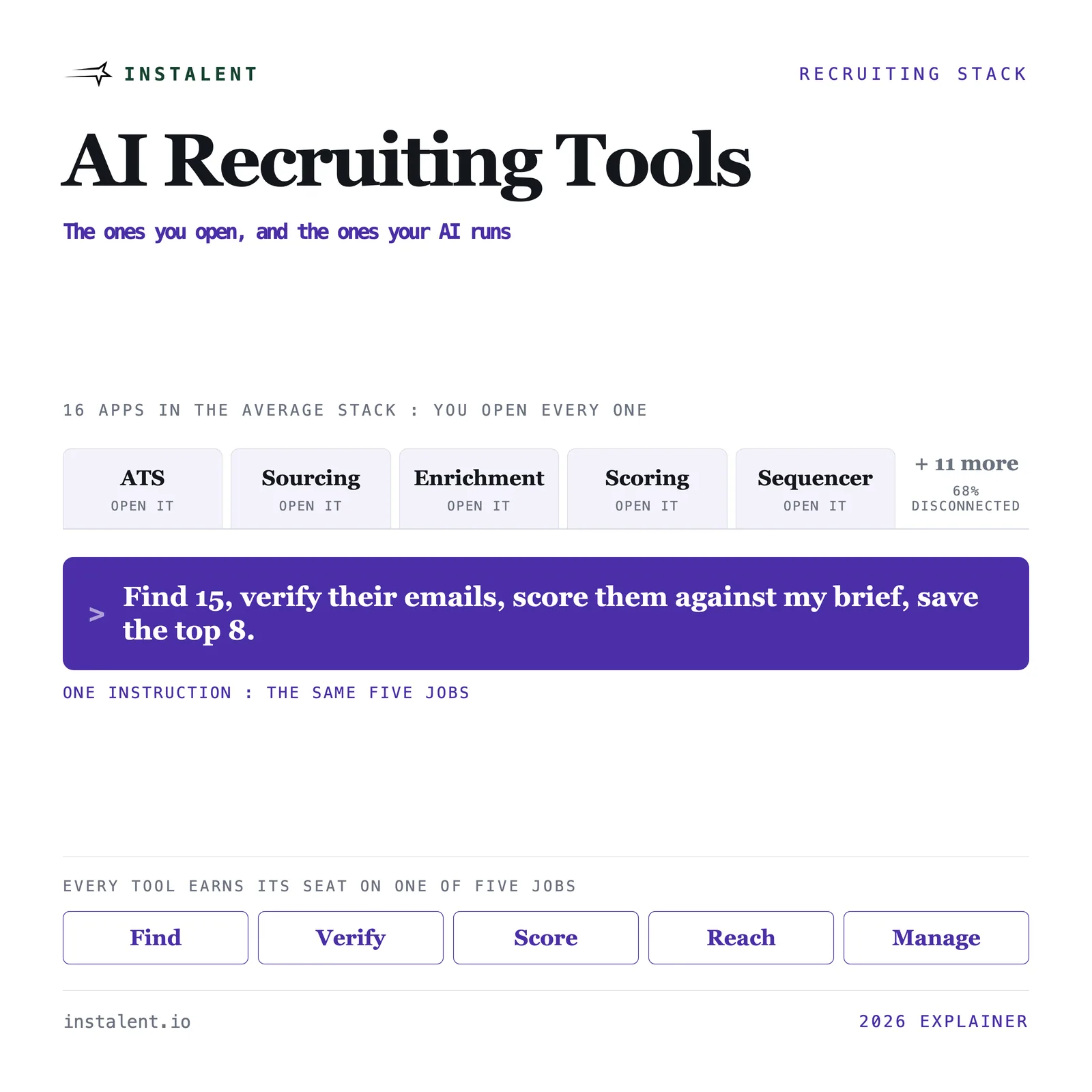
Almost every list of AI recruiting tools sorts the category the same way, by what each product does. That misses the thing that changed. The average organisation already runs roughly sixteen separate HR and recruiting applications and about two thirds of them do not talk to each other, so a seventeenth with AI on the pricing page is not a strategy. What actually moved in 2026 is quieter: a small number of tools can now be called directly by your AI assistant, with nothing opened at all. That line, between the tools you operate and the tools your assistant operates, is the most useful way to judge AI recruiting software right now, and almost nobody judges it that way.
Sixteen apps, and the number that actually matters
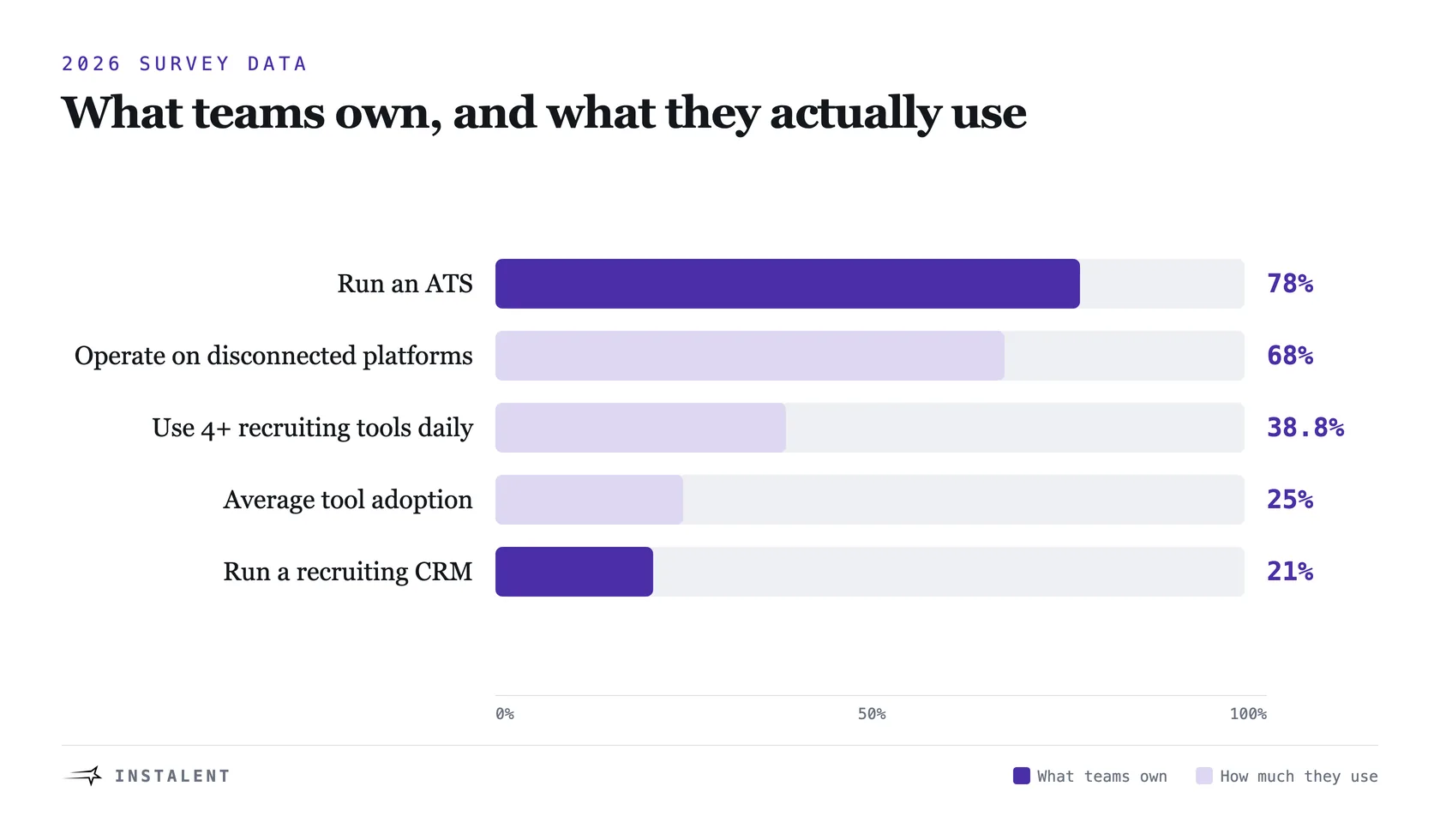
Start with the honest picture of a 2026 recruiting stack. The average organisation runs roughly sixteen separate HR and recruiting applications, 68% operate on disconnected platforms, and average adoption across HR technology sits near 25%. So the typical team is paying for sixteen things, using about a quarter of what it bought, and moving data between them by hand.
A 2026 survey of more than 2,000 organisations and 20,000 users found 38.8% of teams juggling four or more distinct recruiting tools every day. Seventy-eight per cent ran an ATS. Only 21% ran a recruiting CRM. That 57-point gap is the shape of the problem: teams buy the system that stores candidates and skip the system that works them.
The number that matters is not how many tools you own. It is how many handoffs a single candidate crosses before someone talks to them. Each handoff is a copy-paste, a CSV, or a task that quietly does not happen on a Friday.
Where AI recruiting tools actually get used
SHRM's State of AI in HR 2026 - fielded across December 2025, with 1,722 HR professionals completing it - shows exactly where AI got adopted. Sixty-six per cent use it to write job descriptions. Forty-four per cent screen resumes with it. Twenty-nine per cent use it to communicate with applicants. But only 32% use it to automate candidate searches.
That distribution is not about appetite. It is about what AI recruiting tools can actually reach. Writing a job description needs a chat box and nothing else, so adoption was instant and free. Sourcing needs live access to the open market, verified contact data and a way to send a message, so adoption depended on buying something that could actually do it. The AI went where the friction was already lowest, which is the opposite of where the time goes.
We covered why that gap persists in the 2026 agentic AI adoption gap. The short version: the constraint has never been willingness.
The 2026 test: can your assistant call it?
Here is the shift that has not made it into the comparison posts yet.
Until recently, every AI recruiting tool was something you opened. You logged in, you typed into its search box, you exported a list. The AI was inside the tool, and you were the integration between tools.
That is no longer the only option. Through the Model Context Protocol - an open standard now governed under the Linux Foundation - a product can expose its functions as named tools that your assistant calls directly. You describe the outcome in Claude or ChatGPT, and the work happens in the product without you opening it.
The practical difference is not speed of clicking. It is that a multi-step job stops needing you in the middle of it. "Find fifteen people who fit this, verify their emails, score them against my brief and save the top eight" is one instruction against a callable stack, and four separate tool sessions against a conventional one.
A one-question filter for any vendor call
Ask: "can my AI assistant call your product directly, or do I have to open it?" Most vendors will say they have an API. That is not the same answer. An API is something your engineer integrates. A callable tool surface is something your assistant uses today, unprompted, with no build.
We wrote the detail up separately in recruiting MCP server: the tools your AI can actually run, including which recruiting products already ship one and the security controls to insist on before you connect anything.
The five jobs every AI recruiting tool should do
Forget vendor categories for a moment. A desk has five jobs, and every AI recruiting tool you pay for should be doing one of them well enough to justify its seat.
Find. Can it reach people who are not in your database? This is the single most common failure. A tool that searches your own records is a search box, not a sourcing tool. Judge it on a role you are genuinely struggling to fill, not on a demo query. See AI candidate sourcing for what the work looks like end to end.
Verify. Does it find a working email and phone number, or does it pattern-guess an address and let your sender reputation absorb the bounce? Ask what happens when the first source fails - a serious tool cascades through several and tells you when it found nothing. That distinction is the whole subject of contact enrichment.
Score. Does it explain the number? A ranked list with no reasoning cannot be argued with, corrected or defended to a hiring manager. Demand a breakdown against your stated criteria, not a score. Candidate analysis exists for exactly this.
Reach. Can it run a real sequence across multiple channels, pace it sensibly, and stop the moment someone replies? Volume tools that keep sending after a reply do measurable damage. Multichannel outreach and the unified inbox are two halves of one job.
Manage. Does the work survive you closing the laptop? Saved lists, scheduled runs, follow-ups that fire on their own, and a push into RecruiterFlow, Greenhouse, Lever or TeamTailor when the shortlist is done.
If two tools claim the same job, one of them is a subscription you have stopped noticing.
Audit your stack in an hour
This is worth doing properly once a year, and it takes less time than the renewal call.
- List every tool with a recruiting seat, including the ones on someone's personal card. Expect the list to be longer than you thought.
- Tag each one with its job - find, verify, score, reach, manage. Anything that does not map to one of the five is admin, not recruiting.
- Mark every handoff. Draw the line a candidate travels from first sighting to first reply, and mark each point where a human moves data. Those marks are your real cost.
- Mark what is callable. For each tool, note whether your assistant can drive it or whether a person must open it. Most stacks come out at zero, which is itself the finding.
- Check usage, not licences. Pull actual logins for the last 90 days. Against ~25% average adoption, expect at least one tool nobody has opened since onboarding.
- Cut, then consolidate. Kill the unused. Then look at what is left: if three tools each do a third of one job, one tool doing the whole job removes two handoffs as well as two invoices.
What to cut, and what to keep
Most lists of the best AI recruiting tools will not tell you to remove anything, so here is the other half. Cut anything whose only AI feature is text generation you could get free. Cut the second tool doing a job you already have covered. Cut anything that produces a list you then have to move somewhere else by hand, because that tool is charging you for a step and leaving you the hard part.
Keep the tools that reach data you do not have. Keep the ones that verify rather than guess. Keep the ones that explain themselves. And weight heavily toward anything your assistant can call directly, because that is the only property on this list that removes a step rather than speeding one up.
Want one platform doing all five jobs, callable from your AI assistant? Get started and you can run your audit against it the same week.
For the connection layer in detail, read recruiting MCP server. For what changes once an agent has the tools, AI recruiting agents. For a straight comparison of sourcing products, the best AI sourcing tools.
Sources
- The Recruiting Tech Stack Report 2026 - Pin, 2026. Survey of 2,000+ organisations and 20,000+ users (38.8% using four or more tools daily; 78% ATS vs 21% recruiting CRM; ~25% average adoption), citing HR.com 2025 for the ~16 applications and 68% disconnected figures.
- The State of AI in HR 2026 - SHRM, published May 2026. Fielded 5-23 December 2025 via SHRM's Voice of Work Research Panel; 1,908 HR professionals started and 1,722 completed the survey (66% job descriptions, 44% resume screening, 32% automating candidate searches, 29% applicant communication).
- MCP joins the Agentic AI Foundation - Model Context Protocol Blog, 9 December 2025 (protocol governance under the Linux Foundation).
- What is the Model Context Protocol - modelcontextprotocol.io (open standard, client support).
Find better candidates, faster
Source, verify and reach candidates on one engine. Get 25% off your first month.
Keep reading