Recruiting MCP Server: The Tools Your AI Can Actually Run
Every recruiting MCP server so far reads records you already have. Here is what a working one does instead, and how to judge one before you connect.
Let your AI assistant source, verify, score and reach out - in one conversation.
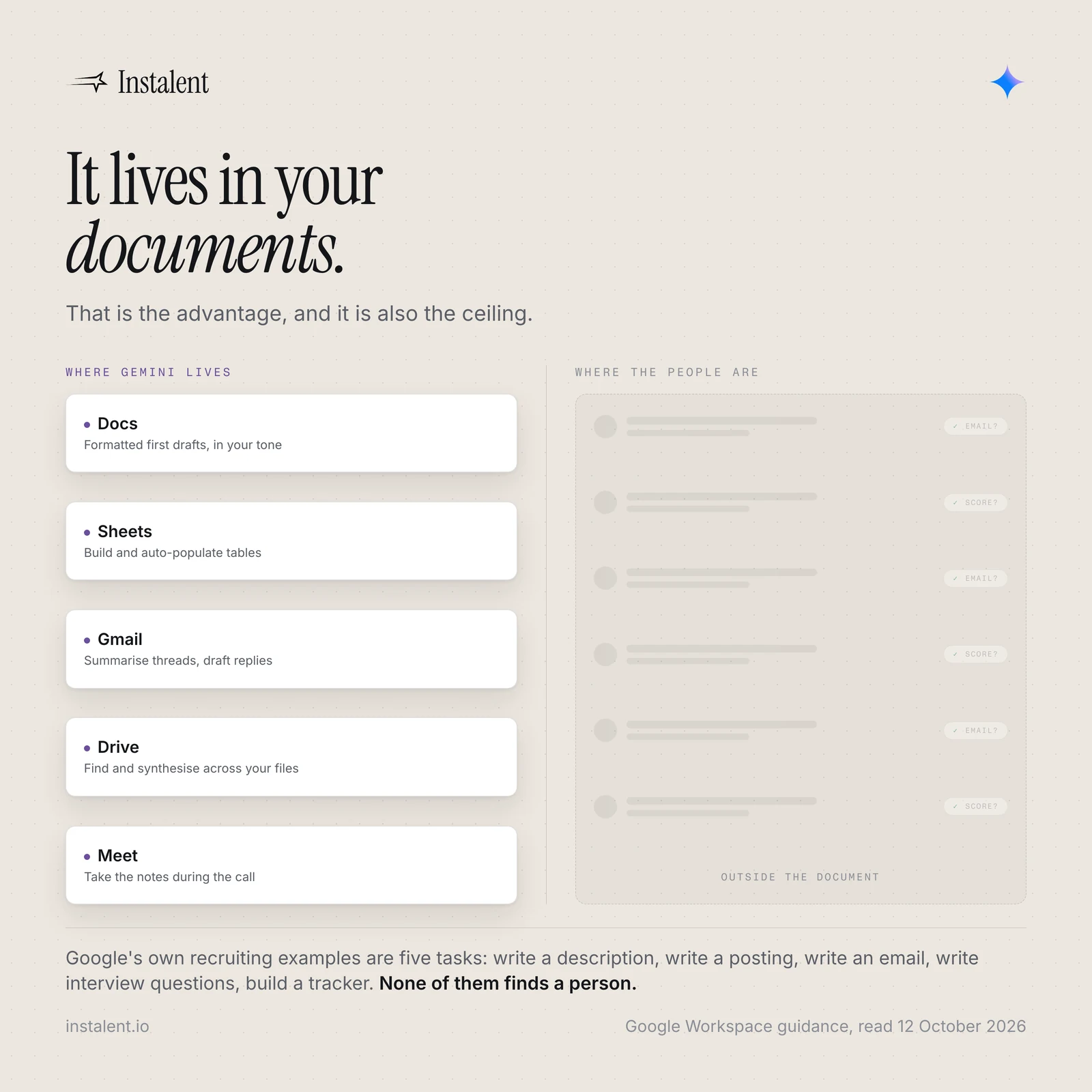
A recruiting MCP server used to be a thing you had to explain. Eleven HR and recruiting products now run one, and if you use an ATS there is a decent chance yours is among them. But look at what those eleven servers are: an ATS, an ATS, an HRIS, a payroll system, a performance tool, a background-check provider. Every one of them is a connector to a system of record. Every one of them can only tell your assistant about people who are already in your database. Which leaves the question nobody in the category is answering: what happens when the person you need is not in there?
What a recruiting MCP server actually is
The Model Context Protocol is an open standard for connecting AI applications to external systems. Without it, an assistant can only talk about recruiting. With it, the assistant can call real, named tools inside the products you already pay for.
The governance question is settled. MCP was donated to the Agentic AI Foundation, a directed fund under the Linux Foundation, on 9 December 2025 - co-founded by Anthropic, Block and OpenAI, with support from Google, Microsoft, AWS, Cloudflare and Bloomberg. At the time of the handover it was running over 97 million monthly SDK downloads and 10,000 active servers. The current specification revision is dated 28 July 2026. This is plumbing now, not one vendor's product decision, and that is precisely why it is worth an hour of your attention.
For a fuller explanation of the protocol itself, we wrote MCP for recruiters. This post is about the part that matters commercially: what is actually on the other end of the connection.
Every recruiting MCP server today reads data you already have
Here is the ecosystem as of a 21 August 2026 review, sorted by what the server is attached to.
| Product | Category | What the server operates on |
|---|---|---|
| Workable | ATS | Jobs, candidates, stages, reviews, requisitions, offers |
| Greenhouse | ATS | Your records, permission-aware, open beta |
| Ashby | ATS | Your records, per-user OAuth, open beta |
| Manatal | ATS | Candidate and job search, notes, matches |
| Zoho Recruit | ATS | Candidate modules and job openings |
| HiBob | HRIS | Employee data, time off, tasks |
| Gusto | Payroll | Payroll and people data |
| Calamari | Leave | Clock in and out, time-off requests |
| Lattice | Performance | Draft, edit and submit reviews |
| Checkr | Background checks | Employer and candidate reports |
| Hirevire | Video screening | Screening responses, read or read-write |
Read that column again. Every single entry is a system of record. The ecosystem has, so far, standardised entirely on one thing: letting an assistant talk to the database you have already filled.
That is genuinely valuable. If you run a large ATS and your consultants lose twenty minutes a day hunting for a record, connect it today. Greenhouse in particular did the boring parts properly, with org-level admin controls and permission-aware access, which is what a client's IT reviewer will ask about.
But it does not touch the thing most desks are actually stuck on.
System of record versus system of work
The distinction that decides whether any of this helps you is simple.
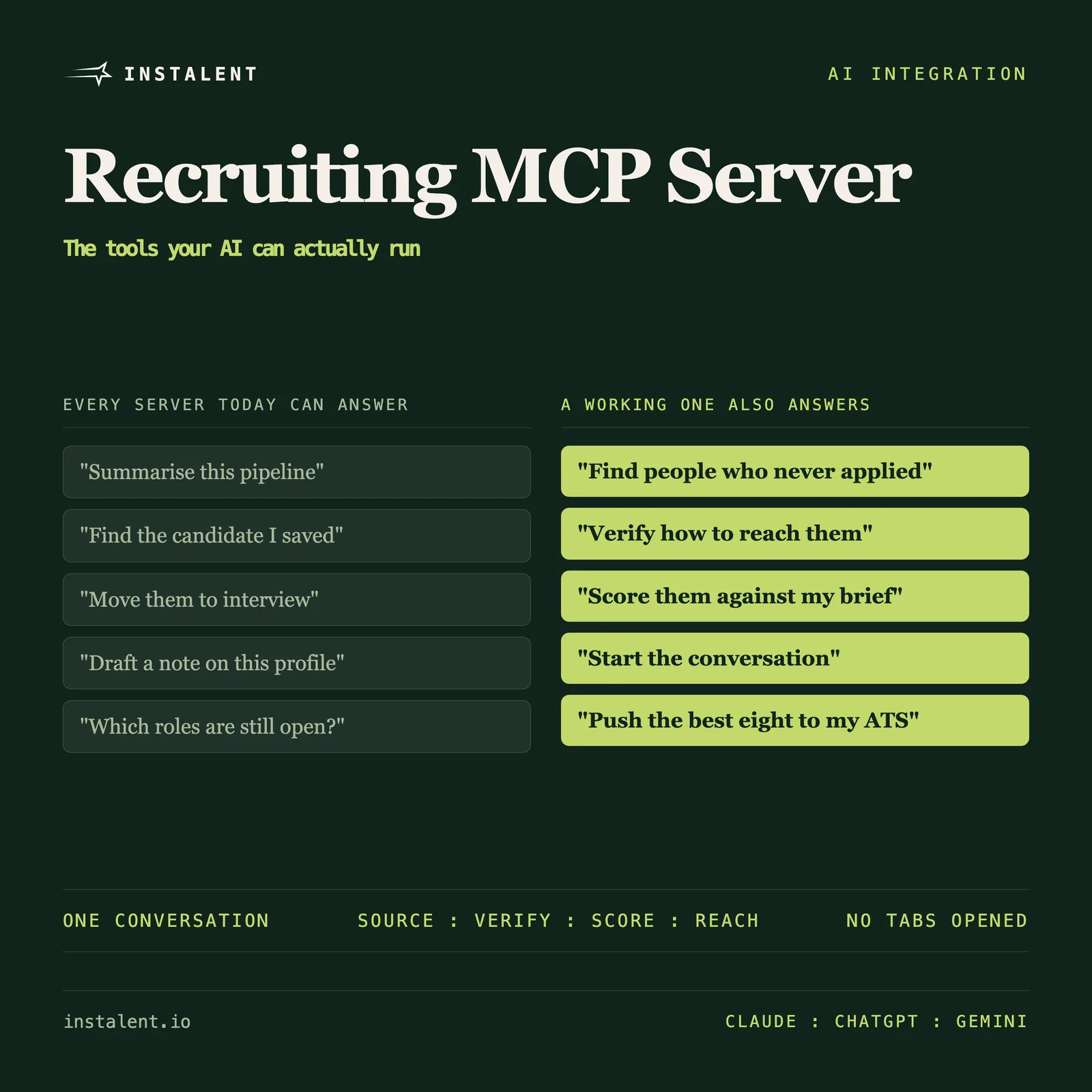
A system-of-record server tells the assistant what you already know. It reads, summarises and annotates. Its ceiling is the quality and size of your database. Ask it for five senior platform engineers in Munich and it will return the ones you already sourced, or nothing.
A system-of-work server changes what you know. It searches the open market, verifies contact details, scores people against a brief, starts conversations and manages the replies. Its ceiling is the market, not your database.
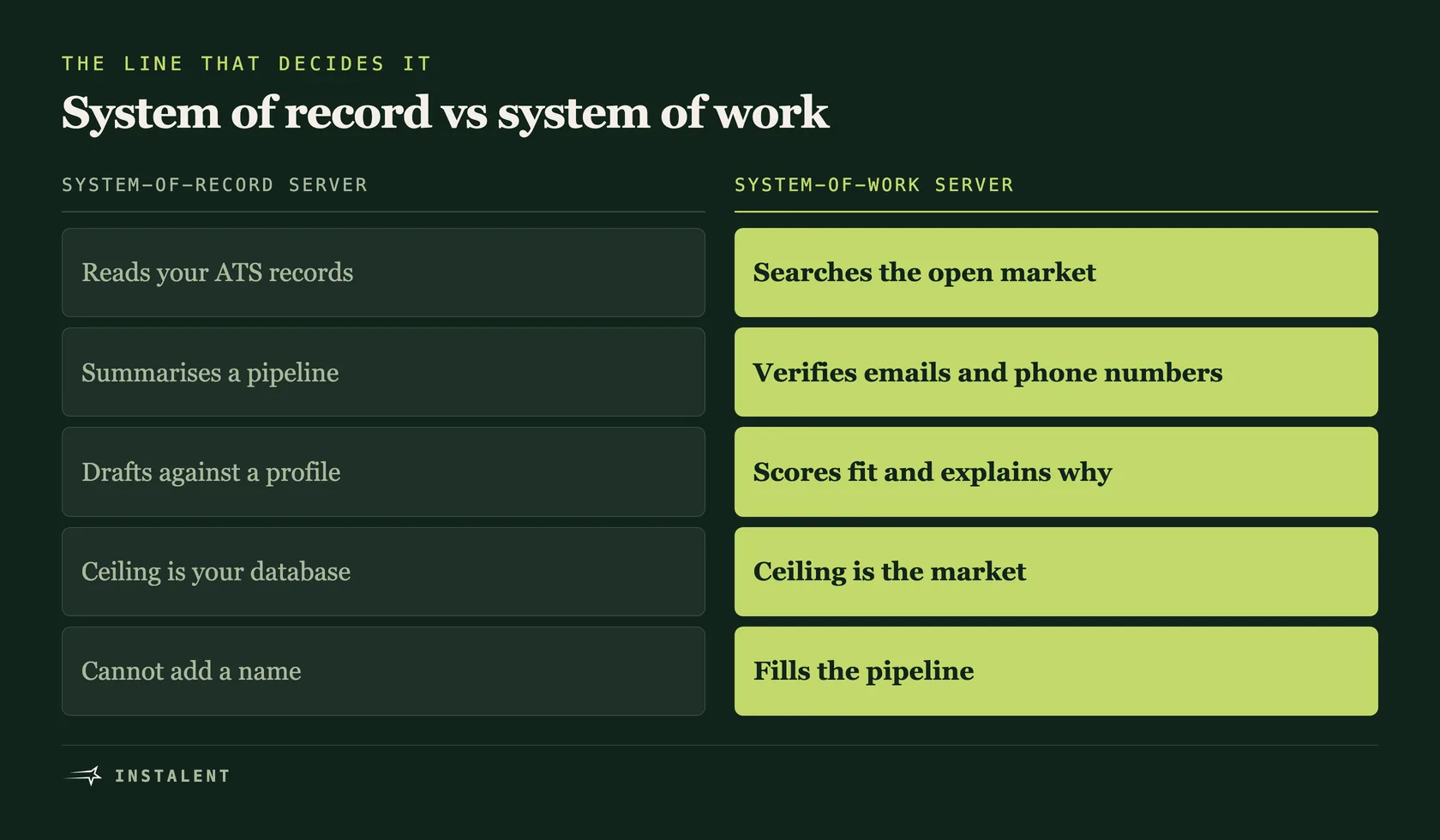
Neither replaces the other. The mistake is assuming that connecting your ATS to Claude has solved AI sourcing, when what it has solved is AI record-lookup. On a desk carrying a real req load, the ATS lookup saves minutes. The market search fills the role.
The question that separates the two categories
Ask any recruiting MCP server this: "find me eight people who fit this brief and are not in my database." If the honest answer is that it cannot, it is a record connector. That is fine, as long as you bought it knowing.
What a working connector actually does
The Instalent MCP server sits on the other side of that line. The useful thing about it is not how many functions it exposes - it is that they cover a whole desk, so a request can travel from a plain-English brief to a sent message inside one conversation, with no handoff back to you in the middle.
- Source. Find people who are not in your database, from a brief written the way you would explain it to a colleague. The same applies on the client side: which companies employ a role, and who to talk to at each. See AI candidate sourcing.
- Verify. Find missing emails, phone numbers and profile URLs from multiple verified sources, charged per person per channel so nothing is spent silently. See contact enrichment.
- Score. Grade people against plain-English criteria and explain each score, so a shortlist arrives with reasoning attached rather than a bare ranking.
- Reach. Build and run multichannel outreach, and work the shared team inbox where the replies land.
- Manage. Saved lists, follow-ups, recurring agents, and pushing a finished shortlist into RecruiterFlow, Greenhouse, Lever or TeamTailor.
The part that matters most is the least visible: whole workflows are exposed as single steps, not just individual functions. The common failure of a large connector is an assistant that does three things correctly and then stalls, because nothing told it what a finished job looks like. Ours is built so "find, verify, score and save the best eight" is one request rather than four.
Setup takes a few minutes and is covered step by step in our MCP setup guide.
Five prompts that run a real desk
Once connected, the interesting part is that these are single messages, not sessions.
- "Find 15 senior backend engineers in Berlin who have shipped payments infrastructure, score them against this brief, and save the top 8 to a project called Fintech Q4."
- "Get verified emails for everyone in the Fintech Q4 project, then tell me which ones you could not verify and why."
- "Build a three-step outreach sequence for that project in my voice, show me the drafts, and do not send anything until I say so."
- "Which of my open campaigns has the worst reply rate, and what do the replies that did come back have in common?"
- "Every Monday at 8am, map the companies in the DACH region that have posted a Head of Engineering role in the last week, and send me the list."
The fifth one is the one that changes a week: it turns the conversation into a recurring agent, so the market map arrives before you sit down rather than after you remember to run it.
To get consistently good results rather than occasionally good ones, install the three Instalent skills - candidate sourcing, client prospecting and outreach campaigns. A skill teaches the assistant how to do the work well: cast wide before scoring, verify in the right order, interview you before drafting a sequence. Capability without a playbook produces an assistant that guesses.
What to lock down before you connect anything
The security conversation around MCP has matured, and it is worth taking seriously rather than clicking through.
On 20 May 2026 the NSA's Artificial Intelligence Security Center published a Cybersecurity Information Sheet, Model Context Protocol (MCP): Security Design Considerations for AI-Driven Automation. Its core observation is structural: MCP inverts the familiar pattern, because the server often queries and sometimes acts on behalf of the client. That inversion creates attack paths that traditional application security was not built to trace. The sheet names serialization risks, trust boundaries and agent misuse.
The incidents are not hypothetical either. In September 2025 a malicious npm package called postmark-mcp shipped a hidden backdoor that blind-copied every email it sent, exposing password resets and internal mail. In May 2025 a prompt-injection flaw in the GitHub MCP server allowed private repository information to be extracted through a malicious issue. The pattern in both: the danger is rarely the protocol, it is the supply chain and the instructions the model is willing to follow.
Five controls cover most of it on a recruiting desk:
- Connect vendor-operated servers, not community rebuilds of them. A third-party wrapper around a real product is where poisoned tool descriptions live.
- Scope the credential. One connection, one token, the narrowest permission set that still does the job.
- Require approval on anything outward-facing. Nothing should send a message, delete a record or push to your ATS without a human confirming. Instalent classifies every action as read, mutating or destructive, and destructive actions ask you to type the name back before they run.
- Read the audit log. Every tool call should leave a row. If you cannot answer "what did it do last Tuesday", you cannot govern it.
- Assume the model will read hostile text. A candidate profile, a job description or an email body can contain instructions aimed at your assistant. Approval gates are what make that survivable.
What to connect first
If you already run one of the eleven, connect it this week - the record lookup is a genuine time saving and the setup is short. Then be honest about whether it moved the number you care about. Record lookup speeds up admin. It does not add a single name to your pipeline.
If your bottleneck is the pipeline, connect something on the other side of the line and give it one real req to work. Not a demo brief - a role you are actually struggling to fill, with your real criteria, so the output is judged against a standard you already hold in your head.
Want your assistant to do the work instead of describing it? Get started and you can point it at a live req the same afternoon.
For the wider stack question this sits inside, see AI recruiting tools: the ones you open and the ones your AI runs. For what an agent does once it has the tools, see AI recruiting agents. Agencies weighing this at firm level should read our recruitment agencies solution page.
Sources
- MCP joins the Agentic AI Foundation - Model Context Protocol Blog, 9 December 2025 (97 million monthly SDK downloads, 10,000 active servers, founding organisations).
- What is the Model Context Protocol - modelcontextprotocol.io (client support, current specification revision 2026-07-28).
- Which HR Tools Have MCP Servers? - Hirevire, page verified 21 August 2026 (the eleven native servers and their scope).
- NSA Releases Security Design Considerations for AI-Driven Automation Leveraging the Model Context Protocol - National Security Agency, 20 May 2026.
- MCP Security: Risks, Real Incidents and Controls - Checkmarx (postmark-mcp backdoor, September 2025; GitHub MCP server prompt injection, May 2025).
Find better candidates, faster
Source, verify and reach candidates on one engine. Get 25% off your first month.
Keep reading