MCP for Recruiters: What Connecting Your AI to Your Stack Actually Means
MCP for recruiters, explained without the hype: what changed in the last year, what it does on a desk, and the questions to ask before you connect anything.
Do this in Instalent - source, verify and reach candidates in one flow.

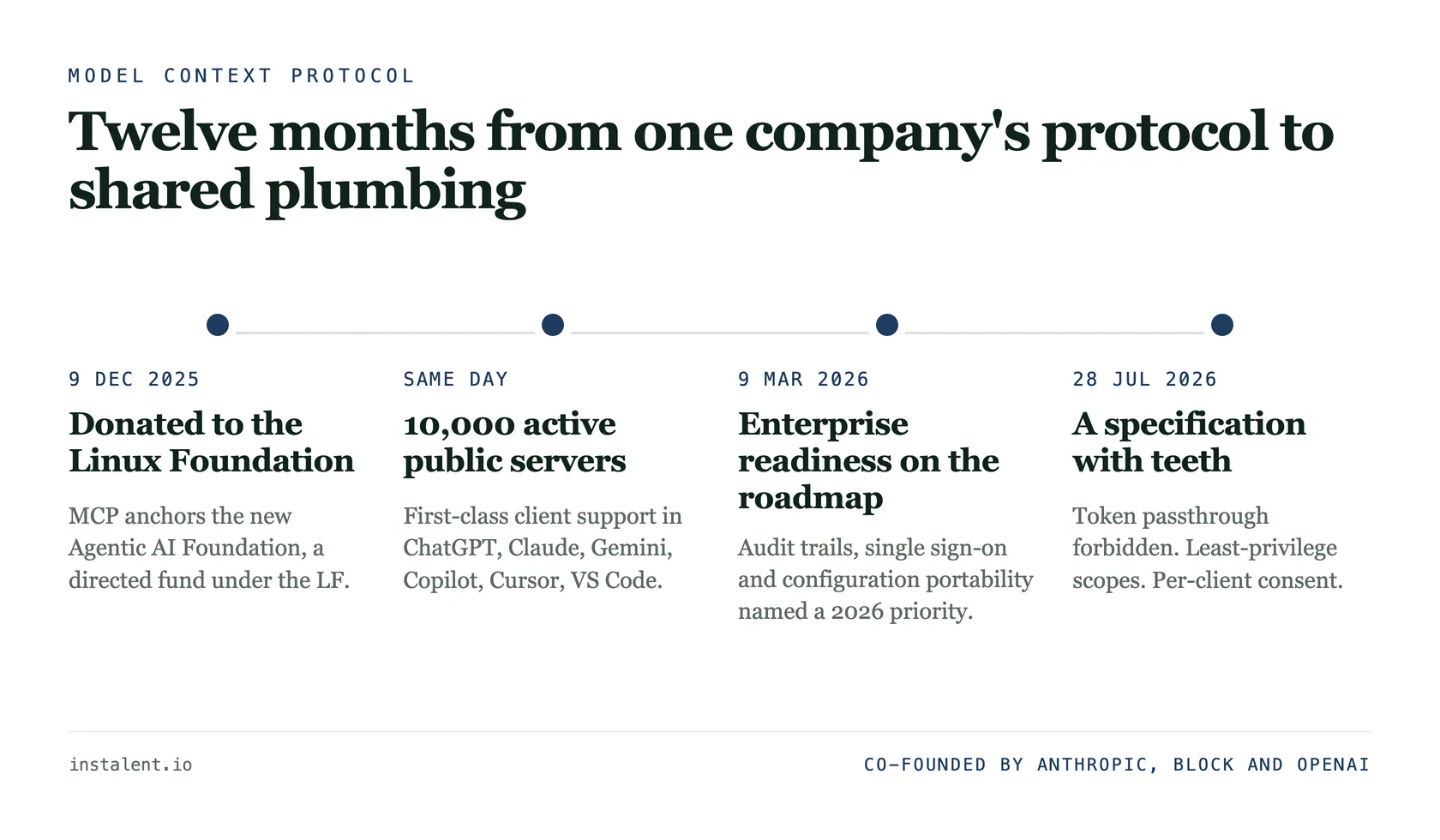
Twelve months ago, MCP was a protocol one AI company had published and a handful of engineers were experimenting with. In December 2025 it was donated to the Linux Foundation, and it now sits under the Agentic AI Foundation, co-founded by Anthropic, Block and OpenAI with support from Google, Microsoft, AWS, Cloudflare and Bloomberg. More than 10,000 public servers speak it. That is the moment a protocol stops being someone's product decision and becomes plumbing, which is exactly when it starts mattering to people who do not write code.
If you have seen MCP explained before, you have probably been given the USB-C analogy, which is the official one and a good one. What almost nobody explains is the part a recruiter or an agency owner actually has to decide: what you are granting, what it changes on a desk, and what it very much does not fix.
What is MCP, in one paragraph
The Model Context Protocol is an open standard for connecting AI applications to external systems. Without it, your assistant can discuss recruiting in the abstract. With it, the assistant can call real tools in the products you already pay for, read the data you allow it to read, and take the actions you approve. Same chat window, completely different capability.
The important word is standard. Before MCP, every AI-to-tool connection was a custom build, which meant integrations only existed where a vendor had decided to fund one. Now a tool exposes its capabilities once and every compatible client can use them. Claude, ChatGPT, Gemini, Microsoft Copilot, Cursor and Visual Studio Code all have first-class client support.
Why the governance change is the part that matters commercially
This is the bit worth understanding before you commit any process to it.
A protocol controlled by one vendor is a strategic risk. If that vendor changes direction, your integrations follow. MCP's donation to a neutral foundation, alongside contributions from competing companies, is what turns it from one firm's interface into shared infrastructure. The published 2026 roadmap makes the direction explicit: alongside transport and agent-communication work, one of the four stated priorities is enterprise readiness, specifically audit trails, single sign-on and configuration portability.
Read that list again with a procurement hat on. Those are the three things your security reviewer, your client's IT team, or your own compliance obligations will ask about. They are being built into the standard rather than left to each vendor.
What an MCP server actually changes on a recruiting desk
The honest version. MCP does not make the model smarter and it does not know anything about recruiting. What it removes is the gap between deciding something and doing it.
Today, most AI use on a desk looks like this: you ask an assistant to help with a search, it gives you advice or a string, and then you go and do the work in another tab. The thinking happens in one place and the doing happens somewhere else, and you are the transport layer between them.
With a connected stack, the same conversation can carry the whole chain:
- Describe a role in plain language and get a real list of matching people back, rather than a Boolean string to paste elsewhere.
- Ask for verified contact details on the ones worth reaching.
- Score a list against your own criteria and get the reasoning, not a generic fit label.
- Find the companies worth a business-development conversation and the people who own the budget.
- Draft and queue outreach for your approval.
- Save what is good into a project, and push records into the systems of record you already run.
The change is not speed on any single step. It is that the steps stop being separate applications with a human copying between them, which is the same argument as recruiting automation generally, applied to the chat window you already have open.
Read-only MCP servers and working MCP servers are not the same thing
There is a distinction the category tends to blur, and it decides whether this is useful to you.
Most MCP servers being marketed to recruiting right now are connectors to a system of record. They let an assistant read your pipeline, summarise a candidate, or draft a note against records that already exist. That is genuinely useful, and if you run an ATS with a server available, connect it.
But it only works on data you already have. If the person is not in your database, an ATS connector cannot find them, cannot verify a contact detail for them, and cannot start a conversation with them. The bottleneck on most desks is not describing the pipeline. It is filling it.
Instalent's MCP server is built for that second job. It exposes the working end of a recruiting desk to your assistant: sourcing across the open web and professional signals, verified enrichment from multiple sources, scoring against your criteria with the evidence attached, client prospecting, and multichannel outreach with the reply landing back in one inbox. Ask for thirty people, get thirty real people. We also publish installable skills so the assistant knows how a recruiter would actually run those tools, rather than guessing.
The two categories complement each other. A system-of-record connector tells the assistant what you already know. A working connector changes what you know.
Eight questions to ask before connecting an MCP server
This is where senior operators earn their keep, because "one-click OAuth" hides real decisions. The MCP specification's own security guidance names most of these risks explicitly, which is a good sign about the standard and a good checklist for you.
- What scopes am I granting, exactly? The specification recommends least-privilege, progressive scopes and warns against omnibus permissions such as
allorfull-access. If a connector asks for everything at once, ask why. - Can I revoke it in one place, and does revoking it break anything I depend on? Consider the answer before you connect, not after someone leaves.
- What is logged? You want an audit trail of what the assistant did on your behalf, especially for anything client-facing.
- Does anything go out under my name without me approving it? Reading is one risk category. Sending is a different one entirely, and it should always be a deliberate approval.
- Where does the server run? Servers that run on a machine are a much larger trust decision than remote ones. The specification is blunt about the risks of executing a locally installed server from an untrusted source.
- Whose tokens are being used? The specification forbids token passthrough outright: a server "MUST NOT accept any tokens that were not explicitly issued for the MCP server". You do not need to implement that. You do need a vendor who can answer the question.
- What happens to client data? If you are an agency, your obligations to your clients do not change because a new interface appeared. Whatever you would ask before adding any subprocessor, ask here.
- Who on the team can connect things? Decide this once, centrally, before ten people each connect their own.
Treat tool output as data, not instructions
An assistant that can read outside content and also take actions is a new shape of risk. Content it reads can contain text that tries to instruct it. Keep anything that leaves your organisation, sends a message or writes to a system of record behind an explicit human approval, and keep a record of what was done. This is the same discipline as never letting a sequence send unreviewed, applied one layer up.
A realistic first week with an MCP server
You do not need a strategy for this. You need one useful loop.
- Connect one working tool and one system of record. Two connections, not twelve.
- Run your next live req end to end in the assistant: brief, search, shortlist, enrich, score.
- Keep outreach on manual approval for the whole week, and read every draft.
- Write down the three requests you made most often. Those are the ones worth turning into a saved workflow.
- At the end of the week, compare time-to-shortlist against your last three reqs for the same role family.
If it does not beat your normal process on a real req, it does not matter how good the demo was.
Where this is going
The 2026 roadmap points at the boring, load-bearing work: scalable transports, agent-to-agent communication, audit trails, single sign-on. That is what infrastructure looks like when it grows up, and it is a better signal for a buyer than any feature announcement.
For a recruiting desk, the practical read is that the chat window is becoming a real interface to your stack rather than a research tool beside it. The desks that benefit first are the ones that connect a small number of things deliberately, keep approval on anything outbound, and measure it on one req.
Want your assistant to do the work, not just describe it? Instalent connects to Claude, ChatGPT, Gemini and other MCP clients so you can source, verify, score and reach people from the chat you already have open. Follow the step-by-step setup guide, or start free and see how it fits an agency.
Where to go next, depending on what you need:
- The ecosystem, not the protocol. Which recruiting products actually shipped a server, and why every one of them so far only reads records you already hold: recruiting MCP server.
- Setting it up. The step-by-step connection guide for Claude, ChatGPT and Gemini: connect Instalent by MCP.
- Making the assistant good at it. Tools alone leave a model guessing at method; skills give it the playbook: install the Instalent skills.
- What an agent is, in general. The difference between a copilot and an agent, the workflows one runs end to end, and where a human stays in control: AI recruiting agents.
Sources
- Model Context Protocol - MCP joins the Agentic AI Foundation (December 9, 2025: "Anthropic is donating MCP to the Agentic AI Foundation, a directed fund under the Linux Foundation"; "10,000 active servers"; first-class client support in ChatGPT, Claude, Cursor, Gemini, Microsoft Copilot and Visual Studio Code; foundation co-founded by Anthropic, Block and OpenAI with support from Google, Microsoft, AWS, Cloudflare and Bloomberg)
- Linux Foundation - Formation of the Agentic AI Foundation (December 2025: AAIF formed with founding project contributions including MCP, goose and AGENTS.md)
- Model Context Protocol - What is MCP? ("an open-source standard for connecting AI applications to external systems"; the USB-C analogy; broad client support)
- Model Context Protocol - The 2026 Roadmap (March 9, 2026: four priorities, transport evolution and scalability, agent communication, governance maturation, and enterprise readiness covering audit trails, SSO authentication and configuration portability)
- Model Context Protocol - Security Best Practices (2026-07-28 specification: token passthrough forbidden, "MCP servers MUST NOT accept any tokens that were not explicitly issued for the MCP server"; scope minimisation guidance against omnibus scopes such as
*,all,full-access; per-client consent requirements; local MCP server compromise risks)
Find better candidates, faster
Source, verify and reach candidates on one engine. Get 50% off your first month.
Keep reading