AI Recruiting Agents: Capabilities, Workflows and Risks
What an AI recruiting agent actually is, how it differs from a copilot, the workflows it runs end to end, and where a human stays in control.
Do this in Instalent - source, verify and reach candidates in one flow.
An AI recruiting agent doesn't just answer questions about your pipeline - it does the work. It sources, enriches, scores and reaches out, from a plain instruction, with you approving the moments that matter. Here's what that really means, and how to adopt one without handing over your judgment.
"AI recruiting" has come to mean everything from a resume parser to a chatbot bolted onto an ATS. An agent is a specific, more useful thing: software that carries out a multi-step recruiting task on its own - not a feature you operate, but a worker you delegate to. This guide draws the line clearly, walks through the workflows a recruiting agent actually runs, and is honest about where the risks are.
Agent vs. copilot: the distinction that matters
The industry uses "AI" loosely, so start with the difference that changes how you work:
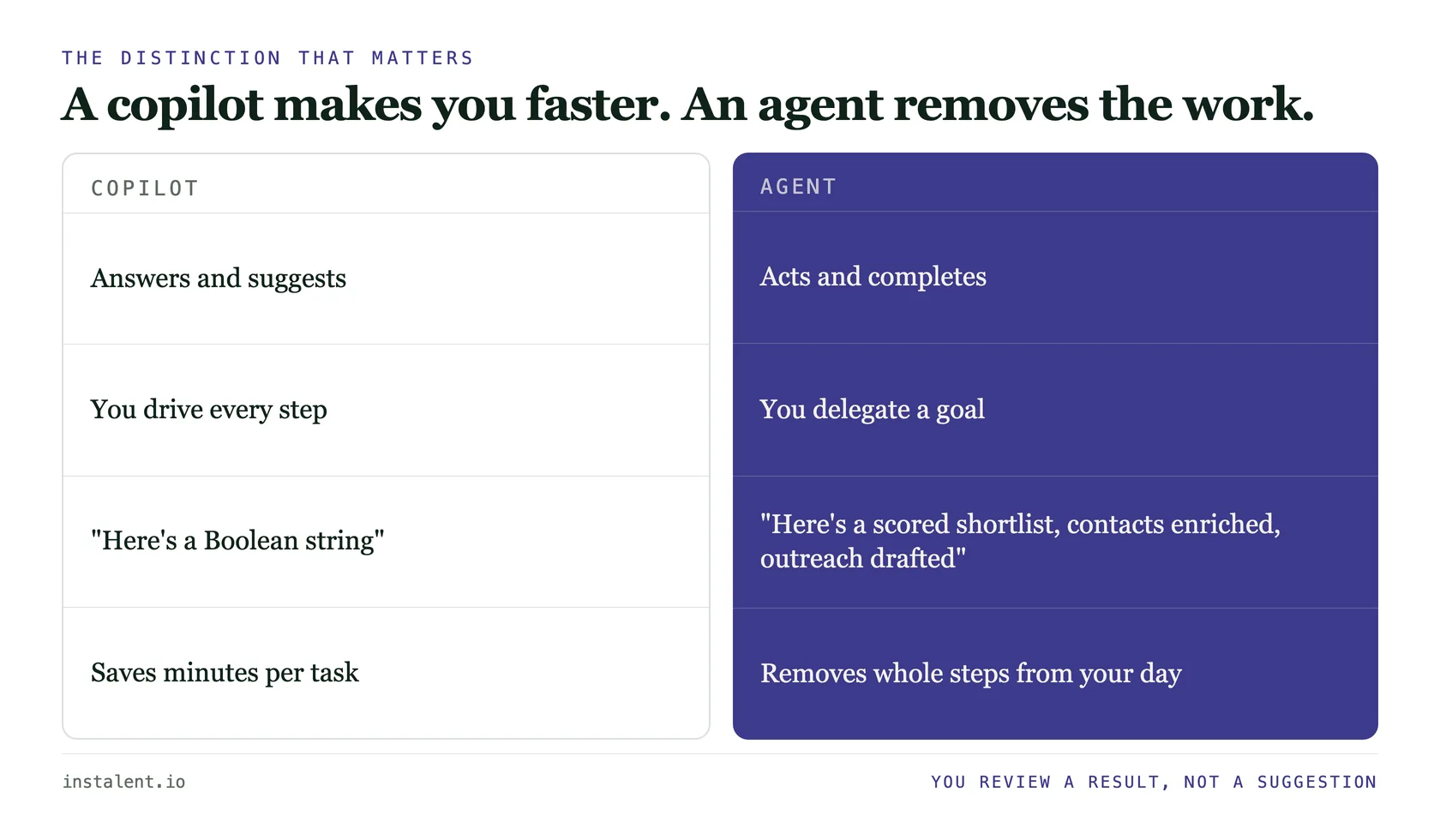
| Copilot | Agent |
|---|---|
| Answers and suggests | Acts and completes |
| You drive every step | You delegate a goal |
| "Here's a Boolean string" | "Here's a scored shortlist, contacts enriched, outreach drafted" |
| Saves minutes per task | Removes whole steps from your day |
A copilot makes you faster at the work. An AI recruiting agent removes the work. You give it a role and criteria; it runs the pipeline and comes back with a result to review - not a suggestion to act on.
What an AI recruiting agent actually does
A capable agent runs the same workflow a recruiter would, end to end:
- Understands the brief. You describe the role in plain language - the seniority, the kind of company, the must-haves. No Boolean.
- Sources candidates. It searches across many sources at once and returns a deduplicated pool, including passive candidates who aren't job-hunting. (For the full sourcing workflow, see the complete guide to AI candidate sourcing.)
- Enriches contacts. It adds verified email and phone data so the shortlist is reachable, not just visible.
- Scores fit. It ranks each profile against your criteria with the evidence behind the score - a breakdown you can sanity-check, not a black box.
- Reaches out. With your approval, it runs personalized multichannel outreach and follows up on a sensible cadence.
- Manages replies. Responses land in one place, and the agent can draft replies for you to send or approve.
The same idea applies to the other side of the desk: an agent can prospect clients - finding companies that are hiring and the decision-makers to reach - just as readily as it sources candidates.
Human-in-the-loop AI recruiting: where you stay in control
Autonomy is not the same as being unsupervised, and a recruiting agent should never be. The right model is the agent does the work; the human owns the decisions that carry weight. In practice that means clear approval gates:
- Sourcing and scoring can run freely - reading public information and ranking it is low-risk and high-leverage.
- Anything that leaves the building - a message to a candidate or a client - should be gated by your approval, at least until you trust the persona and the copy.
- Anything sensitive or irreversible stays with you by default.
Autonomy is a dial, not a switch
Good agent design lets you choose how much runs on its own. Start with the agent drafting and you approving every send, then widen the autonomy as trust builds. An agent you can't supervise is a liability, not a productivity gain.
Where AI recruiting agents run
One of the quieter shifts of 2026 is that the agent doesn't have to live in a separate app. Instalent's agent runs inside the product and also from the assistants recruiters already use - it can be operated through ChatGPT, Claude and Gemini, so "source me ten backend engineers in Berlin and enrich them" is something you can ask from the tool already open on your screen. (If you want to wire that up, here's how to connect Instalent to Claude, ChatGPT and Gemini.)
The risks of AI recruiting agents, honestly
An agent is powerful, which means the failure modes are worth naming:
- Over-automation. Fully automated outreach with no human check erodes quality and can damage your reputation faster than it books meetings. Keep a person on the send until the results earn autonomy.
- Unverified data. An agent acting on bad contact data sends to dead addresses and hurts deliverability. Verification isn't optional.
- Compliance and candidate experience. Automated does not mean exempt from data-protection rules or from basic courtesy. The agent should make it easier to treat people well, not to spray them.
- Black-box scoring. A fit score you can't inspect is a score you can't trust. Insist on the reasoning behind every ranking so you can overrule it.
None of these are reasons not to use an agent. They're reasons to use one that keeps you in the loop, verifies its data, and shows its work.
Measuring whether it's working
Judge an agent by outcomes, not activity. The questions worth asking:
- Are you getting to a reviewed shortlist faster than before?
- Is a higher share of your shortlist reachable on the first try?
- Are your response rates holding or improving as volume goes up?
- Is the recruiter spending more time in conversations and less in tabs?
If the answer is yes, the agent is doing its job - compressing the mechanical parts of recruiting so the human does more of the part only a human can.
How to adopt an AI recruiting agent
Start narrow. Point an agent at one repeatable workflow - a role you source often, or a client segment you prospect regularly - and keep yourself on every send. Watch the scored shortlists and the reply quality. As it earns trust, widen what it runs on its own and let workflow automation carry the path from brief to shortlist to outreach.
The goal was never to replace the recruiter. It's to give every recruiter the leverage of a small team - so the judgment, the relationships and the close stay human, and everything mechanical around them runs on its own.
See what an AI recruiting agent looks like in practice, or read the complete guide to AI candidate sourcing.
Two related reads: AI recruiter untangles the two very different products sold under that name and answers the replacement question with labour-market data rather than reassurance, and AI recruiting tools sorts the wider category by whether a human has to open the tool or an assistant can call it.
For the plumbing that lets an agent run inside the assistant you already use, MCP for recruiters is the place to start.
Find better candidates, faster
Source, verify and reach candidates on one engine. Start your 7-day free trial.
Keep reading