AI Recruiter: What It Actually Is, and Whether It Replaces You
Two very different products are sold as an AI recruiter. Here is what each one does, what the data says about both, and whether either replaces a recruiter.
The AI that fills your pipeline, not the one that interviews for you.
Search for an AI recruiter today and the first page is mostly one product: a bot that phones, screens and interviews applicants at volume. That is a real category with real buyers, and it is not the only thing the phrase means. A second, quieter product also calls itself an AI recruiter and does the opposite job - it finds people who never applied, verifies how to reach them, scores them against your brief and starts the conversation. The two get sold under one name, they fail in completely different ways, and choosing the wrong one is an expensive mistake. Here is how to tell them apart, and what the evidence says about the question underneath all of it.
What an AI recruiter is: two products, one name
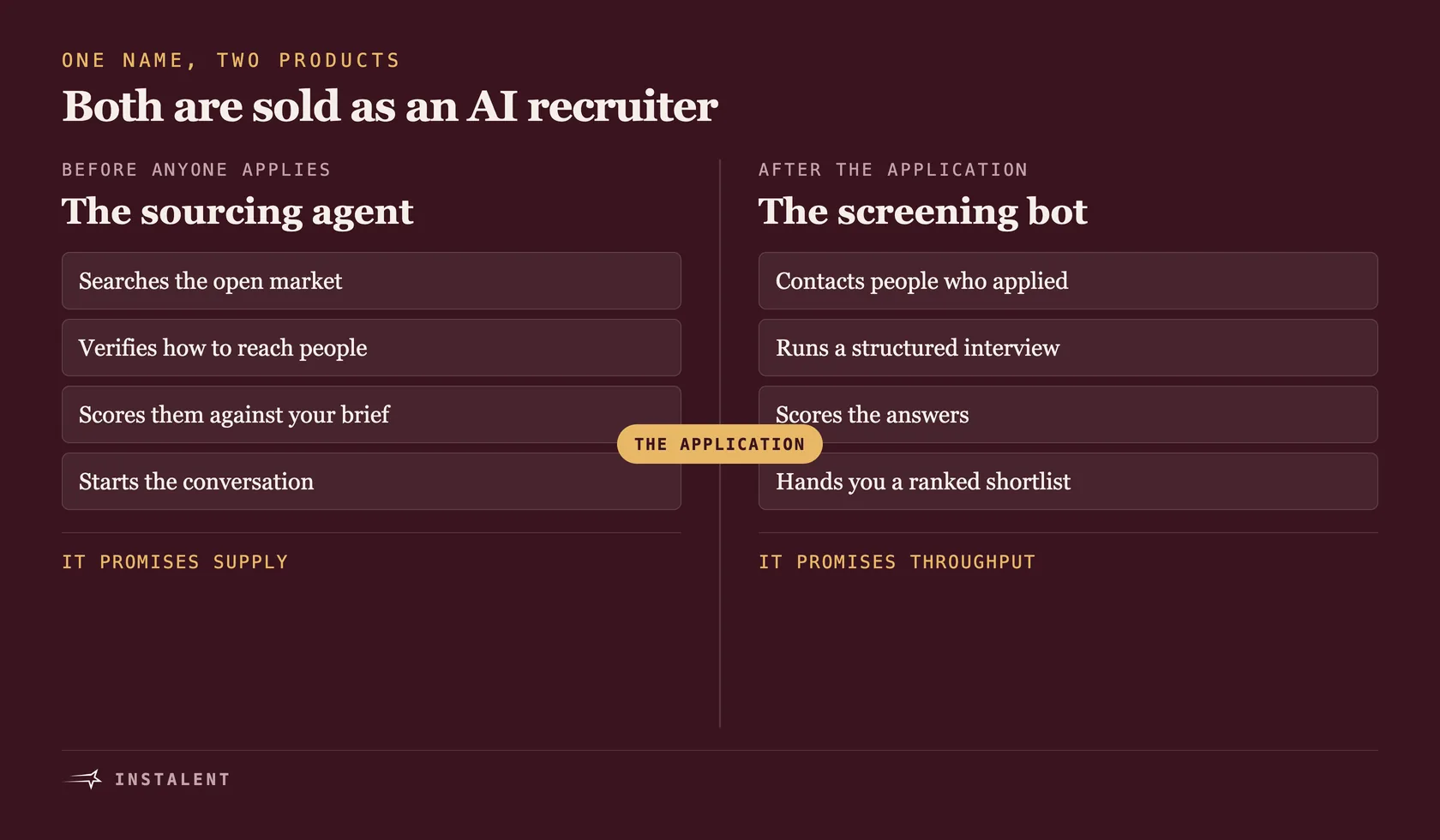
The confusion is not the buyer's fault. Both categories are marketed as an AI recruiter, both genuinely automate recruiting work, and they start at opposite ends of the funnel.
The screening bot starts after the application. It phones or messages applicants, runs a structured interview, scores the answers and hands you a ranked shortlist. It is built for volume - hundreds of applicants per role, where reading every CV is not realistic. Its promise is throughput.
The sourcing agent starts before anyone applies. It searches the open market, returns people who fit, finds a working email or phone number, scores them against your criteria with reasoning attached, and runs the outreach until someone replies. Its promise is supply.
If you have 400 applicants and no time, the first one is what you need. If you have eight applicants and none of them are right, the first one has nothing to work with. That is the whole decision, and it takes thirty seconds to make once the two are separated.
The screening bot has a number people leave out
The throughput case is easy to make and easy to model. The cost sitting next to it is newer, and it is now measured rather than argued.
Greenhouse's 2026 Candidate AI Interview Report, published on 1 May 2026, surveyed 2,950 candidates across the US, UK, Germany, Australia and Ireland. Among US job seekers, 63% had been interviewed by an AI - up 13 percentage points in six months. So exposure is no longer novel.
Acceptance is a different measurement. In the same survey:
- 38% had walked away from a hiring process because it included an AI interview, and another 12% said they would.
- 70% were never clearly told upfront that AI would be evaluating them; 21% only found out once the interview started.
- Just 18% say employers have clear AI policies, and only 21% believe most employers are using AI responsibly.
A tool that screens 400 applicants but loses roughly a third of them at the door has not saved you 400 applicants. For a high-volume, low-scarcity role that trade may still be worth it. For a scarce, senior or hard-to-fill role, where the whole game is persuading a small number of specific people to talk to you, it is close to indefensible.
If you do run one, fix the transparency first
Seventy per cent of candidates were not told an AI would evaluate them. That single number explains a lot of the hostility, and it is the cheapest thing on this list to correct. Say so before the interview, in plain words, and give people a route to a human.
Will AI replace recruiters?
This is the question under every other question, so it deserves a real answer rather than reassurance.
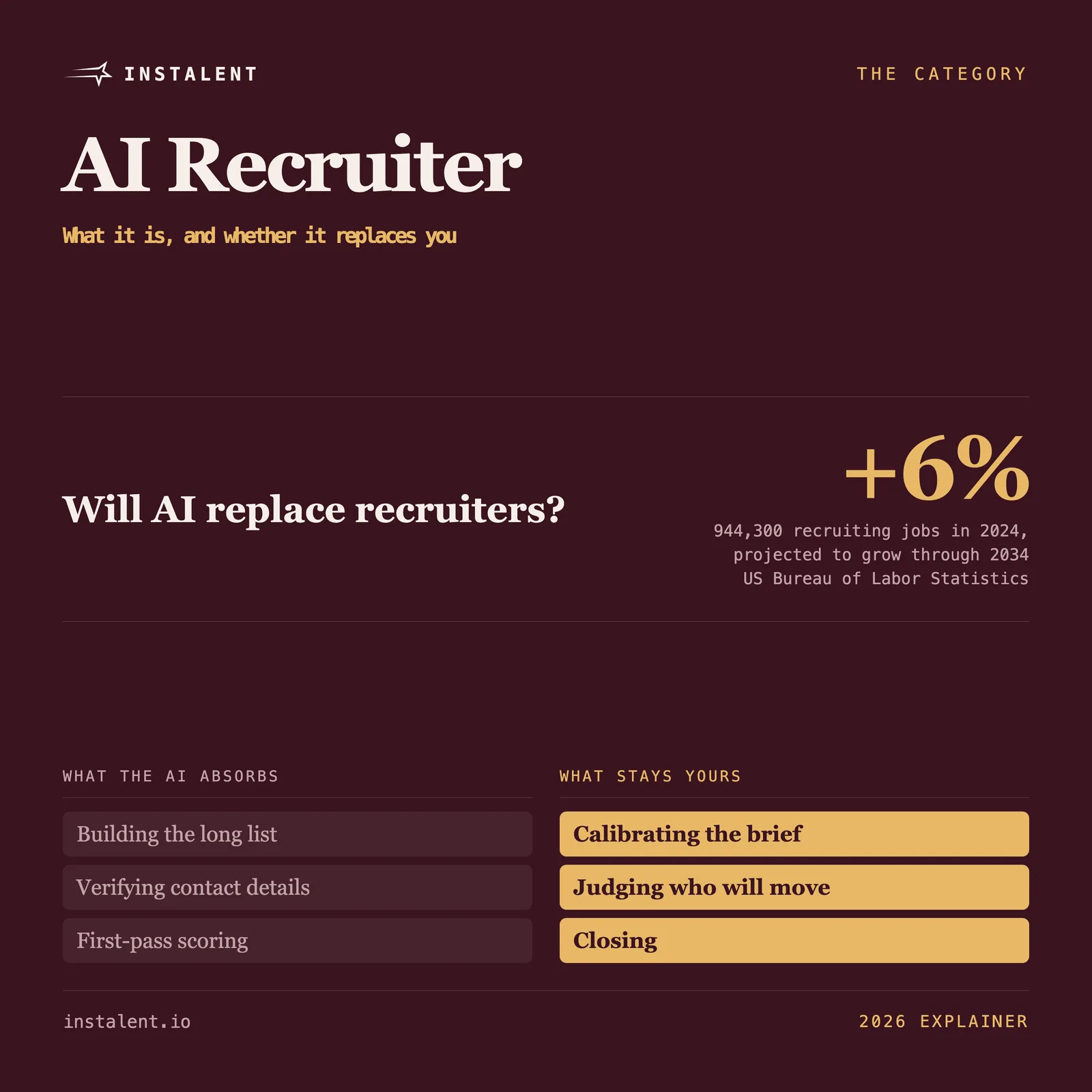
The most useful evidence is not a vendor survey. The US Bureau of Labor Statistics counts 944,300 human resources specialists in 2024 - and its own definition of that occupation is people who "recruit, screen, and interview job applicants and place newly hired workers in jobs." That is the exact job description AI screening is supposed to be taking over.
BLS projects it to grow 6% from 2024 to 2034, faster than the average for all occupations: 58,400 more jobs, with about 81,800 openings a year over the decade. Median pay was $72,910 in 2024.
That projection was published while AI interviewing scaled to 63% candidate exposure. Two readings are possible, and only one survives contact with the data: either the projection is wrong, or the tasks AI is absorbing are not the tasks that constitute the job.
The second reading matches what actually happens on a desk. What gets absorbed is list-building, contact verification, first-pass scoring, sequence drafting, follow-up chasing, data entry. What does not is calibrating a vague brief with a hiring manager, telling a client their salary band is two years behind the market, judging whether someone will actually move, and closing. Those are the parts that get paid for, and they are the parts nobody has automated.
The honest version is less comforting than "your job is safe" and less dramatic than "you will be replaced": the ratio changes. A recruiter who spent 60% of the week on the absorbable work and 40% on judgment now spends most of it on judgment, and is expected to carry more reqs. That is a real change in what the job feels like. It is not the same as the job disappearing.
What an AI recruiter delegates well
The useful test is not "can AI do this" but "can I check the output before it matters."
- Building a long list. Fully delegable. You can see the names.
- Verifying contact details. Fully delegable, and better done by software than by a person guessing at an email pattern. See contact enrichment.
- Scoring against a written rubric. Delegable if the tool shows its reasoning. A bare score you cannot interrogate is worse than no score. See candidate analysis.
- Drafting outreach. Delegable to draft, never to send unreviewed in your name.
- Running the follow-up. Delegable, with a hard stop the moment someone replies.
- Deciding who to put in front of a client. Not delegable. This is the job.
That list is what an AI recruiting agent should actually be doing, and it is deliberately upstream of every decision that carries your name.
Which AI do recruiters use
Three layers, and most desks over-invest in the first.
A general assistant - Claude, ChatGPT or Gemini - for anything text-shaped. Briefs, job copy, rewriting a sequence, summarising a call. Cheap or free, immediately useful, and genuinely as good as a paid tool at this specific thing.
A sourcing and outreach platform for the work that needs live market data. A general assistant cannot see the open market, cannot verify an email address, and cannot tell you whether a phone number is still live. That is an access gap, not a quality gap, and no prompt closes it. This layer is where most desks find the actual bottleneck - we set out how to judge it in AI recruiting tools, and how to connect it directly to your assistant in recruiting MCP server.
A screening tool, for high-volume hiring only, with the transparency caveat above.
Where it should never be in the loop
Three places an AI recruiter should stay out of, and they are worth writing into your own policy before a vendor writes one for you.
- Final decisions. A score is an input. A rejection is a decision. Keep them separate, and keep a human on the second one - both because it is right and because regulators are increasingly interested in automated hiring decisions.
- Anything sent in your name without review. Approval gates are not friction, they are the thing that makes delegation survivable. A message that goes out wrong costs more than the twenty seconds of checking it.
- The client conversation. Nobody is paying your fee for a summary they could have generated themselves.
How to trial one in a week
Do not run a demo brief. Take a role you are genuinely struggling to fill, with your real criteria, and give it to the tool.
- Day one. Write the brief the way you would explain it to a colleague. Run it. Judge the first twenty names the way you would judge a researcher's list.
- Day two. Ask for verified contact details on the ones you would actually approach, and count how many come back with something that works.
- Day three. Ask it to score the list against your criteria and read the reasoning, not the numbers. If the reasoning is generic, the score is decoration.
- Rest of the week. Send outreach you have personally reviewed, and watch the reply rate against your own baseline.
At the end you will know whether it produces a slate you would defend to a client. That is the only benchmark that matters, and it is the one no vendor page can answer for you.
Want the AI that fills your pipeline rather than the one that interviews for you? Get started and you can point it at a live req today.
For the agent side in depth, read AI recruiting agents. For how the wider category sorts, AI recruiting tools. Agency owners weighing this at firm level should read our recruitment agencies solution page.
Sources
- Human Resources Specialists, Occupational Outlook Handbook - US Bureau of Labor Statistics (944,300 jobs in 2024; projected 6% growth 2024-34; 58,400 employment change; about 81,800 annual openings; $72,910 median pay, 2024; the occupation definition quoted above).
- 63% of Job Seekers Have Faced an AI Interview. Most Haven't Had a Good One Yet - Greenhouse 2026 Candidate AI Interview Report, 1 May 2026; 2,950 candidates across the US, UK, Germany, Australia and Ireland, 1,200 of them US (63% AI-interviewed, up 13pp in six months; 38% walked away, 12% would; 70% not told upfront, 21% found out mid-interview; 18% clear policies; 21% believe employers use AI responsibly).
Find better candidates, faster
Source, verify and reach candidates on one engine. Get 25% off your first month.
Keep reading