Agentic AI in Recruiting: Why Most Agencies Are Still on the Sidelines in 2026
New SHRM and Indeed Hiring Lab data shows AI adoption in hiring is real but concentrated at the top. What the gap means for independent agencies.
Do this in Instalent - source, verify and reach candidates in one flow.
AI adoption in recruiting just crossed a real threshold - but the data says almost none of that gain is reaching the agencies and lean in-house teams doing the actual sourcing and outreach every day. Here's what the 2026 numbers actually show, and what it means for the recruiters who don't have an enterprise data science team on staff.
If you've been keeping up with our complete guide to AI candidate sourcing or how we think about multi-channel outreach, you've heard us say some version of this before: the tooling gap between large TA orgs and everyone else is widening, not closing. Two reports released this year put numbers behind that feeling, and a third - Instalent's own Insta Agent - is our attempt to close it.
The adoption number everyone's citing, and the one nobody is
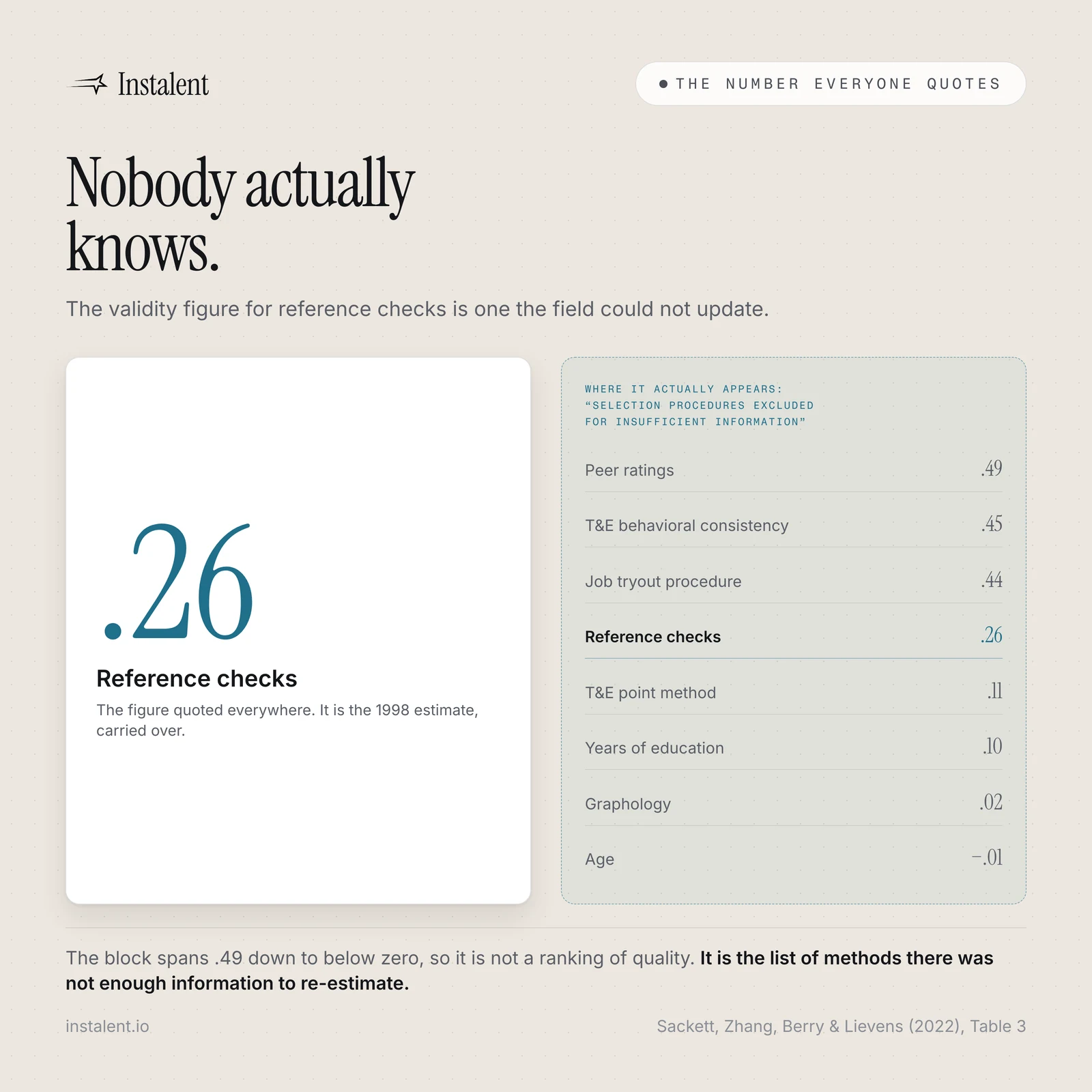
SHRM's State of AI in HR 2026 report puts recruiting at the top of the list: 27% of organizations now use AI tools somewhere in their recruiting practice, making it the single most common HR application of AI - ahead of onboarding, performance management, or benefits administration. That's the headline stat getting quoted everywhere.
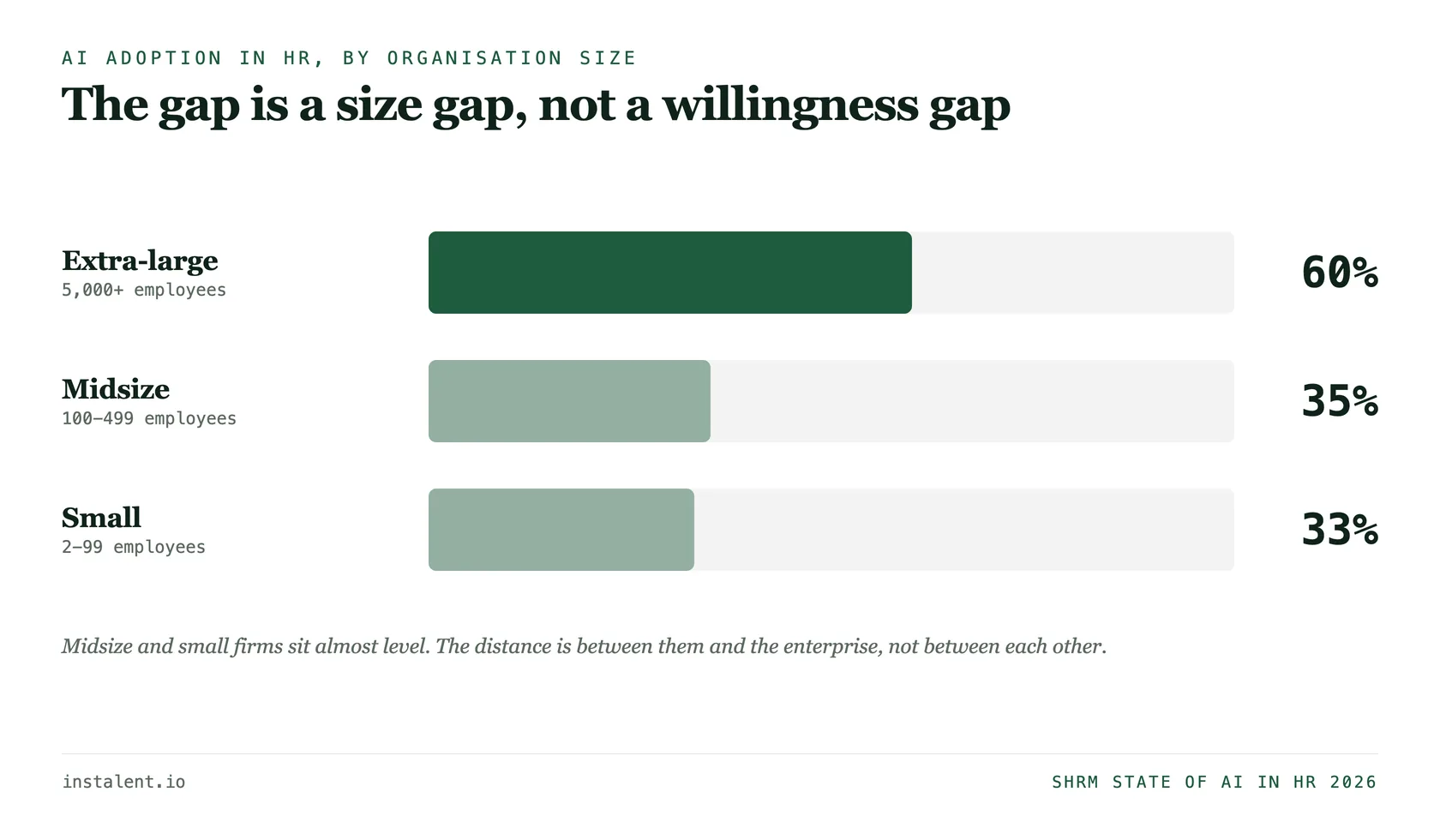
The number that matters more for agencies is the one broken out by company size. Among organizations that have deployed AI in HR at all, adoption looks like this:
| Organization size | Uses AI in HR (SHRM 2026) |
|---|---|
| Extra-large (5,000+ employees) | 60% |
| Midsize (100–499 employees) | 35% |
| Small (2–99 employees) | 33% |
Note
54% of organizations surveyed by SHRM have adopted no AI in HR and have no plans to start this year. The largest reported barrier isn't cost or trust - it's awareness: 67% cite simply not knowing what the tools can do, followed by 49% citing data accuracy and transparency concerns.
Indeed Hiring Lab's labor-market data tells a similar story from a different angle. By late 2025, only 5.7% of US firms had posted even one AI-related job - up from roughly 2% in 2018 - but that growth is brutally concentrated: firms in the top 1% by size accounted for nearly 90% of all AI-related job postings, and adoption among that top 1% sits at 49.9% versus 1.3% for the smallest third of firms. Hiring Lab's own framing is blunt: this pattern "raises concerns about the uneven diffusion of potential AI-related productivity gains across the economy."
Put the two datasets together and the picture is consistent: AI is genuinely changing how the largest employers hire, and it is barely touching the independent agencies and small in-house teams who make up most of the recruiting industry.
Why the gap isn't really about willingness
It would be easy to read "33% of small orgs use AI" and conclude small teams just don't want it. The SHRM barrier data says otherwise. Lack of awareness (67%) outranks every technical or budget concern combined, and the tools that do get adopted at scale - resume parsing, interview scheduling, candidate-job matching, screening assessments - are largely single-purpose point solutions bolted onto an existing ATS, not something built for the reality of an agency: prospecting new clients, sourcing candidates, and running outreach across several channels at once, often with a team of two or three people wearing every hat.
Tip
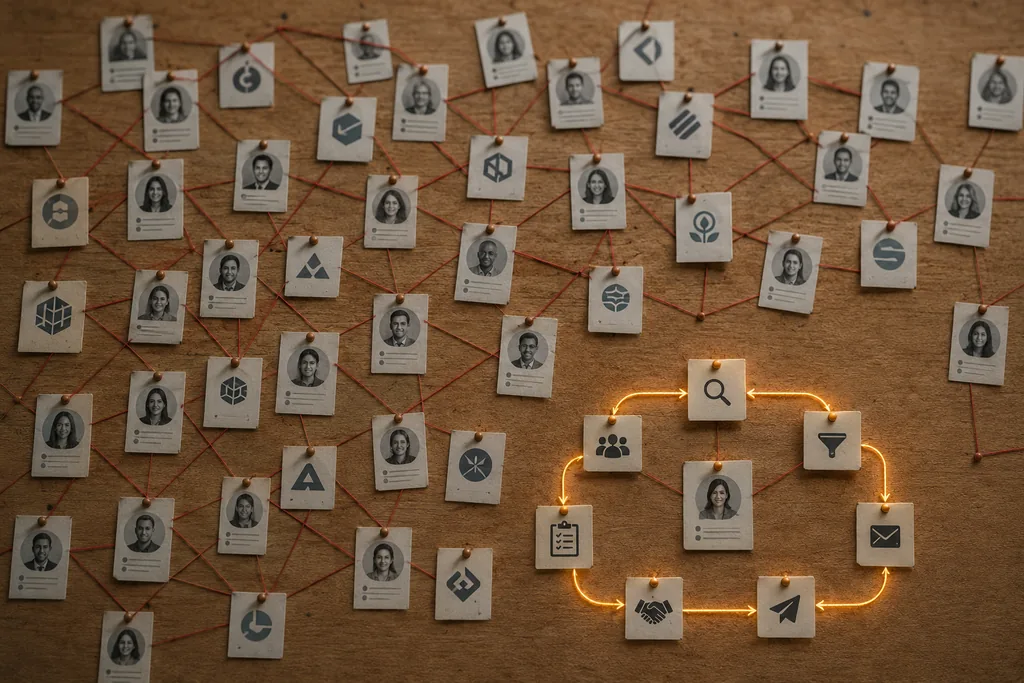
This is the specific gap agentic tooling is meant to close: not another parsing plugin, but one system that can actually run the sourcing-to-outreach loop end to end for a team that doesn't have a RevOps function to stitch five tools together.
LinkedIn's 2026 Talent Report frames the same divide as a "talent velocity" gap - the ability to see, build, and mobilize the right people fast. Only 14% of organizations qualify as talent velocity leaders in LinkedIn's data, and those leaders are 2.1x more likely to have invested in AI literacy skills across their teams. Velocity, in other words, tracks with how deliberately a team has adopted AI - not with headcount alone, but headcount is clearly correlated with the resources to figure it out.
Where an AI agent actually earns its place in the workflow
This is where "agentic AI" gets overused as a buzzword and undersold as an actual capability. For a recruiting agency, the useful version of an agent isn't a chatbot bolted onto a search bar - it's something that runs a defined loop with a human checking in at the right points:
- Define the target - the candidate profile or client ICP (industry, buying signals, decision-maker seniority) the agent should go find.
- Source continuously - the agent searches and re-searches across data sources rather than a one-time export, surfacing candidates or buying-signal companies as they appear.
- Enrich and verify - contact details, current role, and signal freshness get checked before anything goes out, so outreach doesn't degrade the sender's reputation.
- Orchestrate outreach - sequenced messages across email and WhatsApp, timed and personalized, without a human manually copy-pasting into three different tools.
- Route replies to one inbox - every channel's responses land in a single unified inbox so nothing gets missed because it arrived on the "wrong" platform.
- Learn from outcomes - response and placement data feeds back into how the agent prioritizes the next batch of candidates or prospects.
That loop - sourcing, prospecting, outreach, and inbox management run by one orchestrating agent - is exactly what we built Insta Agent to do, under the idea we keep coming back to: hire talent, win clients, let the agent do the work.
What the data doesn't say
None of this means agentic tooling is a substitute for recruiter judgment, and the reports above don't claim it is. SHRM's own barrier data shows persistent, legitimate concern about data accuracy and transparency in AI-driven screening - concerns that are especially valid in high-stakes or regulated hiring, where a human still needs to be the one making (and defending) the final call. The adoption numbers also don't separate agencies that adopted a tool and saw real placement or revenue lift from those that adopted one and saw nothing - usage isn't the same as impact, and none of the sources here measure ROI directly.
Relationship-driven, low-volume search - the kind built on a recruiter's personal network in a narrow executive niche - is also not really what any of this data is about. An agent is built to widen the top of the funnel and keep outreach consistent at a scale one or two people can't sustain manually; it's not a replacement for the trust a specialist has spent a decade building with a handful of repeat clients.
Closing the gap starts with the workflow, not the headcount
The 2026 numbers make one thing clear: the agencies waiting for AI tooling to "mature" before adopting it are watching the largest players pull further ahead, for reasons that have more to do with awareness and workflow fit than raw capability. The tools available to a three-person agency in 2026 can run the same sourcing-to-outreach loop a much larger TA org runs - the gap is in whether that agency has found a system built for how they actually work.
Ready to see what an agent-run sourcing and outreach loop looks like for your team? Talk to Instalent about putting Insta Agent to work on your next search.
If the question behind the hesitation is the blunt one - whether any of this replaces the recruiter - AI recruiter answers it with labour-market data rather than reassurance, and separates the screening bots from the sourcing agents they get confused with.
Sources
Find better candidates, faster
Source, verify and reach candidates on one engine. Start your 7-day free trial.
Keep reading