A Gem Alternative Focused on Sourcing, Enrichment and Fit Scoring
A Gem alternative for teams that want natural-language sourcing, verified enrichment and AI fit scoring - without committing to a full CRM suite to get started.
Do this in Instalent - source, verify and reach candidates in one flow.

A Gem alternative makes sense when you want sharp sourcing, enrichment and fit scoring without adopting - and paying for - an entire recruiting CRM suite to get there.
Gem is an AI-first, all-in-one recruiting platform: ATS, CRM, sourcing, scheduling and analytics over a large profile base. That breadth is the draw and the trade-off. It rewards teams that genuinely live inside a CRM - where the day-to-day job is nurturing a known talent pool over months, tracking touchpoints, and reading pipeline analytics to defend headcount decisions. If that's the shape of your work, Gem is a serious tool and you should evaluate it on its own merits.
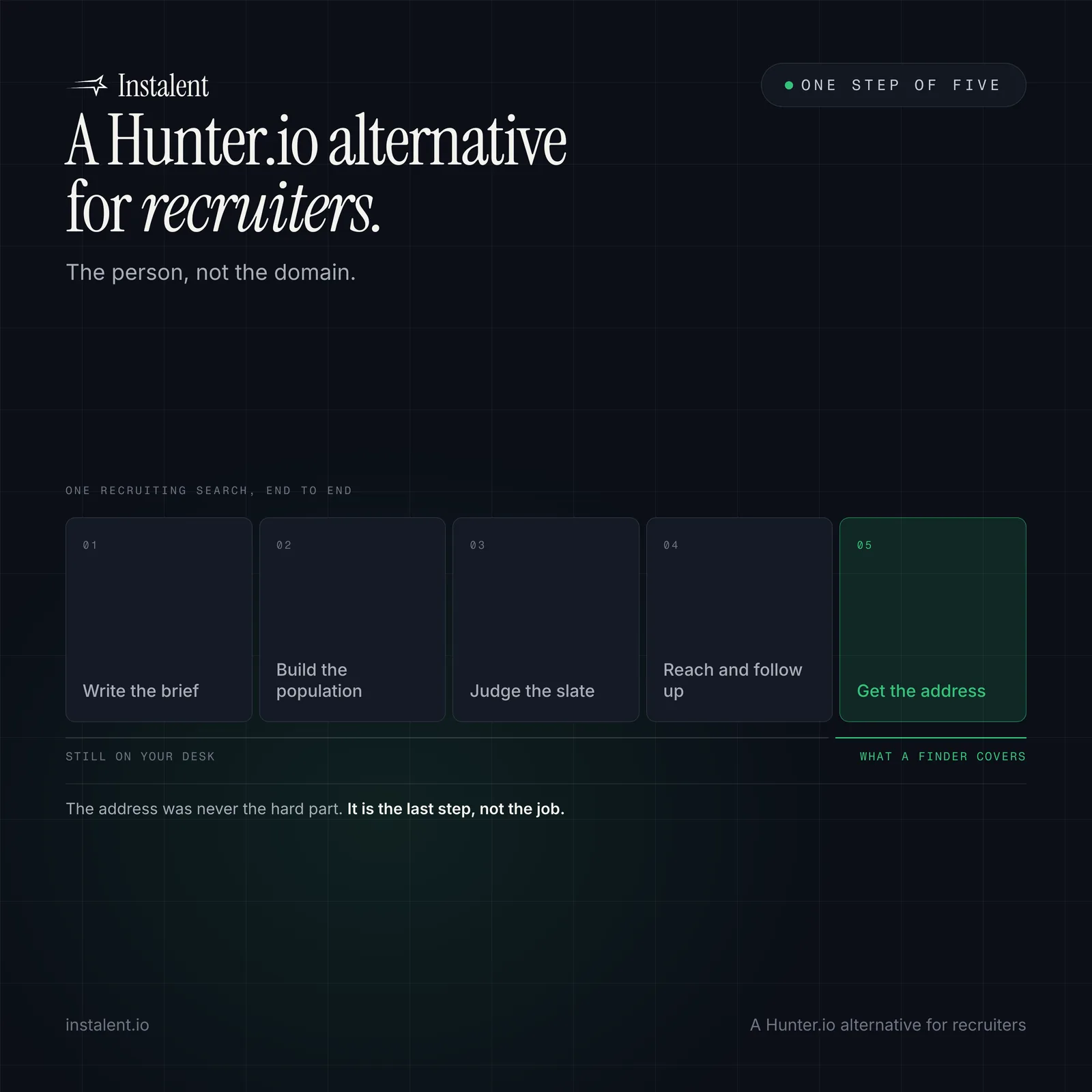
But not every team works that way. Plenty of recruiters open the week with a brief, not a pipeline. The first hour isn't "who in my CRM should I re-engage" - it's "who on the planet fits this role, and how do I reach them." If that's you, a full CRM suite is overhead you carry before you've sourced a single candidate. That's the gap Instalent is built for: natural-language search across multiple sources, dynamic waterfall enrichment of verified contacts, and AI scoring against your criteria - then sync to the ATS you already run.
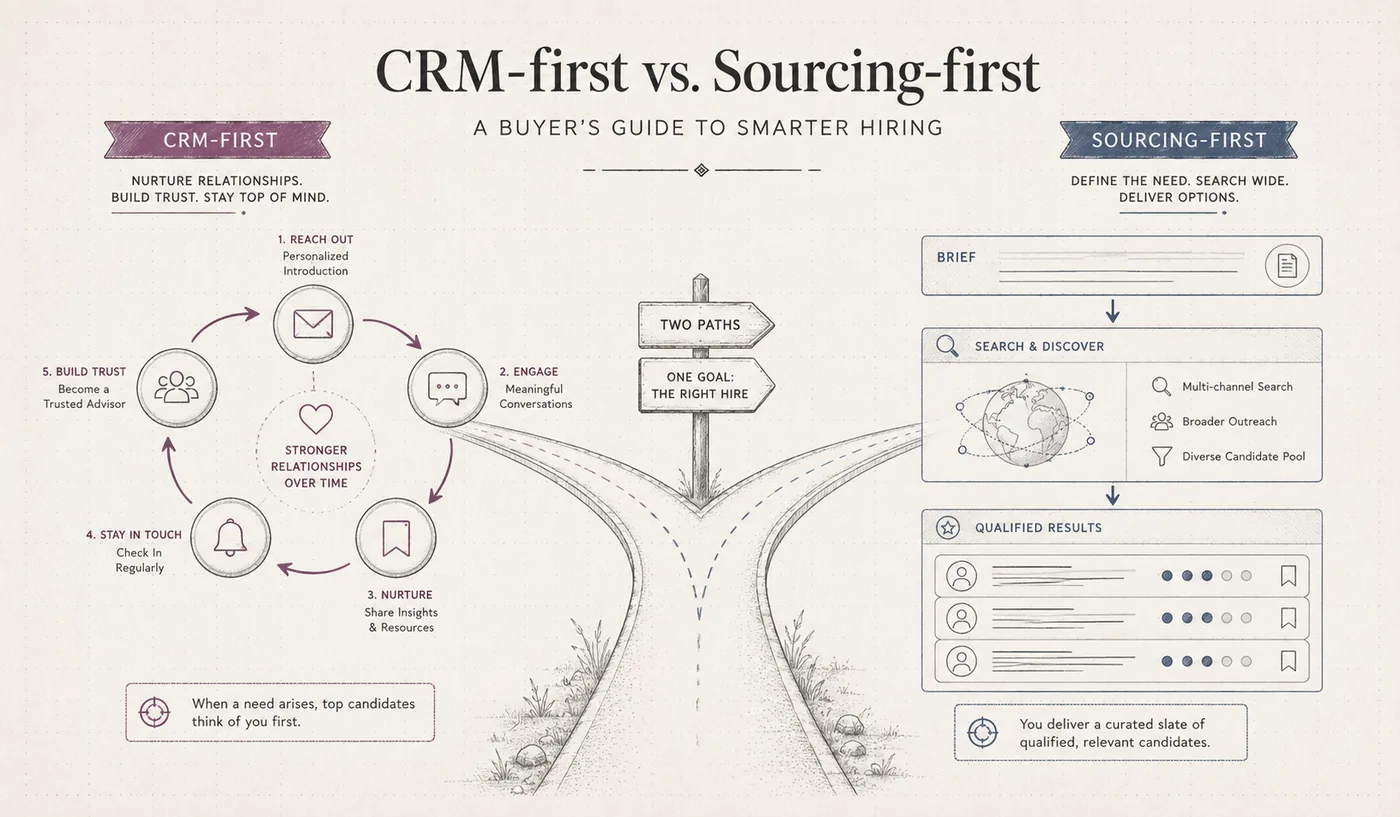
CRM-first vs sourcing-first: the real decision
This isn't a feature shoot-out so much as a question about where your funnel starts. Most tools quietly assume one of two starting points, and picking the wrong one means paying for capabilities you route around.
When CRM-first wins
A CRM-first platform like Gem is the right call when the relationship is the asset:
- You run a larger TA team with named owners, shared talent pools and handoffs that need an audit trail.
- You nurture talent over time - silver-medalist candidates, passive folks you'll re-approach next quarter, alumni you keep warm.
- Leadership wants pipeline analytics: source-of-hire, conversion by stage, time-in-stage, and the dashboards that justify req decisions.
- Engagement sequencing and scheduling living next to the candidate record actually saves you tab-switching.
If three of those four describe your week, lead with the CRM. The nurture layer is doing real work.
When sourcing-first wins
A sourcing-first tool wins when the bottleneck is finding and qualifying people, not remembering them:
- You're agency or embedded, spinning up new roles constantly, often in unfamiliar talent markets.
- Your CRM is thin because the candidates aren't in it yet - every brief is a fresh search.
- You need verified contact data fast, and you'd rather not maintain a standalone enrichment subscription.
- You already have an ATS you like and don't want a second system of record competing with it.
The honest test: count how often you start from a saved pipeline versus a blank brief. If most weeks begin blank, you're paying CRM prices for a sourcing problem.
Gem vs Instalent
| Gem | Instalent | |
|---|---|---|
| Scope | All-in-one: ATS + CRM + sourcing + analytics | Sourcing → enrichment → scoring → outreach prep |
| Search | Sourcing + filters over 800M+ profiles | Natural language across the open web - GitHub, company profiles, forums and more |
| Enrichment | Contact data | Dynamic waterfall enrichment: verified email / phone / LinkedIn |
| Scoring | Matching + analytics | AI scoring/classification against your criteria |
| Pricing | Custom / contact-sales | See pricing |
On Gem pricing
Gem positions pricing as custom / contact-sales. Third-party sources cite entry plans from roughly $99–$135 per user/month, and buyer data (Vendr) puts median total spend near $25,000/year - both buyer-reported, not Gem's published list. Gem also cites a 4.8/5 rating on G2.
How to evaluate Gem alternatives without a sales call
You can size up the fit before anyone schedules a demo. Run the same role through both lenses and watch where the time goes.
Run a real brief, not a tidy one
Pick a role you're actually struggling with - a niche skill, an odd location combo, a title that means five different things across companies. Easy reqs flatter every tool. Then judge:
- Search: Does plain English get you there, or do you have to translate the brief into a stack of boolean filters first? A sourcing-first tool should take "senior backend engineers who've scaled payments infra at a startup" and return people, not ask you to build the filter tree.
- Coverage: Are results coming from more than one place? Instalent searches across the open web - GitHub, company profiles, forums, professional signals and more - which surfaces people who never tidied up a single profile.
- Enrichment hit rate: Of the shortlist, how many come back with a verified email or phone - and how many vendors did it take? Dynamic waterfall enrichment tries multiple sources before giving up, which matters most on the hard-to-reach names you actually need.
Score against your criteria, then check the work
Matching engines are only useful if you trust the ranking. With AI scoring, the discipline is the same as with a junior coordinator: read the reasoning, not just the number.
- Feed in your criteria - must-haves, nice-to-haves, dealbreakers - and see whether the score reflects them or some generic notion of "good."
- Sanity-check a few. Say Riverstone Labs needs someone who's been employee-30 at a Series B; does a fictional "Dana Okafor" actually score high for the right reasons, or just because the title matched?
- Decide what you'd do with a borderline 70/100 candidate. The tool that explains why it's a 70 saves you the second-guessing.
A fair read on Gem
None of this is a knock on Gem. If your edge is the relationship - long nurture cycles, a warm pool you've built over years, analytics that steer hiring plans - that's exactly what a recruiting CRM is for. The alternative argument is narrow on purpose: it's for teams whose first move is sourcing, not nurturing.
Where Instalent is more focused
Gem's strength is consolidation. Instalent's focus is the part many pipelines stall on: turning a plain-English brief into streaming candidate results, then enriching contacts, scoring fit and preparing outreach. From there it leans on company intent signals - hiring, funding, leadership change - and decision-maker identification so you're not just finding candidates but reading the moment, then syncing the shortlist into your ATS and kicking off multichannel outreach across email and other channels.

The practical payoff is fewer tools between the brief and the conversation. You don't adopt a system of record to get a shortlist; you start from the search, keep the ATS you already trust, and let enrichment and scoring do the qualifying that usually eats the morning.
Early customers report 52% less manual workflow admin and 3× more profiles reviewed per brief. More on the about page and blog.
Try a free search - paste your role and watch Instalent source, enrich and score candidates in seconds. Start free →
Sources
Find better candidates, faster
Source, verify and reach candidates on one engine. Get 50% off your first month.
Keep reading