A Klenty Alternative for Recruiters: The List Is the Hard Part
A Klenty alternative for recruiting: why a sales engagement platform optimises the half of the job recruiters already find easy, and when Klenty is still the right buy.
Instalent solves the half that is actually hard: who to contact.
A sales engagement platform is built on an assumption so basic it is never written down: somebody has already given the rep a list. Everything the product does well happens after that. Klenty is a strong example, and the feature list you pay for makes the assumption visible. For a recruiting desk the assumption is the problem, because on a hard role the list is the entire job.
What Instalent does first
Instalent begins with the part a sales stack skips. A brief in plain language, run across many sources to build a population of people who have actually done the work, then candidate analysis grading the whole slate against your criteria with the breakdown visible.
Only then does outreach happen, to the people you chose, with a verified contact attached to the same record that holds the evidence.
What Klenty actually is, by its own price list
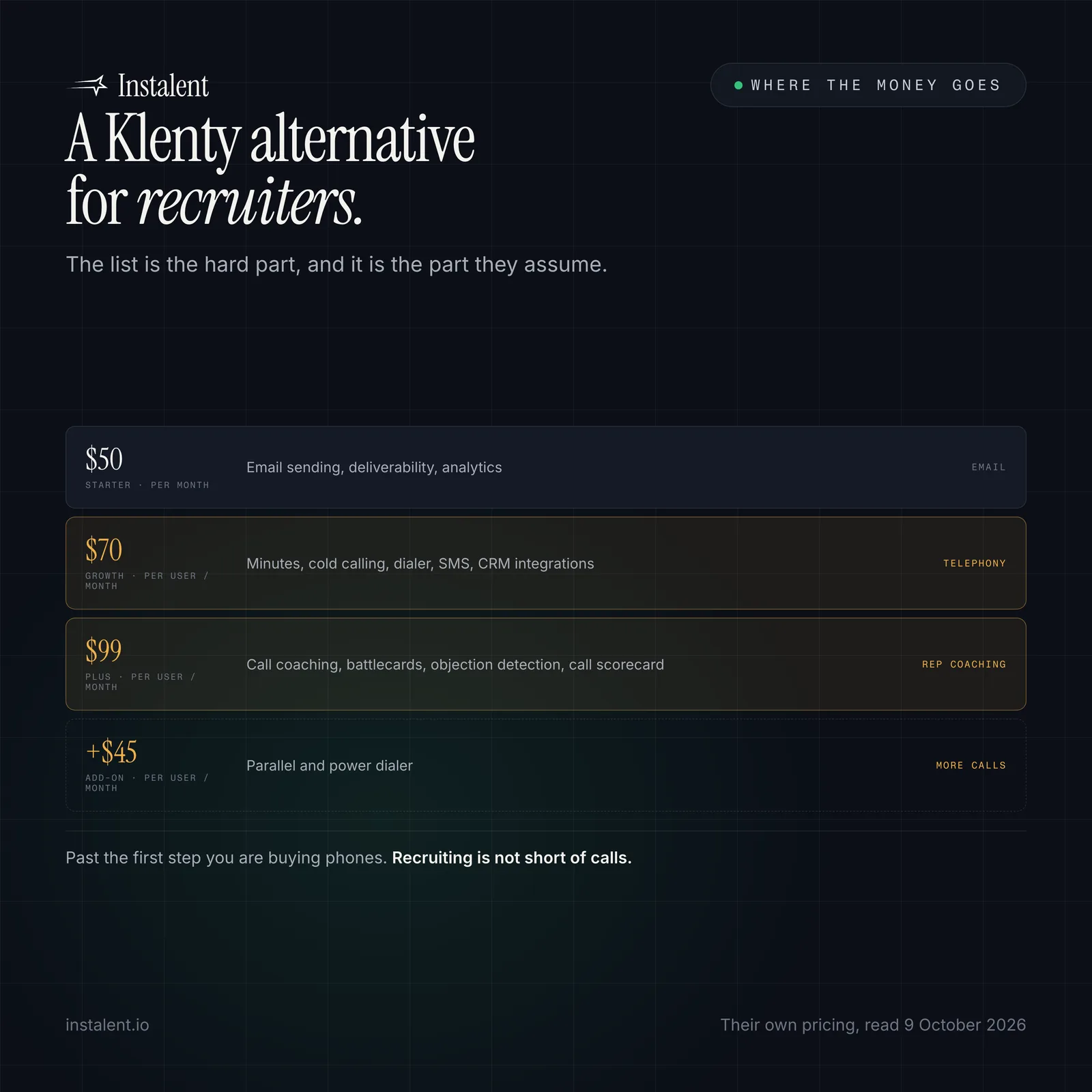
The fairest way to describe a product is to read what it charges for. From Klenty's own pricing page, the tiers escalate like this:
- Starter covers email: contacts, sending volume, deliverability, custom domain tracking, analytics, A/B testing and personalisation.
- Growth adds the telephone. Included minutes, cold calling, number auto-rotation, a one-click-to-call dialer, AI voicemail and IVR detection, AI outcome detection, SMS automation, social selling and CRM integrations.
- Plus adds rep coaching. More minutes, account-based selling, account prioritisation, call coaching, AI battlecards, live transcription, AI objection detection, an AI call scorecard and goals tracking.
- A parallel and power dialer is a paid add-on on top.
Look at where the money goes as you move up. Past the first tier, you are mostly buying telephony and rep performance: dial faster, detect a voicemail, handle an objection, score the call, coach the rep.
That is a coherent and valuable product. It is also a very specific bet about where the difficulty lives.
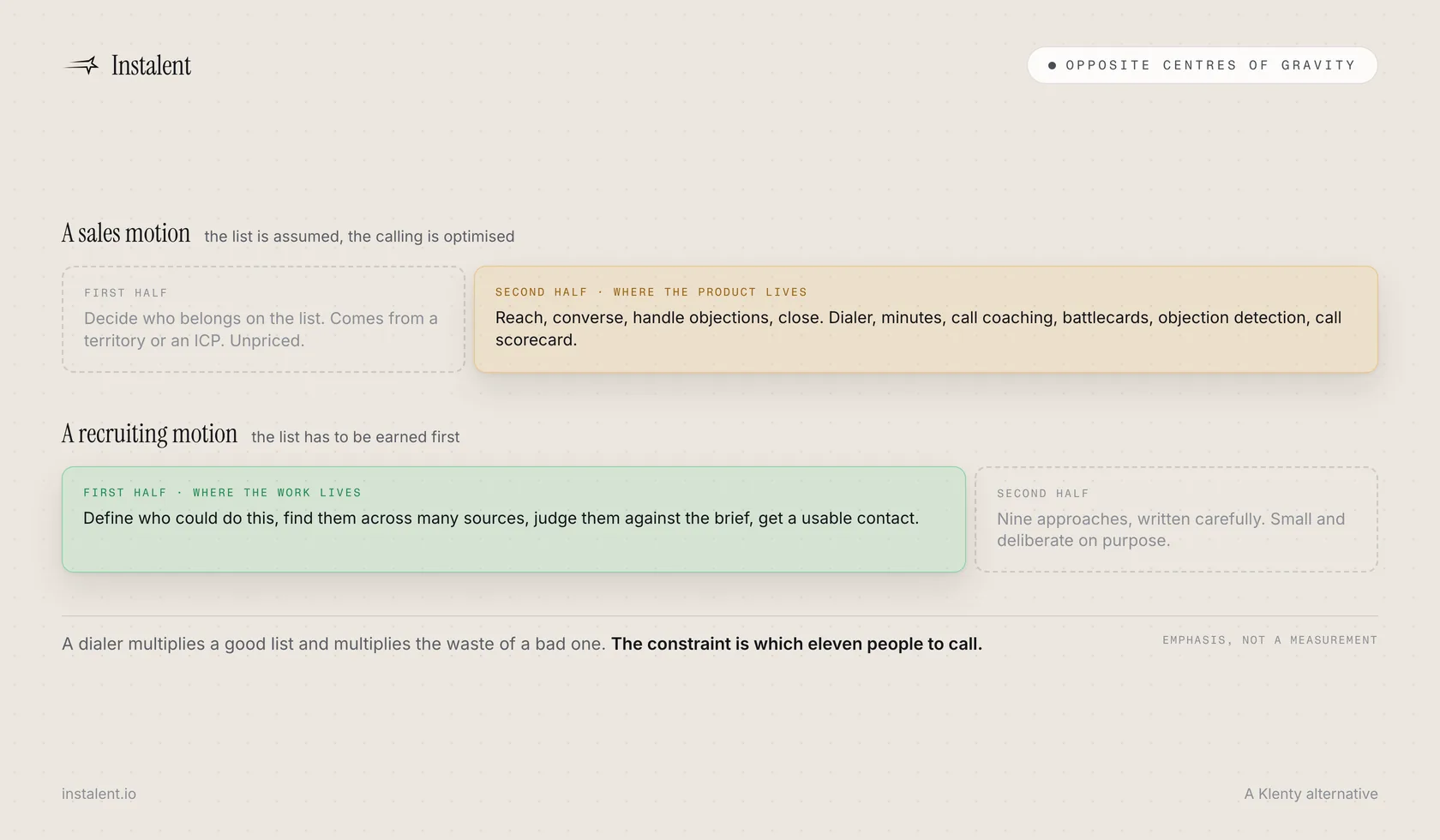
It optimises the back half of a sales motion
A sales motion runs roughly: build a target list, reach the contacts, hold conversations, handle objections, close.
Klenty is excellent at the second half of that. Battlecards, objection detection and call scorecards only make sense once a conversation is happening, and a parallel dialer only pays for itself if you already have hundreds of numbers worth dialling.
The first half, deciding who belongs on the list at all, is assumed. In B2B sales that assumption is usually fair, because the account list comes from a territory, an ICP or a data vendor and the rep did not have to invent it.
The assumption breaks on a scarce role
A dialer multiplies the value of a good list and multiplies the waste of a bad one. If eleven people in the market can actually do the job, the constraint is identifying those eleven, and no amount of call throughput moves that number. Faster dialling against the wrong list is just a more expensive way to be wrong.
Why that is the wrong half for a recruiting desk
Three things invert when the contact is a candidate rather than a buyer.
- The list is the scarce input. Sales reps are rarely short of accounts. Recruiters on a hard role are short of qualified people, and that is the bottleneck every time.
- Objection handling is the wrong frame. A candidate is not raising objections, they are deciding whether this is worth a conversation. Treating "not now" as something to overcome is how a good approach becomes a bad one.
- Throughput is capped by something other than you. The right answer on a senior search is often nine approaches, written carefully. A product whose top tier is built around dialling more is optimising a number you do not want to raise.
Scoring a shortlist covers the judgement half that decides the list, and sourcing for judgment covers the hardest version of that problem.
On dialers and social selling, which we deliberately do not do
Klenty bundles calling and social selling. We do neither, and both are decisions rather than gaps.
We do not ship a dialer because the recruiting bottleneck is not call volume, and building one would be optimising the half of the job our users already find easy. We do not automate activity on social networks because doing so puts the recruiter's own professional account at risk, and that account is usually the most valuable thing on their desk.
If a power dialer or automated social activity is a requirement for you, that is a real reason to choose something else, and it is better said here than discovered after buying.
Klenty pricing, from their own page
Read on 9 October 2026, so check before quoting it.
| Plan | Published price | What it is really for |
|---|---|---|
| Starter | $50 per month billed annually | Email sending, deliverability, analytics |
| Growth | $70 per user per month billed annually | Telephony, dialer, SMS, CRM integrations |
| Plus | $99 per user per month billed annually | Rep coaching, battlecards, call scoring, account-based selling |
| Parallel and power dialer | $45 per user per month | Add-on |
The per-seat escalation is the tell. You are paying per rep because the product's value scales with how many reps are making calls, which is exactly right for a sales floor and a strange fit for a desk measured in placements.
Where Klenty is the better choice
- You run an outbound sales team with quota-carrying reps and the account list already exists.
- Calling is a real channel for you and you want the dialer, the minutes and the call coaching in one place.
- You want AI call analysis, battlecards and scorecards to raise a team's conversation quality.
- Your CRM is the system of record and you want sales stage automation wired into it.
If the job is "we have the accounts, help the reps work them harder", Klenty is a good answer and we are not.
Where this leaves a recruiting desk
If the job is "find me the people who can do this, tell me which are worth the call, and help me reach them without burning the relationship", then the dialer was never the missing piece.
Instalent builds the population, scores it against your brief, attaches a verified contact for the people you chose, and runs multichannel outreach that stops the moment somebody answers. The agency view sits on solutions for recruitment agencies. If you are comparing the sending and deliverability layer specifically rather than a full sales stack, the Saleshandy comparison is the closer read.
Want help with the half that is actually hard? Get started
Common questions
What is Klenty used for?
It is a sales engagement platform. Its own pricing escalates from email sending into telephony, with a dialer, included minutes, SMS and CRM integrations, then into rep coaching with call scoring, battlecards, objection detection and account-based selling.
Why would a recruiter need a Klenty alternative?
Because it optimises the second half of a sales motion and assumes the list already exists. On a hard role the list is the scarce input, and no amount of call throughput changes how many people can actually do the job.
Does Instalent have a dialer?
No, and that is deliberate. The recruiting bottleneck is not call volume, so a dialer would optimise the half of the job most recruiters already find easy. If calling at volume is a requirement, that is a genuine reason to choose something else.
When is Klenty the better buy?
When you run an outbound sales team with quota-carrying reps, the account list already exists, calling is a real channel, and you want the dialer and call coaching in one place.
Sources
- Klenty pricing - read 9 October 2026 (Starter $50 per month billed annually with 15,000 monthly contacts and 75,000 monthly emails, deliverability, custom domain tracking, analytics, A/B testing and personalisation; Growth $70 per user per month billed annually adding 200 included minutes, cold calling, number auto-rotation, a one-click-to-call dialer, AI voicemail and IVR detection, AI outcome detection, SMS automation, social selling and CRM integrations; Plus $99 per user per month billed annually adding 1,000 included minutes, account-based selling, account prioritisation, call coaching, AI battlecards, live transcription, AI objection detection, an AI call scorecard and goals tracking; parallel and power dialer add-on at $45 per user per month).
Find better candidates, faster
Source, verify and reach candidates on one engine. Get 25% off your first month.
Keep reading