The Scarcest Skill Is Judgment, and You Cannot Keyword-Search It
The hardest skill to hire for is judgment, not a technical one. What it leaves behind on a profile, how to write it as a must-have, and how to score it honestly.
Instalent scores the evidence, not the adjectives.
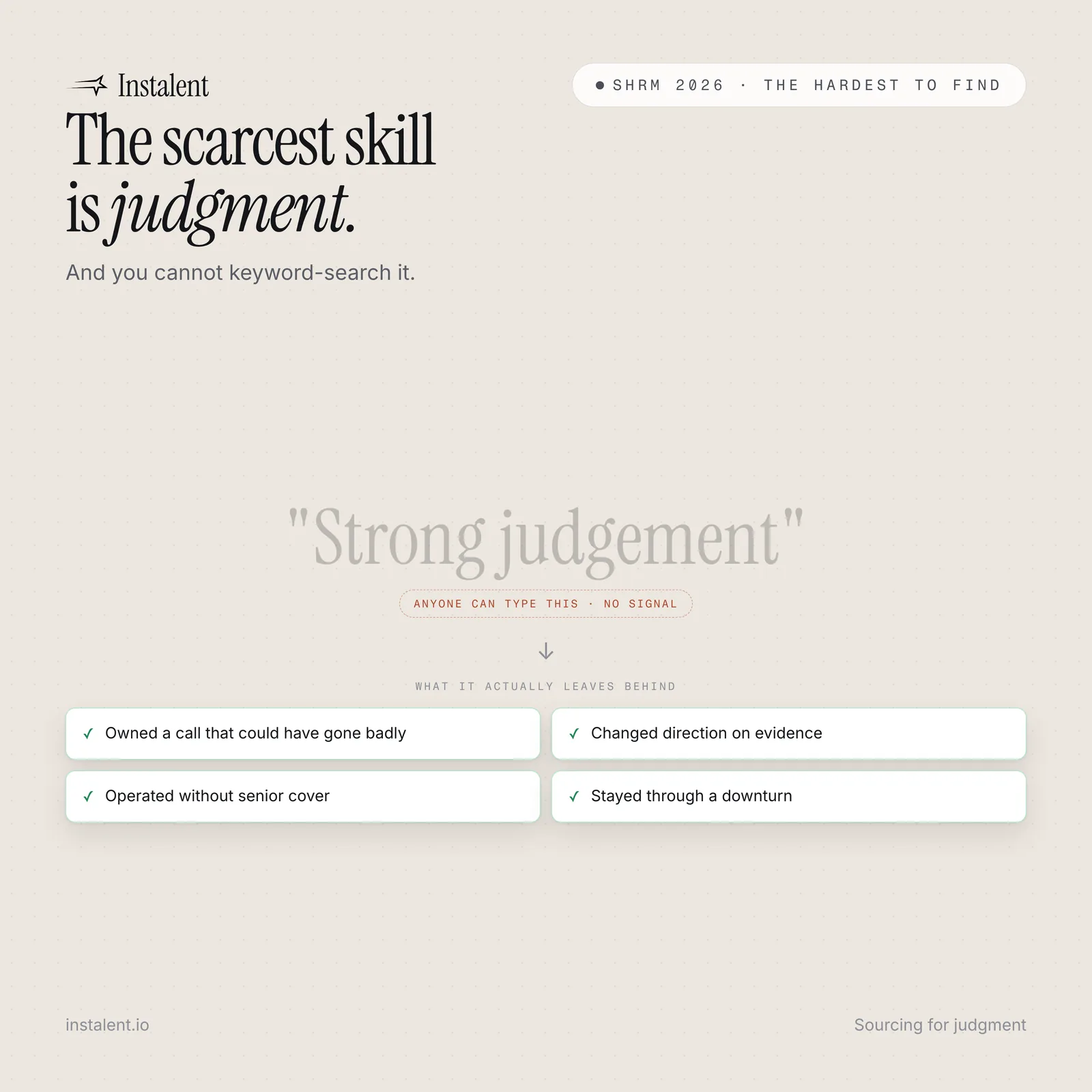
Ask a hiring manager what went wrong with the last person who did not work out and you will almost never hear that they could not do the technical work. You will hear that they escalated the wrong things, or did not escalate at all, or spent a quarter on the problem that did not matter. That is a judgment failure, and judgment turns out to be the hardest thing in the market to hire for, which is awkward because it is also the hardest thing to put in a search string.
The finding that reframes a hard search
SHRM's 2026 Talent Trends report, published 27 April 2026 from a survey of 2,094 HR professionals fielded 9 to 20 February 2026, found that 80% report the greatest difficulty finding candidates with systems and resource management skills, a category the report defines as including judgment, decision-making, complex problem-solving and time management.
That is the highest difficulty figure in the report, and it is not about a technology or a certification. The same survey found 68% reported difficulty recruiting for full-time roles, with 53% of those saying it had become harder than a year before.
Read those together and the scarcity has moved. The constraint on most senior searches is no longer finding someone who has used the tool. It is finding someone who has decided well under pressure, with incomplete information, when it mattered.
Why judgment does not survive a keyword search
Every other must-have has a proxy you can search. Judgment does not, for three reasons.
- Nobody writes it down about themselves truthfully. Profiles claim "strategic thinker" at roughly the rate at which the claim is meaningless. The word is free, so it carries no information.
- It has no vocabulary of its own. There is no tool, framework or certification that signals it, so there is no term to search for. Searching "decision-making" returns people who typed it.
- It is invisible in the good case. A person who made the right call in 2023 has nothing on their profile about the disaster that did not happen. The evidence of good judgment is usually an absence.
This is the trap that makes senior searches drag. The brief says "strong judgement", everyone nods, and the search quietly proceeds on the proxies that are searchable, which are titles and tools. You end up with a slate selected on the two attributes that matter least.
An unsearchable must-have is still doing work
If a requirement cannot be evidenced, the honest move is not to delete it. It is to stop pretending the sourcing stage can filter on it, and to design the stage that can. A must-have you cannot search is a must-have the interview owns, and the brief should say so explicitly rather than leaving it to drift.
What judgment actually leaves behind
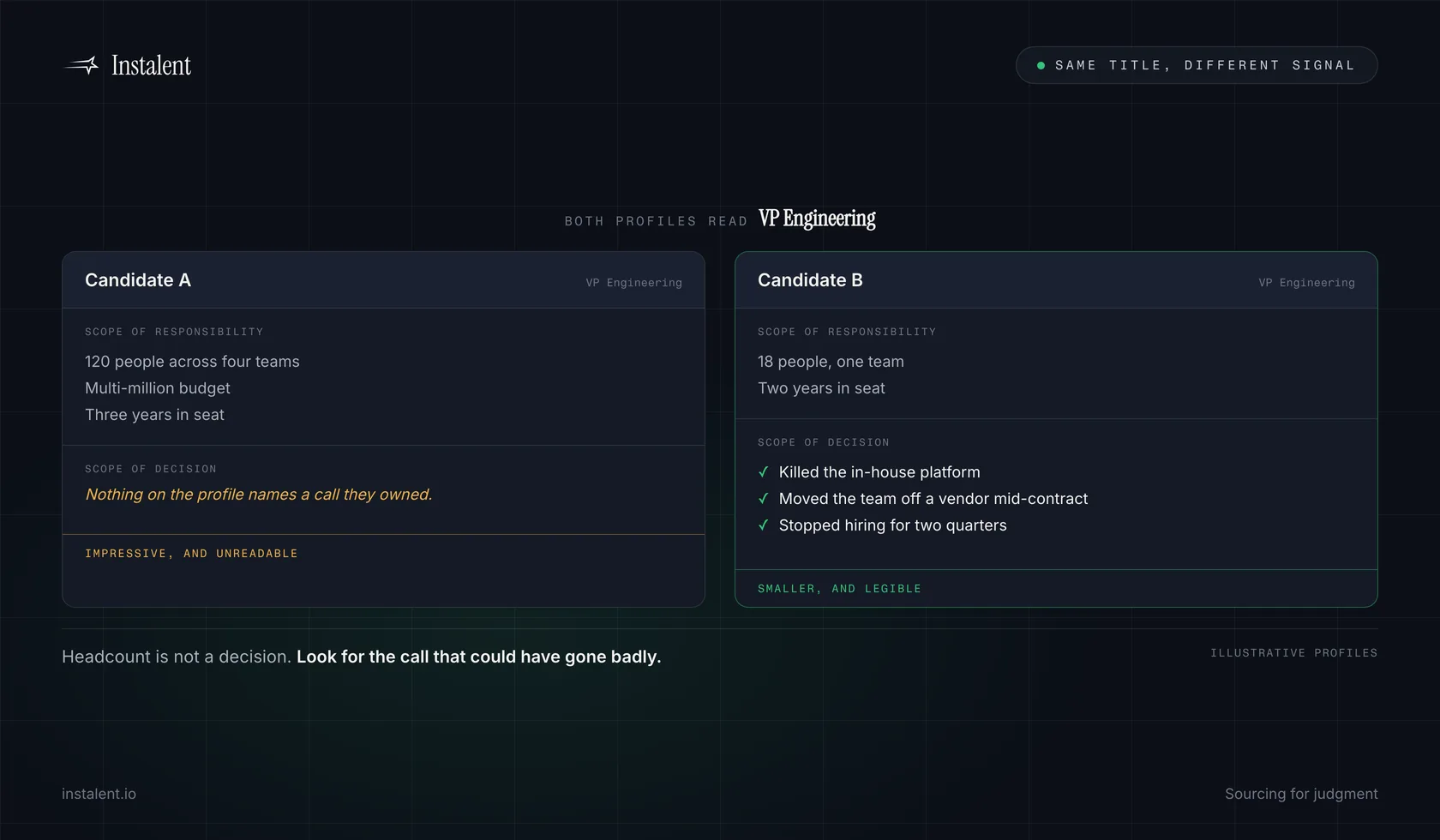
It is not entirely invisible. It leaves a shadow, and the shadow is scope of decision, not scope of responsibility. Those are different, and the difference is the whole craft.
Four traces worth looking for:
- Owned a call that could have gone badly. Led a migration, chose the vendor, killed a product line, reorganised a team. The point is not that it succeeded. It is that the person was the one who decided.
- Changed direction on evidence. Someone who ran the same play for six years has not demonstrated judgment, they have demonstrated consistency. A visible pivot, especially a public one, is a stronger signal.
- Operated without cover. First in a function, only senior person in a region, founder, early employee. Scarce supervision forces decisions.
- Stayed through a hard period. Tenure across a downturn, a restructure or a failed funding round usually means a sequence of unglamorous calls that nobody put on a profile.
None of these is conclusive on its own. Together they are a far better filter than any adjective, and crucially they are all things a profile can actually show.
Writing it as a must-have
The rewrite follows the same rule as any other criterion, which is that the requirement has to name something a profile could show. The difference is that for judgment you are naming the consequence rather than the trait.
Weak, and unsearchable:
Strong commercial judgement and the ability to make decisions under ambiguity.
Stronger, and actually gateable:
Has owned a decision with a material downside, for example choosing or killing a platform, a market or a team structure, and can describe what the alternative was.
The second version does two things the first cannot. It tells a sourcer what to look for, and it tells an interviewer what to probe. Writing a sourcing brief covers the general discipline, and scoring a shortlist covers turning requirements into gates that hold.
Scoring it without pretending it is binary
Judgment is the criterion most likely to be scored dishonestly, because it is tempting to mark it cleared or missed when the evidence is a matter of degree.
Treat it as a nice-to-have with weight rather than a gate, for a specific reason: a gate on something this inferential will eliminate people whose evidence simply is not public, and those are disproportionately the people worth calling. Put the hard gates on the facts you can verify, let the judgment traces order the survivors, and keep the reasoning visible so you can argue with it.
Candidate analysis grades the whole slate against your criteria and returns the breakdown per criterion, which matters more here than anywhere else: a score on an inferential requirement is only useful if you can see what it was inferred from. The population work that precedes it is in talent intelligence, and the agency view sits on solutions for recruitment agencies.
Where this sits next to skills-based hiring
Worth drawing the line, because they sound similar and are not.
Skills-based hiring is about the standard moving from credentials and titles to demonstrable skills, and about those skills spreading into functions whose titles never mentioned them. It is a story about the market repricing capability.
This is the harder residue of that shift. Once you have moved past titles to skills, you are left with the thing that is neither a title nor a skill and is scarcer than both. Skills-based hiring tells you to stop filtering on the job title. This tells you what to do about the requirement that has no filter at all.
Want the reasoning visible on every score? Get started
Common questions
Why is judgment so hard to hire for?
It has no searchable vocabulary, nobody describes it truthfully about themselves, and in the good case it is invisible, because a correct call leaves behind a disaster that did not happen. SHRM's 2026 survey found 80% report the greatest difficulty finding candidates with systems and resource management skills, the category that includes judgment and decision-making.
How do you source for judgment?
Look for scope of decision rather than scope of responsibility: someone who owned a call that could have gone badly, changed direction on evidence, operated without senior cover, or stayed through a downturn or restructure. Those traces are visible on a profile in a way the trait itself is not.
How should you write judgment into a brief?
Name the consequence rather than the trait. Instead of "strong commercial judgement", write "has owned a decision with a material downside, for example choosing or killing a platform, a market or a team structure". That tells a sourcer what to look for and an interviewer what to probe.
Should judgment be a must-have or a nice-to-have?
A weighted nice-to-have rather than a gate. A hard gate on something this inferential eliminates people whose evidence simply is not public, and those are often the ones worth calling. Keep the gates on facts you can verify and let the judgment traces order the survivors.
Sources
- SHRM Unveils 2026 Talent Trends Report - SHRM, 27 April 2026 (survey of 2,094 HR professionals fielded 9 to 20 February 2026; 80% report the greatest difficulty finding candidates with systems and resource management skills, including judgment, decision-making, complex problem-solving and time management; 68% reported difficulty recruiting for full-time roles, 53% of those saying it had become harder than a year before).
- 2026 Talent Trends - SHRM, 2026 (full report landing page).
Find better candidates, faster
Source, verify and reach candidates on one engine. Get 25% off for life.
Keep reading