Talent Intelligence: What It Actually Is, and What It Changes on a Desk
What talent intelligence is, how it differs from talent mapping and recruitment analytics, the four questions it has to answer, and what it changes on a desk.
Instalent turns the market into something you can query.
Talent intelligence is one of those phrases that arrived fully formed and slightly empty. Most definitions of it describe a category rather than a job. The useful version is narrower: talent intelligence is knowing what the market will actually give you, before you promise a client or a hiring manager something it will not. Everything else is reporting.
What talent intelligence actually is
It is the practice of answering questions about the outside market with data rather than instinct. Not how your funnel performed, which is analytics looking backwards, but what exists out there and what it will cost you to reach.
Four questions make up most of the real work:
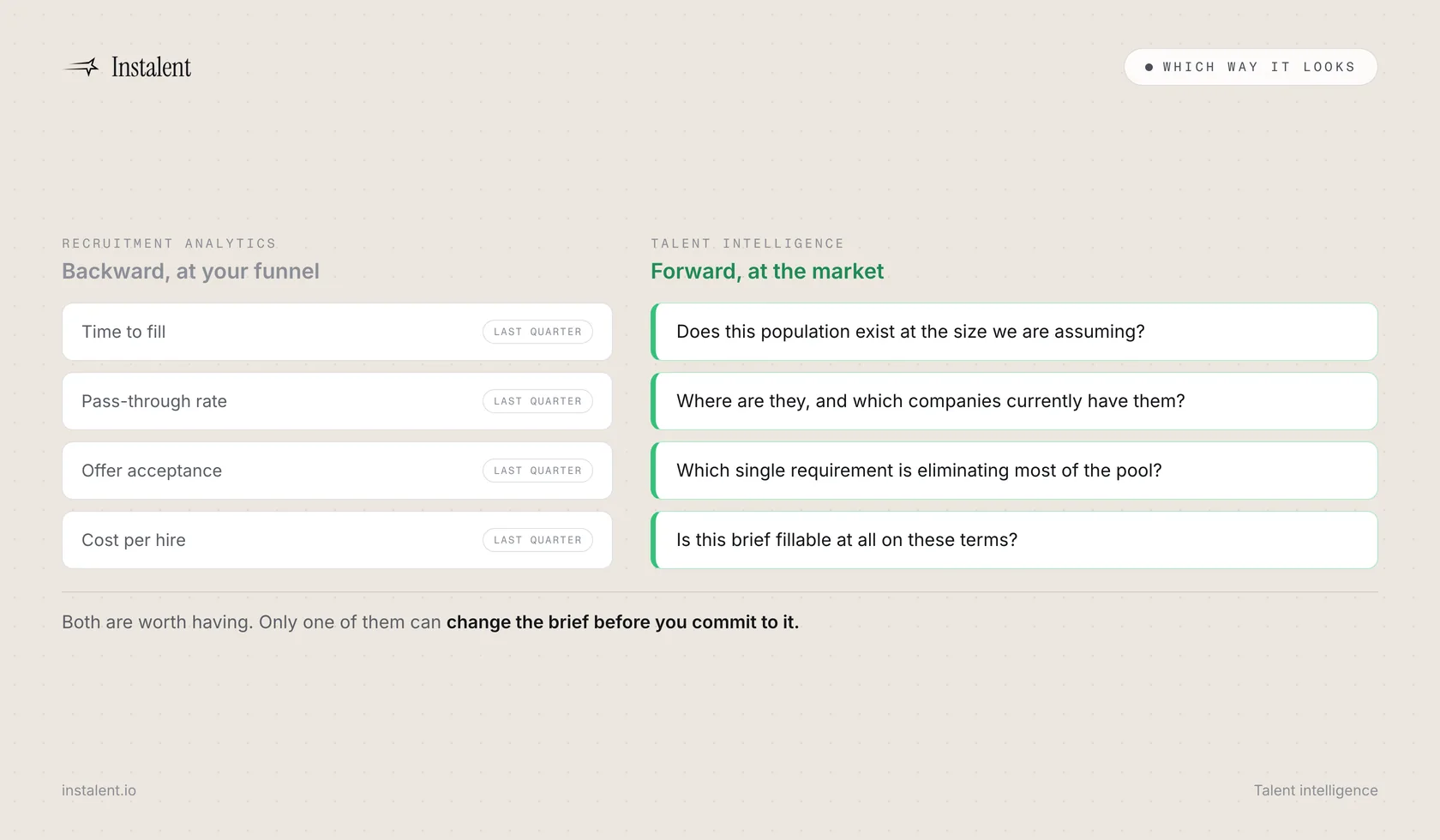
- Does this population exist at the size we are assuming? How many people have actually done this, within reach of this location and this budget.
- Where are they, and who has them? Which companies are the feeder set for this skill, and which are currently shedding or hiring.
- What does the brief cost in scarcity terms? Which single requirement is eliminating most of the pool, and what happens to the numbers if it moves.
- Is this brief fillable at all on these terms? The answer is sometimes no, and finding that out in week one is worth more than any other output.
A desk that can answer those four is running talent intelligence. A dashboard of last quarter's time-to-fill is not.
The gap it exists to close
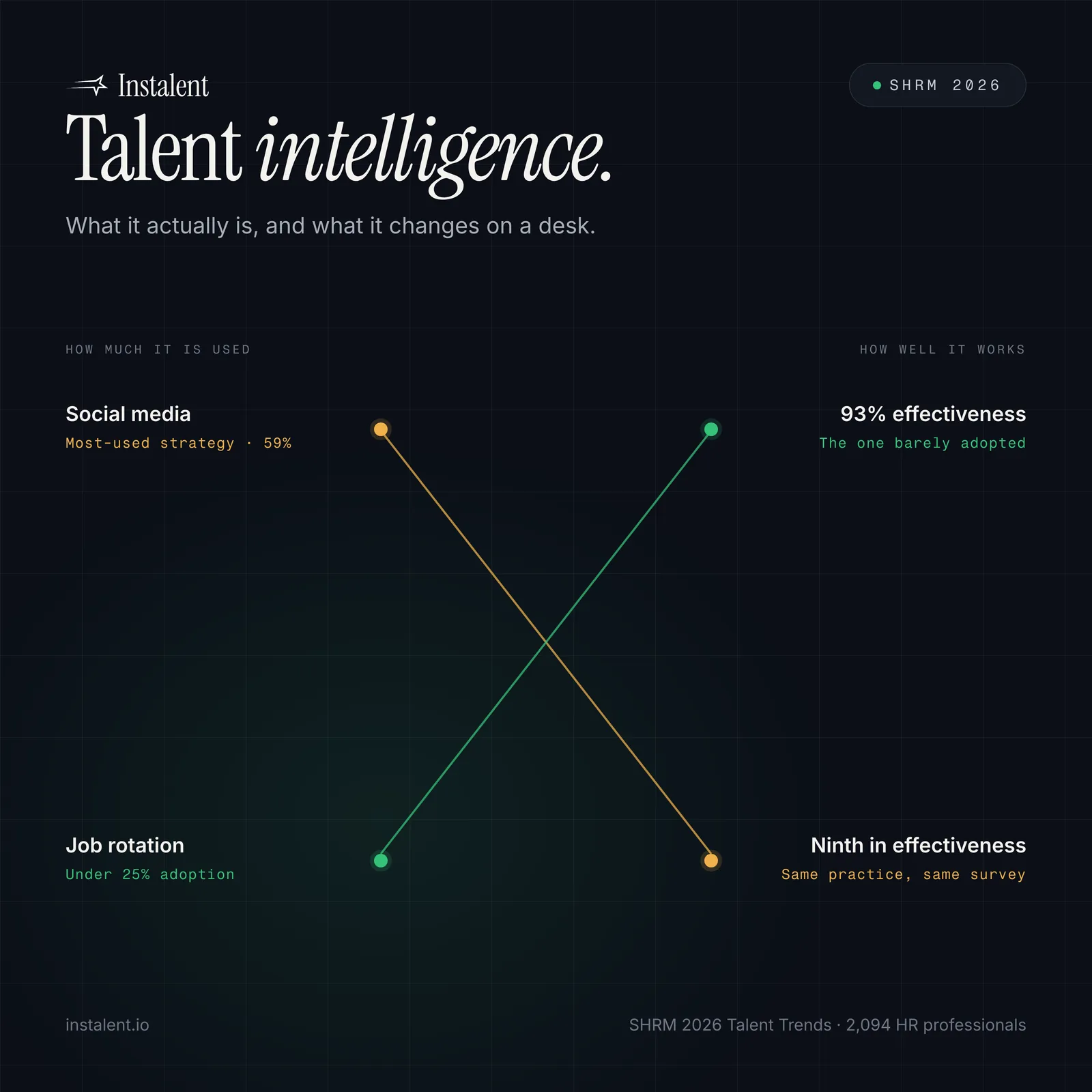
Here is a measured version of the problem. SHRM's 2026 Talent Trends report, published 27 April 2026 from a survey of 2,094 HR professionals fielded 9 to 20 February 2026, found that social media is the most-used recruiting strategy at 59%, and ranks ninth in effectiveness.
That single line is the argument for talent intelligence in full. The most popular channel in the profession is not among the most effective ones, and the only thing that reveals a gap like that is data about outcomes rather than habit.
The same report found the same shape elsewhere: job rotation programmes show 93% effectiveness but under 25% adoption. The effective practice is the under-used one, again.
The point is not that anyone is doing it wrong
Channels persist because they are fast, familiar and cheap to start. That is a rational reason to use one. Talent intelligence does not say stop; it says know the trade you are making, and stop paying for reach you are not getting.
Talent intelligence vs talent mapping vs recruitment analytics
These three get used interchangeably and they are not the same thing. The distinction is worth holding because it decides who owns the work.
- Recruitment analytics looks inward and backward. Your funnel, your pass-through rates, your time-to-fill. Recruitment analytics covers why the dashboard is rarely the real problem.
- Talent mapping looks outward at one population, in depth, at a point in time. Talent mapping covers building a map a desk actually uses.
- Talent intelligence is the standing capability that makes both answerable on demand, for any brief, without a two-week project first.
The practical test: if answering "how many of these people exist in this market" takes you a week, you have mapping. If it takes a minute, you have intelligence.
Where the data actually comes from
This is where the category gets oversold, so it is worth being plain about it.
Talent intelligence is assembled, not bought. It comes from live search across many sources rather than a single network, from what a brief returns when you actually run it, and from the pool you already own. There is no single feed that knows the labour market, and any tool that implies otherwise is describing a sample and calling it a census.
Three things make the assembled version trustworthy:
- Run the brief, do not estimate it. The population size for a real set of requirements is something you measure by searching for it, not something you look up.
- Count in evidence, not job titles. Titles are inconsistent across companies, so a count based on them is a count of naming conventions. Skills-based hiring covers why this matters upstream.
- Include the list you already have. Old exports and a neglected pool are part of your market and are usually the cheapest part of it.
What it changes on a desk
The output is not a report. It is a different conversation, held earlier.
When you can show a hiring manager that the must-have they added last week takes the qualified population from a few hundred to eleven, the requirement usually moves. When you can tell a client in week one that their brief is fillable but not at that salary in that city, you keep the relationship and lose the doomed search. SHRM's same 2026 report found 68% of HR professionals reported difficulty recruiting for full-time roles, and 53% of those said it had become harder than a year before - which is the environment in which promising a slate you cannot build gets expensive.
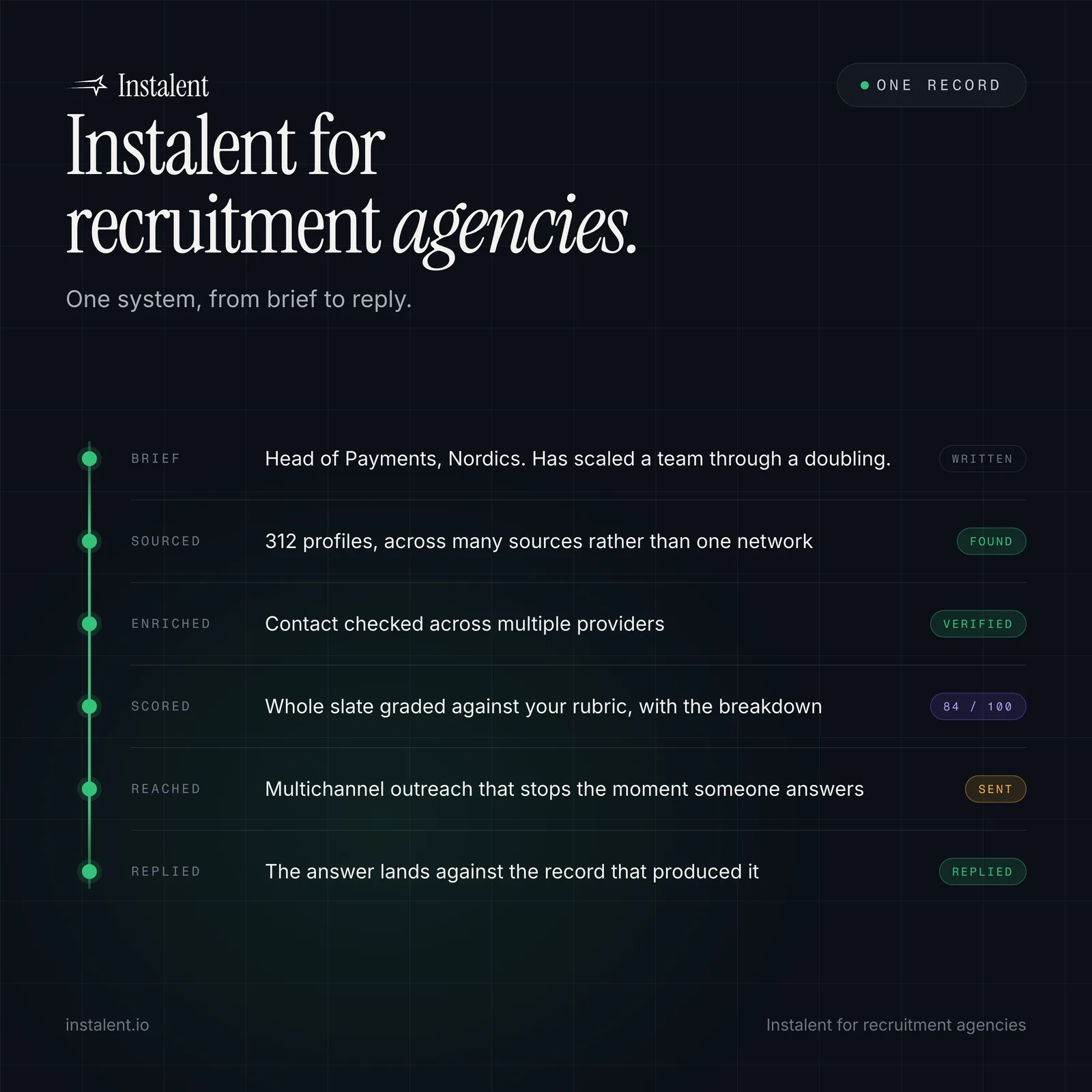
In Instalent this sits in the ordinary flow of work rather than in a separate module. AI candidate sourcing runs the brief in plain language across many sources and returns the population, candidate analysis grades it against your criteria so the count is qualified rather than raw, and client prospecting applies the same machinery to the company side. The count, the pool and the reasoning stay on one record, which is the part covered in Instalent for recruitment agencies. The wider picture for agency desks sits on solutions for recruitment agencies.
Want the market as something you can query? Get started
Common questions
What is talent intelligence?
It is the practice of answering questions about the outside labour market with data rather than instinct: whether a population exists at the size you assume, where those people are, which requirement is costing you the most pool, and whether the brief is fillable on its current terms.
How is talent intelligence different from recruitment analytics?
Recruitment analytics looks inward and backward at your own funnel. Talent intelligence looks outward at the market and forward at what it will give you. Only the second one can change a brief before you commit to it.
Do you need a dedicated talent intelligence platform?
Not necessarily. The capability matters more than the category label, and the practical test is whether answering "how many of these people exist in this market" takes a week or a minute.
Where does the underlying data come from?
It is assembled rather than bought: live search across many sources rather than a single network, what a real brief returns when you run it, and the pool you already own. No single feed knows the labour market.
Sources
- SHRM Unveils 2026 Talent Trends Report - SHRM, 27 April 2026 (survey of 2,094 HR professionals fielded 9 to 20 February 2026; social media most-used recruiting strategy at 59% but ninth in effectiveness, job rotation 93% effectiveness with under 25% adoption, 68% reporting difficulty recruiting full-time roles and 53% of those saying it had become harder than a year before).
- 2026 Talent Trends - SHRM, 2026 (full report landing page).
Find better candidates, faster
Source, verify and reach candidates on one engine. Get 50% off your first month.
Keep reading