Instalent for Recruitment Agencies: One System From Brief to Reply
Recruitment agency software that keeps one record from brief to reply: sourcing, verified enrichment, scoring, outreach and client prospecting in one place.
Instalent runs the whole desk on one record.
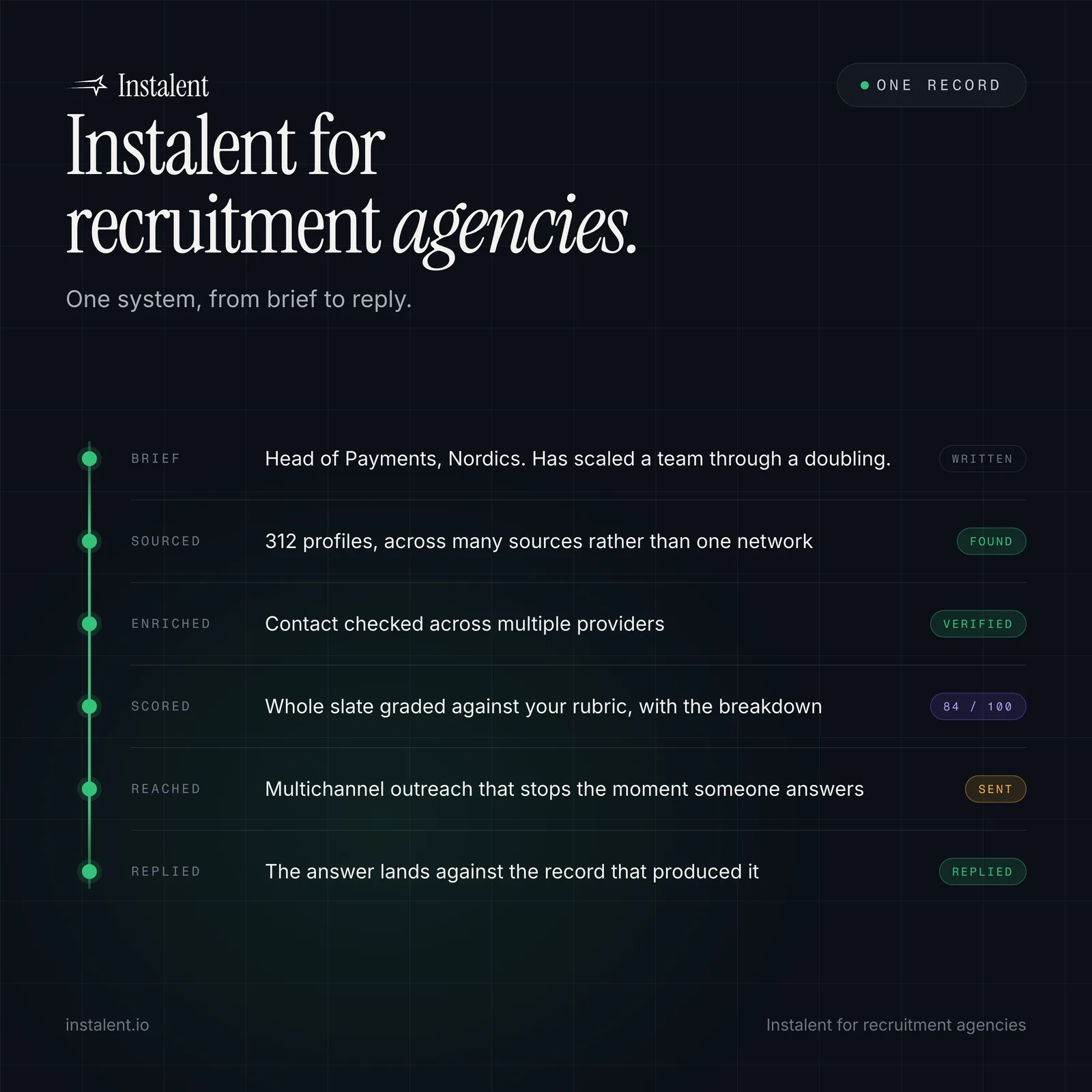
Most agency desks are not short of software. They are short of continuity. A name gets found in one place, verified in a second, scored in a spreadsheet, written to in a third, and the reply lands somewhere nobody is watching. Every handoff is a retype, and every retype is where the record thins out. Instalent exists to hold that record in one piece from the brief to the reply.
The loop a recruiting desk actually runs
Strip away the tooling and a desk runs the same loop on every req:
- Take the brief and turn it into a search that reflects what the client will actually say yes to.
- Build a slate, and judge it against the brief rather than against the keyword.
- Get a contact you can use, for the people worth contacting.
- Reach out, follow up, and stop the moment someone answers.
- Handle the reply while it is still warm.
- Keep the client side fed so there is another req behind this one.
Nothing in that list is new. What has changed is how many separate systems a desk now crosses to finish one pass of it.
Functional, but fragmented
This is the part worth being precise about, because it is measured. In ATLAS's State of Agency Recruitment benchmark, published 16 March 2026 from a survey of more than 1,000 agency recruiters, 56.16% described their tech stack as "functional but fragmented" and only 28.77% called it well integrated.
The same report found 80.82% now use AI for admin and data entry - the single most common application of it in the industry.
Read those two findings together and a pattern shows up. The tools work. They just do not share a record, so the most widespread use of AI on an agency desk is retyping between them faster. That is a real gain, and it is also the lowest-value slot the technology could occupy.
The cost is not the subscriptions
A fragmented stack does not mainly cost money. It costs the context that should travel with a candidate. The reason a strong name goes cold is rarely that nobody found them. It is that by the fourth system, nobody remembers why they were interesting.
What the fastest-growing firms do differently
Bullhorn's 2026 GRID Industry Trends report, published 25 February 2026 from nearly 2,300 recruitment professionals surveyed in November and December 2025, puts a number on the other side of this. Among firms that grew revenue more than 25%, 78% were using AI tools embedded in their applicant tracking system rather than bolted alongside it. Top-performing firms were four times more likely to be using AI at all, and 56% of the highest-growth firms reported average placement times under ten days.
The word doing the work there is embedded. The firms pulling ahead are not the ones with the most tools. They are the ones whose tools sit where the record already lives, rather than in a tab beside it. Instalent is not an ATS, and it writes to yours for exactly that reason.
Bullhorn also found only about 10% of firms have agentic AI running across a full workflow. The gap between using AI for data entry and running it across the loop is still wide open.
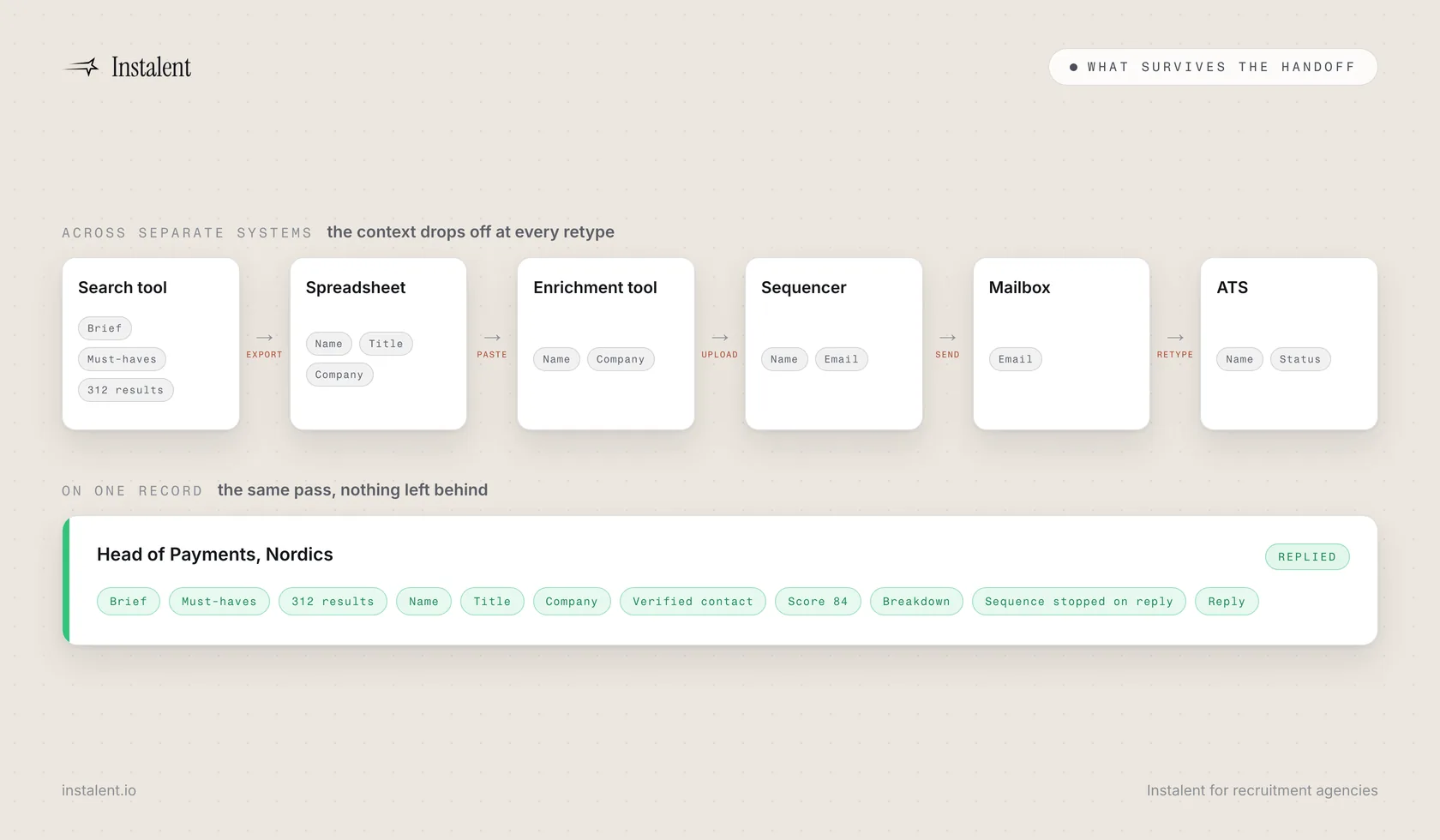
One record: brief, slate, verified contact, score
In Instalent the brief is written in plain language, the way you would describe the role to a colleague. The search runs across many sources rather than a single network, and results stream in as they are found instead of arriving as a finished export.
From there, the record keeps growing rather than starting again:
- Verified enrichment from multiple sources. Contact details are gathered for the people you choose, checked across providers, and attached to the same profile you were already looking at.
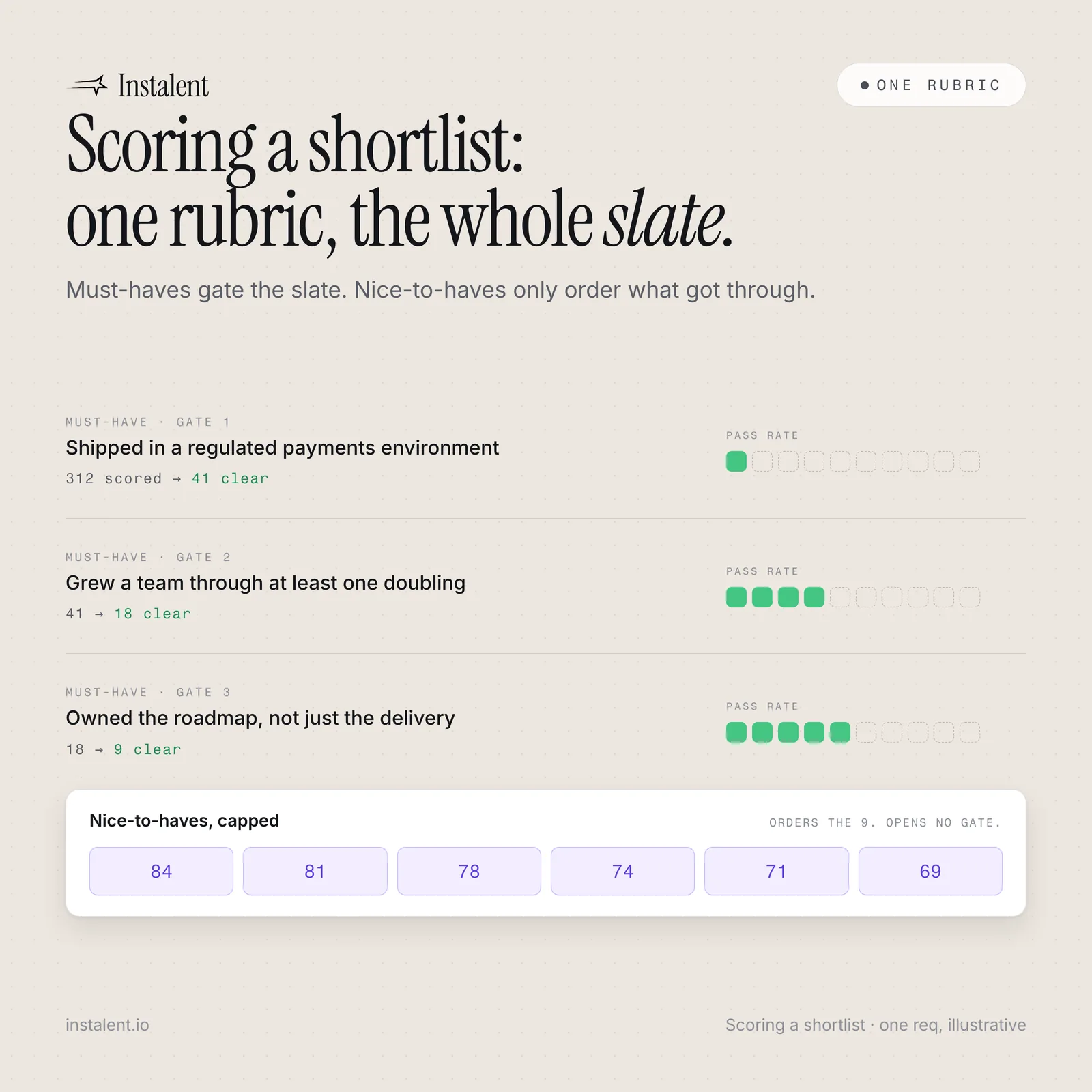
- Scoring against the brief. Candidate analysis grades the whole slate against your own criteria in one pass and shows the breakdown, so a score is something you can argue with rather than a number you have to trust.
- Any list you already own. Old exports and conference lists can be dropped in, structured, and searched alongside everything else, which is usually the cheapest pipeline an agency has.
The point is not that each of those steps exists. It is that none of them requires you to rebuild the context first.
The client side runs on the same machinery
An agency desk has two funnels, and the second one is usually served worse. Finding companies that are hiring, working out who owns the req, and getting to that person is the same problem as candidate sourcing with the subject changed.
Client prospecting runs on the same engine: hiring signals to tell you which companies are worth the call, the person who actually owns the requirement rather than a generic inbox, and the same verified contact step. If you want the method rather than the product, how recruitment agencies win clients covers it, and client market mapping covers turning one job title into a full list.
The reply is where most stacks stop
Outreach is well served by the market. Replies are not. A sequence that keeps sending after someone has answered is the fastest way to undo good sourcing, and a reply that lands in a mailbox nobody opens is the same as no reply at all.
Multichannel outreach sends across channels and stops the sequence the moment a prospect answers. The answer arrives in one place, against the record that produced it, with the score and the history still attached. That is the part covered in the reply problem.
Sending infrastructure is included rather than assumed: domains, mailboxes and warm-up can be bought and set up inside the product, which is the piece most outbound setups discover late. The detail is in cold email infrastructure for recruiters.
What this looks like on a live desk
Instalent connects to the ATS you already run - RecruiterFlow, Greenhouse, Lever or TeamTailor - so the shortlist lands where your team works rather than in another silo. The full picture for agency desks sits on solutions for recruitment agencies. There is a Chrome extension for the pages you are already on, and the same tools can be driven from Claude, ChatGPT or Gemini if that is where you work (setup guide).
What changes is not that any single step gets faster. It is that the brief, the slate, the reason a person scored well, the verified contact and the reply are all one object. Nobody has to reconstruct the thinking at step four.
Want the whole loop on one record? Get started
Common questions
Is Instalent an ATS?
No. It is the sourcing, enrichment, scoring and outreach layer in front of your ATS, and it pushes to RecruiterFlow, Greenhouse, Lever and TeamTailor. If you are weighing the two categories against each other, recruiting CRM vs ATS covers where the line sits.
Where does the candidate data come from?
Searches run across many sources rather than one network, and contact details are verified across multiple providers before they reach you.
Can we keep using our existing sequencer?
You can, and some desks do at first. The trade is that the reply then lands outside the record that produced it, which is the specific handoff this system is built to remove.
Does it work for a solo desk as well as a team?
Yes. The loop is the same at both sizes, and a solo desk feels a fragmented stack harder because there is nobody else to absorb the retyping.
Sources
- The State of Agency Recruitment: 2026 Benchmark Report - ATLAS, 16 March 2026 (survey of 1,000+ agency recruiters; 56.16% "functional but fragmented" tech stack, 28.77% well integrated, 80.82% using AI for admin and data entry).
- Bullhorn GRID report: Staffing firms using AI see stronger growth, faster placements - Bullhorn, 25 February 2026 (nearly 2,300 recruitment professionals, surveyed November to December 2025; 78% of >25% growth firms using AI embedded in the system of record, top performers 4x more likely to use AI, 56% of highest-growth firms placing in under ten days, ~10% running agentic AI across a full workflow).
- 2026 Recruitment Industry Trends Report - Bullhorn GRID, 2026 (full report landing page).
Find better candidates, faster
Source, verify and reach candidates on one engine. Get 50% off your first month.
Keep reading