Skills-Based Hiring in 2026: What It Changes for Sourcers
What skills based hiring means in practice. It is now standard at the screen, but sourcing is the stage it has not reached - and the plays that close the gap.
Do this in Instalent - source, verify and reach candidates in one flow.

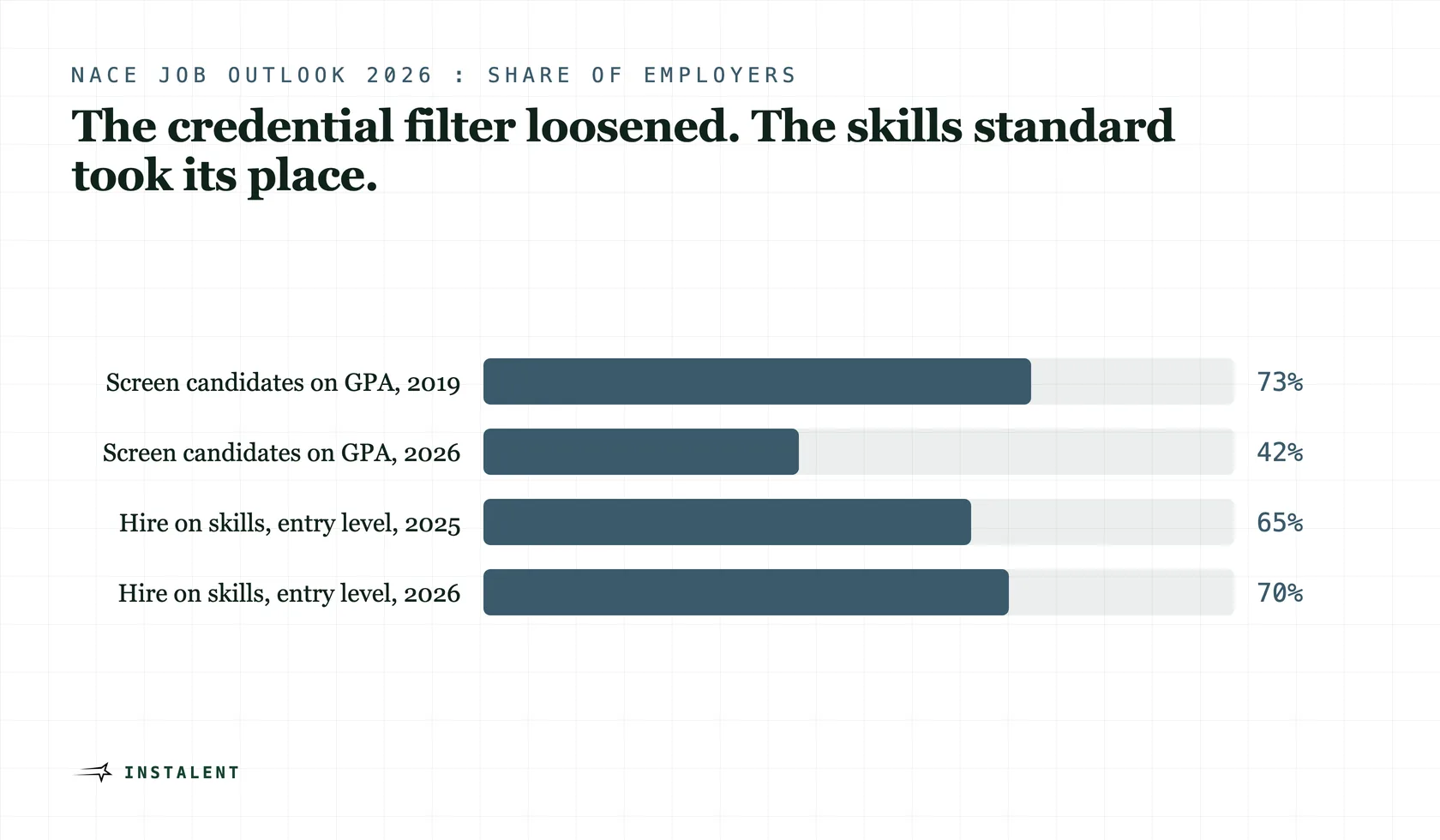
NACE put a number on something most desks already feel. Seventy percent of employers now use skills-based hiring for entry-level roles, up from 65% a year earlier, and GPA has quietly stopped being the gate it was: 73% of employers screened on it in 2019, 42% do today. The bar your slate is judged against has moved. On most desks, the search that produces the slate has not moved with it.
That gap is the opportunity. Hiring managers are increasingly ready to argue about evidence rather than pedigree, and evidence is something a sourcer controls. The desks that benefit are the ones moving the skills standard upstream, into the search and the shortlist, instead of leaving it at the screen.
The standard moved, and it landed at the screen
NACE's Job Outlook 2026, fielded across employer members in August and September 2025 and published in January 2026, is the cleanest read available on how far this has actually gone. Seventy percent report using skills-based hiring for entry-level hires, up from 65% the year before. Seven in ten say they use it at least half the time, and they use it most often at screening and interviewing. More than 80% now name the skills they want inside the job description itself.
The GPA number is the one to sit with. A filter that nearly three-quarters of employers applied in 2019 is now applied by fewer than half. Nothing replaced it as a single hard gate, which is exactly the point: the gate became a judgement, and judgements need evidence.
The skill left the job title
The second change is the one sourcers feel directly, and it is easy to miss because it happens inside the market rather than inside a policy.
Lightcast analysed over 1.3 billion job postings for its July 2025 report on AI skills and found that in 2024, 51% of postings requiring AI skills sat outside IT and computer science occupations. Those postings carry a 28% salary premium, close to $18,000 a year. The skill is real, it is priced, and half the demand for it comes from functions that do not have "engineer" anywhere in the title.
The World Economic Forum's Future of Jobs Report 2025 explains the drift. Employers expect 39% of workers' core skills to change by 2030, and the fastest-growing skill of all is AI and big data, which rose 17 percentage points as a declared core skill in two years.
Put those together and the practical conclusion is not complicated. A job title tells you less about capability than it did five years ago, and it decays faster. If your search still keys on titles, half the people who can do the work are sitting in the part of the market nobody is searching.
Skills-based hiring is won upstream, in the pool
The Burning Glass Institute and Harvard Business School tracked what happened after employers removed degree requirements, using Lightcast postings data across a decade of hiring. Their February 2024 finding is worth quoting: "For all its fanfare, the increased opportunity promised by Skills-Based Hiring was borne out in not even 1 in 700 hires last year."
The interesting part is the split. The report sorts employers into leaders, in-name-only and backsliders, and what separated the leaders was not stronger conviction. It was operational detail, applied all the way through the process. A requirement removed from a posting changes nothing on its own, because the posting is not what selects people. The search is.
That is a sourcing conclusion dressed as a policy finding. Whoever builds the pool sets the ceiling on how skills-based the hiring can be downstream.
Five things that change on the desk
- Brief the skill before you brief the title. Three to five must-haves, each written as something you could point at on a profile. The mechanics of that document are in our guide to writing a sourcing brief; what changes now is that the hiring manager will meet you halfway, because they are already screening this way.
- Search for the work, not the label. Describe the environment, the scope and the artefact rather than the job title. This is the practical reason keyword strings keep under-returning: a boolean can only match the words on a profile, and the words on a profile are the old proxies. Plain-language search over the open web, public code and professional signals is how you reach the other half of the pool.
- Widen deliberately into the titles that carry the skill. For every req, name the adjacent functions where the same work happens under a different label, then source them on purpose rather than by accident. That is where the Lightcast 51% lives, and it is the cheapest passive-candidate expansion available.
- Treat a listed skill as a claim and go find the proof. Scope, duration and outcome are evidence. A tag is not. Shipped work, systems owned, deal sizes carried, code in public, teams built: these are the things that survive a hiring manager's push-back.
- Hand over the evidence, not the CV. When the screen judges skills and the handover contains a resume, the recruiter's work is invisible and the pass-through takes the blame. Send the must-have, the proof and the gap for every person on the slate.
A listed skill is a claim, not evidence
Skills-based hiring raises the stakes on what you record. Write down which evidence satisfied which must-have, keep it attached to the profile, and keep the scoring the same for everyone on the slate. Ranking should support a human's decision, not replace it, and you want to be able to explain any rejection in terms of the work.
What actually changes, stage by stage
| Stage | What most searches still key on | What the screen now asks for |
|---|---|---|
| Search | Title, company, degree | Evidence the work was done |
| Shortlist | Who reads as senior | Who scores against one rubric |
| Handover | The CV | The proof behind each must-have |
| Feedback | "Not a fit" | Which skill failed, and on what evidence |
The right-hand column is harder, and that is the moat. Anyone can run a title search. A slate where every profile arrives with its evidence attached is a different product, and it is the one that survives a calibration call.
Run it on one req
Pick a live role, ideally one that has been slow. Rewrite the must-haves as demonstrable skills. Run the search on the work rather than the title, and let it reach into two adjacent functions you would not normally touch. Score every profile against the same rubric, then compare the screen pass-through of that slate against your last three for the same role family.
One req, one week. If pass-through holds or improves while the pool gets wider, you have your answer, and you have the evidence to take the same approach to the rest of the desk.
Want your search to run on the skill instead of the job title? Instalent takes a plain-language brief and builds the pool from the work rather than the label, adds verified enrichment from multiple sources, then scores every profile against the same rubric with evidence so the bar is identical from profile one to profile three hundred. Get started, or see how it fits your team.
Related reading: interview questions to ask candidates covers assessing for skills once someone is in front of you, and talent acquisition vs recruitment covers where this work sits in the function.
Sources
- NACE - Skills-Based Hiring Grows, but College Students Don't Fully Understand It (January 23, 2026; Job Outlook 2026 survey fielded August 7 to September 22, 2025, 183 respondents: 70% use skills-based hiring for entry-level hires vs 65% the prior year; GPA screening 73% in 2019 vs 42% now; more than 80% list sought skills in job descriptions)
- Lightcast - Beyond the Buzz: Developing the AI Skills Employers Actually Need (July 23, 2025; over 1.3 billion job postings: in 2024, 51% of postings requiring AI skills were outside IT and computer science occupations; AI-skill postings pay a 28% premium, close to $18,000 a year)
- World Economic Forum - Future of Jobs Report 2025, Skills Outlook (January 7, 2025; employers expect 39% of workers' core skills to change by 2030, down from 44% in 2023; AI and big data is the fastest-growing skill, up 17 percentage points as a core skill since the 2023 edition)
- Burning Glass Institute and Harvard Business School - Skills-Based Hiring: The Long Road from Pronouncements to Practice (February 2024; Sigelman, Fuller and Martin, using Lightcast job postings data: increased opportunity "borne out in not even 1 in 700 hires last year"; employers sorted into leaders, in-name-only and backsliders)
Find better candidates, faster
Source, verify and reach candidates on one engine. Get 50% off your first month.
Keep reading