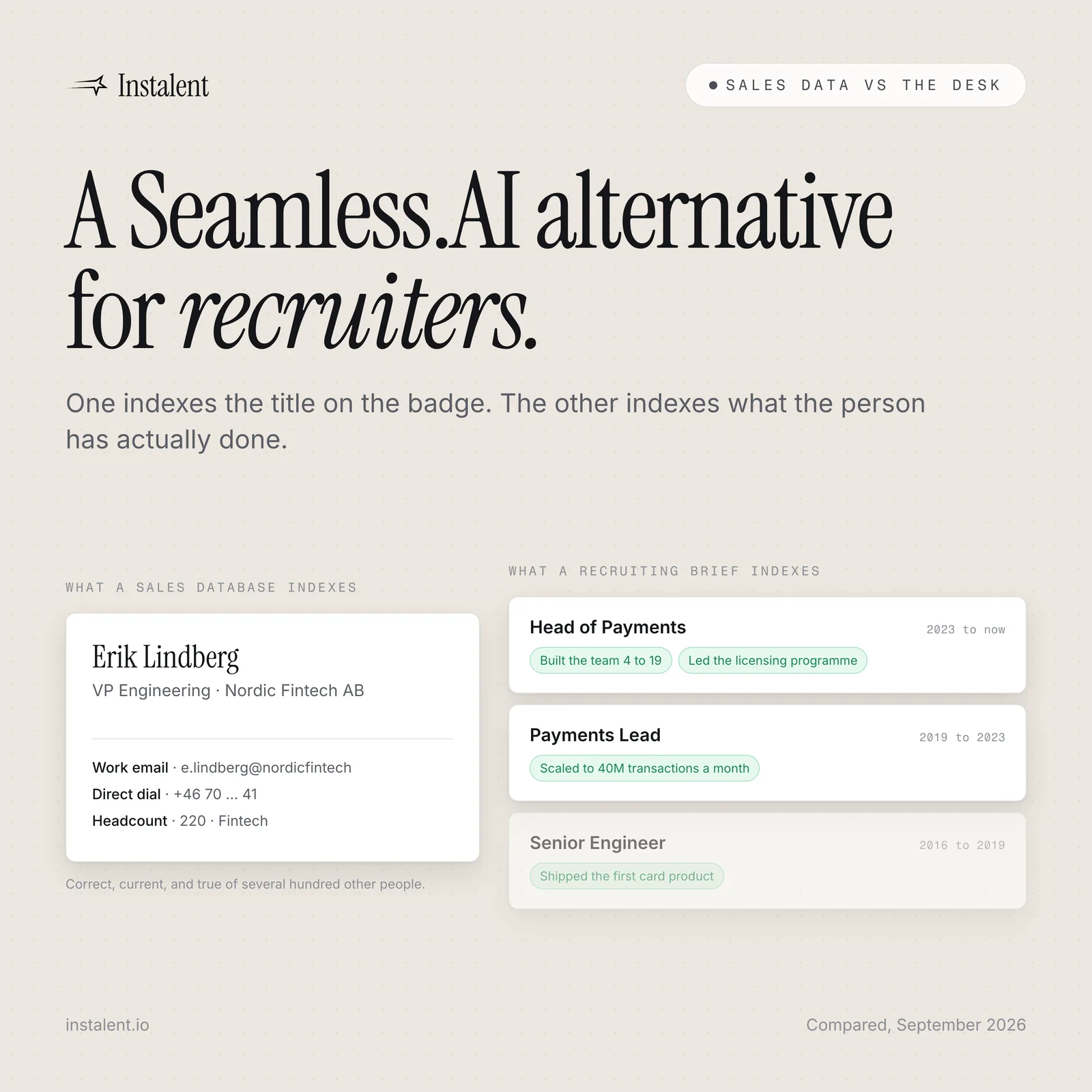
A Hunter.io Alternative for Recruiters: The Person, Not the Domain
A Hunter.io alternative for recruiting: why a company-domain primitive stops working on a candidate search, what the comparison pages leave out, and where Hunter still wins.
Instalent starts from the person, not the company domain.
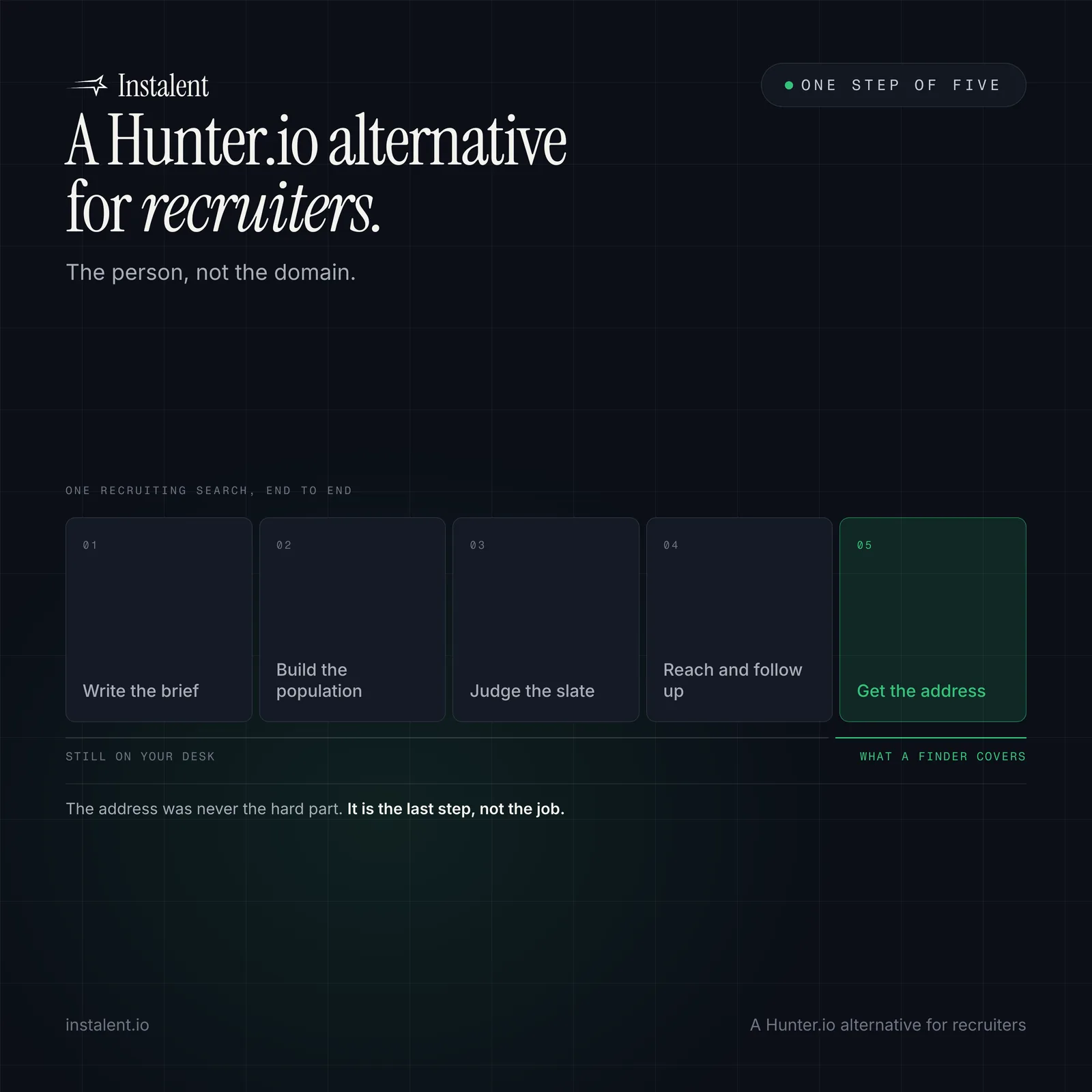
Every page comparing email finders answers the same question: which one gets a salesperson the most working addresses at a list of target companies. It is a fair question and Hunter.io answers it well. It is also not the question a recruiting desk is asking. A recruiter does not start with a company and work down to a person. They start with a person who can do a specific job, and the company is a detail that may already be out of date.
What Instalent does first
Instalent begins where a recruiting search begins, with a brief written in plain language, and runs it across many sources rather than a single network. The result is a population of people judged on what they have actually done.
Contact details come after that, not before it. Contact enrichment checks for a usable address across multiple providers, for the people you have already decided are worth approaching, and attaches it to the same record that holds the evidence and the score. The verified address is one field on a profile, rather than the whole product.
That ordering is the difference, and everything below follows from it.
What Hunter.io is actually built around
Hunter has grown well beyond a single trick, and it is worth describing accurately rather than from a few years ago. As of their own pricing page, the product spans a Discover B2B database with AI-assisted filters, Domain Search, Email Finder, Email Verifier, connected email accounts and sequences.
Underneath all of it, though, the organising idea is the company domain. Domain Search answers "who works here and what does the address format look like". Email Finder answers "given this name at this company, what is the address". Discover answers "which companies, and who in them".
For outbound sales that primitive is close to perfect. The account is the unit of work, the company is stable for the length of a deal cycle, and a work address is exactly the channel you want.
Where the domain primitive stops working on a recruiting desk
Three places, and they are the three that matter most on a hard search.
- The person is the unit, not the company. Your must-haves are about what someone built, scaled or shipped. Two people with identical titles at the same company are rarely equally relevant, and a domain-first tool has no opinion about which one clears the brief.
- The current employer is often the least durable field you have. The candidate worth approaching may have moved last month, may be between roles, or may sit in a company too small to have a predictable pattern. Pattern inference degrades exactly where scarce candidates live.
- A work address is a compromised channel for a candidate approach. It is monitored, it is the employer's property, and an approach that lands there can create a problem for the person you are trying to help. Sales does not have this constraint. Recruiting does.
This is a layer distinction, not a quality complaint
Hunter is good at what it is built for. The argument here is not that its data is worse. It is that finding an address is the last step of a recruiting workflow, and a tool scoped to that step leaves every step before it on your desk.
What the comparison pages do not tell you
If you search for a Hunter.io alternative you will find a page of comparisons, and nearly every one is published by a company selling a competing finder. You will also see accuracy figures quoted, commonly somewhere in the eighties for one tool against the low eighties for another.
Treat those carefully. We went looking for a primary source behind the accuracy numbers while writing this and could not find one. The figures come from vendor blogs, each run on that vendor's own test list, and they do not agree with each other. There are no accuracy percentages in this post for that reason.
The more useful observation is what the entire page has in common: every result answers the question for a salesperson. Nobody writes this comparison for a recruiter, which is why the criteria on offer are coverage and cost per lookup rather than whether the tool helps you decide who to contact.
Hunter.io pricing, from their own page
Read on 1 October 2026, so check before quoting it:
| Plan | Monthly | Credits per month |
|---|---|---|
| Free | $0 | 50 |
| Starter | $49 ($34 billed yearly) | 2,000 |
| Growth | $149 ($104 billed yearly) | 10,000 |
| Scale | $299 ($209 billed yearly) | 25,000 |
| Enterprise | Custom | Custom |
Hunter counts one credit per email found through Domain Search, Email Finder or Bulk Email Finder, and half a credit per verification.
That is clean and predictable pricing for a lookup tool. The question for a recruiting desk is what else has to be bought and stitched around it: the sourcing that produced the names, the judgement that ranked them, and the outreach that does not restart the record. If you are weighing the wider contact market rather than finders specifically, our RocketReach comparison covers the database end of it.
Where Hunter.io is the better choice
Worth saying plainly, because a comparison that never concedes anything is not worth reading.
- You are doing account-based outbound sales, where the company really is the unit of work.
- You need a clean verification API to sit inside something you are building yourself.
- You want a predictable, low-cost lookup utility and you already have sourcing and judgement solved elsewhere.
- Your volumes are small and the free tier covers you.
If the job is "I have a list of companies, get me reachable addresses", Hunter is a good answer and we are not a better one.
Where this leaves a recruiting desk
If the job is "I have a role nobody has filled for three months, find me the eleven people on earth who could do it, tell me which are worth the call, and reach them without losing the thread", then the address was never the hard part.
AI candidate sourcing builds the population, candidate analysis grades the whole slate against your criteria with the breakdown visible, enrichment attaches a usable contact for the people you chose, and multichannel outreach runs the approach and stops the moment someone answers. It stays on one record, which is the argument in Instalent for recruitment agencies. The judgement half is in scoring a shortlist, and what happens to a verified address once you start sending to it is in sender reputation for cold outreach. The agency view sits on solutions for recruitment agencies.
Want the contact to be the last step rather than the whole tool? Get started
Common questions
Is Instalent an email finder?
No. It is a sourcing, scoring and outreach system for recruiting, and verified contact details are one step inside it. The address is a field on a profile that already holds the work history and the score.
How is this different from Hunter.io?
Hunter is organised around the company domain, which suits account-based sales. Instalent is organised around the person and the evidence that they can do a specific job, with the contact attached after you have decided who is worth approaching.
Are the accuracy figures comparing email finders reliable?
Treat them carefully. The commonly quoted percentages come from vendor blogs, each run on that vendor's own test list, and they do not agree with each other. We could not find a primary source for them.
When should you choose Hunter.io instead?
When the company is genuinely the unit of work. Account-based outbound sales, a verification API inside something you are building, or a low-cost lookup utility when sourcing and judgement are already solved elsewhere.
Sources
- Hunter pricing - Hunter, read 1 October 2026 (Free 50 credits per month; Starter $49 per month or $34 billed yearly, 2,000 credits; Growth $149 or $104 yearly, 10,000 credits; Scale $299 or $209 yearly, 25,000 credits; Enterprise custom. One credit per email found via Domain Search, Email Finder or Bulk Email Finder, half a credit per verification. Free tier also lists basic Discover filters, AI Assistant in Discover, one connected email account and 500 recipients per sequence).
Verified contacts for your whole shortlist
Find and verify email and phone for the people you actually want to reach. Get 50% off your first month.
Keep reading
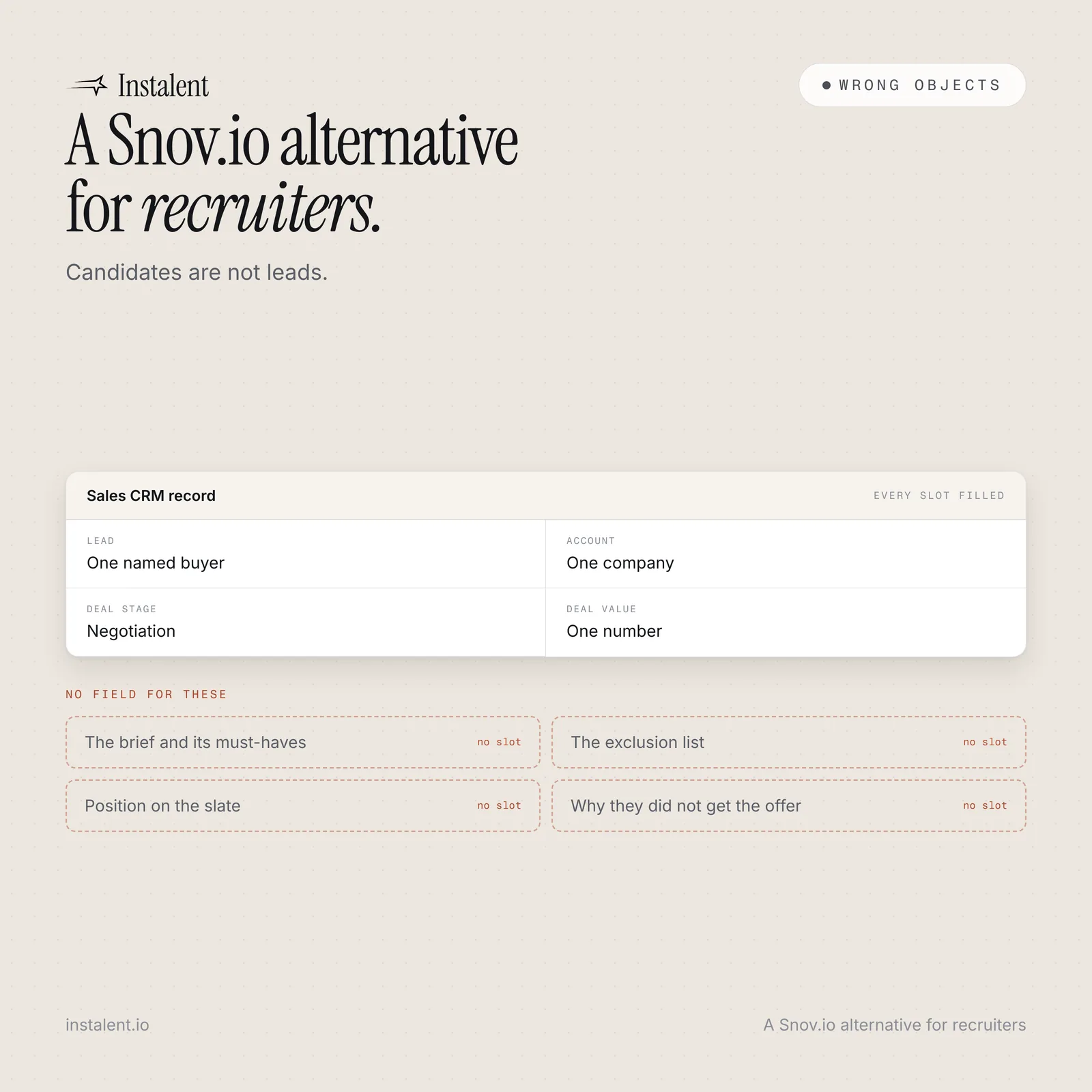
A Snov.io Alternative for Recruiters: Candidates Are Not Leads
An Amplemarket Alternative for Recruitment Agencies: Right Machine, Wrong Signal