Bullhorn Alternatives in 2026: What Switching Actually Fixes
Comparing Bullhorn alternatives for your agency: the real options, what a migration moves, and the two problems no ATS swap will solve.
Do this in Instalent - source, verify and reach candidates in one flow.
Bullhorn's own GRID 2026 report surveyed nearly 2,300 recruitment professionals in November and December 2025. For the third year running, the top challenge firms named was tight talent pools and falling job volumes. The biggest obstacle to winning new business was budget constraints and hiring freezes, with competition from other firms second. Recruiters named candidate search as the most time-consuming part of their day. Read that list twice before you sign a migration contract, because nothing on it is a system-of-record problem.
Plenty of desks have fair reasons to leave. This is a straight look at the real Bullhorn alternatives, what a migration actually moves, and the two-week test worth running before you spend a quarter on one.
Why desks actually leave Bullhorn
Three reasons come up, in this order.
Cost against value. On Capterra, Bullhorn holds 4.0 out of 5 across 1,023 reviews. That is a solid score. But value for money is its weakest sub-rating at 3.7, sitting below ease of use at 4.1, customer service at 4.0 and features at 3.9. That single gap is the whole "alternative" search. Most people are not saying the software cannot do the job. They are saying it costs more than the job is worth to them.
Admin drag. Capterra's review summary flags unresolved technical glitches, slow system performance, and disruptive login and timeout problems. On a desk where the entire point of the CRM is to stop consultants retyping things, friction in the tool is friction in the billing.
Configuration debt. A system of record shaped by five years of your own custom fields, workflows and integrations stops being a product and quietly becomes your process. Some firms leave to escape that. Most rebuild it on the other side.
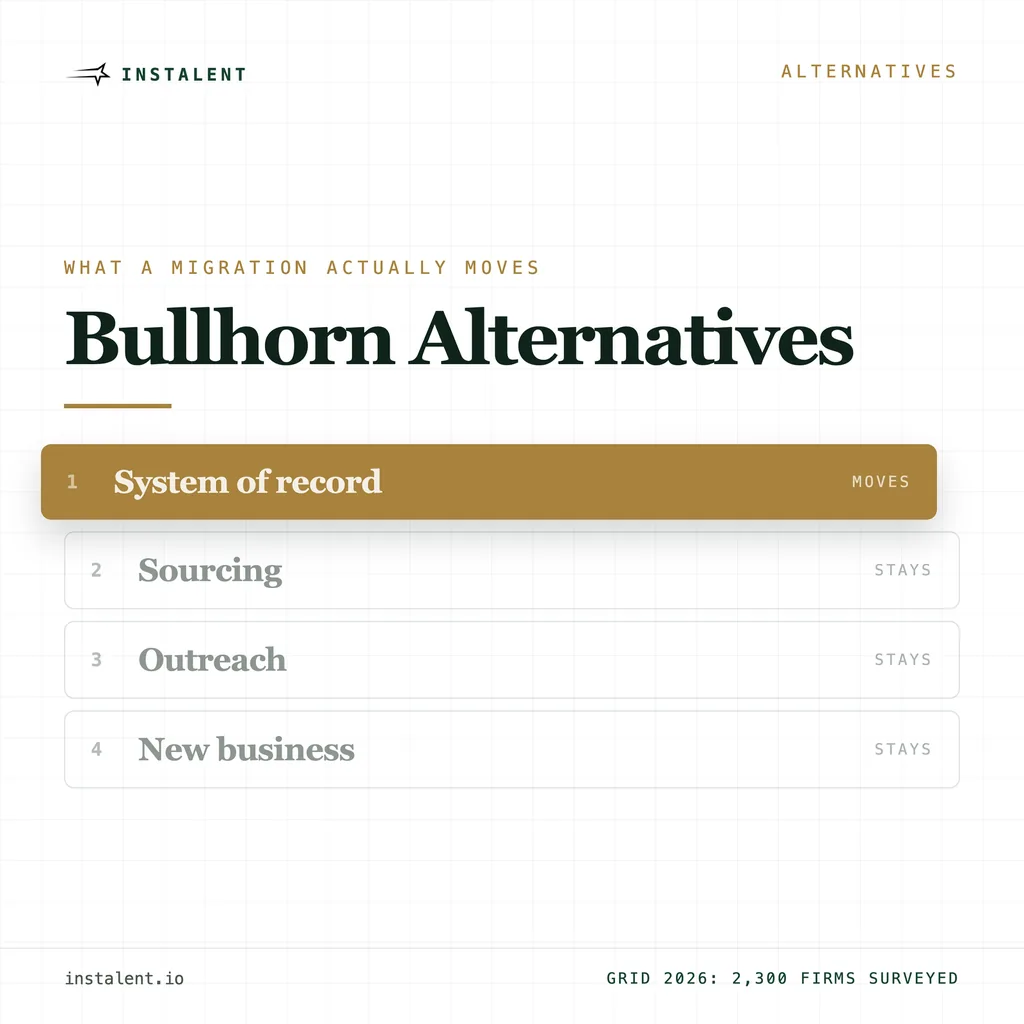
An agency stack has four layers, and a migration moves one
Be precise about what you are shopping for.
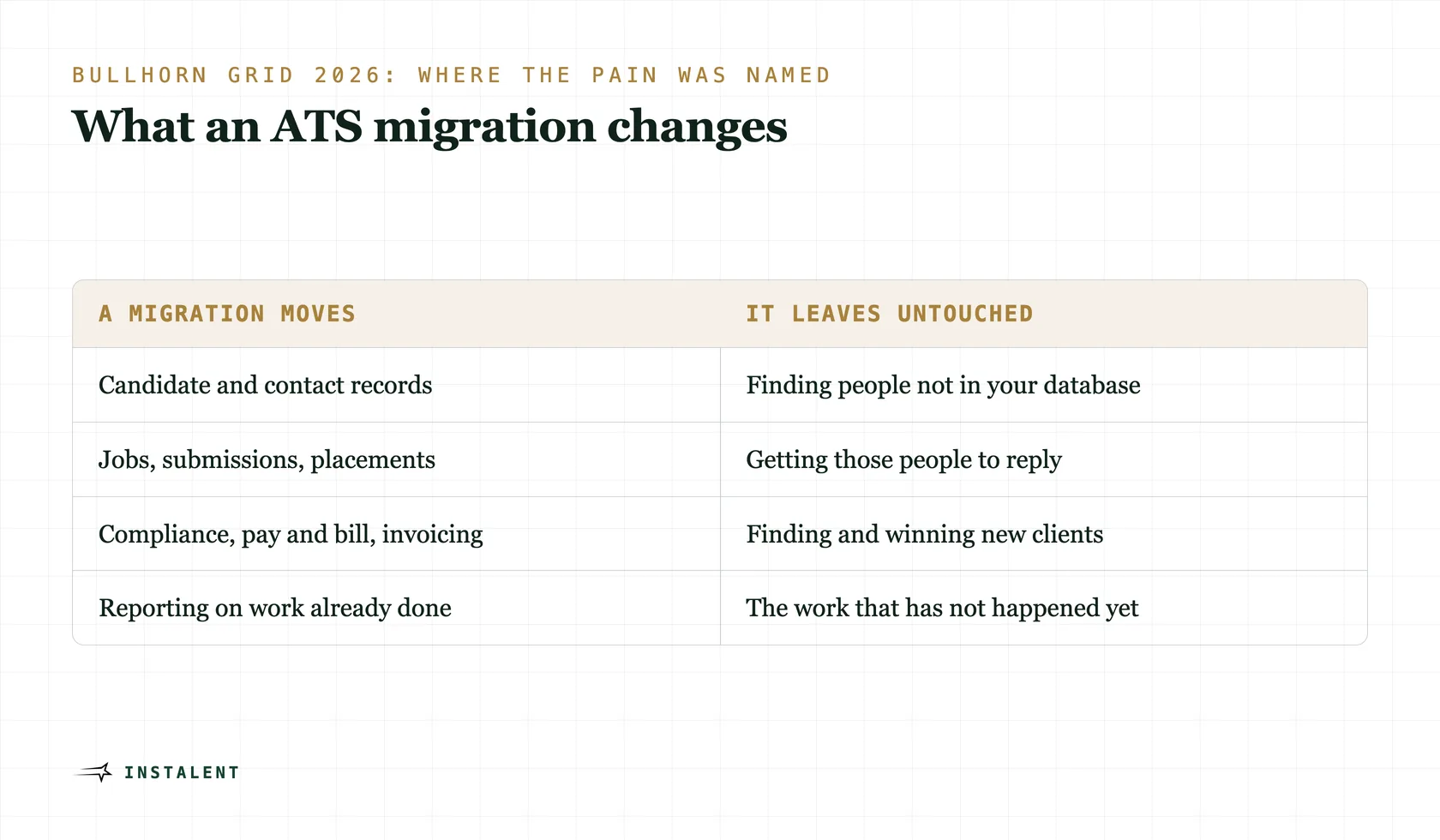
- System of record. Candidates, contacts, jobs, submissions, placements, compliance, invoicing. This is the ATS and CRM, and it is the only layer a migration touches.
- Sourcing. Finding people who are not already in your database.
- Outreach. Getting them to reply.
- Business development. Finding and winning the clients whose reqs feed the other three.
Bullhorn's respondents put their pain in layers 2 and 4. A migration replaces layer 1. That mismatch is the reason so many switches feel disappointing six months in: the software is genuinely better and the numbers have not moved.
The real Bullhorn alternatives, and who each one is for
All of these are credible agency platforms. None of them is Bullhorn with the bad parts removed.
- RecruiterFlow - automation-first ATS and CRM aimed at agencies that want sequences and workflow built into the system of record rather than bolted on.
- Loxo - ATS and CRM with a sourcing database included, so layers 1 and 2 sit in one contract. Attractive if you want fewer vendors.
- Crelate - agency ATS and CRM, and one of the few here that publishes real list pricing. Essentials is $85 per user per month and Business is $119 per user per month on annual billing.
- JobAdder - strong on job-board distribution and a clean, low-training interface. Popular with high-volume and contract desks.
- Access Vincere - acquired by The Access Group in January 2022 and now inside its recruitment division, which extends into back office and pay-and-bill.
- Recruit CRM - lighter and cheaper than the enterprise options, common with boutique and executive search firms.
| Platform | Typically chosen by | Sourcing database included | Publishes list pricing |
|---|---|---|---|
| Bullhorn | Established agencies already on it | No | Entry tiers only |
| RecruiterFlow | Desks wanting automation in the system of record | No | - |
| Loxo | Firms consolidating vendors | Yes | - |
| Crelate | Buyers who want a number before a demo | No | Yes |
| JobAdder | High-volume and contract desks | No | - |
| Access Vincere | Firms needing back office and pay-and-bill | No | - |
| Recruit CRM | Boutique and executive search | No | - |
A dash means the vendor does not publish per-seat pricing on its own site. Any article quoting confident figures for those rows is reading them off another article, not off a price list.
One disclosure, because it should change how you read the list: Instalent is not an ATS and does not compete with any of them. We connect to RecruiterFlow, Greenhouse, Lever and TeamTailor. So treat the above as a category map, not a leaderboard we win.
Price the migration, not the licence
Licence cost is the small number. The real bill is historic data and its mapping, rebuilt integrations, retraining the desk, and a quarter of reduced billing while consultants relearn where everything lives. Price that honestly, then ask what the same money would do if you spent it on the layer your consultants say is actually slow.
The published price is not the price you will pay
Bullhorn does publish entry pricing: Starter at $99 per user per month, Core at $165. What it does not publish is anything above that. Pro, Max, Bullhorn One, the whole Front Office range and every AI and automation product are quote-only.
That gap is the part worth planning around, because the published tiers are rarely where a growing agency lands. The number you are really comparing sits behind a discovery call, and the same is true across most of the competitive set. Crelate is the rare exception.
So pricing this category honestly means booking demos before you see real numbers. Budget the time, and treat any "Bullhorn alternatives" article quoting confident per-seat figures across the whole field as guessing.
What a migration actually costs, beyond the licence
The licence is the number in the proposal. It is rarely the number that hurts. Four other costs land, and only one of them appears on an invoice.
Historic data and its mapping. Years of candidates, contacts, jobs, submissions and placements have to move, and your custom fields have to become somebody else's fields. Nobody can quote this from the outside because it depends entirely on how much configuration debt you built - which is exactly the debt some firms are migrating to escape, and most rebuild on the other side.
Rebuilt integrations. Job boards, background checks, pay-and-bill, your website's job feed, whatever you wired into the old system. Each one is small. Together they are a project.
Retraining the desk. Not the training session - the weeks after it, when a consultant who knew where everything lived now has to think about it.
Reduced billing while that happens. This is the largest of the four and the only one nobody budgets, because it does not arrive as a bill. It arrives as a quarter that came in under plan.
Be suspicious of any timeline given before someone has looked at your data. The honest version of this estimate is a range, produced after a discovery call, by a vendor who has seen your field list.
Bullhorn alternatives for UK agencies
The shortlist barely changes at the border. What changes is the weighting.
Pay-and-bill and compliance move up the list. On a UK contract or temp desk, the system of record is not just where candidates live - it is where timesheets, rates, margins and the weekly pay run live too. That pushes back-office depth from a nice-to-have to a selection criterion, and it is the reason Access Vincere reads differently to a UK contract desk than to a US perm desk: The Access Group is headquartered in Loughborough and Vincere sits inside its recruitment division, which extends into back office and pay-and-bill. A perm-only desk can reasonably ignore that entire column. A contract desk cannot.
The published prices are in dollars. Every list price quoted above is USD, because that is what the vendors publish. A UK buyer is therefore comparing against an exchange rate and, more importantly, against a GBP quote that has not been published anywhere. Ask for the GBP number in writing, and ask whether it is fixed for the term - that is a real negotiating point and it never appears in a comparison article.
The underlying data does cover you. GRID 2026 surveyed UK and Ireland alongside North America, Benelux, DACH and APAC, so the challenge ranking this post is built on is not a US-only artefact. Tight talent pools and falling job volumes topped the list across those regions, and the layer-1 mismatch argument holds the same way.
The honest conclusion for a UK reader is the same as for everyone else, with one extra question attached: if you run contract, price the back office as part of the migration rather than as a later phase, because that is where UK-specific switching costs actually accumulate.
The two-week test to run before you switch
No tooling needed. Have the desk log where the hours actually go, in four buckets: admin inside the system of record, sourcing, outreach and follow-up, and BD.
Bullhorn's respondents said candidate search was the most time-consuming part of their day, with screening second. If your log agrees, a migration is a large project aimed at your smallest bucket.
If admin genuinely is the biggest bucket, you have a real case, and now you have the evidence to negotiate with. That is worth running even if you decide to stay, because renewal conversations go differently when you can put a number on the drag.
If the pipeline is the problem, fix the pipeline
The other half of the same report is the more useful half.
Firms using AI at any stage of the recruitment cycle were 3.5 to 4.5 times more likely to have grown revenue. Of the firms that grew revenue by more than 25%, 78% had AI tools embedded in their ATS, against 51% of firms that declined by more than 10%. Among those using AI screening, 55% said it improved their KPIs by more than 25%, and 46% cut screening time by half or more. Yet only 10% have AI embedded across the full workflow.
That last number is the opportunity. The measurable separation in the 2026 data is not between firms on different systems of record. It is between firms that automated layers 2, 3 and 4 and firms that did not.
Fixing the pipeline instead of the plumbing? Instalent runs the layers a migration will not touch: sourcing from a plain-language brief, verified enrichment from multiple sources, scoring every profile against one rubric, multichannel outreach with every reply in one inbox, and the same engine pointed at finding new clients. It sits on top of the ATS you already run, with two-way sync to RecruiterFlow, Greenhouse, Lever and TeamTailor, so it does not depend on how you resolve layer 1. Get started, or see how it fits your team.
If you want Bullhorn scored head to head against the tools that do find new clients, we put it in a scored client prospecting round-up on a published rubric. For the wider BD picture, how recruitment agencies win clients and the client scarcity data go deeper, and the real cost of candidate sourcing breaks down where the hours go.
If you are still deciding which category you actually need rather than which vendor, recruiting CRM vs ATS explains what each system is for and where sourcing sits.
Sources
- Bullhorn - GRID 2026 Recruitment Industry Trends Report (16th annual report; nearly 2,300 recruitment professionals across North America, UK and Ireland, Benelux, DACH and APAC: top challenge for a third consecutive year is tight talent pools and falling job volumes; budget constraints and hiring freezes the biggest obstacle to winning new business, competition from other firms second; candidate search named the most time-consuming part of a recruiter's day; only 10% have AI embedded throughout the workflow)
- Bullhorn - GRID report press release: staffing firms using AI see stronger growth, faster placements (February 25, 2026; survey fielded November to December 2025: firms using AI at any stage 3.5x to 4.5x more likely to have grown revenue; 78% of firms with over 25% revenue growth use AI tools in their ATS; 55% report AI screening improved KPIs by more than 25%; 46% cut screening time by 50% or more)
- Capterra - Bullhorn ATS and CRM (accessed August 2026: 4.0 out of 5 from 1,023 reviews; ease of use 4.1, customer service 4.0, value for money 3.7, features 3.9; review summary cites technical glitches, slow performance, login and timeout problems)
- Bullhorn - Pricing (accessed August 2026: Starter $99 per user per month and Core $165 per user per month published; Pro, Max, Bullhorn One, the Front Office range and all AI and automation products quote-only)
- Crelate - Pricing (accessed August 2026: Essentials $85 per user per month, Business $119 per user per month)
- The Access Group - The Access Group acquires Vincere (January 2022 acquisition announcement)
- The Access Group - About (accessed August 2026: headquartered in Loughborough, UK)
Find better candidates, faster
Source, verify and reach candidates on one engine. Get 50% off your first month.
Keep reading