What Candidate Sourcing Actually Costs: Agency vs LinkedIn Recruiter vs AI Tool
The real cost of candidate sourcing - agency fees, a LinkedIn Recruiter seat, or an AI sourcing tool - compared honestly, so you can pick the model that fits.
Do this in Instalent - source, verify and reach candidates in one flow.
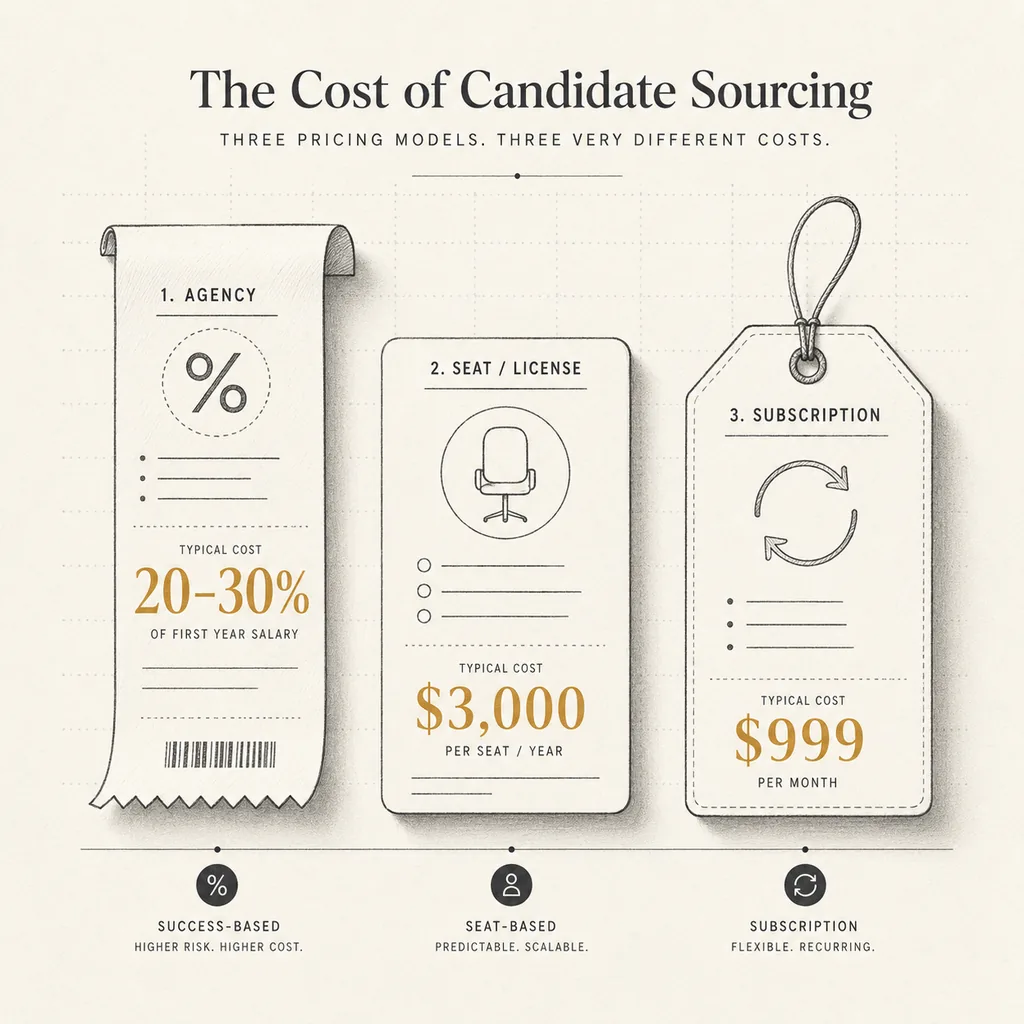
The cost of candidate sourcing depends less on the sticker price and more on the model you choose: pay a percentage per hire, pay for a seat, or pay a flat subscription and do the sourcing yourself.
Ask a recruiter what sourcing costs and you'll usually get a single number - the agency fee, or the price of a tool seat. That number is the easiest part of the bill to read and the smallest part of what you actually spend. The real cost of candidate sourcing splits into three very different shapes, and most of it never lands on an invoice at all. Agencies charge a slice of salary per placement. A LinkedIn Recruiter seat charges per user. Many AI sourcing tools charge a flat subscription. None of these is "cheapest" in the abstract - it depends on your hiring volume, the seniority of your roles, and how much recruiter time you're willing to pour into each search.
This piece breaks the cost down properly: the subscriptions and per-credit charges you can see, the recruiter time you usually can't, the agency fees you pay when you outsource, and the opportunity cost of a role that stays open. Then it gets to the metric that actually matters - cost per qualified candidate, not cost per contact.
Candidate sourcing cost: three models compared
Before the hidden costs, the visible ones. These three models map to three different ways of paying - per hire, per seat, or per month.
| Model | Typical cost | Best when |
|---|---|---|
| Recruitment agency | ~15–30% of first-year salary, per hire | Rare, senior, or hard-to-fill roles |
| LinkedIn Recruiter | Lite ≈ $1,680/yr; Corporate contact-sales | You live inside LinkedIn's network |
| AI sourcing tool | Subscription model - see pricing | Steady, repeatable sourcing volume |
Why the same role costs wildly different amounts
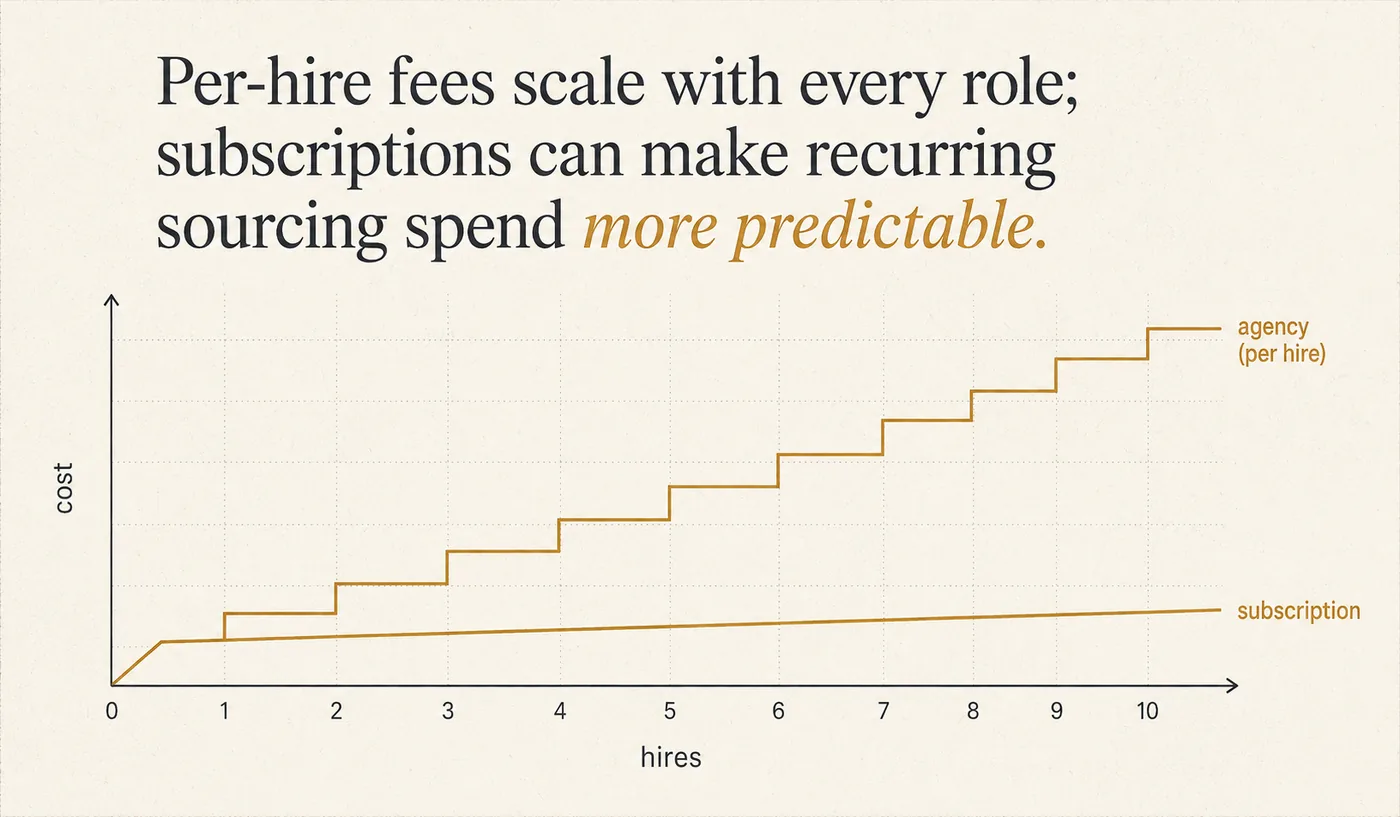
The agency model front-loads everything into one fee that scales with salary: a more senior role costs proportionally more, even if the search took the same effort. A seat-based tool flattens that - you pay the same whether you fill one role or ten - but you trade money for your own time, since you're now doing the sourcing. A subscription tool sits in the same per-seat shape, with the cost decoupled from how many placements you make. The right answer flips depending on how many roles you run through it per year.
Do the per-hire math
At a 20% agency fee, a single $120,000 hire costs roughly $24,000. That one placement can exceed some AI sourcing subscriptions - which is why teams with regular hiring volume often evaluate bringing more sourcing in-house.
The hidden candidate sourcing costs that never show on an invoice
Sticker price isn't the whole bill. Agency placements are fast but expensive and outside your control. A LinkedIn seat adds the time cost of Boolean tuning and InMail limits. The cheapest line item can still be the most expensive once you count recruiter hours.
Sourcer and recruiter time - the biggest hidden cost
Here's the line item nobody puts on a spreadsheet: the hours your team spends building lists, hunting for emails, and reading through profiles that don't fit. You can estimate it yourself without any vendor figures. Take your sourcer's fully-loaded hourly cost - salary plus benefits and overhead, divided by working hours. Then count the hours a single search actually eats:
- Building a long-list from search results and Boolean strings
- Cross-checking each profile against the brief
- Tracking down a verified email or phone for the shortlist
- A first-pass screen before anyone gets contacted
Multiply your hourly cost by those hours and you have the labor cost of one search. Run that number across a month of open roles and it routinely dwarfs the subscription line. The cheap-looking tool that demands ten manual hours per role can quietly cost more than the "expensive" one that demands two.
Data and per-credit charges
Subscriptions often aren't the whole spend either. Many sourcing and contact-data tools meter usage: a monthly base plus per-credit charges for revealing an email, a phone number, or exporting a profile. When you compare tools, normalize them to the same unit of work - what does it cost to get one verified, contactable, on-brief candidate? - rather than comparing headline subscription prices that hide very different credit models underneath.
Agency fees when you outsource
Outsourcing converts time into money cleanly: you pay a percentage of salary and the agency absorbs the hours. For a rare or genuinely hard-to-fill role, that trade is often worth it. The catch is control and repeatability - every placement is a fresh fee, and the search expertise walks out the door with the agency. For roles you hire for again and again, those fees compound fast.
The opportunity cost of a slow pipeline
The quietest cost of all is the role that simply stays open. A vacant seat is lost output, work redistributed onto an already-stretched team, and sometimes a competitor closing the candidate first. You don't need a precise figure to take it seriously - estimate the daily value of the work that seat would produce, then count the days your pipeline is slow. A sourcing approach that fills the top of the funnel faster is paying you back in days-to-fill, not just in subscription terms.
Measure cost per hire, not cost per contact
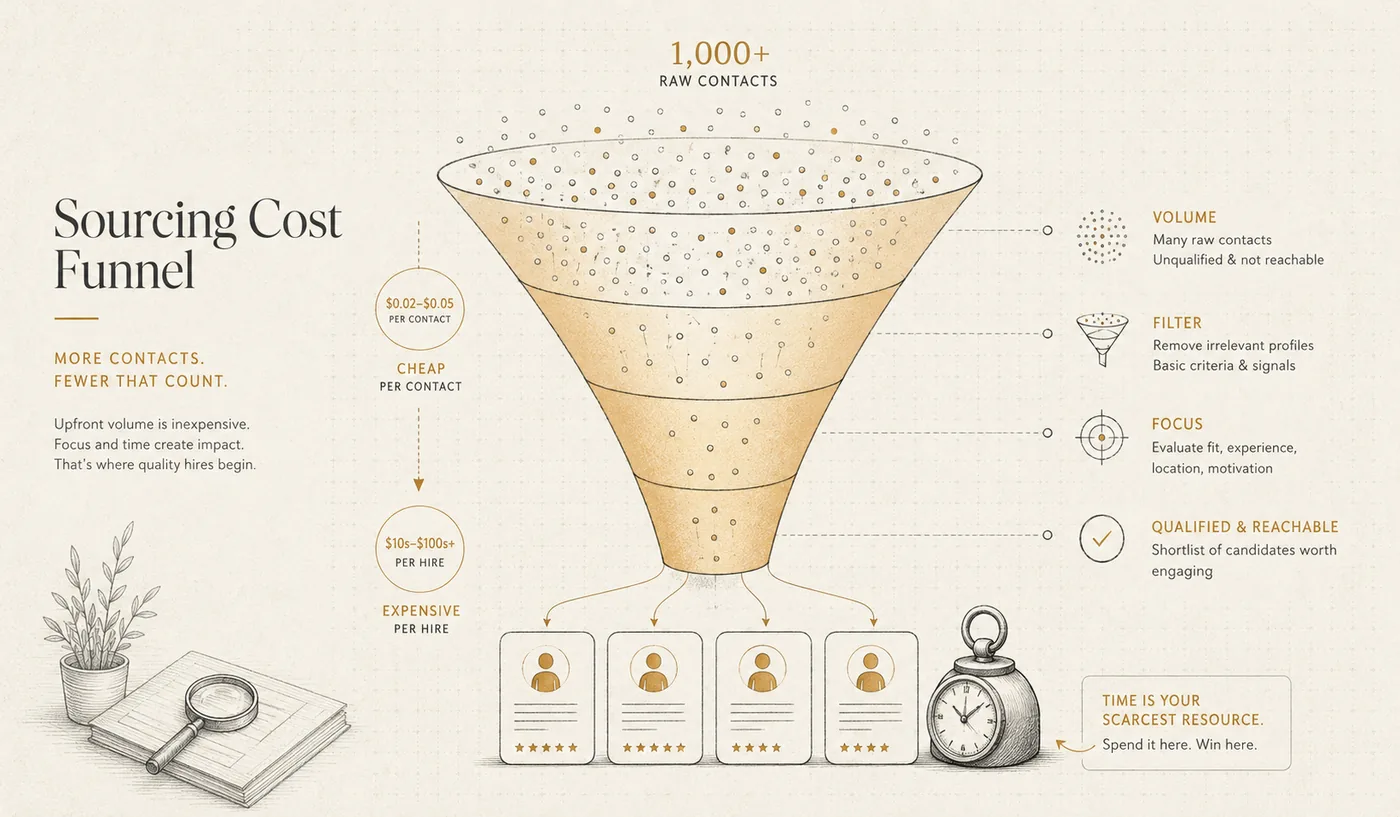
The number most teams optimize - cost per contact, or cost per profile pulled - is the wrong one. A thousand cheap contacts that don't match the brief cost you more in wasted screening time than a hundred well-targeted ones. The metric that matters is cost per qualified candidate: total spend (subscriptions, credits, and the recruiter hours above) divided by the number of people who actually fit and are reachable.
A simple way to reason about it
Picture a fictional team - call them Northwind Talent - running ten engineering searches a quarter. To compare two approaches honestly, they'd add up the same buckets for each:
- Subscription or per-seat cost for the period
- Per-credit charges for contact reveals
- Sourcer hours × fully-loaded hourly cost
- Then divide by qualified, contactable candidates produced
The approach with the lower cost per qualified candidate wins, even if its sticker price is higher. That's usually where the surprise lives - the visible price and the true cost point in opposite directions.
Where AI shifts the math
AI doesn't make recruiters cheaper; it moves their hours to where they're worth most. The low-value, high-volume steps - list-building, contact verification, first-pass screening - are exactly the ones that eat sourcer time and add little human judgment. Automate those and the same headcount covers more roles, with human time freed for the parts that genuinely need a person: writing outreach, reading between the lines of a profile, and deciding who's actually worth a conversation.
Instalent sits in the third column: a subscription that sources across many sources from a natural-language brief, surfaces company buying signals like hiring and funding, enriches verified contacts, and scores fit against your criteria - so the spend isn't tied to a per-placement fee, and the manual hours come down. Early customers report 74% less time on search and 3× more profiles reviewed per brief. From there, multichannel outreach - email and other channels - happens on your terms. See the about page, or read more on the blog.
The honest comparison
Don't compare sticker prices - compare total cost per qualified candidate. Add the subscription, the credits, and the recruiter hours, then divide by the people who actually fit and are reachable. That's the only number that tells you which model is really cheaper for your volume.
Cost is only half the question. The ROI of AI sourcing covers the other half - what AI sourcing actually moves on time-to-shortlist and cost-per-hire, and what it does not - and the state of AI sourcing in 2026 has the wider benchmark numbers.
Try a free search - paste your role and watch Instalent source, enrich and score candidates in seconds. Start free →
Related reading: recruitment analytics covers reading cost figures in comparison rather than in isolation, and talent pipeline covers the cheapest source of a placement - somebody you already met.
Sources
Find better candidates, faster
Source, verify and reach candidates on one engine. Get 50% off your first month.
Keep reading